本版为2026年依据英文原版重新完成的 AI 辅助中文新译,经过模型逐块审校,尚未人工定稿。原书作者、原英译者与编辑的署名均按原书保留;他们并非本次中文译者。
CHAPTER 8:
第八章:
Explanation of Activities for Uncovering Primordial Wisdom, the Root Sadhana of the Chimé Phakmé Nyingtik
无死圣母心髓根本成就法《显露本初智慧之事业》讲解
by Tulku Orgyen Tobgyal
乌金督佳仁波切讲授
INTRODUCTION
引言
Why I am Talking to You Today
我今天为何向你们讲说
First, let me tell you why I am talking to you today. It all started with Prashant, who has asked me again and again to talk here at Deer Park; then Khyentse Rinpoche repeatedly backed him up. From my point of view, to flout Khyentse Rinpoche’s command would be highly inappropriate, and so that is why I came here today to talk to you. Turning to the dharma teaching I have been asked to talk about, it is a terma that was revealed by Jamyang Khyentse Wangpo. Of all the different termas this great master revealed, the Chimé Phakmé Nyingtik is one of those that focuses on practice. Specifically, it is a sadhana or a “means of accomplishment” and to say a little about it might serve those who relate to such explanations—basically practitioners—and that’s another reason I agreed to talk about it today.
首先,说明我今天为何向你们讲说。事情始于 Prashant,他一再请我到 Deer Park 这里讲法;后来钦哲仁波切也多次支持他的请求。在我看来,违背钦哲仁波切的吩咐极不妥当,因此今天我来这里向你们讲说。至于受邀讲授的教法,它是蒋扬钦哲旺波开启的伏藏。在这位大德所开启的种种伏藏之中,无死圣母心髓属于着重实修的一类。具体说,它是一部成就法,即“成就的方法”;对此略加讲说,或许能帮助与这类讲解相契的人,主要也就是修行者。这也是我同意今天讲它的另一原因。
The Chimé Phakmé Nyingtik is part of the vast body of teachings Jamyang Khyentse Wangpo received through the seven authoritative transmissions. I practise the Chimé Phakmé Nyingtik and am somewhat familiar with it. Although I haven’t attained any kind of accomplishment through my practice, I believe sharing my experience of practice and what I have learned as a result of it could be helpful. These are my reasons for talking about the Chimé Phakmé Nyingtik on this occasion.
无死圣母心髓属于蒋扬钦哲旺波经七种权威传承所领受的广大教法。我自己修无死圣母心髓,对它还算熟悉。虽未通过修持获得任何成就,但我相信,分享自己的修行经验及从中所学,可能有些帮助。这就是我这次讲无死圣母心髓的原因。
Let’s turn now to the dharma teaching at hand. To begin with, it is important to know that the range of dharma teachings is extremely vast. According to the Nyingma tradition, there are two great categories of teachings—the teachings of the causal Vehicle of Characteristics and the Vajrayana teachings. The Chimé Phakmé Nyingtik belongs to the second category, the Vajrayana vehicle that uses fruition as the path. Its teachings are divided into categories, and the Chimé Phakmé Nyingtik belongs to the teachings of the Mahayoga that emphasize the generation phase (kyerim). How do we practise these teachings? By following a sadhana that brings the practitioner to realization.
现在来讲眼前的教法。首先,要知道佛法教法范围极其广大。依宁玛传统,教法分两大类:因相乘的教法与金刚乘教法。无死圣母心髓属于第二类,即以果为道的金刚乘。金刚乘教法又分若干类别,无死圣母心髓属于强调生起次第的玛哈瑜伽教法。如何修持这些教法?依循能够引导行者证悟的成就法。
Ground
基
Before we enter into the Chimé Phakmé Nyingtik itself, it might be good first to talk generally about the view, but I won’t go into great detail. The Buddha taught that the ground is the buddha nature present in all sentient beings. Even though all schools of Tibetan Buddhism accept that all sentient beings have buddha nature, each has its own way of proving it. The Chimé Phakmé Nyingtik follows the approach of the Nyingma school. According to the Nyingmapas, there are two types of teaching—the kama and the terma. Chimé Phakmé Nyingtik is a terma teaching. Of the many termas that have been revealed, the Chimé Phakmé Nyingtik was brought out during the time of the three Jamgöns—Chokgyur Dechen Lingpa, Jamyang Khyentse Wangpo and Jamgön Kongtrul. I will therefore show that buddha nature is present in all sentient beings by following Lamrim Yeshe Nyingpo which in many ways is the root tantra of all the profound termas revealed by the three Jamgöns and will repeat the explanation exactly as Guru Rinpoche presented it in that text.
进入无死圣母心髓本身之前,先概说见地或许较好,但我不会详谈。佛陀教导,基就是一切众生所具的佛性。虽然藏传佛教各宗都承认一切众生具有佛性,但各自的证明方式不同。无死圣母心髓遵循宁玛派的方法。依宁玛派,教法有噶玛与伏藏两类,无死圣母心髓属于伏藏教法。在已开启的众多伏藏中,无死圣母心髓是在三位蒋贡——秋吉林巴、蒋扬钦哲旺波与蒋贡康楚——的时代取出的。因此,我将依据《道次第智慧心髓》(Lamrim Yeshe Nyingpo),说明一切众生具有佛性。这部法在许多方面是一切三蒋贡所开甚深伏藏的根本续;我会完全依莲师在该法中的讲述,重述其解释。
The proof that buddha nature exists in all sentient beings also appears in other teachings. For example, the Sublime Continuum offers teachings on buddha nature from the Sutrayana perspective, and the Tantrayana perspective is explained in the Secret Essence Tantra. But since Lamrim Yeshe Nyingpo brings together very essentially the pith instructions of both approaches and is a direct instruction of Guru Rinpoche, I will use it as the basis for a very clear and simple presentation about how all sentient beings have buddha nature. If this is not enough for you, refer to the teachings Dzongsar Khyentse Rinpoche began in 2011 in Canada on Lamrim Yeshe Nyingpo. You could also consult the commentaries on this text that go into great detail based on quotations from the sacred texts and using logical reasoning.76
一切众生具有佛性的证明,也见于其他教法。例如《宝性论》从经乘立场讲佛性,《秘密藏续》则说明密续乘的立场。不过,《道次第智慧心髓》极为精要地汇集两种方法的窍诀,又是莲师的直接教授,所以我将以它为依据,十分清楚简明地说明一切众生如何具有佛性。若这对你还不够,可以参考宗萨钦哲仁波切自2011年起在加拿大所讲的《道次第智慧心髓》。也可以参阅对此法的释论,它们引用圣典、运用正理,作了详尽阐述。[76]
I will now present this teaching very simply without using extensive quotations or going into the different logical arguments, but rather will wholly rely on the original text. Buddha nature is the essence or nature of the buddhas. So “all sentient beings have the ground of buddha nature” means that all sentient beings have the nature of a buddha. This can be understood to mean that we are buddhas or, as some think, that there are two different things—the buddhas and our buddha nature. There are those who take “sentient beings” to mean all human beings and forget about other kinds of sentient beings. This is a misunderstanding. Here “sentient beings” means all human and non-human beings who are able to perceive and feel things, who are “sentient”. If we allow ourselves to contemplate this sentence for a moment, what can we make of it?
现在,我不广引经典,也不展开各种理证,而是完全依根本文,极简明地讲此教法。佛性就是诸佛的体性或本性。因此,“一切众生具有佛性之基”,意味着一切众生具有佛的本性。这可以理解为我们就是佛;也有人认为,佛与我们的佛性是两种不同事物。有些人把“众生”理解为所有人类,忘了其他众生,这是一种误解。这里“众生”指所有能够感知、感受事物,也就是“有情”的人类与非人类生命。若容许自己稍稍思维这句话,我们能从中领会什么?
Basically, the buddha is our mind. As it says in the termas, “Apart from mind there is no buddha.” All sentient beings have a mind—there is not one sentient being without a mind. Therefore, we all have this buddha nature which is the cause for enlightenment. Hearing this, many people are often taken aback. We tend to think of the Buddha as the most extraordinary of beings with qualities beyond our imaginations. So when we hear that our minds are buddha too, it dumbfounds us. It’s true, it’s not easy to accommodate such ideas, but to be able to practise the Secret Mantra Vajrayana, you need to accept that it is possible. If you can’t, you will not be able to practise the path of the Mahayoga that emphasizes kyerim.
基本上,佛就是我们的心。伏藏说:“心外无佛。”一切众生都有心,没有任何一个众生无心。因此,我们全都具有这成佛之因的佛性。听到这里,许多人常感惊讶。我们往往认为佛是最非凡的存在,功德超乎想象。因此,听到自己的心也是佛,就会目瞪口呆。确实,这样的观念不容易接受;但要修秘密真言金刚乘,就需要承认这是可能的。若不能,就无法修持强调生起次第的玛哈瑜伽道。
Don’t look outwardly too much. If you do, you will get lost in the arguments and quotations that explain why all sentient beings have buddha nature. Don’t get drawn into that kind of thinking and conceptualization. Instead, look inwardly. You have now been told that all sentient beings have this extraordinary buddha nature, and your master has told you that buddha nature is your mind. So investigate and probe the idea to test whether or not it is true. When you eventually see that it is true, just rest with that certainty. Think, “All sentient beings have the ground of buddha nature and so I too have buddha nature.” Verify this statement for yourself and meditate on it. If you have buddha nature, you must also have all the incredible enlightened qualities described in the sutras and tantras because as a buddha, it would be impossible not to have them. So check whether it’s true or not. Think about it very carefully. If you have all those qualities, you have the ground of buddha nature. If you don’t have buddha nature, to repeat the words that your mind is buddha and has all the incredible qualities of enlightenment would be sheer invention.
不要过分向外看。否则,你会迷失于解释一切众生为何具有佛性的论辩和引文之中。不要陷入那类思考与概念分别,而应向内看。现在你已听说,一切众生具有这种不可思议的佛性,上师也告诉你佛性就是自心。那么,就观察、探究这一说法,检验是否真实。最终见到它确实如此时,只须安住于这份确信。思维:“一切众生都有佛性之基,因此我也有佛性。”亲自验证这一说法,并观修它。如果你有佛性,也必定具有经续所述的一切不可思议的觉悟功德,因为作为佛,不可能不具这些。因此,检查是否真实,极仔细地思维。若具这些功德,就有佛性之基。若无佛性,反复说自心是佛、具有一切不可思议的觉悟功德,就纯属捏造。
Other vehicles or paths teach that the enlightened qualities of buddha nature are not present in us at this very moment, but rather that they exist as a seed. Once the seed of our buddha nature has fully matured, all its qualities will manifest and this is what happens when we reach enlightenment. However, if you want to practise the Chimé Phakmé Nyingtik, you must think, “I already have all the enlightened qualities. They are already in me and not something new that I have to acquire.” Actually, this is true for practitioners of all the practices of the Mahayoga that emphasize kyerim, not just those who practise the Chimé Phakmé Nyingtik. Whatever practice you do, you must consider that you already have all the enlightened qualities. To imagine you don’t and by doing this practice you will acquire them is a mistake. In short, the mind that practises the sadhana is actually the Buddha. All his enlightened qualities which are even greater than their extensive descriptions in the sutras and tantras and beyond imagining are complete within your mind. So you need to make a clear and confident decision that this is how it is.
其他乘或道路说,佛性的觉悟功德此刻并不现存于我们之中,而是以种子形式存在。佛性种子完全成熟时,一切功德便会显现;这就是成佛时发生的事。然而,若想修无死圣母心髓,必须这样想:“我已具有一切觉悟功德。它们已经在我之中,并非尚须获得的新事物。”其实,这适用于所有强调生起次第的玛哈瑜伽修法行者,并非只限于无死圣母心髓。无论修什么,都必须认为自己已经具有一切觉悟功德。以为现在没有、通过此修法才会获得,是错误的。简言之,修成就法的心本身就是佛。佛的一切觉悟功德,甚至比经续中的广泛描述还更广大、超乎想象,已圆满具足于你的心中。因此,需要对此作出清楚而坚定的抉择。
As I am presenting these teachings so essentially, you may not understand what I’m trying to say. Or rather, you might be able to hear what I’m saying and even understand most of the words I use but find you don’t trust that what I say is true. If this is the case, then maybe you should spend some time studying the teachings of the sutras and especially the tantras, since they offer a vast array of authoritative references from the sacred texts and logical arguments that support this truth, which you should examine and reflect upon. Having studied in this way, if you are still not confident that the mind is the Buddha and that all his enlightened qualities are present within your mind and if you still harbour a “maybe they are, may be aren’t” kind of attitude, you will need to accumulate a lot more merit and purify your obscurations. If even this approach does not work, it probably means that you lack the good fortune to be a recipient of teachings of the path of the Mahayoga, the higher path of Anuyoga or the path of Dzogchen.
因为我讲得如此简要,你可能不明白我想说什么。或者,你能听见我的话,甚至理解其中大部分词语,却不能相信我说的是真实。若是这样,或许应花些时间学习经教,尤其是密续,因为其中有大量权威圣典依据和理证支持这一真理,你应加以观察和思维。这样学习之后,如果仍不确信心即是佛、佛的一切觉悟功德都具于自心,仍抱着“也许有,也许没有”的态度,就需要更多地积累福德、净除障蔽。如果这样也没有效果,大概意味着你缺乏成为玛哈瑜伽道、更高的阿努瑜伽道,或大圆满道教法领受者的福缘。
Delusion
迷惑
As it is said,
如所说:
All sentient beings have the ground of the buddha nature, mind is the Buddha.
一切众生具有佛性之基,心即是佛。
This doesn’t mean that all these people are the Buddha—just to have the ground of buddha nature, doesn’t make you a buddha. Sentient beings have that ground, but it is temporarily hidden by both cognitive and habitual obscurations, and these two kinds of obscuration are explained at length in the sutras and tantras, so I won’t go into them here in any detail. At the most basic level though, obscurations are our thoughts, and at this very moment, it is our thoughts that obscure our buddha nature. This is what we call ignorance or “not knowing” which is a more literal translation of the Tibetan term. What is it that we do not know? That buddha is our nature. And we are deluded because we do not recognize the buddha that is our nature. It is said, “Know, and you are a buddha; ignore, and you are a sentient being.” At the moment we are ignorant, and that very ignorance is concealing our buddha nature.
这不表示所有这些人都已经是佛——仅有佛性之基,并不会使你成为佛。众生有这个基,但它暂被认知障与习气障遮蔽。经续对这两种障蔽有详尽解释,这里不作细说。不过,最基本而言,障蔽就是我们的念头;就在此刻,遮蔽佛性的正是念头。这称为无明;更贴近藏文的直译是“不知”。不知道什么?不知道佛就是我们的本性。我们之所以迷惑,是因为没有认出作为自身本性的佛。所谓“知则为佛,不知为众生”。目前我们处于无明中,而正是这无明遮住了我们的佛性。
Now we must identify what delusion really is. Many people think delusion is any one of the destructive emotions (like desire, aversion, jealousy or pride), the ten negative actions and so on, and that positive thoughts and emotions like faith, devotion and so on are not delusions, but it’s not like that. All our thoughts involve grasping at subject-object duality, and based on all those dualistic thoughts we accumulate karma, then repeat the process endlessly. This is what we call delusion.
现在必须辨明迷惑究竟是什么。许多人认为,迷惑就是贪、嗔、嫉妒、骄慢等烦恼,或十不善业等等,而信心、虔敬等善的思想和情感并非迷惑;事实并非如此。我们的一切念头都涉及对能所二元的执著,依这些二元念头积业,又无休止地重复这一过程。这就是我们所说的迷惑。
Path
道
Once you understand the nature of delusion clearly, you realise that although mind is the ground of your buddha nature, it is deluded and impure. To remove those impurities, you must follow a path that eliminates all contaminations and reveals your inherent purity. This is why we practise sadhanas, even though a sadhana is itself a delusion and so are the deities. But the Buddha tells us just as we must rely on a material that is as strong as iron in order to cut through iron, we must rely on the delusion of deity, samadhi, mantra and so on to cut through and remove our fundamental delusions. So even though all aspects of the path of kyerim fall into the category of delusion, it is through such practices as kyerim that we are able to realise the nature of our mind, the primordial ground.
清楚了解迷惑的性质之后,就会明白:心虽是佛性之基,却处于迷惑、不净之中。要除去这些不净,必须循一条道路,消除一切染污,显露本具清净。这就是修成就法的原因,尽管成就法本身也是迷惑,本尊也一样。但佛陀告诉我们,正如要切断铁,必须依靠同铁一样坚硬的材料,要斩断并除去根本迷惑,也必须依靠本尊、三摩地、咒语等迷惑。因此,虽然生起次第之道的一切方面都属迷惑范畴,但正是通过生起次第等修法,我们才能证悟自心本性,即本初之基。
Atiyoga or Dzogchen teaches that mind is the Buddha, and Atiyoga practitioners meditate by simply looking directly at mind itself. It is a path that does not involve the elaborations of visualizing deities, performing mudras, reciting mantras, resting in samadhi and so on and is suited only to those of superior capacity. Others, those of middling capacity for example, won’t benefit from the Atiyoga approach and should rely instead on Maha-yoga practices that are taught as pith instructions and involve deity, mantra, mudra and samadhi. Through such practices, their intrinsic nature which is the primordial ground will be liberated.
阿底瑜伽,也就是大圆满,教导心即是佛;阿底瑜伽行者只须直接看心本身而禅修。这条道不涉及观本尊、结手印、持咒、安住三摩地等等繁复施设,只适合上根者。其他人,例如中根者,不会从阿底瑜伽方法获益,而应依靠以窍诀传授、涉及本尊、咒语、手印及三摩地的玛哈瑜伽修法。通过这些修法,他们本具的本性,也就是本初之基,将得解脱。
There are infinite deities of all kinds to correlate with the many dispositions of sentient beings. Each aspect of each deity—the face, expression, number of arms, whether they are peaceful or wrathful and so on—manifests based on the corresponding propensities of the sentient beings they help. We always say that there are infinite deities corresponding to the infinite dispositions of beings, but if you imagine this means you can do whatever you like, your practice is not likely to be very beneficial. Great practitioners like Guru Rinpoche or Vimalamitra are able to see all phenomena as the deity, and if Guru Rinpoche says, “The stone in front of me is the deity”, it works because for such great masters, there are no deities with characteristics to be held onto. The ultimate point of kyerim is that all that appears and exists is infinite purity. But to count or make lists of all the different deities and their aspects would take all your time, and you’d never get to the infinite purity of all that appears and exists. So when those who have yet to realise that infinite purity first set out on the path, they take as the support of their practice a specific deity and mantra which they then accomplish. In this case, we will rely on the Chimé Phakmé Nyingtik, the main deity of which is Tara in union with Amitayus in a mandala of three main deities with a retinue of eight. This will be explained as we go through the text.
为契合众生种种根性,有无量各类本尊。每位本尊的每个方面——面容、神情、手臂数量、寂静或忿怒等等——都依所利益众生的相应习性而显现。我们常说,无量本尊对应众生无量根性;但若以为这表示可以随心所欲,修持就不大可能有益。莲师、无垢友这样的大修行者,能将一切现象视为本尊;如果莲师说“我面前的石头就是本尊”,便能成立,因为对这样的上师而言,没有具有可执特征的本尊。生起次第的究竟要点,是一切显有皆为无量清净。但若去计数或列举一切不同本尊及其形貌,就会耗尽时间,永远到不了一切显有的无量清净。因此,尚未证悟这种无量清净的人初入道时,应以特定本尊与咒语为修持所依,然后加以成就。这里,我们依靠无死圣母心髓,其主尊是与无量寿佛双运的度母,坛城有三位主尊及八位眷属。讲解法本时将会说明。
Fruition
果
It is important to recognize that the reason we follow the path of the deity is to eliminate delusion and that the fruition of this path is liberation within the primordial ground. Mind is the deity, there is no deity other than mind. Once you realise this, you will have accomplished the deity. If you don’t, to have dreams about the deity or even meet the deity face-to-face won’t help you much. Having said that, dreaming about or meeting the deity are signs you are getting closer to realising that your mind is the deity and the deity is your mind.
必须认识到,修本尊之道的原因,是遣除迷惑;这条道的果,是在本初之基中解脱。心即本尊,心外无本尊。一旦证悟这一点,就已成就本尊。若未证悟,即使梦见本尊,甚至亲见本尊,也帮不了多少忙。话虽如此,梦见或见到本尊,仍是你逐渐接近证悟“自心即本尊、本尊即自心”的征相。
From the perspective of the ground, all sentient beings are buddhas—the minds of sentient beings are buddhas. As sentient beings do not recognize mind is buddha, they are said to be deluded or obscured, and the path through which practitioners free their minds from delusion is the practice of meditating on the deity. Once we have freed our minds from delusion, the fruition is fully manifest.
从基的角度,一切众生皆是佛——众生的心就是佛。由于众生不认识心即是佛,才说他们迷惑或被遮蔽;行者使心脱离迷惑的道路,就是观修本尊。一旦心从迷惑中解脱,果便完全显现。
Conclusion
结语
If you don’t know at least this much about ground, path and fruition, you will have nothing to practise, so first you must understand this much. Dilgo Khyentse Rinpoche said that buddha nature is present in all sentient beings and all sentient beings are buddhas. It is because we have this ground of buddha nature that by following the path, we can become enlightened. The example he often used was of a sesame seed. By pressing a tiny sesame seed, as the seed itself is destroyed, the oil will be extracted, but even if you pressed a stone for thousands of years using all manner of contraptions, you would never be able to extract oil, because stone does not have the same nature as sesame seeds. It is because sentient beings have buddha nature that we can attain enlightenment. If we sentient beings did not have buddha nature, we would not be able to attain enlightenment. That’s one example, but giving too many examples isn’t always helpful.
若连这些关于基、道、果的道理都不知道,就无从修持,因此首先至少要理解这些。顶果钦哲仁波切说,一切众生具有佛性,一切众生皆是佛。正因为有这佛性之基,我们才能循道而觉悟。他常举芝麻为例:压榨小小一粒芝麻,种子本身被破坏,油便提取出来;但即使用种种器械压榨石头数千年,也绝提不出油,因为石头没有与芝麻相同的性质。正因众生具有佛性,我们才可成佛。若众生没有佛性,就不能成佛。这是一个例子,但举太多例子未必有帮助。
Let’s look again at delusion. To think, “I am deluded. I need to remove all my delusion”, then to apply various different methods for eliminating delusion will of course have some impact. But the most helpful kind of thought is, “I am deluded, but my ground is buddha nature, and if I realise the nature of my mind directly within the primordial ground, all my delusions will vanish.”
再看迷惑。想“我处于迷惑中,我需要除去一切迷惑”,然后用各种方法消除迷惑,当然会有些影响。但最有帮助的思维是:“我虽迷惑,我的基却是佛性;若在本初之基中直接证悟自心本性,一切迷惑便会消失。”
For example, to meditate on the pointing-out instructions your master teaches makes it easier for you to remove delusion. In other words, once you are aware you are deluded, you find there are innumerable ways for eliminating that delusion like offering your own head or limbs to others. To apply these many different methods is of course helpful, but not that fruitful. However, to know you are deluded and to liberate the knower directly within the primordial ground will result in immediate liberation. The example used is of a house that has been kept in absolute darkness for thousands of years, yet the moment a light is switched on all the darkness completely disappears. There is not one dark patch left. Where there is no light, it is correct to say, “It is dark”, but once you switch on the light, the darkness has gone. Similarly, if we follow a path that removes the darkness of delusion, there will be no darkness. This is where the practice of kyerim will help.
例如,观修上师所授的直指教授,更容易遣除迷惑。也就是说,一旦知道自己迷惑,就会发现无数消除迷惑的方法,比如将自己的头或肢体施予他人。运用这许多方法当然有帮助,但成果并不那么大。然而,知道自己迷惑,并将这个能知者直接解脱于本初之基,就会立即解脱。所举的例子是一所房子,数千年来一直全然黑暗,但一开灯,所有黑暗便完全消失,连一块阴暗处也不剩。没有光时,说“这里很暗”是对的;但一开灯,黑暗就没有了。同样,若循能除迷惑黑暗之道,便不再有黑暗。生起次第修法正能在这里帮助我们。
If you can understand this much, you will have the necessary basis from which to embark not just on dharma practice, but on the practice of the Vajrayana path. Problems will arise though if you have not established such an understanding. If for example you imagine the deity and you are separate and different, there will be nothing for you to accomplish. As you practise the Chimé Phakmé Nyingtik, if you imagine that the deity is extraordinary but you are ordinary, it won’t work. This is the attitude adopted by the practitioners of Kriyayoga. Many people these days try to accomplish different deities in the same way that they make friends with people they think will eventually be useful to them. They accomplish a deity for a specific purpose, then move on to accomplish another deity for a different purpose and so on. This is an extremely limited approach and won’t get you very far. If you really do manage to accomplish a deity, you also accomplish all the infinite number of mandalas. Beings are deluded by all manner of thoughts, and therefore many different deities manifest. But once all the delusions created by conceptual thought are eliminated, since the deity is the mind there will no longer be a deity—there is no buddha other than mind.
若能理解这些,就具备了踏入修行所需的基础,不仅是一般佛法修行,也是金刚乘道的修行。但若未建立这一理解,就会出现问题。例如,若认为本尊与你分离、不同,就没有什么可以成就。修无死圣母心髓时,若以为本尊超凡而自己平凡,就行不通。这是事瑜伽行者采取的态度。如今许多人试图成就不同本尊,像是结交一些以为将来对自己有用的朋友。为某个目的成就一位本尊,再为另一个目的成就另一位,如此继续。这种方法极其狭隘,走不了多远。如果真正成就一位本尊,也就成就无量坛城。众生被种种念头迷惑,因此显现许多不同本尊。但概念分别所造的一切迷惑消除后,既然本尊就是心,便不再有另一个本尊——心外无佛。
Therefore, our view should be the highest possible. If we adopt a high view, we must also be realistic about how we then conduct ourselves and practise the path. Practice will involve deity, mantra, samadhi and mudra as they occur in the sadhana text. Essentially, as we visualize the deity using the methods of kyerim, we should also embrace dzogrim practice that dissolves our visualization into emptiness as we unite both kyerim and dzogrim. But I’ll explain that more fully later when it comes up in the text. If we fail to do so and instead continue to grasp as we practise, our efforts will be useless.
因此,我们的见地应尽可能高。采取高见地,同时也必须切实看待自己的行为和修道方式。修持包括成就法本中的本尊、咒语、三摩地与手印。要而言之,运用生起次第方法观本尊时,也应摄持圆满次第,将观想融入空性,使生起次第与圆满次第双运。以后讲到法本相应处,我会更详尽说明。若不如此,反而修时继续执著,努力便徒劳无功。
Don’t practise with the idea that the result is a long way away or that the fruition of your practice is something extra you need to acquire. Once our obscurations have been dispelled, the fruition of practice—our true nature—will manifest. For now, it is obscured or covered up, but it is definitely there. So we must develop the certainty that the result of our practice is already with us and by eliminating our obscurations, that result will manifest.
不要怀着“结果还很遥远”或“修行之果是必须额外获得的东西”这种想法来修。一旦障蔽消除,修行之果——真实本性——就会显现。目前它虽被遮蔽或掩盖,却肯定存在。因此,必须确信修行之果已经具于自身;遣除障蔽,果便显现。
In this brief presentation of the ground, path and fruition of the Vajrayana, I have tried to set out the crucial understanding you need to arrive at in order to practise. People who are not familiar with the teachings may think, “Yes, maybe that is true. It sort of makes sense.” People with more experience of the buddhadharma, but with little exposure to the Vajrayana teachings, might get a bit overexcited. Whichever the case, it is important you check thoroughly each point you get excited about and reflect on its meaning as presented in the great sutras and tantras. If you do, the conclusion you reach will be what I have just explained. There is no other conclusion possible. This is certainly true of practice, but also of empowerments which are the foundation of the Vajrayana path. Unless you understand at least this much about ground, path and fruition, you will not be able truly to receive the empowerments.
在这段关于金刚乘基、道、果的简要介绍中,我试图阐明修持所必须达到的关键理解。不熟悉教法者可能想:“是啊,也许是真的,似乎有点道理。”较了解佛法、但接触金刚乘不多的人,可能会有些过于激动。无论哪种情况,都要彻底检查每个令你激动的要点,依大经大续所述思维其义。这样做,最终结论就会是我刚才所讲的,不可能有其他结论。这对于修持固然如此,对作为金刚乘道基础的灌顶也一样。若对基、道、果连这些都不了解,就不能真正领受灌顶。
I. BEFORE YOU START TO PRACTISE
一、开始修持之前
If you wish to practise the Chimé Phakmé Nyingtik and truly actualise its meaning, you must:
若希望修持无死圣母心髓,真正现证其义,必须:
A. Learn about the history of the teachings so you gain confidence in them.
甲、了解教法历史,从而对它生起信心。
B. Receive the empowerment, which will mature you, so you can do the practice.
乙、领受使自身成熟的灌顶,从而能够修持。
C. Hear the instructions that liberate and receive the related pith instructions.
丙、听闻解脱教授,并领受相关窍诀。
To that end, I will start by telling the story of the teaching so you develop confidence in it.
为此,我先讲教法的来历,使你们生起信心。
A. The History of the Chimé Phakmé Nyingtik Teachings
甲、无死圣母心髓教法的历史
I will now outline briefly the general background of this teaching. There have been many great practitioners of the Vajrayana both in India and Tibet. The Indian practitioners included for example Garab Dorje, the great nirmanakaya teacher of Dzogchen who went to Akanishtha, received teachings directly from Vajrasattva and managed to hear, practise and realise them in one session. He was a practitioner with superior capacities. Many other great masters followed who were at the same level as Garab Dorje. They realised the teachings as they heard them but displayed a different approach to practice by following a progressive path, for example the great vidyadharas Guru Rinpoche, Vimalamitra and Shri Singha. They practised and perfected each of the three yogas of the Mahayoga that emphasizes kyerim, Anuyoga and finally Atiyoga or Dzogchen, and demonstrated how individuals could follow the path in stages.
现在简述此教法的一般背景。印度与西藏都有许多伟大金刚乘行者。印度行者中,例如大圆满伟大化身导师极喜金刚,前往色究竟天,直接从金刚萨埵领受教法,一座之内便完成听闻、修持与证悟。他是一位上根行者。随后还有许多与极喜金刚同等的大师。他们一闻便悟,却示现另一种修行方式,循序渐进,例如大持明者莲师、无垢友与师利僧哈。他们逐一修持并圆满三瑜伽:强调生起次第的玛哈瑜伽、阿努瑜伽,最后是阿底瑜伽或大圆满,示范个人如何次第修道。
Each of them practised a specific yidam deity and went through the process of progressing through the four vidyadhara levels by accomplishing their yidam. This is the kind of master we are going to discuss now, and we will base our discussion on the Nyingma approach.
他们各自修持特定本尊,通过成就本尊,逐步经历四持明位。现在所要讨论的,就是这类上师,并以宁玛派的方法为依据。
Let’s now turn to the origins of the Chimé Phakmé Nyingtik. Ushnisha Vijaya (tsuktor namgyalma in Tibetan) was so named after she emerged from the protuberance on top of the Buddha’s head (ushnisha) and because she was fully victorious (vijaya) over the four maras. Ushnisha Vijaya sutras can be found in the causal vehicle, while the Vajrayana offers Ushnisha Vijaya tantras and sadhanas. The great vidyadhara Shri Singha took Ushnisha Vijaya as his yidam, then practised and fully accomplished her, while the great master Vimalamitra practised and accomplished Chimé Phakma. Chimé Phakma, the Sublime Lady of Immortality, is White Tara known as Yishin Khorlo, the Wish-Fulfilling Wheel. She came into being when noble Avalokiteshvara helped sentient beings. He generated the enlightened mind and shed two tears of compassion, one tear became White Tara and the other Green Tara. The great Pandita Vimalamitra took white Tara as his yidam and gained mastery over birth and death, the state beyond decrease and increase. Guru Rinpoche accomplished the four levels of a vidyadhara. He practised Amitayus in the Maratika Cave to accomplish the level of a vidyadhara with power over life, and Amitayus in union appeared and bestowed the long-life empowerment on him, through which Guru Rinpoche became immortal and is able to remain in samsara to help sentient beings until eventually it is emptied.
现在谈无死圣母心髓的起源。佛顶尊胜母(藏语 tsuktor namgyalma)如此得名,是因为她从佛陀头顶的隆起(ushnisha,肉髻)化出,并完全战胜(vijaya)四魔。因乘中有佛顶尊胜母的经,金刚乘中则有她的续与成就法。大持明者师利僧哈以佛顶尊胜母为本尊,修持并圆满成就她;大德无垢友则修持并成就 Chimé Phakma。Chimé Phakma,即无死圣母,是称为 Yishin Khorlo——如意轮——的白度母。她在圣观世音利益众生时化生。观世音发菩提心,流下两滴悲泪,一滴化为白度母,另一滴化为绿度母。大班智达无垢友以白度母为本尊,获得生死自在,达到超越减增的境界。莲师成就了四持明位。他在玛拉蒂卡洞修无量寿佛,成就寿命自在持明位;双运无量寿佛显现,赐予长寿灌顶,由此莲师成就无死,能够留住轮回利益众生,直至轮回最终空尽。
These three great masters—Guru Rinpoche, Vimalamitra and Shri Singha—who had accomplished these long-life deities appeared to Jamyang Khyentse Wangpo, made prophecies and blessed him. As a result, Khyentse Wangpo revealed the mind terma of Chimé Phakmé Nyingtik combining all three long-life deities—Amitayus, White Tara and Ushnisha Vijaya.
这三位成就长寿本尊的大师——莲师、无垢友与师利僧哈——向蒋扬钦哲旺波显现,授记并加持他。由此,钦哲旺波开启无死圣母心髓意伏藏,合摄无量寿佛、白度母与佛顶尊胜母这长寿三尊。
The key points to understand here are that the three deities of long life are yidam deities. Guru Rinpoche, Shri Singha and Vimalamitra are the three great vidyadharas who practised and accomplished these yidams, becoming indivisible with them. All three great masters—with a single, indivisible wisdom mind—appeared to and blessed Jamyang Khyentse Wangpo. The play of these three great masters’ indivisible wisdom mind is the mind terma. When Jamyang Khyentse Wangpo’s mind became indivisible from the wisdom mind of Guru Rinpoche, Shri Singha and Vimalamitra, the wisdom mind of all these masters was one and the same. The play of this wisdom manifests in the form of the practice that accomplishes the three deities of longevity, and each vidyadhara accomplished one deity’s sadhana. This unprecedented approach resulted in the Chimé Phakmé Nyingtik. Both the Sakya and Nyingma traditions have practices that accomplish each of the three deities individually, but the Chimé Phakmé Nyingtik accomplishes all three deities together and as such is a practice that had never before dawned upon this earth.
这里应理解的关键是,长寿三尊属于本尊。莲师、师利僧哈与无垢友是修持并成就这些本尊、与其不可分的三大持明者。三位大师以一个不可分割的智慧心,向蒋扬钦哲旺波显现并赐加持。三位大师不可分智慧心的游戏,就是意伏藏。当蒋扬钦哲旺波的心与莲师、师利僧哈及无垢友的智慧心不可分时,所有这些上师的智慧心即为一体。这智慧的游戏,显为成就长寿三尊的修法;每位持明者各成就了一尊的成就法。这前所未有的方法,形成了无死圣母心髓。萨迦与宁玛传统都有分别成就三尊各自的修法,但无死圣母心髓同时成就三尊,因此是此前从未在此世间出现的修法。
Jamyang Khyentse Wangpo may have looked like an ordinary person, but his mind was far beyond anything ordinary people could even conceive. Why? Because he was able to remember what had happened to him in a vast number of his past lives, for example when he was Vimalami tra. He could remember very clearly and vividly what happened at that time as if it were yesterday. For example, he sometimes imagined he still had certain brocades or other belongings but then realised they had been his when he was Vimalamitra or the accomplished yogi Vajraghantapada or Pratiharanandamati. He’d forget which lifetime he was in, wondering where specific objects that appeared in his mind that he’d owned when he was Vimalamitra now were. An infinite, limitless, unfathomable number of mind termas manifested in Jamyang Khyentse Wangpo’s wisdom mind. He would have known all the different termas revealed by the one hundred and eight major tertöns and all the future tertöns and their termas. And it was within the wisdom mind of this great master that the Chimé Phakmé Nyingtik manifested as a terma.
蒋扬钦哲旺波外表或许像普通人,但他的心远远超出普通人所能想象。为什么?因为他能够记得极多前世中发生的事,例如作为无垢友时的事。他能极其清晰鲜明地记起当时的经历,如同发生在昨天。例如,有时他以为自己仍拥有某些锦缎或物品,后来才想起,那是他作为无垢友、成就瑜伽士金刚铃足,或 Pratiharanandamati 时的所有物。他会忘记自己处于哪一世,想知道心中浮现的、作为无垢友时拥有的特定物品如今在哪里。无量无边、不可测度的意伏藏显现于蒋扬钦哲旺波智慧心中。一百零八位大伏藏师所开的各种伏藏,以及未来一切伏藏师及其伏藏,他想必都知晓。无死圣母心髓正是在这位大师的智慧心中显现为伏藏。
He received teachings through all seven authoritative transmissions, which include the six types of termas. Mention is also made of eighteen categories of terma. But of all the different kinds that exist, the most profound is the mind terma. Why? A mind terma is revealed when the wisdom mind of the tertön and the wisdom mind of the yidam deity in the sadhana and of Guru Rinpoche have become indivisible. Until that happens, it cannot be revealed. For mind termas, there’s no need to translate or decipher anything, the terma just appears in the mind of the master directly. Jamyang Khyentse Wangpo revealed this teaching, transmitted it to his main disciple Jamgön Kongtrul Lodrö Taye and since then it has been transmitted from teacher to student down to the present day.
他通过全部七种权威传承领受教法,其中包括六类伏藏。也有十八类伏藏之说。但一切种类之中,最甚深的是意伏藏。为什么?意伏藏是在伏藏师的智慧心、成就法本尊的智慧心与莲师智慧心成为不可分时显露的。在此之前,无法显露。意伏藏不需要翻译或解读任何东西,伏藏直接出现在上师心中。蒋扬钦哲旺波开启此教法,传给主要弟子蒋贡康楚罗卓泰耶,此后师徒相传,直到今日。
This terma is very concise, it has very few words, yet its meaning is extremely profound. Anyone who practises this sadhana will eliminate all obstacles and obscurations and accumulate vast stores of merit. It has the power to cause an ocean of profound wisdom to swell and all five clear perceptions to manifest. The result of just seven days of practice is so powerful that the practitioner will be protected from untimely death. Noble Jetsun Tara will take the practitioner into her care, and he or she will ultimately be able to accomplish all the paths and bhumis in a single lifetime. Guru Rinpoche said that those who come across the Chimé Phakmé Nyingtik and have the opportunity to receive this cycle of teachings or simply to hear them must realise what extremely fortunate karma they have.
这部伏藏非常简洁,文字很少,含义却极其甚深。凡修此成就法者,将遣除一切障碍与障蔽,积累广大福德。它有力量令甚深智慧海增长,显现全部五种神通。仅修七天,效果就极强,能护持行者免于非时之死。圣至尊度母将摄受行者,他或她最终能够在一生中圆满一切道与地。莲师说,凡遇到无死圣母心髓,有机会领受这一法类,或只是听闻它的人,必须认识到自己的业缘何等幸运。
This concludes the first point which is learning about the teachings as a way of gaining confidence in them, because to hear how the teachings came about helps us develop that confidence. It is important, isn’t it?
第一点至此结束,即通过了解教法而生信,因为听闻教法如何产生,有助于培养信心。这很重要,不是吗?
B. Receive the Empowerment
乙、领受灌顶
The second point is that practitioners must be matured by receiving the empowerment. Unless you receive the empowerment, not only can you not practise these teachings but you will not even be allowed to listen to them. That is the approach of the tantras.
第二点是,行者必须通过领受灌顶而成熟。未领受灌顶,不仅不能修这些教法,甚至不被允许听闻。这就是密续的方法。
C. The Instructions that Liberate
丙、解脱教授
In terms of the liberating instructions, the way to do a nyenpa77 practice of the Chimé Phakmé Nyingtik has already been explained by Jamgön Kongtrul Lodrö Taye. The text has been translated into English, and you can therefore consult it. I have nothing to add to Jamgön Kongtrul’s Retreat Manual.78 At the beginning of the Chimé Phakmé Nyingtik cycle is a tantra called the Quintessential Blessings of Lama Practice,79 the commentary of which teaches the hidden meaning of the symbolic expressions that appear in the tantra and so on. But I’m not going to talk about the tantra today. What we are concerned with here is the sadhana which is the means for accomplishing this path. It is called Activities to Uncover Primordial Wisdom, from the Heart Essence of the Sublime Lady of Immortality.
In the Mantrayana, generally speaking, it is said that those of superior capacity merely have to read the title of a teaching to understand it. For those of middling capacity, it is necessary just to explain the meaning; while those of lesser capacity require each word to be explained. Those of superior capacity are able to understand the entire contents of a teaching just by being shown its title. Longchen Rabjam explained that this is like holding the tip of an arrow, the raison d’être of the weapon—if we understand the teaching just by hearing the title, its purpose is fulfilled. For those of middling capacity, the main points of the teaching must be explained which is like holding the spear in the middle of its shaft—its waist—to accomplish its purpose. For those of lesser capacity, every word of the text must be explained which is like holding the grip of a sword that is at the bottom end of the weapon.
一般说来,密咒乘中,上根者只须读教法名称便能理解;中根者只需解释其义;下根者则须逐字解释。上根者仅见标题,就能了解教法全部内容。龙钦绕降解释说,这如握住箭尖——武器之所以存在的核心;若只闻标题就理解教法,其目的便已达成。对中根者,须解释教法要点,如握住长矛杆中部,即“腰”,以实现其用途。对下根者,则须解释法本每个字,如握住兵器下端的剑柄。
1. The Title
1. 标题
So for those of you of superior capacity, I will present the title, Activities to Uncover Primordial Wisdom from the Heart Essence of the Sublime Lady of Immortality. Who is the deity of immortality? Externally, the essence of the yidam deity is the Buddha; internally, it is the mind. Mind doesn’t die, it has never experienced death and this deathless mind is what manifests in the form of Jetsun Phakma for the sake of sentient beings to be tamed. The Tibetan word phakma means “most supreme” and here indicates that Jetsun Tara, the Sublime Lady, has risen above everything in samsara and nirvana. “Most supreme” Tara is the embodiment of the enlightened activities of all the sugatas of the ten directions and four times; Vajrakilaya is the male deity who embodies the enlightened activities of all the buddhas.
因此,为你们中的上根者,我先提出标题:《无死圣母心髓之显露本初智慧之事业》。谁是无死本尊?外在而言,本尊本体是佛;内在而言,是心。心不死,从未经历死亡;这无死之心,为利益所化众生,显为至尊圣母的形相。藏语 phakma 意为“最为殊胜”,这里表示至尊度母这位圣母已超越轮涅一切。“最为殊胜”的度母,是十方四时一切善逝觉悟事业的体现;金刚橛则是体现一切诸佛觉悟事业的男尊。
The buddhas are characterized by their inexhaustible wheels of enlightened body, enlightened speech, enlightened mind and enlightened qualities. Yet the ultimate expression, purpose or fruition of these four enlightened aspects is enlightened activity. Buddhas manifest through three kayas, dharmakaya, sambhogakaya and nirmanakaya. Ultimately, a buddha is dharmakaya and from a dharmakaya buddha’s point of view does not manifest a physical body. To be able to guide sentient beings though, buddhas display bodies and these are the nirmanakaya manifestations that have the thirty-two major and eighty minor marks and even more enlightened qualities beyond our imaginations. They all make an impact on sentient beings, and it is said we accumulate incredible merit just by looking at the form of a buddha.
诸佛具有无尽的觉悟身、觉悟语、觉悟意及觉悟功德之轮。然而,这四种觉悟方面的究竟表达、目的或成果,就是觉悟事业。诸佛通过法身、报身与化身三身显现。究竟而言,佛是法身,从法身佛自身立场,并不显现有形身体。但为了引导众生,诸佛示现身形,即具有三十二相、八十随好,以及更多超乎想象的觉悟功德的化身显现。这些全都对众生起作用;据说,只是观看佛的身相,就能积累不可思议的福德。
Although the enlightened form of a buddha is incredibly beneficial, enlightened speech is said to be even more important. The physical body of a buddha can only benefit sentient beings for a limited time, whereas the enlightened speech of a buddha reveals the three or nine yanas and so on—enlightened speech turns the wheel of the dharma of an infinite number of yanas. So enlightened speech benefits far more sentient beings than the body of a buddha. The enlightened mind abides in the samadhi of great equanimity in the fourth time beyond past, present and future, and therefore manifests for sentient beings outside the limitations of the three times. It is said to benefit sentient beings on an immense scale through the emanation and reconvergence of blessings borne on rays of light that spring from a pure and infinite array of mandalas.
佛的觉悟身相虽有不可思议的利益,但觉悟语据说更为重要。佛的有形身体,只能在有限时间内利益众生;觉悟语却开示三乘、九乘等等——觉悟语转无量乘的法轮。因此,觉悟语所利益的众生,远多于佛身。觉悟意安住于超越过去、现在、未来的第四时之大平等三摩地,因此能够超越三时限制,为众生显现。据说,它通过纯净无量坛城所发光芒承载的加持放射与收摄,以极广大规模利益众生。
Enlightened qualities are the root or source of the enlightened body, speech and mind that benefit sentient beings, and the fruit or power of these enlightened qualities are the enlightened activities of the buddhas. This is Jetsun Drolma or Tara; she is the embodiment of the enlightened activities of all the buddhas and was given the name Phakma, Sublime Lady, because her enlightened activities exceed those of any other buddha. She vowed to continue to manifest in the form of a woman for the sake of sentient beings until there is no one to be helped out of samsara. This amazed all the other buddhas because such a vow took such great compassion to make. She is also called Nyurma Phakmo, Swift Lady of Courage, and is extremely quick to respond.
觉悟功德是利益众生之觉悟身语意的根源,而这些觉悟功德的果或力量,就是诸佛的觉悟事业。这就是至尊卓玛,也就是度母;她是一切诸佛觉悟事业的化身,因其觉悟事业超胜其他任何佛,故名 Phakma,即圣母。她发愿,为了众生,将持续显现女身,直至再无众生需要救出轮回。这令其他一切佛都惊叹,因为立下这样的誓愿,需要极大的慈悲。她也称 Nyurma Phakmo,即迅捷勇母,回应极其迅速。
“Nyingtik” means heart essence and in this case is the essence (tik) of the heart (nying) of Phakma, the Sublime Lady. The “essence of the heart” refers to the purest, most essential, innermost aspect with infinite qualities, one of which is activity. “Activity” here basically means sadhana. Anyone practising this sadhana will see the primordial wisdom being uncovered and all obscuring ignorance will disappear.
“Nyingtik”意为心髓,此处就是圣母 Phakma 之心(nying)的精髓(tik)。“心之精髓”指最清净、最根本、最内在的部分,具有无量功德,事业即其中之一。此处“事业”基本上就是成就法之意。任何修持此成就法的人,都会见到本初智慧显露,一切遮蔽的无明也会消失。
That was the title. If you are at the level where you can understand the text just by hearing the title, this is all you need! If not, there is still a little that can be understood from this title. This text is the heart essence of the Sublime Lady of Immortality, Chimé Phakma, in the form of a sadhana which—if applied—makes it possible for the light of wisdom to become the path, while the deluded ignorance of worldly beings and so on will be eliminated.
以上就是标题。如果你达到只听标题便能明白正文的程度,这些就够了!否则,从标题中还是能了解一点:此文是无死圣母 Chimé Phakma 的心髓,以成就法形式呈现;若加以修持,就能使智慧之光成为道,同时遣除世间众生的迷乱无明等。
2. Symbolic Script
二、象征文字
A number of symbolic scripts appear throughout the text and they are not unimportant. The Lamrim Yeshe Nyingpo mentions seven different purposes of symbolic scripts.80 Basically, it indicates that this text is not the creation of the mind as a result of reflection, deep or otherwise, but a terma of Guru Rinpoche who mastered the dakinis’ secret symbolic language. Even the most eminent linguist, someone who speaks all the languages of the world, cannot understand the language of terma—it would be like giving grass to a dog! But for an owner of the teaching with the right karma whose mind is indivisible from the wisdom mind of Guru Rinpoche, the entire meaning will appear within the expanse of his wisdom mind when he reads the secret dakini script. And he will also be able to write it down.
全文多处出现象征文字,它们并非无关紧要。《智慧心髓道次第》提到象征文字的七种不同用途。[80] 基本上,这表示本文并非心经过思考——无论深浅——而创作的作品,而是通达空行母秘密象征语言的莲师之伏藏。即使最卓越、会说世间所有语言的语言学家,也无法理解伏藏语言;那就像拿草给狗吃!但对于具有相应业缘、心与莲师智慧心无别的法主,读到秘密空行文字时,全部意义便显现于其智慧心的广境中,他也能将之写下。
When the Indian or American governments produce a document, it always appears under the governments’ own seal, which these days comes in the form of a letterhead for example. And the secret script of the dakinis indicates that the text is a profound terma of Guru Rinpoche. So whenever you see symbolic script, you immediately know you are in the presence of a terma.
印度或美国政府制作文件时,总会加盖自己的印记,如今例如采用印有抬头的信纸。空行母的秘密文字,就标明此文是莲师的甚深伏藏。所以只要见到象征文字,立即便知面前的是伏藏。
Termas are not trivial, although these days revealing them seems to have become so easy that complete ignoramuses are doing it! But if you really think about it, you will realise that to reveal a terma is in fact extremely difficult. Were you to ask these modern-day tertöns to explain the meaning of what they write, they wouldn’t be able to. Why? Because what they’ve done is gather bits and pieces from other termas, strung them together and announced, “Here is my new terma.” They’re like parrots, they can repeat what other people say but have no idea what their words mean! Such modern revelations have nothing in common with the termas uncovered by Jamyang Khyentse Wangpo through the seven transmissions. This concludes the explanation of the title.
伏藏不是小事,虽然如今发掘伏藏似乎容易得连全然无知的人也在做!但若认真思量,就会明白取伏藏其实极其困难。若请这些现代伏藏师解释所写的意思,他们是做不到的。为什么?因为他们只是从别的伏藏东拼西凑,串在一起,再宣布:“这是我的新伏藏。”他们就像鹦鹉,会重复别人的话,却根本不知道话是什么意思!这样的现代“取藏”,与蒋扬钦哲旺波经七种传承所发掘的伏藏毫无共同之处。标题的解释到此结束。
3. The Explanation of the Text
三、正文解释
Now, to the explanation of the text. Rather than go through the Retreat Manual, I will go through the words of the main sadhana itself and will simply explain the main points of the practice without spelling out the meaning of each word. In other words, I will use the teaching method for beings of medium capacity.
现在解释正文。我不逐段讲《闭关手册》,而将依据根本成就法本身的文字,只解释修法要点,不逐字说明意义。换言之,我采用适合中等根器者的讲授方式。
You should also know that I am not teaching this text because I want to share fascinating pieces of information. I am talking to those who will put this teaching into practise as their daily practice or even if they just want to do a one-week retreat. This teaching is given with the sole intention of helping such people.
你们也应知道,我讲这篇文本,并不是为了分享一些有趣的知识。我是对那些会把教言落实为日常修持的人讲的,或者即使只想闭关修一周也可以。此教言唯一的用意,是帮助这样的人。
There’s no point in explaining this text in too much detail, we don’t need to do that. Why not? Because if you explain in great detail and don’t point out the actual meaning, most people are unable to retain all the information. Having received the teaching, when asked, “What did he say?”, most of you will reply, “Ah, it was a very elaborate teaching, he gave a lot of detail!” But when you find yourself sitting on a cushion, you will be unable to put those details together meaningfully. As you then read your practice text, all manner of thoughts about those details will pop into your mind; but because you can’t make sense of any of them, they will just clutter it up. Mind is quite limited and cannot embrace all these details. Instead, it just gets confused.
没有必要把这篇文本解释得过分详细,我们不需要那么做。为什么?因为若讲许多细节,却不点明实际意义,大多数人记不住全部资料。听完开示,有人问:“他说了什么?”你们多半会答:“啊,讲得非常广,细节非常多!”但等自己坐到垫子上,却无法有意义地把细节串联起来。读修法文本时,有关那些细节的种种念头会涌入心中,但既然无法理解,它们只会使心杂乱。心相当有限,无法包容所有这些细节,反而只会迷惑。
II. THE MAIN PART: THE SADHANA OF CHIMÉ PHAKMÉ NYINGTIK
二、正行:无死圣母心髓成就法
The text begins,
本文开头说:
O Immortal Wish-Fulfilling Wheel
无死如意轮尊,
In devotion, I pay homage to you, body, speech and mind.
我以虔诚,身语意顶礼您。
The recipient of the homage is the Wish-Fulfilling Wheel of Immortality (Chimé Yishin Khorlo).
礼敬的对象是无死如意轮(Chimé Yishin Khorlo)。
The author of the homage is Guru Rinpoche. The purpose of Guru Rinpoche’s prostration to the Wish-Fulfilling Wheel of Immortality is that it will stave off any obstacle that might hinder the compilation of this sadhana and prevent it from being of benefit to sentient beings in the future.
礼敬文的作者是莲师。莲师向无死如意轮顶礼,是为了遣除可能妨碍此成就法编成、或阻止它未来利益众生的任何障碍。
I shall now elucidate the profound yoga of uniting one with your nature,
我今阐明与您本性相合的甚深瑜伽,
So practitioners may accomplish the two siddhis.
令修行者成就二悉地。
This “profound yoga” is the Chimé Phakmé Nyingtik. What does profound mean here? We usually consider all dharma teachings to be profound, the Vajrayana teachings to be particularly profound, and the three inner yogas of the Vajrayana teachings to be incredibly profound, perhaps the most profound of all. Why? They are rich in methods involving very little hardship that aim at leading an individual to the enlightened state of indivisible unity—the level of Vajradhara—in a single lifetime.
此“甚深瑜伽”就是无死圣母心髓。这里“甚深”是什么意思?我们通常认为一切佛法都甚深,金刚乘教法尤其甚深,金刚乘内三瑜伽则不可思议地甚深,或许是最甚深的。为什么?因为它们富有方便,艰辛极少,旨在令人在一生中达到无二双运的觉悟境界,即金刚持位。
To practise the path of this profound sadhana, it is necessary first to receive the ripening empowerment. Then when you practise the sadhana, it will be genuine practice if it includes two aspects—kyerim and dzogrim.
要修持这一甚深成就法之道,必须先领受成熟灌顶。随后修成就法时,若具足生起次第与圆满次第这两方面,才是真实修持。
This practice isn’t something you can just do for one session, one day or one month. It’s not a “one-off” kind of practice, but a yoga which literally means “unite with the essence” or “nature”. And a yogi is one who trains himself continuously to recognize all appearances, sounds and awareness as the play of the dharmakaya. What is the benefit of practising this profound yoga of uniting with the essence? Through it, we attain the two kinds of accomplishment or siddhi, the supreme accomplishment or the great seal of mahamudra and the ordinary accomplishments which are the eight great accomplishments. That is why Guru Rinpoche states that he has explained this profound yoga for “accomplishing the two siddhis”.
此修法不是只修一座、一天或一个月就行的。它不是“一次性”的修法,而是瑜伽,字面意思即“与体性”或“与本性相合”。瑜伽士,就是不断训练自己,认知一切显现、声音、觉知皆为法身游戏的人。修持这与体性相合的甚深瑜伽有什么利益?由此可获得二种成就,即悉地:殊胜成就——大手印,以及共同成就——八大成就。因此莲师说,他为“成就二悉地”而解释此甚深瑜伽。
Samaya!
三昧耶!
This is to seal the text with samaya. What does that mean? The samaya associated with this text is that it should become known to those who need it, while those who cannot appreciate it should not see it. Also, when you have been granted the empowerment and have received the liberating instructions, you are ready to practise the sadhana; but if you haven’t received the empowerment, you are breaking the samaya. This is what the “Samaya!” in the text indicates. If you own a jewel of great value but never take advantage of it, it is just a useless rock. Similarly, this path can lead you to the two accomplishments, but if you don’t put it into practise, you will remain destitute of accomplishment. This is another aspect that “Samaya!” points to.
这是以三昧耶封印文本。什么意思?与本文相关的三昧耶,是应让需要它的人知道,而不能珍重它的人不应看见。此外,获得灌顶、领受解脱指导后,便具备修此成就法的条件;若未得灌顶,就是违犯三昧耶。文中的“三昧耶!”便有此意。拥有极贵重的宝石却从不利用,它便只是无用的石头。同样,此道能引你到达二种成就,但若不实际修持,你仍会毫无成就。这也是“三昧耶!”所指出的另一层意思。
The root of all samayas in the Secret Mantra Vajrayana is the necessity for secrecy. Actually, nowadays lamas are more worried about not enough people turning up to receive their empowerments or teachings than they are about maintaining samaya. Indeed, they expend a great deal of energy making advertisements on video or in newspapers, declaring, “I am giving an empowerment, please come” or “I am teaching, you are welcome.” The result of giving empowerments without showing any respect for the secrecy samaya is that very few people accomplish signs of actual realization.
秘密真言金刚乘一切三昧耶的根本,就是必须保密。实际上,如今喇嘛们比起守护三昧耶,更担心来受灌顶或听法的人不够多。他们确实花大力气用视频或报纸做广告,宣称:“我要灌顶,请来吧”,或“我要讲法,欢迎参加”。不尊重保密三昧耶而传灌顶,其结果就是极少有人获得实际证悟的征相。
Termas mention “samaya gya gya” specifically and repeatedly at the end of each section throughout the text as a way of sealing (gya) each element of the practice with samaya.
伏藏文本各节末尾,都会特别而反复提及“samaya gya gya”,以三昧耶封印(gya)修法的每个部分。
A. Preparing to Practise
甲、修法准备
1. Where Should You Practise?
一、应在何处修持?
In a supreme place, solitary and pleasant, …
于殊胜、幽静、悦意之处……
The instructions given in the tantras about doing a practice to accomplish a deity like this one are that you should first gather the five perfections. If the five perfections are not complete, there is no ground to support the practice. This is especially true of great accomplishment practice or drupchen. In this case, the five perfections are an absolute requisite.
续典关于修持此类本尊成就法的指导说,首先应集齐五种圆满。若五种圆满不具足,修持便无所依之地。尤其大成就修法,即大修法会,更是如此;此时五种圆满是绝对必需的。
Clearly, if you don’t have somewhere to practise, you can’t practise, and masters have described the ideal practice environment at great length—the front should be lower, the back higher, the sun rising early and so on. There is no shortage of details, and even the direction in which the water should flow or the wind blow is described! However, these days it isn’t essential to know all these details.
显然,没有修行处所,就无法修行。上师们曾极为详尽地描述理想修行环境:前低后高、日出宜早等等。细节绝不缺乏,甚至水应向哪方流、风应向哪方吹都有说明!但如今不必知道所有这些细节。
The most essential point is, “A place of solitude blessed by the great beings of old …”81 The great beings of old are the practitioners of the past like the Buddha, and a place he visited or blessed is ideal. If it’s not possible to go to such a place, choose somewhere pregnant with Guru Rinpoche’s blessings or with those of any of the Indian and Tibetan siddhas. Basically, you should find somewhere the great masters of the past have set foot or where they attained accomplishment; these are the supreme places of practice. The Secret Mantra Vajrayana approach generally talks about twenty-four sacred places, thirty-two hallowed lands and eight great charnel grounds. There are also equivalent secondary sacred places that can substitute for the primary ones since they retain the same power. When you stay in such places, experiences, realization, wisdom and qualities flourish naturally, while destructive emotions and your host of thoughts subside equally naturally. This is how the qualities of sacred places are described.
最根本的要点是:“往昔大德加持的幽静处……”[81] 往昔大德指佛陀等过去的修行者,他们到过或加持过的地方最理想。若无法前往,就选择充满莲师加持、或任何印度及西藏成就者加持之处。基本上,应寻找过去大德曾踏足或获得成就之地,这些是最殊胜的修行处。秘密真言金刚乘通常讲二十四圣地、三十二胜境、八大尸陀林。此外,还有相应的次级圣地,因具同样力量,可代替主要圣地。住在这些地方,觉受、证悟、智慧与功德自然增长,烦恼和纷繁念头也同样自然平息。这就是圣地功德的描述。
To be more specific, what are the qualities we should look for in the place we choose to practise the Chimé Phakmé Nyingtik? As it is predominantly a long-life practice, the best places are on a mountain where the snow never melts, a place adorned by a turquoise lake of longevity, lush forests where trees are laden with fruit and places with bountiful harvests and perfect fruit. A barren desert like those in Australia is not good. The pith instructions particularly mention that where the sun rises very early in the morning and sets late at night will naturally gather all the qualities necessary for long-life practice and for attaining the siddhi of immortality. The suggestion that you practise in snow mountains doesn’t imply you have to practise in the snow.
具体而言,选择修无死圣母心髓的处所,应寻找哪些特点?由于它主要是长寿修法,最佳处所包括积雪不化的山、以长寿绿松石色的湖庄严之地、果实累累的茂林,以及收成丰盛、果实完美之处。澳大利亚那样的荒漠便不好。口诀尤其指出,日出很早、日落很晚之地,自然具足长寿修法及获得无死悉地所需的一切功德。建议在雪山修,并不意味着必须在雪里面修。
There are people who hear instructions like this and imagine they have to move to Canada. The teachings speak of mountains with everlasting snow, so a couple of snowy days would be worthless! “Turquoise lakes” suggest to such people that they should practise by the ocean, but in this case the teachings refer to a lake that never dries up. When they performed longevity practices, the great siddhas of the past used the mountains with everlasting snow as their long-life tormas and long-life pills, and turquoise lakes as their long-life alcohol for example. Such mountains and lakes retain their blessings which is why mountains with everlasting snow and turquoise lakes of longevity are recommended to us today as places to do long-life practices.
有些人听到这些指导,就以为必须搬去加拿大。教言说的是终年积雪之山,所以只下几天雪毫无意义!他们听到“绿松石色的湖”,就以为应到海边修,但这里说的是从不干涸的湖。过去的大成就者修长寿法时,例如以终年积雪之山为长寿食子与长寿丸,以绿松石色的湖为长寿酒。这些山湖仍保有他们的加持,因此,今天仍建议我们到终年积雪的山和长寿绿松石色的湖修长寿法。
The above are the outer considerations to bear in mind when choosing a place to do long-life practices.
以上是选择长寿修法处所时,应留意的外在考虑。
From a more personal perspective—the inner point of view—you should practise somewhere pleasant, somewhere your mind feels well. This point is clarified in the teachings. At first, you may feel good in a place, but after a few days or a week or two you don’t want to stay there any longer. This is a sign that this particular place is not so good for practice. On the other hand, you may feel agitated when you first arrive somewhere, but find your mind slowly settles down and you feel increasingly happy. This is the sign the place is very good for practice. Wherever you practise, if experiences and realization happen easily and you like your environment—whether you are on a mountain, in a cave or in a house—that place will be good for your practice. So if you feel good in a house, it’s fine to practise in a house. It is even said that providing the place you stay has all the genuine qualities, you can even practise in a town or a city.
从较个人的角度,也就是内在角度说,应在悦意、令心舒适之处修行。教言对此有明确解释。起初,你在某地或许觉得很好,但几天或一两周后便不想再住,这是该地不太适合修行的征兆。反之,初到某地可能觉得烦躁,但心渐渐安定,也越来越快乐,这是该地很适合修行的征兆。无论在哪里,若容易生起觉受证悟,又喜欢所处环境——山上、洞中或屋内都可以——那里就适合你修行。因此,若住屋里感到好,在屋里修完全可以。甚至说,只要住处具有一切真实功德,即便城镇都市也可以修。
The secret level concerns the mind. Wherever you practise, your mind should be joyful and enthusiastic. It is said that if the practitioner is not happy, their practice will not be beneficial. For a genuine dharma practitioner, the more virtue and merit that is accumulated, the happier he or she will feel.
秘密层面关乎心。无论在哪里修,心都应欢喜、热忱。据说,修行者若不快乐,修持便无利益。真正的佛法修行者,积集的善行和福德越多,便越感快乐。
In any case, it is said that the outer, inner and secret aspects of the place you practise are important. Why are they so important? In the past, the great masters left their blessings at the places they practised because that was where they accomplished the deity, mudra, mantra and samadhi. At present, these places appear impurely to us, yet the great masters blessed all these impure appearances—the earth, rocks, stones, trees and so on—as the pure mandala of primordial wisdom with the nature of the five feminine buddhas like Buddhalochana and Mamaki. This is because the nature of the five elements is the five feminine buddhas, and the power of mantra and samadhi is unfathomable.
总之,修行处所的外、内、密三方面都很重要。为何如此重要?过去大德在修持处留下了加持,因为正是在那里,他们成就了本尊、手印、咒语与三摩地。如今,这些地方在我们眼中显为不净,但大德已将所有这些不净显现——土、岩、石、树等——加持为清净的本初智慧坛城,其本性为佛眼佛母、玛嘛姬佛母等五佛母。这是因为五大本性即五佛母,而咒语与三摩地之力不可测度。
As it is said, “As long as space endures, the accomplishments of mantras will not be lost.” Since the accomplishments attained through mantra recitation will not be lost, the power of all mantra recitation will continue to bless those who stay in the sacred places, even beginners. Blessings are like fire. When you are cold, sitting next to a fire will warm you, won’t it? But getting warm by a fire has nothing to do with you, it happens because of the quality of fire. You receive the blessings of a sacred place in the same way—as soon as you get to such a place, you feel well.
如言:“乃至虚空住,咒之成就不失。”由持咒获得的成就既不会消失,一切持咒之力就会持续加持住在圣地的人,甚至初学者。加持犹如火。冷的时候,坐到火边就会暖起来,不是吗?但靠火取暖,并非你自身有什么本领,而是火的特性使然。领受圣地加持也是一样:一到那里,就感到安适。
2. The Practitioner
二、修行者
The practitioner of mantra who has received the empowerment and keeps the samayas,…
已受灌顶、守持三昧耶的真言行者……
Such a place is a good platform for practice for the right kind of practitioners, in this case ourselves. We are the right kind because, obviously, we have obtained a precious human body without which it is impossible to practise Secret Mantra Vajrayana. There is a lot to say about this. You cannot practise Secret Mantra Vajrayana if you are born in the body of an animal for example. But there’s not much point in talking about it right now.
这样的地方,是适合修行者的良好修持基础,此处指我们自己。我们适合,因为显然已获得珍贵人身,没有它便无法修秘密真言金刚乘。对此可以讲很多。例如生为动物,就无法修秘密真言金刚乘。但现在没有必要多讲。
You have obtained a human body, and it’s not just any human body but the body in which you have met a lama. You can see that the lama who gives you empowerments is the lord of all the mandalas and therefore has the power to “pour and disperse”. Through the empowerment, the lama is able to pour all the blessings into students, while dispersing all thoughts that grasp at the reality of phenomena.82 The practitioner is someone who—having received such an empowerment—keeps the samayas.
你已获得人身,且不只是任何一种人身,而是以此身值遇了上师。你能见到为你灌顶的上师是一切坛城之主,因而具有“注入与遣散”的力量。通过灌顶,上师能把一切加持注入弟子,同时遣散一切执著诸法实有的念头。[82] 修行者,就是获得如此灌顶之后,守持三昧耶的人。
The text indicates that you must keep the samayas. Sometimes, it is said that there are a hundred thousand samayas to be kept or that there are twenty-five samayas and so on. Guru Rinpoche said, in essence, the root of all samayas is the lama. The samaya of the lama relates to his enlightened body, speech and mind—and there is quite an important point to notice here. When you take ordination as a monk, according to the Vinaya you must consider the abbot from whom you receive the vows as your father and yourself as his son. When practising the Mahayana, practitioners consider the teacher to be a doctor and themselves as his sick patient. The master is a skilled doctor and unless you do exactly as he says, you will die. Once you have received a Vajrayana empowerment, it is said that you must consider your teacher indivisible from the lord of the mandala. All the Sarma and Nyingma schools agree on this point.
法本指出,必须守护三昧耶。有时说有十万条三昧耶,有时说二十五条,等等。莲师说,要而言之,一切三昧耶的根本是上师。上师的三昧耶关联其觉悟身、语、意;这里有一个相当重要的要点。出家受比丘戒时,依律藏,必须视授戒亲教师如父,自视为子。修大乘时,行者视老师为医生,自己为病人。上师是良医,若不完全遵其嘱咐,就会死去。领受金刚乘灌顶之后,据说必须视老师与坛城主不可分。新译派各宗与宁玛派对此都一致。
When it comes to empowerment, there are many categories we could talk about, but they boil down to the four empowerments:
灌顶可以谈许多分类,但归纳为四灌顶:
—The vase empowerment enables the practitioner to visualize the deity.
——宝瓶灌顶,使行者能够观想本尊。
—The secret empowerment authorizes the recitation of mantra.
——秘密灌顶,授权念诵咒语。
—The wisdom empowerment makes it possible for the recipient to experience samadhi with bliss, clarity and no thought and to practise the emanation and reabsorption of rays of light.
——智慧灌顶,使领受者能够体验乐、明、无念的三摩地,并修光芒放射与收摄。
—The word empowerment authorizes the practise of dzogrim.
——句义灌顶,授权修持圆满次第。
We must receive the four empowerments fully—ideally, so our perception changes—before we can do these practices. People who practise the Mantrayana without having received empowerments will not achieve the fruition of the practice, besides that they will go to the hell realms when they die as a result of the samayas they have broken.
必须完整领受四灌顶——理想而言,达到知觉转变——才可作这些修持。未受灌顶而修密咒乘者,不会获得修法之果;此外,由于毁犯三昧耶,死后还会堕入地狱道。
Those who have been empowered and practise deity, mantra, mudra and samadhi are called ngakpas in Tibetan. They are Vajrayana practitioners or “practitioners of mantra”, as it says in the text. There are instructions in the teachings about the dress code for ngakpas including the ornaments they should wear, their long hair style, wearing a white lower garment and so on. But these are side issues, the main point is the practice.
已受灌顶,并修本尊、咒语、手印与三摩地者,藏语称 ngakpa。他们是金刚乘行者,或如法本所说,“持咒行者”。教法中有关于 ngakpa 衣着规范的教授,包括应佩的饰物、留长发、着白色下衣等等。但这些是枝节,主要在于修持。
3. Setting up the Mandala
3. 布置坛城
… should set up a general mandala.
……应建立通用坛城。
A practitioner of mantra first needs a mandala as the basis for the practice. The explanation of the mandala has probably been influenced by Hindu culture. “Khyil khor” is the Tibetan word for mandala: “khyil” means middle, the central unit, and “khor” refers to what surrounds it. There are elaborate discussions in the Secret Essence Tantra about how these two aspects relate to the masculine and the feminine, wisdom and skilful means, kyerim and dzogrim, male and female deities, main deity and retinue and so on. However, it is all contained in the palace, the support, and the deities supported by the palace. So when the palace and the deities come together you have a khyil khor, a mandala.
持咒行者首先需要坛城,作为修持基础。坛城的解释可能受到印度教文化影响。藏语坛城为 khyil khor:khyil 是中间、中心部分,khor 指其周围。《秘密藏续》广泛论述这两个方面如何对应男女、智慧与方便、生起与圆满次第、男尊与女尊、主尊与眷属等等。但一切都包含于作为所依的宫殿,以及依托宫殿的诸尊。因此,宫殿与诸尊合在一起,就有 khyil khor,即坛城。
The mandala used in this practice is a general mandala. In the Mahayoga tantra tradition, the mandala palace is square with four doors, eight-level toranas, walls, jewelled murals, looping and hanging chains and so on—nothing you’d understand right now. It also has four pillars, eight beams, thirteen rings and so on. To be brief, the different features of the palace correspond to the thirty-two major marks of a buddha, but you won’t get a handle on this concept straightaway. The text indicates that the mandala of the Chimé Phakmé Nyingtik is a general mandala. Practices like Vajrakilaya, Yamantaka or Kagye and mandalas of magnetising deities and so on generate their own specific mandalas. There is a lot to say about mandalas. There are different kinds of mandalas, for example the outer substantial mandala with characteristics, the inner mandala of aggregates as deities and the mandala of absolute definitive wisdom.
此修法用的是通用坛城。玛哈瑜伽续传统中,坛城宫殿为方形,具四门、八层门楼(toranas)、墙垣、珍宝壁饰、环绕与垂挂的链饰等等——这些你们现在还不明白。还有四柱、八梁、十三轮等等。简言之,宫殿不同特征对应佛陀三十二相,但这个概念你们不会立即掌握。法本指出,无死圣母心髓坛城是通用坛城。金刚橛、大威德、八大法行,以及怀摄本尊坛城等修法,则生起各自特有坛城。关于坛城,有很多可说。坛城有不同种类,例如外在有相实物坛城、内在蕴为本尊的坛城,以及究竟了义智慧坛城。
Without going into it too much, the tantras of the Nyingma tradition say the outer mandala can be a multi-coloured sand mandala, but if that’s not possible use a drawing of the mandala. If you can’t get hold of a drawing, even heaps of grain to represent each deity placed on a flat surface will work.
不详谈,宁玛传统续典说,外坛城可以是彩沙坛城;若做不到,则用坛城绘图。若找不到绘图,即便在平面上放谷堆,分别代表各尊,也可以。
Onto this general mandala are placed the accomplishment substances. They are crucial because their power is incredible and is similar to the extraordinary power latent in atoms that scientists today have made us aware of. Actually, we need many, many substances when we practise, for example representations of the enlightened body, speech, mind, qualities and activities, a bell and a vajra which are kept in front of the practitioner, a mala to count recitations and so on. But this text mentions only the most important ones. So what does the text say? Because this is a long-life practice, the most important substance is for alchemy and longevity, called “chulen” in Tibetan. Before introducing the substances required to prepare the chulen, the text describes the vessel that will contain it,
在此通用坛城上,安置成就物。它们极其重要,因其力量不可思议,就像今日科学家揭示的原子潜藏的非凡力量一样。其实,修法需要很多很多物品,例如觉悟身、语、意、功德与事业的表征,放在行者面前的铃杵,计数持咒的念珠等等。但此文只提最重要的。那么,法本怎么说?因为这是长寿修法,最重要的物质是用于炼制精华与延寿的,藏语称 chulen。介绍制作 chulen 所需物质之前,法本先描述盛放它的容器:
In the centre, place a bandha with three sections …
中央安放分为三部分的 bandha……
This is a kapala divided into three by lines on its surface. There are several kinds of kapalas since there can be anything from one to nine such divisions, and each kind is classified according to quality—best, ordinary and low. There are detailed explanations about each one, but we will move on.
这是表面由纹线分成三部分的嘎巴拉碗。嘎巴拉有多种,因为这种分区可从一到九不等,每种又依品质分为上、常、下。各有详细说明,但我们继续往下讲。
Filled with calcite, bitumen, the three fruits, Indra’s hand, the “weeping ceaselessly” flower, And the five roots, all mixed together…
盛满方解石、岩沥青、三果、帝释手、常啼花与五根,混合一起……
The text mentions the twelve medicinal substances that should be gathered and placed in the kapala. Even if you were told the English translation of their names, I doubt you would be able to recognize what they are, so there’s not much point in talking about them. The first is a calcite called “chong shyi” in Tibetan. It is the essence of stones chipped from white stone that was formed over hundreds of thousands of years. There are three types—male, female and neuter. All three are required here. Bitumen (drak shum in Tibetan) is a kind of black sweat, or nectar to use a more flattering term, that oozes from rocks that have been exposed to the sun for millions of years. The three fruits are arura, barura and kyurura. The next substance is called “Indra’s hand”. Indra had his hand cut off and of course he bled, and wherever his blood touched the ground, a small flower sprang up that looked like a hand which has since been used as a medicinal plant. The “weeping ceaselessly” flower is a kind of grass on which small flowers blossom that grows in holy places like the Wutai Shan mountains in China. There are three kinds—Manjushri’s “weeping ceaselessly” flower, Avalokiteshvara’s weeping ceaselessly” flower and Vajrapani’s “weeping ceaselessly” flower. The names given refer to the great bodhisattva who blessed each type. You also need five specific roots, which you can dig up or buy,
法本列出应收集并置于嘎巴拉中的十二种药物。即便告诉你们英文名,我也怀疑你们能否辨认,因此谈它们意义不大。第一种是方解石,藏语称 chong shyi,是从经历数十万年形成的白石上凿取的石之精华。有雄、雌、中性三种,这里三者都需要。岩沥青,藏语 drak shum,是经数百万年日晒的岩石渗出的一种黑色汗液;说得好听些,可称甘露。三果是 arura、barura、kyurura。下一种叫“帝释手”。帝释天的手被砍断,自然流了血;凡血滴落之处,便长出像手的小花,此后被用作药用植物。“常啼”花是一种草上开的小花,生长于中国五台山等圣地。有三种:文殊常啼花、观世音常啼花、金刚手常啼花。名称指加持各类花的大菩萨。还需要五种特定根茎,可以挖取或购买,
…and rolled into pills the size of peas.
……搓成豌豆大小的丸药。
The benefit of consecrating such pills of longevity is explained later in the text.
加持这些长寿丸的利益,法本后面会解释。
Cover them with red silk, and set out offerings and tormas.
覆以红绸,陈设供养与食子。
Then cover the pills in the kapala with red silk. A kapala filled with long-life pills is the main support of the practice in the mandala. Set the offerings and tormas around it. The offerings are the outer, inner and secret offerings and the offering of suchness. Arrange the outer, inner and secret offerings on the shrine. The outer offerings are drinking water, water for cleansing, flowers, incense, light, scented water, food and music offerings. These offerings support the practice which means making water offerings is not enough. In this case you should offer flowers, incense and so on. Jamyang Khyentse Wangpo wrote an instruction describing how to prepare these offerings. The inner offerings are pleasant forms, sounds, smells, tastes and textures. The secret offerings are of amrita, torma and rakta. Amrita is made of eight root and one thousand minor ingredients. It is said, “We offer amrita nectar of eight major and a thousand minor ingredients.” Merely to pour some whisky or wine into a container doesn’t really do for amrita.
然后,用红绸盖住嘎巴拉中的丸药。盛满长寿丸的嘎巴拉,是坛城中修法的主要所依。其周围陈设供品与食子。供养分外供、内供、密供及真如供养。坛上布置外、内、密供。外供是饮水、净水、花、香、灯、香水、食物与音乐。这些供养支持修法,意味着仅供水还不够;这里应供花、香等等。蒋扬钦哲旺波写过一篇教授,说明如何准备这些供品。内供是悦意的色、声、香、味、触。密供是甘露、食子与血供。甘露由八种根本、一千种次要成分制成。所谓“供养八主千辅甘露”。只是往容器倒些威士忌或葡萄酒,并不能真正代替甘露。
Rakta is made of thirty-five substances. The Treasury of Precious Termas contains a ten-page sadhana by Jamyang Khyentse Wangpo for consecrating rakta. If you gather the thirty-five substances, you will be able to obtain rakta. However, were I to explain the ingredients of amrita and rakta, you might be a little shocked—so much so that instead of encouraging you to practise, it might unnerve you and put doubts into your mind about having set out on the Vajrayana path in the first place! I say this for those who have limited powers of discernment.
血供由三十五种物质制成。《大宝伏藏》中收有蒋扬钦哲旺波撰写的十页血供加持成就法。收集三十五种物质,就能制得血供。但若我解释甘露与血供的成分,你们也许会有点震惊——甚至不但不能鼓励修行,反而可能令你不安,怀疑自己当初是否该踏上金刚乘道!这话是对辨别力有限的人说的。
In the absence of the minimum of three substances—amrita, torma and rakta—I think it would be very difficult to accomplish sadhana practices. You can, for example, practise without putting physical outer offerings on your shrine and instead just imagine that all the water in the world is offering water for drinking and cleansing, all the flowers in the world are flower offerings, all the great smells in the world are incense offerings, the radiance of sun and the moon and all illuminations are light offerings, all the wonderful smells form the scented water offerings, all nourishment is the food offering and all pleasant and unpleasant sounds are music offerings. If you can do this, it is acceptable to practise without gathering the physical offerings. The same goes for the inner offerings of form, sound, smell, taste and touch. But it is not possible to offer amrita, torma and rakta in this way because they are an unsurpassable, secret, crucial point of these teachings. If you don’t have at least a little of each, you cannot do the practice.
如果缺少最少的三种物质——甘露、食子与血供——我想,要成就成就法修持,会非常困难。例如,可以不在坛上放实物外供,而在心中观想:世间一切水都是饮水与净水供,一切花都是花供,一切美妙气味都是香供,日月光辉与一切照明都是灯供,一切妙香构成香水供,一切营养都是食物供,一切悦耳或不悦耳的声音都是音乐供。若能做到,不备实物供养而修,也可接受。色、声、香、味、触的内供亦然。但甘露、食子与血供不能这样供,因为它们是这些教法无上的秘密关键。每种若连一点都没有,就不能修此法。
Truly great, accomplished practitioners are probably able to practise without the physical substances. But look at Longchenpa, he was quite realised, wasn’t he? In the Nyingma tradition, he is held up as the epitome of a realised master. Once when he was giving an empowerment, the peacock feathers on the phumba were missing. When the protectress of the Mantra teachings—Ekazati—appeared to him and told him about his lack of peacock feathers, Longchenpa said, “I meditate that they are there”, to which Ekazati swiftly replied that he could not visualize symbolic items and substances.
真正伟大的成就者,也许能不用实物修持。但看看龙钦巴,他很有证悟,不是吗?宁玛传统视他为证悟上师的典范。有一次他授灌顶,phumba 上缺了孔雀翎。密咒教法护法母一髻佛母向他显现,指出没有孔雀翎,龙钦巴说:“我观想它们在那里。”一髻佛母随即答道,象征物品与物质不能以观想代替。
Another very great practitioner was so realised that he could even fly in the sky. Once as he practised in his hermitage, he had nothing to eat for himself and so he certainly didn’t have anything to offer, so he created the offerings in his mind. But when he offered tsok on the tenth and twenty-fifth days, the dakas and dakinis who would usually come from all the sacred places did not gather. He thought about it a lot and, having seriously investigated the matter, came to the conclusion that it was probably because he hadn’t provided any offering substances. Then he remembered a small piece of sugar he had hidden away and on the next tsok day, he dipped it very briefly in a small bowl of water, because if he had left it too long the whole piece would have melted. He then offered the small bowl as a practice substance and did the tsok, and all the dakas and dakinis gathered for his tsok. This shows how extremely important offering substances really are.
另一位大修行者,证量高到甚至能飞翔虚空。一次在山居修持,他自己都没饭吃,自然也没有供品,便在心中变现供养。但初十和二十五作会供时,通常会从一切圣地前来的空行勇父与空行母,却没有聚集。他想了很多,认真考察之后,认为大概因为没有提供供养物质。然后想起自己藏有一小块糖。下次会供日,他把糖在一小碗水中迅速蘸了一下,因为放得太久,整块就会化掉。然后将这小碗水作为修法物质供养,举行会供,一切空行勇父与空行母便都来参加。这说明供养物质确实极其重要。
The text adds that we should arrange tormas, and there is a specific kind of torma for the Chimé Phakmé Nyingtik based on a pure vision that came to Jamyang Khyentse.83 The Tibetan term “torma” is formed of two syllables, tor and ma. All phenomena included in the worlds of appearance and existence are the manifestation of dualistic clinging at subject and object. When they are all destroyed (tor), the ground, like a mother (ma), gives birth to all phenomena of samsara and nirvana as rigpa’s primordial awareness. This is the meaning of “torma”. Again, there is a lot more that can be said about what torma means, but essentially, there are four main ways to relate to tormas.
法本又说应安置食子;无死圣母心髓有一种特定食子,源于蒋扬钦哲所得的净相。[83] 藏语 torma 由 tor 与 ma 两音节构成。显有世界所摄一切现象,都是能所二元执著的显现。当它们全部被摧毁(tor),基便如母亲(ma),生起轮涅一切现象,作为本觉的本初觉性。这就是 torma 的意思。关于食子含义还可讲很多,但基本上,理解食子有四种主要方式。
—Consider the accomplishment torma to be the deity. Meditate on the torma as the deity as you accomplish the practice. It is said, “Consider the vessel as the palace”, so the vessel in which the torma is placed is seen as the palace while the torma is seen as the deity.
——将成就食子视为本尊。成就修法时,观食子为本尊。所谓“视器为宫殿”,因此,盛食子的容器视为宫殿,食子视为本尊。
—Consider the offering torma to be an offering of sensory stimulants by imagining that the nature of the torma is an inexhaustible offering of everything it’s possible to desire.
——将供养食子视为妙欲供,观想食子的本性是一切所欲之物无穷无尽的供养。
—Consider the siddhi torma to be amrita, something you eat when you receive the siddhis.
——将悉地食子视为甘露,是领受悉地时食用之物。
—The fourth is the kind of torma that is like a weapon for scattering, dispersing and eliminating the negativity when expelling the negative forces.
——第四类食子如武器,用于驱逐负面力量时,摧散、遣除、消灭恶力。
The best way to “… set the tormas …” as instructed by the text is to arrange the various kinds of tormas on your shrine—the offering tormas, fulfillment tormas, permanent tormas and support tormas. If you can’t manage to make or find all these tormas, just make one that gathers all the qualities of the others. Interestingly for us Tibetans, the tormas are the easiest part of the practice because we always have tsampa and butter. But when westerners want to practise, making tormas always seems to be the difficult bit; and wherever they live in the world, they have to import torma makers from India! In any case, in retreat you need all three substances—amrita, torma and rakta.
依法本“……安置食子……”的最好方式,是在坛上布置各类食子:供养食子、酬补食子、常设食子与所依食子。若无法制作或找到全部这些,就做一个总摄其余所有功德的食子。有趣的是,对我们藏人而言,食子是修法最容易的部分,因为我们总有糌粑和酥油。但西方人想修法时,制作食子似乎总是困难所在;无论住在世界哪里,都得从印度请来食子制作师!无论如何,闭关需要甘露、食子与血供三种物质。
To do a nyenpa, it is important to have a perfect mala. Again, there is so much to say about malas! There are many different kinds, but for the Chimé Phakmé Nyingtik the best would be one made of real crystal. What should you use if you can’t get a crystal mala? These days, they are easy to find in India, but in Tibet in the old days that wasn’t the case, so practitioners would make malas from dried fruit. But the mala must have one-hundred-and-eight beads.
修近修,拥有一串完好的念珠很重要。关于念珠,又有很多可说!念珠种类繁多,但无死圣母心髓最好用真正水晶制成的。找不到水晶念珠怎么办?如今印度很容易找到,但从前西藏并非如此,行者便用干果制作念珠。不过,念珠必须有一百零八颗。
Before the approach and accomplishment retreat, you must wash your mala with clean water, eliminate impurities with fire and bless it in the appropriate way.
近修与成就闭关之前,必须以净水洗念珠,用火净除不净,并以适当方法加持。
Many instructions have been given about the kinds of string you should use to thread your mala, but the most important point is that it won’t break easily because so many superstitions will clutter your mind if your mala breaks. For example, some say that if a mala breaks in the middle of a retreat, it means samayas have been broken, others that the practitioner will be unable to accomplish the deities and so on. Once Dzongsar Khyentse Rinpoche’s mala broke when he was on retreat in Canada practising Chimé Phakmé Nyingtik, and he called me in the middle of the night about it! This is why I say you need a string that won’t break. Obviously, there’s no such thing as an unbreakable string, it simply doesn’t exist. What I mean is a string that will at least not break during your retreat.
穿念珠应使用何种线,有许多教授;但最重要的是不易断,因为念珠一断,许多迷信就会塞满你的心。例如,有人说闭关中念珠断了,意味着三昧耶已破;也有人说行者将无法成就本尊,等等。有一次宗萨钦哲仁波切在加拿大闭关修无死圣母心髓时,念珠断了,竟在半夜打电话问我!所以我说,你需要不会断的线。当然,不可能有绝对不断的线,根本不存在。我的意思是,至少在闭关期间不会断。
I am often asked, “And what can I do if I am not able to bless my mala?” The answer is to ask a lama who knows how to do it. For the lama just to blow on your mala is not that useful. Actually, there’s a whole practice for blessing malas which the lama should perform if he is to consecrate a mala properly.
常有人问我:“如果不会加持念珠,怎么办?”答案是请会加持的上师。上师只向念珠吹口气,并不那么有用。其实有一整套念珠加持修法;要如法开光,上师应修那套法。
The mala you use for your nyenpa should not be displayed, and you shouldn’t show it to anyone at all—keep it to yourself. It is said that your mala should never be separate from your body heat, and no one should see it even when you are using it.
近修用的念珠不应展示,也不应给任何人看,要自己收好。所谓念珠不离体温,即使用时,也不应让人看见。
There are many other instructions about practical aspects of the practice. For example, you shouldn’t cut your hair or wash during a retreat and so on. Dzongsar Khyentse Rinpoche did a Hevajra retreat in Sikkim for six months and didn’t wash the whole time, as instructed by Khenpo Kunga Wangchuk. Later, Khyentse Rinpoche said that not washing was the most difficult part of the retreat. There are also many dietary restrictions. The best way of putting these instructions into practice is to do your best to apply the ones you can and simply leave out those you can’t.
关于修法实际操作,还有许多教授。例如闭关期间不剪发、不洗浴等等。宗萨钦哲仁波切在锡金作喜金刚闭关六个月,依堪布贡嘎旺秋的指示,全程未洗浴。后来钦哲仁波切说,不洗浴是闭关最困难的部分。也有许多饮食限制。落实这些教授的最好方式,是尽力遵行自己能做到的,做不到的就略去。
What is the minimum number of substances you should have?
至少应具备多少种物质?
—The instruction says, “… a correct drawing of the body” which is a representation of the yidam’s physical appearance that is used as the samaya support. This means you need an accurately made statue or thangka of the deity which has been consecrated.
——指导说:“……身的准确画像”,即作为三昧耶所依的本尊身相表现。这意味着,要有一尊制作准确、已经开光的本尊像或唐卡。
—You also need the sadhana text, don’t you? Make sure you get one without any errors. It is the support of the enlightened speech of the deity.
——你也需要成就法文本,不是吗?务必取得没有错误的版本。它是本尊觉悟语的所依。
—As a representation of the enlightened mind, you need a vajra and a bell.
——作为觉悟意的象征,需要金刚杵和铃。
—As the representation of the enlightened qualities, the kapala filled with long-life pills we have just described. —And, of course, a mala.
——作为觉悟功德的象征,是刚才所说盛满长寿丸的嘎巴拉。——当然,还要念珠。
If you have this much, you can do the practice.
有这些,就可以修法了。
The text says,
文本说:
On a comfortable seat, rest in equanimity,…
于舒适座上,平等安住……
Having gathered everything you need to do the practice, you now need a comfortable seat. Although the text mentions the need for a comfortable seat, it does not say it should be high, yet nowadays the tradition seems to be for practitioners’ seats to be as high as possible. Kyabje Trulshik Rinpoche used to say that his attendants didn’t listen to him at all and even though he told them to arrange a low seat for him, they always seemed to make it higher than before, creating great difficulties for him because he had to climb up and down again each session. He also said, “The tantras mention a comfortable seat, not a high seat, and for me, high seats are so uncomfortable.” Longchen Rabjam—in The Treasury of Pith Instructions—adds that the seat should be a little higher at the back than at the front because then it is more comfortable.
备齐修法所需一切后,现在需要一个舒适座垫。文本虽说座位须舒适,却没说要高;然而如今的习惯,似乎是修行人的座位越高越好。怙主楚西仁波切曾说,他的侍者一点也不听话;虽然告诉他们给自己安排低座,他们却总像是做得比以前更高,使他非常困难,因为每座都得爬上爬下。他还说:“续典说舒适的座位,没有说高座;对我而言,高座太不舒服了。”龙钦饶绛在《窍诀宝藏》中还说,座垫后面应比前面略高,这样更舒适。
What is the point of having a comfortable seat? If you sit comfortably, your body will be at ease. When the body is at ease, the lung—the inner air in your body—will also flow easily. When your inner air is at ease, your mind is at ease. When mind is at ease, kyerim and dzogrim or whatever practice you do will unfold easily. But when the mind is tense and agitated, dharma practice is very difficult.
座位舒适有什么用?坐得舒适,身体便自在。身自在,lung——体内的气——也运行顺畅。内气自在,心就自在。心自在,生起次第、圆满次第,或你所修的任何法,都会容易开展。但心紧张躁动时,修法便很困难。
In one of his pith instructions about retreat, omniscient Longchenpa said that you should draw a svastika in white chalk under your seat, put some kusha grass on it, then some durwa grass with the roots facing forward in the direction you will be facing and the tips pointing to your back and then place your seat on top.
全知龙钦巴在一篇闭关口诀中说,应在座下以白垩画吉祥卐字,其上放吉祥草,再放 durwa 草,草根朝前,即自己面朝方向,草尖朝后,然后把座垫放在上面。
The reasons for taking care about what you sit on during your retreat are explained at length in the teachings—so you will be comfortable enough to sit easily for a long time for example, particularly so that auspicious interdependent connections for experiences and realization will arise naturally and easily and for the long life of the practitioner and so on. You should sit facing a specific direction, the instructions for which appear in each practice. As the Chimé Phakmé Nyingtik is an enriching practice, you should face south. The mandala arranged on the shrine should face the practitioner so that the samayasattva, the practitioner and the jnanasattvas face each other.
教言详细解释了闭关时为何要留意座垫。例如,这样能足够舒适,容易久坐;尤其为了让觉受与证悟的吉祥缘起自然、轻易地生起,并令修行者长寿等等。应面向特定方向而坐,各修法都有相应指导。无死圣母心髓是增益法,所以应面南。佛坛上布置的坛城应面向修行者,使三昧耶尊——修行者——与智慧尊彼此相对。
Again, the text says,
文本再次说:
On a comfortable seat, rest in equanimity, …
于舒适座上,平等安住……
First, as a preliminary to the main practice, expel the foul air nine times—from the right nostril three times, from the left three times, then three times from both, which makes nine. By breathing out strongly through the left nostril, we expel all the poisons created by a host of thoughts rooted in desire. Breathing out through the right nostril expels all thoughts rooted in hate, and breathing out through both nostrils expels all thoughts rooted in ignorance. In this way, all thoughts and concepts associated with the three poisons are eliminated from the body. As you do this practice, it is important that you expel all the air from your lungs, without retaining the tiniest bit.
首先,作为正行前的准备,排浊气九次:右鼻孔三次、左鼻孔三次,再双鼻孔同时三次,共九次。从左鼻孔用力呼气,排出以贪欲为根的种种念头所生诸毒;从右鼻孔呼气,排出以瞋恨为根的一切念头;从双鼻孔呼气,排出以无明为根的一切念头。如此,将与三毒有关的一切念头、分别从体内排除。修此法时,必须排尽肺中之气,不留一丝,这是要点。
What is the point of doing this before you begin the main practice? Before you cook, you should wash the ingredients thoroughly and use clean cooking utensils. Similarly, as you are about to see your body as having the nature of the deity, first you eliminate all its impurities.
正行开始前这样做,有什么意义?做饭之前,要把食材洗净,用干净厨具。同样,既要将身体观为本尊体性,首先便应净除一切不净。
Before you breathe air out of your lungs, you must first inhale some, so you should draw the air in quite slowly. Once you have filled your lungs right down to your belly, think about all the destructive emotions—desire, aversion, ignorance and so on—that you will eliminate as you breathe out. This will probably take a while, and it is said you should retain the air in your belly for as long as it takes. Once you have thought long and hard about all the destructive emotions you are about to expel, breathe out strongly with the force of a shot arrow. Experienced practitioners can expel the air from the three main channels and the four chakras. As you expel the air if you visualize the body empty like an unfilled bottle with the central channel, the kyangma and roma channels inside and the chakras connecting them, the practice is even more powerful.
从肺中呼气之前,必须先吸入一些气,因此应缓缓吸气。气充满肺部直达腹部后,想一想呼气时要排除的种种烦恼——贪、瞋、痴等等。这大概需要一点时间,据说应在腹部持气,直到想完为止。长时间仔细想过即将排除的一切烦恼后,以离弦之箭般的力量用力呼出。有经验的修行者能将三主脉与四脉轮中的气排出。呼气时,若观身体中空,如未装东西的瓶子,内部有中脉、kyangma 脉和 roma 脉,脉轮将它们相连,修法会更有力。
If you do not know how to do these tsalung practices, just practise as I explained earlier. Inhale slowly, then as you exhale consider that you expel all impure aspects whose nature are the three poisons—desire, aversion and ignorance—and that manifest as sickness, harmful spirits, misfortune and so on. Be confident that you really have expelled all the negativity from your body and that it is now completely clean and pure. It is now a pure vessel.
若不懂这些脉气修法,只按先前所讲而修即可。缓缓吸气,呼气时,想自己排除一切体性为贪、瞋、痴三毒的不净方面,它们显现为疾病、恶灵、不幸等等。确信自己已真正排出身体的一切负面之物,如今全然清净,已成为清净容器。
Having exhaled, now inhale a light stream of air that doesn’t fill your whole body—and do it slowly. Then rest for a little while “at ease”. At this point, avoid focusing outwardly where you will be distracted by what’s going on outside. Instead, look inwardly. Look at your mind and its nature. What is my mind? What kinds of thoughts arise? Here, more experienced practitioners will recognize the primordial ground that is beyond the observer and the object to be observed.
呼气后,缓缓吸入一缕轻气,不充满全身。然后“自在”安住片刻。此时不要向外专注,否则会被外面发生的事分散注意;应向内看。观察自己的心及其本性:我的心是什么?有哪些念头生起?此时,较有经验的修行者会认出超越能观与所观的本初基。
You might not be a practitioner of superior capacity and therefore unable to see the nature of mind right now. But even practitioners with less capacity can see that the continuity of thoughts has been interrupted and the gross concepts are not there anymore. At this point when the antidote, which is the observer, presents itself, the object observed is seen as empty.
你也许不是上根修行者,因而此刻不能见到心性。但根器较低的人,也能看见念头相续已被截断,粗大分别已不复存在。此时,作为对治的能观者现前,所观对象被见为空。
If you can rest in that state of recognition, sit with it. When you cannot, as thoughts arise in your mind, visualize in the space in front of you the main deity—here, white Tara Wish-Fulfilling Wheel—indivisible from your glorious root lama and surrounded by the masters of the lineage. As you actualise this visualization, recite the lineage prayers to invoke their blessings.
若能安住于此认知状态,就如此安坐。若不能,念头在心中生起时,就在前方虚空观想主尊——此处为白度母如意轮——与具德根本上师无别,周围有传承诸师。切实作此观想,同时念传承祈祷文,祈请加持。
B. Preliminary Practices
乙、前行修持
1. The Seven Line Prayer
一、七句祈祷文
In the Nyingma tradition, we always begin with the Seven Line Prayer. Rest free from thoughts in the state of recognition of the nature of mind. A thought will inevitably arise and as it does, immediately recognize and transform it into the following visualization. Rays of light with hooked tips emanate from your heart and stream to the Copper-Coloured Mountain of Glory where they touch the heart of Guru Rinpoche, the ocean of panditas and rishis in his retinue and the dakas and dakinis surrounding them. As soon as they are touched by the light, they gather in gigantic clouds in the sky before you and bless your mind. Recite the Seven Line Prayer as you actualise this visualization. In the Nyingma tradition, the Seven Line Prayer is the number one practice! We do it before we begin any other practice, and it is the essence of all the termas of the hundred and eight tertöns. So this is the prayer you should recite at that point. In a terma on the Seven Line Prayer, Guru Rinpoche himself said,
在宁玛传统中,总是先修《七句祈祷文》。离念安住于认知心性的状态。念头不可避免地会生起,一生起便立即认出,并转化为如下观想:心间放出末端带钩的光芒,射往吉祥铜色山,触及莲师心间、其如海班智达与仙人眷属,以及周围的勇父空行母。光一触及,他们便如巨大云聚,来到你前方虚空,加持你的心。一边切实观想,一边念《七句祈祷文》。在宁玛传统里,《七句祈祷文》是第一重要的修法!任何其他修法开始前都修它,它是一百零八位伏藏师一切伏藏的精髓。因此,此时应念这篇祈祷文。在一部关于《七句祈祷文》的伏藏中,莲师亲自说:
If you call out to me by singing the Seven Line Prayer,
若以七句祈祷歌呼唤我,
I, the Lotus-Born,
我,莲花生,
Will come from the Rakshasa Island to the southwest,
将从西南罗刹洲,
Riding the king of the sky.
乘空中王而来。
Instantaneously, I am in front of you,
刹那即在汝面前,
Have no doubt about this.
于此切莫疑。
When you invoke Guru Rinpoche, the Lotus Born, and call out to him by chanting the Seven Line Prayer, he will come from the Rakshasa Island in the southwest to bless you in an instant. “The king of the sky” is the garuda who is able to cover long distances in a very short time, so Guru Rinpoche is saying that he will come that very instant to bless whoever prays to him. The prayer in Tibetan ends with the word naraken, which means “I swear, I promise, I’ll be there for sure”.
当你唱诵《七句祈祷文》,祈请呼唤莲花生大师时,他会刹那从西南罗刹洲前来加持。“空中王”是能在极短时间飞越长距离的金翅鸟,因此莲师是在说,谁向他祈祷,他当下就会来加持。藏文祈祷最后一个词是 naraken,意思是:“我发誓,我承诺,我一定到。”
So with that we have established the power of the Seven Line Prayer through the sacred texts. It’s also possible to prove through reasoning. Guru Rinpoche has obtained the wisdom kaya, so he can fit an aeon into an instant. He doesn’t need to make an effort like ordinary beings and can manifest whatever he wishes.
这样,我们已通过经教确立《七句祈祷文》的力量,也可以通过推理证明。莲师已得智慧身,因此能将一劫纳入一刹那。他无须像凡夫那样费力,想显现什么都能显现。
Another important point here is that as Jamyang Khyentse Wangpo explained, tertöns can actually meet Guru Rinpoche, receive empowerments and blessings directly from him and make vows in his presence which means they can then consider him to be their root teacher. Although Guru Rinpoche is definitely present for ordinary people, we do not receive the empowerments from him or make vows in his presence. Instead, we receive such things from our root teacher which is why it is better for us to meditate on the lama in the physical form of our root teacher whose essence is Guru Rinpoche. Tertöns can visualize Guru Rinpoche directly, but for ordinary people it is better to visualize Guru Rinpoche in essence appearing in the form of their root teacher.
这里还有一个要点。正如蒋扬钦哲旺波所说,伏藏师能够实际见到莲师,直接从他领受灌顶加持,并在他面前立誓,所以能将他视为根本上师。对凡人而言,莲师虽肯定在场,但我们并未从他领受灌顶,也未在他面前立誓;我们是从根本上师领受这些的。因此,对我们来说,最好观想上师具有根本上师的身相,而其体性是莲师。伏藏师可以直接观莲师,但普通人最好观莲师为体性、显现为根本上师之相。
The Nyingma terma texts and most of the Nyingmapa teachers are held in Guru Rinpoche’s care which is why their collections of texts are replete with prayers to him and other such writings. As Guru Rinpoche is omnipresent throughout the terma tradition, the ingrained habit of practitioners is to focus almost exclusively on him at the expense of their root teacher. If you have a personal relationship with Guru Rinpoche, that’s fantastic! But those who don’t must rely on a teacher while remembering that the lama is but the play of Guru Rinpoche’s dynamic expression, his emanation. Bearing this in mind, consider your root teacher and Guru Rinpoche to be indivisible and pray to him. Since they are indivisible, you will receive Guru Rinpoche’s blessings as a matter of course. This is said to be the most beneficial approach.
宁玛伏藏文本与大多数宁玛上师都受莲师护念,所以他们的文集充满对莲师的祈祷及诸如此类的著作。莲师遍在整个伏藏传统,因此修行人养成根深蒂固的习惯,几乎只专注莲师,而忽略根本上师。若你与莲师有亲身关系,那太好了!但没有的人,必须依靠一位上师,同时记住,上师只是莲师动态显现的游戏,是他的化身。铭记此点,视根本上师与莲师无二无别,向他祈祷。既然二者无别,自然便会得到莲师加持。据说这是最有利益的方法。
Each of the yidam deities you practise is the play of the lama’s blessings. So by practising a sadhana you are also accomplishing the lama, which is what we call “guru yoga” or “uniting with the nature of the lama”. Basically, you pray to and invoke the wisdom mind of the master. This is why at the beginning of every practice session you accomplish this crucial point of praying to the teacher which the teachings say again and again is extremely important. It’s not something I came up with on my own, it is said repeatedly in the texts and has also been handed down through the oral tradition. Earlier I said that we practise once we have received the empowerment from the lama who is indivisible from the main deity of the mandala. If you imagine there is a difference between the lama and the deity or that for example the deity is somehow greater than the lama who may even lack some of the qualities of the deity, you are mistaken. Having invoked the lama in this way for some time, direct the practice towards receiving the four empowerments through the rays of white, red and dark-blue light that emanate from the lama. Even if you don’t, at the end of the practice—having prayed and invoked the lama strongly—a delighted master will melt into light which dissolves into you. At this point, if you know the key point of practice, rest in that—rest in equanimity. This is what is meant in the text when it says,
你所修的每位本尊,都是上师加持的游戏。所以修成就法,也就是成就上师;这就是所谓“上师瑜伽”,或“与上师本性相合”。基本上,就是祈祷、祈请上师的智慧心。因此,每座修法开始时,都要完成祈祷上师这一关键要点;教言反复说,这极其重要。这不是我自创的,文本一再这样说,口传中也一直如此传下。先前我说,应从与坛城主尊无别的上师受灌顶后再修。如果想象上师与本尊有别,或例如认为本尊在某种程度上比上师更高,上师甚至可能缺少本尊的一些功德,那就错了。如此祈请上师一段时间后,转而经由上师所放白、红、深蓝光芒,领受四灌顶。即使没有这样做,修法结束时,在强烈祈祷、祈请上师之后,欢喜的上师也会化光融入你。此时,若懂得修法要点,就安住于其中,平等安住。文本所说就是这个意思:
…rest in equanimity,
……平等安住,
Then practise the preliminaries, the main part and the conclusion.
然后修前行、正行与结行。
There are three parts to the practice: the preliminaries, the main part which is from when you visualize yourself as the deity to offering praise and mantra recitation, and the conclusion which starts with a tsok offering and finishes with the prayers of auspiciousness. This is what we must put into practice. Again the text says,
修法分三部分:前行;正行,从观自己为本尊直到赞颂与持咒;结行,从荟供开始,到吉祥祈愿结束。我们必须落实修持的,就是这些。文本又说:
Samaya!
三昧耶!
This has the same meaning as before.
含义同前。
2. Refuge
二、皈依
The preliminary section is divided into two, and the first part is what has been explained so far and corresponds to the lines in the sadhana text that start, “In a sublime place …” up until “…on a comfortable seat.” This deals with the different aspects we have been discussing like the right place to practice, the kind of empowerment practitioners need, how to set up the mandala, the necessary tormas and so on. These are all the preparations that must be completed before you enter into the main part of the practice. The second part is the actual preliminary practices.
前行分二部分,第一部分就是到目前所讲的,对应成就法从“于殊胜处……”至“……于舒适座上”的文字,涉及我们已讨论的各方面:合适的修行地点、修行者所需灌顶种类、如何布置坛城、所需食子等等。这些都是进入正行之前必须完成的准备。第二部分则是实际的前行修持。
The first preliminary practice is to take refuge. Visualize the objects of refuge in the sky in front of you.
第一项前行修持是皈依。观想前方虚空中的皈依境。
Visualize the field of merit instantaneously following the approach which is the complete visualization the moment the practitioner thinks of it. In an instant, the main yidam deity—Sublime Lady Wish-Fulfilling Wheel—appears before you, surrounded by the deities of the Three Roots, the Three Jewels and all the objects of refuge. If you want to visualize elaborately, there is a refuge tree for Chimé Phakmé Nyingtik that you should look at. Visualize the deities as a market crowd, a crowd of people gathered in one place in no particular order. If you can’t, use the all-embodied jewel method. In the same way all wealth is gathered into a precious jewel, Sublime Lady Wish-Fulfilling Wheel is indivisible from the lama since all the deities of the Three Roots and the infinite retinue deities of the mandala are the manifestations of the main deity.
采用一想即圆满现前的方法,刹那观现福田。刹那间,主尊圣母如意轮显现于面前,三根本、三宝及一切皈依境围绕。如果希望广观,应参看无死圣母心髓皈依树图。诸尊如集市人群般观想,聚集一处而无特定次序。若做不到,就用总集宝珠的方法。如一切财富汇于珍贵宝珠,圣母如意轮与上师无别,因为三根本一切尊及坛城无量眷属尊,都是主尊的显现。
“To visualize” means to meditate which is not that simple. To visualize someone is like seeing them as clearly as you see your own reflection in a mirror. This is what qualifies as “visualization”. If you can’t do that kind of visualization, at least try to think about it.
“观想”就是修观,并不那么简单。观想某人,应如在镜中见到自己的倒影一般清楚,这才称得上“观想”。若做不到这种观想,至少试着想一想。
Those who take refuge are yourself and all sentient beings. We take refuge from now until complete enlightenment. We take refuge as we prostrate with hands folded in a physical expression of homage with our body; with our speech, we say the words of the refuge verse; and with our mind, we think with devotion, “Sublime Lady Wish-Fulfilling Wheel, you know us! Care for us! Grant us refuge and protect us from the ocean of suffering that is samsara.” The words you say are the four-line refuge prayer in the text,
皈依者是自己与一切众生。我们从现在直到圆满觉悟,始终皈依。以身合掌顶礼,身体表示礼敬;以语念诵皈依偈;以心虔诚思惟:“圣母如意轮,您知晓我们!请护念我们!赐予皈依,保护我们脱离轮回苦海。”所念就是文中四句皈依祈祷:
NAMO
NAMO
Until we attain enlightenment, I and all sentient beings
乃至获得菩提,我与一切有情,
Take refuge with unwavering devotion
以不动摇的虔诚皈依
In you, Guru Wish-Fulfilling Wheel, who are
上师如意轮尊,您即是
The very essence of the Three Jewels!
三宝的真实体性!
There is a translation to help you understand the meaning of the words, and if you don’t understand that, I am not going to explain each word for you. The explanation of refuge can be found in The Words of My Perfect Teacher and is dealt with in five or six pages. The meaning is encapsulated in various prayers, like the four-line verse given here which points towards relative refuge.
有译文帮助理解字义;若仍不明白,我也不会逐字替你解释。皈依的解释可以在《普贤上师言教》找到,大约五六页。其含义浓缩于各种祈祷文,例如此处四句偈,指向的是世俗皈依。
For absolute refuge, realise that in essence all aspects of the refuge—the field of refuge, the person taking refuge, the reason for taking refuge and so on—come from mind. The empty essence of mind is the dharmakaya, its cognizant nature is the sambhogakaya and its unimpeded compassionate energy is the nirmanakaya. Having recognized that this is reality, ultimate refuge is to rest in a state of direct recognition.
至于胜义皈依,要认识到,皈依的一切方面——皈依境、皈依者、皈依原因等等——本质上都来自心。心之体空是法身,其觉知之性是报身,无碍的悲心能量是化身。认出这就是实相之后,安住于直接认知的状态,就是究竟皈依。
At the beginning of the teaching before we began discussing the Mantrayana, we learned that buddha nature—the ground—is present in all sentient beings. Buddha nature is mind, and mind is the Buddha. We also learned that all the practices we engage in as we follow the path are geared towards liberating us directly into the natural state of the ground. This is the context in which we should understand refuge.
教言开头,在讨论真言乘之前,我们已了解,作为基的佛性存在于一切众生中。佛性就是心,心就是佛。我们也了解,行道过程中所作的一切修持,都是为了让我们直接解脱于基的自然状态。应在这样的背景下理解皈依。
Relative refuge is presented here in the words of the prayer. It is something the mind must think about, so think about the four lines from, “Until enlightenment, I and all sentient beings …” to “… the nature of the Three Jewels.”
世俗皈依在这里以祈祷文的文字呈现。这是心必须思惟的内容,所以要思惟从“乃至菩提,我与一切有情……”到“……三宝的体性”这四句。
I have said already that all grasping thoughts that arise in our minds, both positive and negative, are just delusions. That’s the relative aspect. Ultimately, all thoughts are just mind. The essence of mind is empty and is the dharmakaya. The natural manifestation arising out of the expanse of this empty essence is clarity or cognition, which is the sambhogakaya. All individual aspects that arise are the nirmanakaya. It is said that the dharmakaya of the Buddha gives rise to the sambhogakaya, out of which manifests the nirmanakaya. Therefore, “ultimate refuge” is to maintain, as we take refuge, the clear recognition that dharmakaya, sambhogakaya and nirmanakaya abide as empty essence, cognisant nature and infinite compassionate energy within our mind.
我已经说过,心中生起的一切执取念头,无论善恶,都只是迷乱。这是世俗层面。究竟而言,一切念头只是心。心的体性空,是法身。从这空体的广境中自然显现的,是明或觉知,即报身。生起的每一个别方面,是化身。据说,佛的法身生起报身,从报身显现化身。因此,“究竟皈依”就是皈依时清楚认知:法身、报身、化身,以体空、性明和无量悲心能量的方式住于自心,并保持这一认知。
The Chimé Phakmé Nyingtik is strongly connected with the Dzogchen teachings, and the leading figures who clarified and established the Dzogchen teachings—Shri Singha and Vimalamitra—were teachers of Guru Rinpoche. Guru Rinpoche is the root source of all the Dzogchen teachings. Not only are Shri Singha, Vimalamitra and Guru Rinpoche great Dzogchen masters, but the moment they received the empowerment into the dynamic energy of rigpa (rigpa’i tsal wang), which is the heart of the Dzogchen path, they immediately accomplished its fruition and attained immortality. They are therefore still present in the form of the rainbow body of great transference to be of benefit to sentient beings until samsara is empty. What is the rainbow body of great transference? It means that having attained rainbow body, which is the final result of Dzogchen practice, the elements of their bodies are now beyond decay and degeneration. All three masters have achieved the rainbow body of great transference. Vimalamitra lives on Mount Wutai Shan in China, while Guru Rinpoche lives on the Copper-Coloured Mountain.
无死圣母心髓与大圆满教法关系极深。阐明并确立大圆满教法的主要人物——吉祥狮子与无垢友——都是莲师的老师。莲师是一切大圆满教法的根本来源。吉祥狮子、无垢友与莲师不仅是大圆满大师,而且在领受大圆满道心要——觉性力灌顶(rigpa’i tsal wang)——的当下,就立即成就其果,证得无死。因此,他们仍以大迁转虹身住世,利益众生,直至轮回空尽。什么是大迁转虹身?意即证得大圆满修持的究竟结果——虹身之后,身体诸大已超越衰损败坏。三位大师都成就了大迁转虹身。无垢友住在中国五台山,莲师则住在铜色山。
So to say that the Chimé Phakmé Nyingtik teaching is the ultimate, unified wisdom intent of these three great masters means that this practice is connected with the Great Perfection, the Dzogchen tradition. Therefore, to avoid even touching upon Dzogchen as I explain this practice from refuge and bodhichitta onwards would not be honest of me. To present the practice without making the distinction between the relative and absolute levels, or explaining them individually just a little, would be deceptive. I am saying this not so much for the benefit of the audience I am speaking to today, but for the benefit of the recording which will remain. This is something I must also keep in mind.
所以,说无死圣母心髓教法是这三位大师究竟、合一的智慧密意,就是说此修法与大圆满传统相连。因此,从皈依、菩提心开始讲解此法时,若连大圆满都完全避而不谈,我便不诚实了。若不区分世俗与胜义层面,或不各自略作解释,就呈现此修法,便有误导之嫌。我这样说,与其说是为了今天在座的听众,不如说是为了将留存的录音。这一点我也必须记住。
The first preliminary practice is taking refuge, and I have now explained its two aspects—relative and absolute. This is how refuge should be explained for the Chimé Phakmé Nyingtik. For more ordinary practices, refuge would only be explained on the relative level and that an ultimate refuge exists and that practitioners should actualise it would only briefly be mentioned. It’s important to give explanations that people can understand. The best approach of course is to avoid explaining anything at all and to remain silent! But if I do start to explain something, then I must explain it so that those who are listening can understand. I could say various things without really explaining anything at all! But I must bear in mind that the recording of whatever I say will be broadcast all over the place in the future.
第一项前行修持是皈依,现在我已解释其世俗与胜义两方面。无死圣母心髓的皈依就应如此解释。对较普通的修法,只会在世俗层面解释皈依,而简略提到另有究竟皈依、修行者应实际修证。讲解必须让人听得懂。当然,最好的方式是什么也不解释,保持沉默!但若开始讲解,就必须让听众明白。我也可以说种种话,却实际什么也没解释!然而我必须记住,自己所说内容的录音,未来会传播各处。
3. Bodhichitta
三、菩提心
Second, arouse bodhichitta in aspiration and action.
第二,发起愿菩提心与行菩提心。
Bodhichitta has two aspects—the bodhichitta of aspiration and bodhichitta in action. “Bodhichitta of aspiration” is to make a strong wish to reach enlightenment so we can help all sentient beings, “I will do what all the victorious ones and their heirs have done before me—chief among them Jetsun Drolma—in order to benefit all sentient beings who wander in samsara.” The second aspect of bodhichitta is to act on that aspiration by practising the Chimé Phakmé Nyingtik. These two aspects should be present in your practice, together and inseparably. Both aspects are invoked in the four-line prayer that’s part of the bodhichitta section of the sadhana, so you must generate them both as you say that prayer. Again, Vajrayana is about recitation and meditation, so you must actualise the meaning as you say the words. Don’t just chant mindlessly, oblivious to what you are saying.
菩提心有二方面:愿菩提心与行菩提心。“愿菩提心”是强烈发愿,为帮助一切众生而获得觉悟:“我要效法过去一切诸佛及佛子,尤其以至尊度母为首的诸圣,为利益流转轮回的一切众生而行。”第二方面,是通过修持无死圣母心髓,将这一愿望付诸行动。修持中,这二者应共同具备、不可分离。成就法发菩提心部分的四句祈祷,祈发这两方面,因此念诵时必须同时生起二者。再说一次,金刚乘讲究念诵与禅修,所以念文字时必须切实修其意义。不要心不在焉地唱诵,对自己在说什么全无知觉。
HO
HO
Sentient beings are as countless as space is vast,
有情无数,如虚空广大,
In order to free every one of them from the ocean of suffering
为令每一众生脱离苦海,
By attaining immortality through this yoga of the Sublime Lady,
愿由此圣母瑜伽证得无死,
I arouse the enlightened mind of bodhichitta.
我发觉悟菩提心。
Embraced by bodhichitta, your practice becomes a Mahayana, Great Vehicle, practice. If you don’t generate the mind of enlightenment, your practice won’t even count as a Mahayana practice, so to think of it as a Vajrayana practice would be out of the question.
修持为菩提心所摄,便成为大乘修持。若不发觉悟之心,修持连大乘都算不上,更不可能称为金刚乘修持。
It is very easy to say, “We must think about all sentient beings all the time”, but it’s very difficult to bear in mind every time we do something positive, even during our most benign positive activities. Those who can are very rare. Some of my older monks have spent up to fifteen years in retreat and have recited billions of Vajra Guru mantras. But I tell them, “If you don’t say mantras with bodhichitta in your minds, all those recitations are useless!” If you recite hundreds of millions of Vajra Guru mantras but only think about yourself, if you only hope for a good, long life, free from illness for yourself, if you pray that only you won’t fall back into samsara in your future life—however many mantras you recite, your practice won’t be very beneficial.
说“必须时时想着一切众生”很容易,但每次行善时都记得这一点,却十分困难,即便在最温和良善的行为中也是如此。能做到的人极少。我有些年长僧人闭关长达十五年,念了数十亿遍莲师心咒。但我告诉他们:“若念咒时心中没有菩提心,所有念诵都是无用的!”若念了几亿遍莲师心咒,却只想着自己,只盼自己生活美好、健康长寿,只祈愿自己来世不再堕回轮回,那么无论念多少咒,修持都不会有多大利益。
Before you tackle sadhana practices, you must first complete the preliminary practices; you must do a ngöndro. This Chimé Phakmé Nyingtik teaching presupposes that you have received and practised a ngöndro which is why you won’t find much about ngöndro in it—refuge and bodhichitta for example—or in most other sadhana commentaries.
着手修成就法之前,必须先完成前行,要修 ngöndro。本无死圣母心髓教言,是以你已领受并修过前行为前提的,因此其中不会详讲前行,如皈依、菩提心;大多数其他成就法释论也是如此。
4. Seven-Branch Offering
四、七支供
Third, the seven-branch offering.
第三,七支供。
Next, we accumulate merit and purify negativity. All the aspects of collecting merit and purifying obscurations and so on are included in the seven branches of offering which can be practised in a number of different ways.
接着积集福德、净除罪业。积福净障等一切方面,都包含在七支供中,而七支供又有多种不同修法。
I multiply my body as many times as there are atoms in the universe.
我化自身,数等宇宙微尘,
Overflowing with devotion, I pay homage, body, speech and mind,
虔诚洋溢,以身语意礼敬,
These two lines tell us to bring to mind the objects of refuge once again. Prostrations are offered with the following two lines,
这两句告诉我们,应再次忆念皈依境。以下两句作顶礼:
As I bow to the lotus beneath the feet of the buddhas and bodhisattvas of all directions and times,
我俯首礼敬十方三世诸佛菩萨足下莲花,
And to their sublime mother, Tara.
及其圣母度母。
According to the Vajrayana, you offer a full prostration. As your five points—hands, knees and forehead—touch the ground, you must bring to mind their significance.84 Alternatively, you can follow the Sutrayana approach and offer by emanating an infinite number of visualized forms of your own body to pay homage to the buddhas and bodhisattva through your body, speech and mind.
按金刚乘,作全身顶礼。当五处——双手、双膝与额头——触地时,必须忆念其意义。[84] 也可以依显乘方式,观想化现无量自身,以身语意向诸佛菩萨礼敬。
We offer with the following two lines,
以下两句作供养:
Here is an unsurpassable array of outer, inner and secret substances,
此有无上外、内、密供物庄严,
Like the vast cloud-like offerings of Samantabhadra.
犹如普贤广大供养云。
The practice text includes two lines for each of the first two branches, and the remaining five have one line each.
修法文本中,前两支各有两句,其余五支各一句。
Offer the outer, inner and secret offerings—which will be discussed more fully later in the text—and every kind of offering that comes to mind. In this way you make infinite offerings beyond the conception of an ordinary mind, not just once but continuously throughout all eternity.
供养外、内、密供——后文会更详细讨论——以及一切能想到的供品。如此作超越凡心想象的无量供养,并非仅供一次,而是在永恒之中持续不断地供养。
I confess all negative actions, obscurations, faults and downfalls, …
我忏悔一切恶业、障蔽、过失与堕罪……
Confession must always involve the four powers. Because we have so many vows to keep, it’s inevitable that we’ll break some of them. So to purify all these breakages and faults, we must confess using the four powers, which are the power of support, the lama; the power of practice; the power of heartfelt regret; and the power of strong resolve never to do it again even if one’s life is at stake.
忏悔必须始终具足四力。因为要守的誓戒很多,难免会违犯其中一些。为净除这些违犯与过失,必须依四力忏悔:所依力,即上师;修持力;由衷悔过力;以及即使生命受威胁也绝不再犯的坚定誓愿力。
In the Nyingma tradition, we maintain all the vows associated with all three yanas together and at the same time, and so confession is relatively easy. When you receive an empowerment, you become a Vajrayana practitioner, a vajra holder, because you will then hold all three sets of vows—the vows of individual liberation, the bodhisattva vows of bodhichitta and the Vajrayana vows or samaya commitments. Each vow progresses from the previous vow, in essence though they are all the same. In order to follow the path, we must take these vows, but since they are not easy to keep we offer confession based on the four powers to purify the breakages.
宁玛传统中,同时守持三乘的一切戒律,因此忏悔相对容易。领受灌顶时,就成为金刚乘行者、持金刚者,因为那时你持有三类戒:别解脱戒、菩提心的菩萨戒,以及金刚乘戒或三昧耶。每一种戒都在前一种基础上递进,但本质相同。为行道,必须受这些戒;然而守持不易,所以依四力忏悔,净除违犯。
And rejoice in the practice of the two accumulations.
随喜二资粮之修持。
The two accumulations are all the merit and wisdom accumulated by sentient beings. “Merit” is positive action that’s driven by mind, whereas “wisdom” is accumulated without mental activity or references, for example by resting in meditative equipoise. By rejoicing in someone else’s positive activity, you will accumulate the same amount of merit as they accumulate. This is very important.
二资粮就是众生所积集的一切福德与智慧。“福德”是由心推动的善行;“智慧”则在没有心的造作与所缘中积集,例如安住禅定等持。随喜他人善行,就能积集与对方同等的福德。这一点非常重要。
Continue turning the wheel of the dharma, …
祈请常转法轮……
And do not pass into nirvana, but remain here, we pray.
莫入涅槃,祈请住世。
I dedicate our accumulation of merit towards the attainment of the heart of enlightenment.
我将我们所积的福德,回向证得菩提心髓。
May we swiftly accomplish buddhahood for the benefit of others.
愿为利他迅速成佛。
Here, in the Chimé Phakmé Nyingtik, the seven-branch practice follows the approach common to Sutrayana and Tantrayana.
在无死圣母心髓中,七支供依显密二乘共同的方法修持。
5. Dissolution of the Field of Refuge
五、融摄皈依境
The field of merit dissolves into you, inseparably.
福田融入自身,无二无别。
Dissolve all the deities in the field of refuge into yourself and actualise the state of being inseparable from Wish-Fulfilling Wheel. It is crucial that we see ourselves as not being separate from the deity. Once we do, we will also be convinced that we embody all the qualities of the deity, which is why this dissolution is very important. Once the deity has dissolved into you, rest in the state of unity but not for too long. When thoughts begin to arise, feel once again the vajra pride of being the deity. Actually, a Mantra practitioner should bring the awareness of being the deity to mind in every moment. Then you arise as the activity deity,
将皈依境一切尊融入自身,切实安住与如意轮无别的状态。见自身与本尊不分离,至关重要。一旦如此,也会确信自己具足本尊一切功德,因此这一融摄非常重要。本尊融入后,安住合一状态,但不宜过久。念头开始生起时,再次生起自己即本尊的金刚慢。实际上,真言行者应每一刹那都忆念自己就是本尊。随后,现起为事业尊:
In that state, arouse the vajra pride of being the wrathful activity deity.
于彼状态,生起自身为忿怒事业尊的金刚慢。
The wrathful activity deity is Hayagriva. He holds a lotus club in his right hand and a skull cup in his left. He wears the eight charnel ground ornaments of a wrathful deity, but not all the ten glorious ornaments. Here again, in an instant you visualize yourself as the deity, then hold the vajra pride of the view, thinking, “I am the deity.”
忿怒事业尊就是马头明王,右手持莲花棒,左手持颅碗,身着忿怒尊的八种尸林装饰,但不具足全部十种威德庄严。此处也在刹那间观自己为本尊,而后执持见地的金刚慢,心想:“我就是本尊。”
6. Torma Offering to the Obstructing Forces: the Gektor
六、施予作障势力的食子:Gektor
On the first day of a retreat, you must offer a torma to dispel obstructing forces—that torma is called a gektor. As you place the gektor in front of you, arise as Hayagriva and feel a complete confidence, or vajra pride, that you are Hayagriva. Out of emptiness arises compassion. From that compassion arises wrathful action which manifests in a wrathful form—not out of anger, but as the wrathful expression of compassion. From Hayagriva’s heart emanate rays of light in the form of hooks which produce vast numbers of wrathful deities and more hooks and lassos and so on. These emanations summon all the malevolent beings who create obstacles to dharma practice, who gather in front of Hayagriva. It is to these malicious creatures that we must offer the gektor torma which takes the form of the inexhaustible five sensory stimulants and is therefore beautifully shaped, makes pleasant sounds, has a wonderful fragrance, has an excellent taste and is soft to the touch.
闭关第一天,必须施食子以遣除作障势力,这种食子称为 Gektor。将 Gektor 放于面前时,现起为马头明王,完全确信自己就是马头明王,即生金刚慢。空性中生起慈悲,由慈悲生起忿怒事业,显为忿怒形相;这不是来自愤怒,而是慈悲的忿怒表达。马头明王心间放出钩形光芒,化出大量忿怒尊、更多钩索等等。这些化现召来一切障碍修法的恶意众生,聚集在马头明王面前。我们必须向这些恶意众生施 Gektor 食子;食子显为无尽五欲妙供,因此形状美妙、发出悦耳声音、芳香馥郁、滋味上好、触感柔软。
To purify the gektor torma, the three syllables RAM YAM KHAM emanate from your heart. RAM releases the fire of wisdom to burn away our grasping at the idea that the torma and so on exists, that it has true existence. YAM releases a wind that disperses all grasping. KHAM releases water to cleanse impurities so that all grasping is entirely removed. Then out of emptiness, the syllables OM AH HUNG manifest and bless the offerings which then become inexhaustible wisdom nectar and appear in the form of the five sensory stimulants. The gektor is offered as you bring together deity, mantra and mudra. Visualize yourself as the deity Hayagriva, perform the mudras of the sensory stimulants and use samadhi to visualize what I have just explained. The mantra is BALINGTE SOHA. Once the malevolent spirits have gathered in front of you, say the mantra BALINGTE SOHA, perform the appropriate mudra, then offer the blessed torma. This offering will delight and satisfy the obstructing forces who are now pacified and have abandoned any idea they might have had of obstructing dharma practice. Instead, they are happy, rejoice and then return to where they belong. This is what you actualise.
为净化 Gektor 食子,心间放出 RAM YAM KHAM 三字。RAM 放出智慧火,焚毁我们执食子等存在、实有的观念。YAM 放出风,吹散一切执取。KHAM 放出水,洗净不净,使一切执取彻底去除。然后空性中显现 OM AH HUNG 三字,加持供品,使之成为无尽智慧甘露,以五欲妙供形相显现。施 Gektor 时,要将本尊、咒语与手印相合。观自己为马头明王,结五欲妙供手印,以三摩地观想我刚才所讲内容。咒语是 BALINGTE SOHA。恶灵聚集面前后,念 BALINGTE SOHA,结相应手印,供施加持过的食子。此供养令作障势力欢喜满足,平息下来,放弃原有的一切障碍修法的念头。它们转而快乐随喜,返回各自所居之处。应切实如此观修。
Those obstructing forces who do not leave must be expelled. So Hayagriva produces from his five centres and every pore in his body hundreds of thousands of Hayagriva wrathful deities in huge numbers, which deluge the obstructing forces with the five weapons, expelling them.
不离开的作障势力,必须驱逐。因此,马头明王从五处及每一毛孔,化出数十万、数量极大的忿怒马头明王,以五种兵器如洪流般袭向作障势力,将其驱逐。
In the practice text, the following verse offers the torma and tells the obstructing forces what to do,
修法文本以下偈颂供施食子,并命令作障势力:
HUNG
HUNG
Primordially, samsara and nirvana are inseparable,
轮回涅槃本来无别,
Yet temporary delusion manifests as negative forces and obstacle makers.
暂时迷乱却现为恶力与作障者。
Accept this torma as an offering or a gift
请受此食子供养或布施,
And depart for the dharmadhatu empty of inherent existence.
前往自性本空之法界。
HUNG is the Buddha’s core seed syllable and the primordially pure nature of our mind. So at this level, there is no distinction between samsara and nirvana. “Depart for the dharmadhatu empty of inherent existence” means dissolve into emptiness. So the obstructing forces are sent to the basic space beyond nature, meaning they are naturally liberated and therefore disappear. In other gektor practices, obstructing forces are sent to the other side of the ocean.
HUNG 是佛的核心种子字,也是自心本初清净的本性。因此,在此层面轮回与涅槃无别。“前往自性本空之法界”意即融入空性。因此,作障势力被送往超越自性的基本界,意味着自然解脱,因而消失。在其他 Gektor 修法中,则将作障势力送至大海彼岸。
Recite the fierce mantra,…
念诵猛烈咒……
Here you should recite fierce mantras such as OM PEMA NATA KRITA HA YA GRI WA SARWA BIGHANEN HANA HANA HUNG PET and OM SUMBHANI SUMBHANI HUNG GRIHANA GRIHANA HUNG GRIHANAPAYA GRIHANAPAYA HUNG ANAYA HO BAGAWAN VIDYARADZA HUNG PET, which is the mantra that terminates the malevolent spirits.
此处应念猛烈咒,例如 OM PEMA NATA KRITA HA YA GRI WA SARWA BIGHANEN HANA HANA HUNG PET,以及 OM SUMBHANI SUMBHANI HUNG GRIHANA GRIHANA HUNG GRIHANAPAYA GRIHANAPAYA HUNG ANAYA HO BAGAWAN VIDYARADZA HUNG PET,后者是诛除恶灵的咒。
…and throw power substances at them. Assume the gaze of the vajra view.
……向彼投掷威力物,作金刚见之凝视。
Substances that are feared by malevolent spirits should be offered at this point. These are for example the gugul and mustard seeds blessed and consecrated by Vajrapani who gave them to the Buddha to tame and chase away negative forces. You burn the gugul because the malevolent spirits can’t stand its smell, and you throw the mustard seeds.
此时应供施恶灵畏惧的物质,例如金刚手加持、开光后交给佛陀,用以调伏驱逐恶力的咕咕噜香与芥子。烧咕咕噜香,是因为恶灵无法忍受其气味;芥子则投掷出去。
“Assume the gaze of vajra view” means actualising the view of emptiness. The vajra view isn’t something you do with your eyes, you actualise it through meditation which sends away the negative forces, meaning they dissolve. The vajra is the symbol of indestructibility. A vajra cannot be cut, is indestructible, real, solid and stable. It therefore cannot be obstructed and is completely invincible. This is what emptiness is like. Emptiness is like space, which can’t be altered or cut or burned in any way. You can’t do anything at all to space. So here you introduce emptiness, which negative forces cannot overcome. As you abide in the view of emptiness, delusion doesn’t have a chance; and in the absence of delusion, negative forces won’t know how to obstruct you.
“作金刚见之凝视”意即切实修空性见。金刚见不是用眼睛做的事,而是通过禅修实际证入,由此遣走恶力,即令其融化。金刚杵象征不可摧毁:不能切断、不可毁坏、真实坚固、稳定,因此无可阻碍,完全不可战胜。空性亦复如是。空性如虚空,无法以任何方式改变、切割、焚烧;对虚空根本无可施为。因此,此处引入恶力无法战胜的空性。安住空性见时,迷乱便无机可乘;没有迷乱,恶力也就不知道如何障碍你。
The Lamrim Yeshe Nyingpo says that according to Hindu mythology, Indra’s hundred-spoked vajra has the power to destroy negative forces which is why the vajra is rotated during the recitation of the Sumbhani mantra. In fact, the Lamrim Yeshe Nyingpo says that the vajra has the power to effect four benefits, meaning it is certain to accomplish four specific functions. So it’s a vajra that you throw at those who are hostile, because it will unfailingly hit its target, and the hostile being will certainly die. But a being who is killed by a vajra in this way will then be guided to a higher rebirth. So at this point in the practice, we make sure that all obstacles to our enlightenment which are the thoughts and concepts that arise in our minds—but nothing outside mind—are eliminated.
《智慧心髓道次第》说,依印度教神话,帝释天的百辐金刚杵能摧毁恶力,因此念 Sumbhani 咒时要转动金刚杵。实际上,《智慧心髓道次第》说金刚杵能成办四种利益,亦即必定成办四项特定功能。因此,向敌对者投掷的是金刚杵,因为它必定命中目标,敌对众生也必定死亡。但如此为金刚杵所杀的众生,随后会被引导往生善趣。因此,在修法此处,要确保遣除自己觉悟的一切障碍;这些就是心中生起的念头与分别,绝非心外之物。
7. Protection Spheres
七、防护圈
Fifth, meditate on the protection spheres.
第五,观修防护圈。
A protection sphere is always completely sealed. Nothing—not air, not even mind—can pass into it. The protection sphere or tent forms a boundary inside which the mandala of deities is spontaneously present. This is the kind of protection sphere you must meditate on. There are different ways of visualizing a protection sphere, but at the very least it must always include egg-shaped layers of vajras, fire and wrathful deities that surround the palace and pure realm and the five elements on which they rest. Visualize an egg-shaped vajra protection tent with a double vajra at its top and base and layers—or walls—of many crossed vajras packed together so tightly that there’s not even enough space for air. The tent is surrounded by fire and sometimes also by water and wind, and around the layer of fire is an infinite number of wrathful deities. The male wrathful deities face outwards to protect against incoming negative forces, and the female wrathful deities face inwards to protect against the loss of siddhis. They are sometimes surrounded by a stable, shining, five-layered dome made up of the five attributes of the five buddha families (wheels, vajras, jewels, lotus flowers and swords) sequentially arranged and countless in number which fill all directions (above and below, the cardinal and intermediate points and so on) with rings of fire. The apex of the dome is ornamented with a half-vajra.
防护圈始终完全密闭。任何东西——气,甚至心——都无法进入。防护圈或防护帐构成界限,其内本尊坛城任运现前。必须观修这样的防护圈。防护圈有不同观法,但至少必须包含卵形的金刚杵层、火层及忿怒尊层,围绕宫殿、净土及其所依五大。观想卵形金刚防护帐,顶部和底部各有十字金刚杵,层层墙壁由无数交叉金刚杵紧密相接构成,连气都无隙可入。帐外环绕火焰,有时还有水和风;火层外是无量忿怒尊。男性忿怒尊面朝外,防止恶力侵入;女性忿怒尊面朝内,防止悉地漏失。有时,外围还有稳固明耀的五层穹顶,由五佛部的五种标帜——轮、杵、宝、莲花、剑——依次排列组成,数量无数,以火环充满上下、四正四隅等一切方向。穹顶顶端以半金刚杵庄严。
Read the lines corresponding to the vajra tent in the text and visualize all its characteristics. At the very least, trust that everything is there.
读诵文本中对应金刚帐的句子,观想其全部特征。至少也应相信,一切都已具足。
As you say BENDZA JNANA RAKSHA OM AH HUNG, the protection sphere manifests, inconceivably vast and extremely solid. For the sphere to be as strong as possible, you must first realise emptiness.
念 BENDZA JNANA RAKSHA OM AH HUNG 时,防护圈显现,广大不可思议,极其坚固。要使它尽可能坚固,必须先证悟空性。
8. Invocation and Descent of Blessings
八、祈请与迎降加持
Sixth, visualize yourself clearly as the Sublime Lady …
第六,清晰观想自己为圣母……
Think, “I am Jetsun Drolma.” Again, don’t fake being Tara, you truly are Tara. As I have already told you, if you’re not sure what the view is and if you don’t have confidence in it, you cannot practise Vajrayana. The view of pure perception will give you confidence that you really are the deity. Think, “My mind is the ground, buddha nature, which actually is the deity.” Realise the truth of this! Once you do, the clear appearance of the deity will arise naturally.
心想:“我就是至尊度母。”再说一次,不是装作度母,而是你确实就是度母。我已告诉过你们,若不明白见地是什么,对它没有信心,就不能修金刚乘。清净观的见地,会使你确信自己确实是本尊。心想:“我的心是基,是佛性,它实际上就是本尊。”要认识到这是真实的!一旦如此,本尊的清晰形相就会自然生起。
… and chant the following invocation amidst a profusion of brilliant rays of light…
……于无量灿烂光芒之中,唱诵以下祈请……
The clear visualization of yourself as the deity Jetsun Drolma now emanates innumerable rays of light, “a profusion of brilliant rays”, that fill the whole of space, purifying the environment, all sentient beings and the offerings. Buddhas accomplish their activities with rays of light.
清晰观为至尊度母的自身,现在放出无数光芒,即“无量灿烂光芒”,遍满整个虚空,净化外境、一切众生与供品。诸佛以光芒成办事业。
…with yearning songs, …
……以渴慕之歌……
A “yearning song” is like the cry of a lonely child calling out for his mother and in this context refers to the mantras that follow the invocations: A LA LA HO SAMAYA HO SAMAYA STAM and OM TARE TUTTARE TURE SOHA JNANA BENDZA SAMAYA ABESHAYA A AH HRING HRING PHENG PHENG HUNG HUNG HUNG DZA HUNG BAM HO.
“渴慕之歌”犹如孤单孩子呼唤母亲的哭声,此处指祈请文后的咒语:A LA LA HO SAMAYA HO SAMAYA STAM,以及 OM TARE TUTTARE TURE SOHA JNANA BENDZA SAMAYA ABESHAYA A AH HRING HRING PHENG PHENG HUNG HUNG HUNG DZA HUNG BAM HO。
… incense and music.
……香与乐。
The substances used here are good incense with an exquisite fragrance and lovely music.85 As you offer the music, think to yourself that all sounds are in fact music and that as the music plays, everyone is summoned. It’s like when you ring the lunch bell, everyone comes running, or when you gesture with your hand for someone to come towards you, they come. These are the kinds of convention we use to summon people. It’s the same idea here.
此处所用供物,是芬芳美妙的好香与悦耳音乐。[85] 供乐时,想一切声音其实都是音乐;乐声奏响,便召来所有人。这就像一敲午餐铃,人人跑来;或向某人招手,他就走来。这些都是我们召唤人的惯例,此处也是同样的意思。
The three root deities of the ten directions and four times
十方四时三根本尊,
Are aroused as the mudras of the Sublime Lady’s three secrets—
被唤起,显为圣母三密之印——
Let them dissolve into me, the place, the ritual implements and substances,
融入我身、处所、法器与供物,
Which now blaze with the splendour of blessings.
令其加持光辉炽盛。
OM AH HUNG A LA LA HO SAMAYA HO SAMAYA STAM
OM AH HUNG A LA LA HO SAMAYA HO SAMAYA STAM
From the expanse of the ground, the dharmakaya palace,
从基之广境、法身宫殿中,
Arises the appearance of the ground, the discernment of everything,
生起基之显现,即对一切的明辨,
O bhagavati of the supreme lotus family,
殊胜莲花部薄伽梵母,
Wish-Fulfilling Wheel who increases longevity,
增长寿命之如意轮,
Bless this place and bestow the supreme empowerment,
祈加持此处,赐殊胜灌顶,
Arouse primordial wisdom in our body, speech and mind,
于我等身语意中唤起本初智慧,
Increase our longevity, merit, wealth, experience and realization,
增长我等寿命、福德、财富、觉受与证悟,
And grant us the ordinary and supreme accomplishments.
赐予共同与殊胜成就。
OM TARE TUTTARE TURE SOHA
OM TARE TUTTARE TURE SOHA
JNANA BENDZA SAMAYA ABESHAYA A AH
JNANA BENDZA SAMAYA ABESHAYA A AH
HRING HRING PHENG PHENG HUNG HUNG HUNG DZA HUNG BAM HO
HRING HRING PHENG PHENG HUNG HUNG HUNG DZA HUNG BAM HO
During the descent of blessings, realise that all the deities of the ten directions and four times—of past, present, future and the fourth time of great equality—and all the Three Roots deities——lama, yidam and khandro—are the Sublime Lady of Immortality’s enlightened body, speech and mind, her three secrets. From the Dzogchen perspective, everything we perceive with our five sense faculties—or six if you include mind—is considered to be a thought. So the greatest kind of descent of blessings is when, the moment a thought arises, you are aware of it and recognize it, then it dissolves. But if you can’t do that, then practise as explained. The descent of blessings is about recognizing natural purity—the original primordial purity—and great equality. It’s like prospecting for gold: the point isn’t to change the earth into gold, to change something impure into something pure, it’s about recognizing what is already there.
迎降加持时,应认识到十方四时——过去、现在、未来及大平等的第四时——的一切本尊,以及上师、本尊、空行一切三根本尊,都是无死圣母的觉悟身语意,即三密。从大圆满角度,我们以五根——若包括意根则为六根——感知的一切,都被视为念头。因此,最殊胜的迎降加持,是念头一生起,就觉察、认出,随即消融。若做不到,就按所解释的方法修。迎降加持,在于认出自然清净——原初本净——与大平等。它像寻金:目的不是把土变成金,不是把不净变成清净,而是认出本来已有的东西。
To understand the Mantrayana, first you have to appreciate that the Vehicle of Characteristics is a complete and flawless path and that it came directly from the Buddha. The Vajrayana is the vehicle that takes fruition as the path and has four levels of approach: Kriya Yoga, Charya Yoga, Yoga Tantra and Unsurpassed Yoga Tantra. The Unsurpassed Yoga Tantra has nine divisions, which can also be classified as the three inner tantras of Mahayoga that emphasize kyerim, the Anuyoga practice of dzogrim, and Atiyoga or Dzogpachenpo which is beyond the conceptualization of the two previous vehicles. The Sarma schools speak of male, female and nondual tantras. Each of these three vehicles is divided into three sections, each emphasizing a specific form of practice: Maha-Maha, Anu-Maha, Ati-Mahayoga; Maha-, Anu- and Ati-Anuyoga; and Maha-, Anu- and Ati-Atiyoga. The Chimé Phakmé Nyingtik is an Ati-Mahayoga practice because it follows the kyerim method for generating the deity and because it involves many aspects of the Dzogchen or Atiyoga approach plus all the different levels or bhumis of progressing on the path.
要理解真言乘,首先必须认识到,相乘是一条完整无缺的道,直接来自佛陀。金刚乘是以果为道的乘,分四层次:事瑜伽、行瑜伽、瑜伽续与无上瑜伽续。无上瑜伽续分九类,也可归为内三续:强调生起次第的玛哈瑜伽、修圆满次第的阿努瑜伽,以及超越前二乘概念分别的阿底瑜伽,即大圆满。新译诸派则讲父续、母续与无二续。这三乘各分三类,各自强调特定修法形式:玛哈之玛哈、玛哈之阿努、玛哈之阿底瑜伽;阿努之玛哈、阿努之阿努、阿努之阿底瑜伽;阿底之玛哈、阿底之阿努、阿底之阿底瑜伽。无死圣母心髓属于玛哈之阿底瑜伽,因为它依生起次第方式生起本尊,又包含大圆满或阿底瑜伽的许多方面,以及道上进展的一切不同层次或地。
The text of the descent of blessings says,
迎降加持的文字说:
The Three Roots deities of the ten directions and four times
十方四时三根本尊,
Are aroused as the mudras of the Sublime Lady’s three secrets—…
被唤起,显为圣母三密之印——……
All the deities of the Three Roots dwell in the ten directions which are all around you. The ten directions are the four cardinal points, east, south, west and north; the four intermediate points, southeast, southwest, northwest and northeast; and above and below. The four times are past, present, future and the inconceivable fourth time of the Nyingmapas. If you were to add up all the deities who live in all those directions and times, how many would it make? A lot, yes? And Jetsun Drolma is the expression of the activities of all these billions of deities, her nature is their enlightened activities. All their blessings and rays of light,
一切三根本尊住于周遭十方。十方即东南西北四正方,东南、西南、西北、东北四隅,以及上下。四时即过去、现在、未来与宁玛派所说不可思议的第四时。若把住于所有这些方向与时间的本尊相加,会有多少?非常多,是吧?至尊度母就是这数十亿本尊事业的显现,她的本性就是他们的觉悟事业。他们的一切加持与光芒,
… dissolve into me, the place, the ritual implements and substances,
……融入我身、处所、法器与供物,
Which now blaze with the splendour of blessings.
令其加持光辉炽盛。
As the blessings enter them, the ritual implements and substances blaze with the splendour of blessings. The meaning of these words is encapsulated in the three syllables OM AH HUNG since qualities and activities are merely aspects of body (OM), speech (AH) and mind (HUNG).
加持融入时,法器与供物便炽耀加持光辉。这些话的意义,浓缩在 OM AH HUNG 三字中,因为功德与事业只是身(OM)、语(AH)、意(HUNG)的不同方面。
Realising just how extraordinary these words are, you utter, “A LA LA HO!” which means “incredible” or “beyond words”. SAMAYA HO! invokes the samayas of these inconceivable, inexpressible manifestations of wisdom. What are their samaya pledges? To help sentient beings until samsara is empty. So by invoking their samayas, what you’re saying is, “Do this for me too, now!”
认识到这些话何等非凡,就发出“A LA LA HO!”,意为“不可思议”或“言语难表”。SAMAYA HO!是祈请这些不可思议、不可言说的智慧显现之三昧耶。他们的三昧耶誓愿是什么?就是利益众生,直至轮回空尽。所以,祈请他们的三昧耶,也就是在说:“现在,也请为我这样做!”
There is so much to understand about these mantras. They weren’t translated and so were left in Sanskrit because that language carries more blessings than Tibetan. Those who are well-versed in Sanskrit don’t have to say the prayer in Tibetan, the Sanskrit mantra is enough. In fact, those who have superior capacities can do the whole practice without saying one word of the Tibetan prayers; they just say the mantras. For example, such a practitioner would eliminate negative forces by instantly meditating on the deity and, instead of saying the relevant Tibetan verse, directly actualise the meaning of that verse as they recite the mantras. They would then recite BENDZA JNANA RAKSHA OM AH HUNG as they meditate on the protection spheres and OM AH HUNG A LA LA HO SAMAYA HO SAMAYA STAM as they accomplish the descent of blessings.
这些咒语有许多含义值得理解。它们没有被翻译,而保留梵文,是因为梵文比藏文承载更多加持。精通梵文者无须念藏文祈祷,只念梵文咒语就够了。实际上,上根者能一句藏文祈祷也不念,只念咒就完成整个修法。例如,这样的行者会刹那观本尊,不念相应藏文偈,而在念咒时直接修现偈义,以遣除恶力。之后,一边观防护圈,一边念 BENDZA JNANA RAKSHA OM AH HUNG;一边完成迎降加持,一边念 OM AH HUNG A LA LA HO SAMAYA HO SAMAYA STAM。
9. Blessing the Offerings
九、加持供品
If you want to practise a little more elaborately, the descent of blessings and blessing the offerings can be done separately. But in a less elaborate practice, they can be done together because they have the same meaning.
若想修得略广,迎降加持与加持供品可以分开进行。较简略的修法则可合修,因为二者意义相同。
Visualize yourself clearly as Jetsun Drolma. Rays of light emanate from your heart as you call out to the deities in a song of yearning and offer incense and music to indicate that you want them to come to you. The text goes on to say that all the jnanasattvas in the mandala led by Jetsun Drolma—including her body, speech, mind, qualities and activities, power and ability—arrive in my outer environment and transform it into a pure buddha field. Think, “They dissolve into the space in which I practise, transforming it into the unfathomable palace, then into my body so I truly become the deity. They dissolve into my speech, transforming my words into vajra speech, endowed with the quality of the melodious voice of Brahma. They dissolve into my mind so that my thoughts have no effect upon my mind, and its dharmakaya nature manifests.” Impure body, speech and mind become the pure three vajras so you must trust that they have transformed into vajra body, vajra speech and vajra mind. This is how to practise the descent of blessings.
清晰观自己为至尊度母,心间放光,以渴慕之歌呼唤诸尊,供香、供乐,表示希望他们降临。接着文本说,坛城中以至尊度母为首的一切智慧尊——包括她的身语意、功德、事业、威力与能力——来到我的外境,使之转为清净佛土。心想:“他们融入我的修行处,将其变为无量宫;再融入身体,使我真正成为本尊。融入语,使我的言语变为具足梵音妙声功德的金刚语。融入心,使念头不能影响我的心,而其法身本性显现。”不净身语意成为清净三金刚,因此必须确信它们已转为金刚身、金刚语、金刚意。这就是迎降加持的修法。
You bless the offerings by blessing all material objects arranged before you, as well as the vast offerings you have created in your mind which are just like the clouds of offerings that were offered by Samantabhadra. Use everything you have. Spread a beautiful cloth on the table, present the offerings in your loveliest bowls and arrange everything as exquisitely as possible. Recite the mantras. You can add the eight offerings mantras, for example ARGHAM for drinking water and so on. Perform mudras and rest in samadhi to bless the offerings. The mantra in the text is,
加持供品时,要加持面前所陈设的一切实物,以及心中化现的广大供养,犹如普贤菩萨所供的供养云。将所拥有的一切都用上:桌上铺美丽的布,用最漂亮的碗盛供品,尽可能精美地布置。念诵咒语,可以加念八供咒,例如饮水的 ARGHAM 等。结手印,安住三摩地,加持供品。文中的咒语是:
OM AH HUNG SARWA PUDZA MEGHA SAMAYA HUNG
OM AH HUNG SARWA PUDZA MEGHA SAMAYA HUNG
OM AH HUNG represent enlightened body, speech and mind, respectively. SARWA means all, PUDZA means offer and MEGHA means clouds. So the meaning of the mantra is that you offer everything possible in an extremely vast offering.
OM AH HUNG 分别代表觉悟身语意。SARWA 意为一切,PUDZA 意为供养,MEGHA 意为云。因此,此咒含义是:以极广大的供养,供献一切可供之物。
You will need the three special blessed substances of amrita, torma and rakta. “Sky treasury” means inexhaustible, so when we open the sky treasury, the offerings we make will become inexhaustible.
还需甘露、食子、血供(rakta)这三种特殊加持物。“虚空藏”意为无尽,因此打开虚空藏时,所作供养便成为无尽。
Usually sadhanas have seven preliminary sections, seven sections in the main practice and seven concluding sections. We have now covered the seven preliminary sections. Next, we come to the seven sections of the main part of the practice—kyerim practice.
成就法通常有七项前行、七项正行和七项结行。我们已讲完七项前行,接着进入正行七项,即生起次第修持。
C. The Main Practice
丙、正行修持
1. The Generation of the Samayasattvas
一、生起三昧耶尊
First, generate the samayasattvas.
OM MAHA SHUNYATA JNANA BENDZA SOBHAVA EMAKO HANG
首先,生起三昧耶尊。OM MAHA SHUNYATA JNANA BENDZA SOBHAVA EMAKO HANG
MAHA means great. SHUNYATA means emptiness. JNANA means wisdom. Here, you actualise the dissolution of all phenomena into great emptiness as you recite this mantra. Out of that emptiness arises the deity.
MAHA 意为大,SHUNYATA 意为空性,JNANA 意为智慧。此处念此咒时,切实观修一切现象融入大空性。本尊从空性中生起。
The three samadhis of kyerim practice are very profound. Our nature is primordial purity, you should be clear about that. If we don’t recognize the dharmakaya for what it really is—buddha nature, the true nature of our mind—we are deluded. Since we are deluded, we form concepts, and it is because we have concepts that we are sentient beings, as opposed to buddhas. The primordial purity of our true nature is called “rigpa”, and the display of rigpa now arises in the form of compassionate energy which is the natural expression of primordial purity. The outer display or outer clarity is the delusion that characterizes sentient beings. The inner display or inner clarity is Buddha which is the wisdom that is free from concept and thought.
生起次第的三种三摩地非常甚深。我们的本性是本初清净,这一点应清楚。若不认识法身的真实面貌——佛性、自心真实本性——便是迷乱。由于迷乱,我们形成概念;正因为有概念,我们是众生,而非佛。真实本性的本初清净称为“觉性”(rigpa),觉性的显现如今生起为悲心能量,即本初清净的自然表达。外在显现或外明,是众生特有的迷乱;内在显现或内明,是佛,即离概念、离念头的智慧。
For sentient beings like us, our inner display is very weak, whereas our outer display is very strong. From the outer clarity, karma arises as do destructive emotions and thoughts. Each of our actions strengthens our karma which becomes stronger and stronger. This is how we form our habits and tendencies, and as a result our karma and destructive emotions completely obscure the dharmakaya and we suffer. At the same time, as Longchenpa said, “Our buddha nature is like a diamond that’s been stuck in the mud for a thousand years. Once the diamond is dug up, it is exactly as beautiful as it was a thousand years ago, unspoilt by the mud with all its qualities intact. Similarly, our buddha nature, however obscured, always remains perfect and incorruptible.”
对于我们这样的众生,内在显现很弱,外在显现却很强。从外明生起业、烦恼与念头。每一行为都强化业,使它越来越强。我们就是这样形成习惯与习气,结果业与烦恼完全遮蔽法身,我们便受苦。同时,如龙钦巴所说:“我们的佛性,就像陷在泥中一千年的金刚石。一旦挖出,它仍像一千年前那样美丽,不曾被泥玷污,一切品质完好无损。同样,无论怎样被遮蔽,佛性始终圆满、不可败坏。”
Since buddha nature is obscured by karma and destructive emotions, we are reborn in samsara again and again. There are only four ways of taking birth: from an egg, a womb, heat and moisture, and miraculous birth. Having been reborn in samsara, we are once again deluded sentient beings. And it’s impossible to count the number of times we’ve been reborn or the number of times we’ve died. To stop being ceaselessly reborn in samsara, we must eliminate the causes of rebirth which are karma and habitual tendencies. How do we do this? Through the practice of kyerim. Kyerim is a special teaching from the Secret Mantra Vajrayana that purifies and eliminates the habitual tendencies that cause us to be reborn in one of four ways.
佛性既被业与烦恼遮蔽,我们便一再投生轮回。受生仅有四种方式:卵生、胎生、热湿而生、化生。投生轮回后,又成为迷乱众生。我们生过多少次、死过多少次,根本数不清。要停止在轮回中无尽受生,必须遣除受生之因,即业与习气。如何遣除?通过生起次第修持。生起次第是秘密真言金刚乘的特殊教法,净除令我们以四种方式之一受生的习气。
Egg birth is the most elaborate form of birth. It is called “double birth” because it involves two births—an egg is born from the mother, then the being is born from the egg. Not just birds, but many beings are born from eggs. To purify this kind of birth, we need a similarly elaborate method which involves the practice of the five manifest enlightenments.
卵生是最繁复的受生方式,称为“二次生”,因为经历两次出生:母体产卵,众生再从卵中出生。不只是鸟,许多众生都从卵生。为净化此类受生,需要同样繁复的方法,即五现等觉修法。
To purify birth from the womb, we generate through the four vajras. The parents have sex, a consciousness enters the mother’s womb and a baby develops over nine months. Ask your doctor for the details. Once the baby emerges from the womb, he or she grows up to be an adult. This is true for all beings born from a womb. It’s just details like length of time they spend in the womb and so on that differ.
为净化胎生,依四金刚生起。父母交合,识进入母胎,婴儿在九个月中发育。细节去问医生。婴儿出胎后,长大成人。一切胎生众生皆如此,只是在胎内时间长短等细节有所不同。
The three-vajra generation is practised to purify birth from heat and moisture. This type of birth requires a little heat and moisture to create the right vessel for a consciousness to enter and a being to develop.
为净化热湿而生,修三金刚生起。此类受生需要少许热与湿,形成合适容器,使识进入、众生发育。
Miraculous birth is used by those who just have to think about taking birth for it to happen. They don’t need a father, a mother or heat and moisture. They don’t need anything at all and are born in an instant. The cause for their birth is mind. This is the most common type of birth; most of the beings who fill the hell realms were born miraculously. That’s how they are able to take birth in fire, stones and so on. Instantaneous visualization purifies the habitual tendencies associated with miraculous birth and doesn’t require causes and conditions like reciting prayers and so on. The visualization simply appears in an instant.
化生者只要想到受生,就能受生。他们无须父母,也无须热湿,什么都不需要,刹那出生,其受生之因是心。这是最普遍的受生方式;遍满地狱的大多数众生都是化生,所以能生于火、石等中。刹那观想净化与化生相关的习气,无须念诵祈祷等因缘,观想直接刹那现前。
There is a great deal of explanation in the tantras about the five manifest enlightenments, the four-vajra generation, the three-vajra generation and instantaneous visualization.86 When we die, all the concepts we developed in this life cease and we enter the intermediate state between two lives, the bardo. Beings who pass through the bardo are reborn using one of the four methods of birth. Therefore, to free ourselves from the cycle of rebirth in samsara, we must purify the habitual tendencies that lead us to samsaric rebirth, for example our desire to enter a womb and to then be born nine months and ten days later. In the Chimé Phakmé Nyingtik, the kyerim practice is based on the four vajras which purifies the habit of being reborn from a womb.
续典中,对五现等觉、四金刚生起、三金刚生起与刹那观想有大量解释。[86] 死时,今生形成的一切概念止息,进入两生之间的状态,即中阴。经过中阴的众生,依四生之一再生。因此,要脱离轮回受生循环,必须净除令我们轮回受生的习气,例如想入胎、九个月又十天后出生的欲望。无死圣母心髓中,生起次第依据四金刚,净化从胎中再生的习气。
The stages of generation through the four vajras are:
依四金刚生起的阶段如下:
—Meditation on emptiness and bodhichitta; mind manifests as the seed syllable of the deity, for example HUNG.
——修空性与菩提心;心显现为本尊种子字,例如 HUNG。
—The HUNG descends onto the deity’s seat such as sun and moon disc seats, purifying mind of its tendency to enter a womb.
——HUNG 字降于日月轮等本尊座上,净化心入胎的习气。
—To purify the baby growing in the mother’s womb, the seed syllable transforms into the body of the deity.
——为净化胎儿在母胎中成长的过程,种子字化为本尊身。
—The placement of the three seed syllables at the three places of the body of the deity.
——于本尊身三处安置三个种子字。
All things in samsara and nirvana are
轮回与涅槃一切事物,皆是
The primordial, luminous space of suchness in which arises
本初真如光明界,其中生起
The power of all-illuminating compassion. Their union
遍照悲力。二者双运,
Is the causal samadhi, a white TAM,
为因三摩地,白色 TAM 字,
Appearing like a rainbow from the sky and …
如虹自空显现……
The three samadhis are the most important aspect of both an explanation of kyerim and of its practice. A practitioner must plant the structure of the three samadhis. We practise the three samadhis by reciting the words of the sadhana and meditating on their meaning. Secret Mantra Vajrayana uses both recitation and meditation. So we recite the sadhana using our mouths while our minds actualise the meaning of the words. The dharmakaya buddha, sambhogakaya buddha and nirmanakaya buddhas are linked to the three samadhis. There are a great many teachings about this subject, but at the very least you should know that the sambhogakaya arises from the dharmakaya, that the nirmanakaya arises from the sambhogakaya and that all three kayas arise to help sentient beings. The three samadhis follow the same sequence.
无论讲解或修持生起次第,三种三摩地都是最重要的方面。行者必须建立三种三摩地的结构。我们念诵成就法文句、观修其义,以修三种三摩地。秘密真言金刚乘同时运用念诵与禅修:口念成就法,心现起文句之义。法身佛、报身佛与化身佛,皆与三种三摩地相连。有关教法极多,但至少应知道:报身从法身生起,化身从报身生起,三身皆为利益众生而现。三种三摩地也依同一次序。
The first samadhi, the samadhi of suchness, is the dharmakaya, the primordial luminous space of suchness. Ideally, the practitioner maintains the clarity of rigpa and rests in emptiness. However, what you manage to do will depend on the level of your practice. Best is to actualise the meaning, not conceptually but directly. Breathe out at least twenty-one times, fourteen or a minimum of seven times as you rest in the view.
第一种真如三摩地,是法身、本初真如光明界。理想而言,行者保持本觉明晰,安住空性。但你能做到什么,取决于修持程度。最好是直接现证其义,而非概念理解。安住见地时,呼气至少二十一遍、十四遍,最低七遍。
The second samadhi, the samadhi of universal manifestation, is the sambhogakaya. As a thought arises, meditate on vast compassion indivisible from emptiness. This is how you apply the second samadhi. Our thoughts always end up deluding us, and our delusions lead us to negative actions. Think about how this always happens and develop tremendous compassion for all those who fall into this same cycle of suffering. Just as the light of the sun instantly dispels all trace of darkness, great compassion arising from shunyata instantly dispels delusion.
第二种普现三摩地,是报身。当念头生起,观修与空性不可分的广大悲心。这就是运用第二种三摩地的方法。念头总是使我们迷惑,迷惑又使我们造恶。思维这如何不断发生,对一切陷入同样苦循环者,生起极大悲心。正如阳光瞬间驱散一切黑暗,从空性生起的大悲,也瞬间遣除迷惑。
The third samadhi, the causal samadhi, is the nirmanakaya. The seed syllable arises from great compassion. Indivisible emptiness and compassion become a brilliant white seed syllable TAM that appears from space like a rainbow. Infinite light radiates from the TAM, symbolizing the infinite qualities of the buddhas. The light that shines from the TAM should be dazzling. Why? Because dazzling, brilliant light signifies the inconceivable qualities of the buddhas, for example the thirty-two major and eighty minor marks, the eighteen unshared qualities and the sixty aspects of melodious speech. Visualize the syllables in whichever script you prefer. Jamyang Khyentse Wangpo said it’s better for Chinese people to visualize the syllables as a Chinese script, for Tibetans to visualize Tibetan script and for Indians to visualize an Indic script.
第三种因三摩地,是化身。种子字从大悲生起。不可分的空性与悲心,成为鲜明白色 TAM 种子字,如虹从虚空显现。TAM 字放无量光,象征诸佛无量功德。它的光应耀眼夺目。为什么?因为灿烂明耀的光,表示诸佛不可思议的功德,例如三十二相、八十随好、十八不共法与六十种妙音。可以用自己喜欢的任何文字观想种子字。蒋扬钦哲旺波说,中国人最好观汉字,藏人观藏文,印度人观印度文字。
At the moment, we see the whole universe impurely. We see houses, earth, stones, fire, wind, water and so on. This samadhi is the way to purify those kinds of impure perceptions. If you are able to perceive as described in the text, you have pure perception. However, it is only pure perception in the context of kyerim training. From the dzogrim perspective, even kyerim’s pure perception is still impure. Through kyerim practice, the whole universe and all sentient beings are purified into primordial wisdom. All our grasping at the world’s reality and any sense we have of solidity are purified into nothingness. It doesn’t exist.
目前,我们以不净方式看整个宇宙,见到房屋、土地、石头、火、风、水等等。此三摩地就是净化这类不净知觉的方法。若能如法本所述感知,就有清净观。但这只是生起次第训练中的清净观。从圆满次第角度,连生起次第的清净观也仍不净。通过生起次第,整个宇宙与一切众生净化为本初智慧。我们对世界实在性的执著,以及任何坚实感,全都净化至无有;它并不存在。
There are two stages of generation: the generation of the support (the environment and the palace) and the generation of the deities. The environment and palace are visualized from the outside in, while the deities are visualized from the inside out. The five consorts—the five female buddhas—arise from space and are the embodiment of the five elements, and so they form the environment. They are also the five wisdoms and are therefore related to the five aggregates.
生起分两个阶段:生起所依,即环境与宫殿;生起诸尊。环境与宫殿由外而内观想,诸尊则由内而外观想。五佛母从虚空生起,是五大的体现,因而构成环境。她们也是五智,因此与五蕴相关。
Visualize the syllable TAM in space, enclosed within the protection sphere. The TAM emanates the seed syllables associated with the five elements. E represents the element of space; it also represents mind in the body. YAM represents wind; it also represents the air in the body. RAM represents fire and warmth, BAM represents water and blood, LAM represents earth and flesh, and SUM represents Mount Meru and the bones. There are also kyerim practices that lead you through a visualization of the vajra body mandala, but that’s not the case here.
观想 TAM 字在虚空中,为护轮所围。TAM 字放出与五大相应的种子字。E 表空大,也代表体内的心;YAM 表风,也代表体内的气;RAM 表火与暖;BAM 表水与血;LAM 表地与肉;SUM 表须弥山与骨。也有引导观想金刚身坛城的生起次第修法,但这里不是。
The following syllables now emanate from the TAM: E, YAM, RAM, BAM, LAM, SUM. An E syllable arises first and transforms into the element of space which takes the form of a dark-blue triangle that appears to rest upside down in space, with one point aimed directly downwards. In some practices this syllable is white or the shape of a ball of light, but in all practices it is immeasurably big. YAM, the element of wind, descends into the inverted triangle, and as it approaches the triangle’s lowest point, it transforms into a dark-green crossed vajra radiating dark green light. What you have now is blue light shining from the bottom of the inverted triangle and a sphere of dark-green light surrounding the crossed vajra.
现在从 TAM 字放出以下诸字:E、YAM、RAM、BAM、LAM、SUM。首先出现 E 字,化为空大,形为深蓝色三角,似倒置于虚空,一角直指下方。有些修法中,此字为白色或光球形;但所有修法中都广大无量。风大 YAM 降入倒三角,接近最低尖端时,化为深绿色十字金刚杵,放深绿光。此时,倒三角底部放蓝光,十字金刚杵周围则有深绿光球。
The other syllables now descend into the space of the vast triangle which is visualized this way because the elements and everything that they form always appear in space. Next is the red RAM (fire) which transforms into a bright red triangle radiating red light that forms a sphere around it. From the TAM emerges BAM (water) which transforms into a white disc radiating white light. Then LAM (earth) emerges and transforms into a golden square radiating yellow light. Then SUM descends to rest on top of the golden square and transforms into Mount Meru with its four sides made of the four precious substances, larger at the top than at its base. There are four terraces at the top of Mount Meru, and everything up to the terraces is inside the element of space. The other vajra tent begins at the level of the terraces. Inside it is an iron ring. Inside the iron ring are the eight great charnel grounds, one in each of the eight directions. At the centre of the ring is an unopened, one-thousand-petalled lotus bud which encloses a crossed vajra. Each of its prongs extends to a cardinal direction: the yellow prongs point south, the red point west, the green point north and the white point east.87 Each stage of visualization purifies one of the habitual tendencies associated with the outer environment.
其余种子字接着降入广大三角的空间;这样观,是因为诸大及其构成的一切,总在空间中显现。接下来,红色 RAM(火)化为鲜红三角,放红光,在周围形成光球。TAM 字放出 BAM(水),化为白色圆盘,放白光。随后 LAM(地)放出,化为金色方形,放黄光。然后 SUM 降于金色方形上,化为须弥山,四面由四种珍贵物质构成,上大下小。须弥山顶有四层台地,直到台地的一切都在空大之内。另一金刚帐从台地处开始,其内有铁围。铁围内为八大尸林,八方各一。铁围中央是一朵尚未开放的千瓣莲花蕾,内含十字金刚杵。各股伸向正方位:黄股朝南,红股朝西,绿股朝北,白股朝东。[87] 每一观想阶段都净化一种与外境相关的习气。
All sentient beings live somewhere, and to purify the habitual tendencies associated with our homes, we meditate on the palace.
一切众生都有居处;为净化与住家有关的习气,我们观修宫殿。
Within the expanse of the five elements, the consorts,…
于五大佛母之界中……
All five elements are now as pure as the five wisdoms. When you practise in retreat, you visualize the building where you do your retreat as the palace, not an ordinary house, and by doing so you purify your ordinary perception.
此时五大皆如五智般清净。闭关时,将闭关所在的建筑观为宫殿,而非普通房屋;由此净化凡常知觉。
… Stands the celestial mansion of great liberation,
……安住大解脱天宫,
Formed of precious crystal,
珍贵水晶所成,
Complete with four sides, four doors and all its features.
四方四门,诸相圆具。
A wish-fulfilling jewel beautifully ornaments its summit.
如意宝珠妙严其顶。
It has toranas, dharma wheels, deer and parasols,
门楼(toranas)、法轮、双鹿与宝伞,
And is adorned with the yellow brick frieze, festooned garlands,
黄色砖带、垂挂花鬘,
Sharbu ornaments and pagoda roofs.
Sharbu 饰物与塔式屋顶,庄严其身。
It is encircled by offering goddesses who stand on the pleasure terraces,
供养天女立于游乐台,环绕四周,
And all this is surrounded by the worldly protectors.
外围又有世间护法围绕。
The syllable DROOM descends to the centre of the crossed vajra and transforms into the celestial mansion of great liberation made of precious crystal. So the crossed vajra forms the foundation of the palace. The Chimé Phakmé Nyingtik palace doesn’t have any unique characteristics apart from being made of crystal, so we follow the general description of palaces given in the Secret Essence Tantra. The palace has four sides, but the four gateways mean it isn’t a perfect square. Its characteristics are beyond what we can imagine, and its dimensions are immeasurable. It is protected by worldly protectors.
DROOM 字降于十字金刚杵中央,化为珍贵水晶所成的大解脱天宫。因此,十字金刚杵成为宫殿基础。无死圣母心髓宫殿除了水晶材质,并无特殊之处,所以遵循《秘密藏续》对宫殿的一般描述。宫殿有四面,但因四门的缘故,并非完全方形。其特征超乎想象,尺寸不可量度,由世间护法守护。
The four gateways represent the four immeasurables. The porticos that form the gateways stand in front of each of the four doors and have four pillars—two inner and two outer—and four steps leading up to the door. Here, each portico or torana is made of eight ornamental friezes, although as Jamyang Khyentse Wangpo pointed out, simple visualization practices only include four. All eight are visualized if you follow the more elaborate approach, but both methods are good. Above the ornamental friezes at each door is a dharma wheel with a deer and doe on either side and a parasol above it. The tops of the gateways are open so rays of light can shine out to accomplish the activities.
四门代表四无量。构成门道的门廊立于四门前,各具四柱——内二、外二——以及通往门口的四级台阶。这里,每座门廊或 torana 由八层装饰横带构成;但蒋扬钦哲旺波指出,简略观想只包括四层。依广修方式则观全部八层,两种都可以。每门装饰横带上有法轮,两侧分别有一牡鹿与一牝鹿,上方为宝伞。门顶敞开,让光芒射出成办事业。
Inside the palace stand eight pillars. From the top of the palace wall to each of the pillars are eight beams that support a roof that is open at its centre. A phumba stands above the empty circle in the roof and is curved like a stupa. It represents great equality. Above the phumba, several levels like those you see on top of a stupa, including the thirteen rings, extend skywards. They are surmounted and beautifully ornamented by a sun, a moon and a wish-fulfilling jewel.
宫内立八柱。从宫墙顶部至各柱,有八梁支撑中央敞开的屋顶。屋顶空圆上方安置一个 phumba,弧形如塔,表示大平等。phumba 上方层层向天空伸展,如佛塔顶部,包括十三轮。最上方以日、月和如意宝珠美妙庄严。
The knee-high red pleasure terraces extend from and surround the palace. The palace is white in colour. Around the top of the palace walls are strata of decorative friezes. The lowest is the yellow brick frieze above which stand very short columns linked by beautiful, festooned garlands. Above the columns hang the sharbu ornaments over which slope a yellow pagoda roof with gargoyles in each of the four directions. The top of the pagoda roof is embellished with, for example, the four vases, and ornaments hang from poles such as the four banners, mirrors and so on. On the red pleasure terrace stand four offering goddesses in each direction, so a total of sixteen encircle the palace. Outside in the charnel grounds, the worldly protectors of the ten directions surround the palace. The square floor of the palace is made of crystal and is surrounded by a vajra canal which directs water to flow over the spokes of the crossed vajra as it leaves the palace.
膝高的红色游乐台从宫殿伸出,环绕四周。宫殿为白色。宫墙上缘有层层装饰横带,最下层是黄色砖带,其上立极短的小柱,以美丽垂挂的花鬘连接。小柱上方悬挂 sharbu 饰物,其上覆盖倾斜的黄色塔式屋顶,四方各有吐水兽头。屋顶上以四宝瓶等庄严,竿上悬挂四幢、镜子等饰物。红色游乐台上,每方四位供养天女,共十六位环绕宫殿。外面尸林中,十方世间护法围绕宫殿。宫殿方形地面由水晶构成,周围有金刚水渠,将流出宫殿的水引至十字金刚杵的各股之上。
If you can find a three-dimensional model of this kind of palace, the best way to help you visualize is to look at that. However much I talk about the shape, colour and features of this palace, modern people don’t seem able to understand. At least, that’s my experience. Other lamas like Dzongsar Khyentse Rinpoche have said the same thing: that modern people just don’t get it. The words for porticos, dharma wheels, deer and parasols, yellow brick friezes, festooned garlands, sharbu ornaments and pagoda roofs are all very poor translations because the names of what we’re visualizing don’t exist in western languages. So it’s best to find a picture of each of the features to look at as you go through your practice text. Just talking about these things is of no use at all. The Sakyapas go into great detail about this visualization and include things like measurements and proportions. Dilgo Khyentse Rinpoche didn’t explain the palace when he taught westerners. He told them simply to think of a beautiful but incredible building made of precious substances that is beyond the bounds of possibility. By doing so, he said you purify your habitual tendencies. Alternatively, you could try imagining your own house made of jewels and light with no outside or inside.
若能找到这种宫殿的立体模型,看模型最能帮助观想。无论我怎样讲宫殿的形状、颜色与特征,现代人似乎都无法理解,至少我的经验如此。宗萨钦哲仁波切等其他上师也这么说:现代人就是不懂。门廊、法轮、双鹿、宝伞、黄色砖带、垂挂花鬘、sharbu 饰物和塔式屋顶,这些译词都很不充分,因为我们所观事物的名称,在西方语言中并不存在。所以,最好找到各个部件的图片,读法本时对照观看。只是谈这些,毫无用处。萨迦派对这观想讲得极细,包括尺寸比例等。顶果钦哲仁波切教西方人时,不解释宫殿,只叫他们想象一座珍宝所成、超乎可能范围、美丽而不可思议的建筑。他说,这样便能净化习气。或者,可以试着想象自己的房屋由珍宝与光构成,没有内外。
The palace is the natural manifestation of the deity; there is no difference between a single one of its pillars and the deity. In fact, the whole palace is the deity. If you want to know more details about the palace and their significance, you should read the commentaries or ask people who know about these things.
宫殿是本尊的自然显现;其中任一根柱子与本尊都没有差别。事实上,整座宫殿就是本尊。若想了解更多宫殿细节及其意义,应读释论,或请教懂这些的人。
The descriptions of the deities themselves—for example one face, two hands and so on—are easy to understand from the text. Or you can look at a thangka.
诸尊本身的描述,例如一面二臂等等,从法本就很容易理解;也可看唐卡。
Generally, people need a house to live in. But to build a house, you will need land, an environment. In the house, you need seats to sit on. Right now, our chairs, sofas and benches are impure perceptions whereas a lotus, sun and moon disc are pure. But of course, such seats don’t function within the ordinary realm of possibility. Just try sitting on the sun, you’d burn up instantly!
一般而言,人需要房屋居住。但建房需要土地、环境。屋内又需要可坐的座位。目前,椅子、沙发、长凳都是不净知觉,而莲花、日月轮则是清净的。当然,这些座位并不符合凡常世界的可能性。试着坐在太阳上看,你会立刻烧掉!
In its centre on a four-petalled lotus are
中央四瓣莲花上,
Skilful means and wisdom—sun and moon fused together—…
方便与智慧——日月相合——……
Lotuses grow in mud, yet lotus flowers are unstained by that mud. Likewise, the deity who sits on the lotus is certainly present in samsara, yet is unstained by it. The sun and moon together represent skilful means and wisdom, and both are necessary. In the light of the sun and the moon, darkness is entirely eliminated. In the presence of the sun and the moon, the mind of the deity does not experience the smallest delusion, thought or concept. So the mind of the deity who sits on a sun and moon disc seat will be entirely free of delusion.
莲花长于淤泥,却不染淤泥。同样,坐在莲花上的本尊,确实现于轮回,却不为轮回所染。日月共同表示方便与智慧,二者缺一不可。日月光中,黑暗全被消除。日月之前,本尊心中没有丝毫迷惑、念头或概念。因此,坐在日月轮座上的本尊,其心完全离于迷惑。
In the centre of which is the syllable TAM, as their union.
中央 TAM 字,为二者双运。
TAM which is the causal samadhi that we have mentioned earlier and is indivisible from your own mind descends to rest on the sun and moon discs that form its seat. “Fused together” refers to the union of skilful means and wisdom.
TAM 字就是前面所说的因三摩地,与自心不可分,降下安住于构成其座的日月轮上。“相合”指方便与智慧双运。
Light emanates from TAM as an offering to the noble ones, …
TAM 字放光,供养诸圣……
From TAM, rays of lights shoot out to make offerings to all the noble beings in every direction and to benefit all sentient beings.
TAM 字射出光芒,供养十方一切圣者,利益一切众生。
Gathering and bringing back the quintessence of samsara and nirvana, …
摄集带回轮涅精髓……
“Samsara” means all sentient beings, and “nirvana” means all the tathagatas. When the light returns to the TAM, it brings the essence of all sentient beings and all buddhas which is what is meant by “the quintessence of samsara and nirvana”.
“轮回”指一切众生,“涅槃”指一切如来。光回到 TAM 字时,带回一切众生与诸佛的精华,这就是“轮涅精髓”的意思。
Now meditate on the main deities.
现在观修主尊。
Which transforms into the magical body of wisdom,
转成智慧幻化身,
Embodiment of the enlightened activity of the buddhas, past, present and future,
三世诸佛觉悟事业之体现,
Wish-Fulfilling Wheel, bestower of immortality.
如意轮,赐予无死者。
Brilliant white, with one face and two hands,
洁白明耀,一面二臂,
Her right hand in the mudra of supreme generosity,
右手结胜施印,
Her left grants refuge, symbolizing the Three Jewels,
左手施皈依,象征三宝,
And holds an utpala flower on which rests the vase of longevity.
持乌巴拉花,花上安长寿瓶。
Peaceful, smiling, with seven eyes of wisdom,
寂静含笑,具七智慧眼,
She is lovely. Adorned with silks and jewelled ornaments,
妙相端丽,绸衣珍宝庄严,
Her two legs are crossed in vajra posture,
双腿结金刚跏趺,
She sits on her lotus and moon disc seat.
安坐莲花月轮座。
With her right hand, Tara, the Wish-Fulfilling Wheel, makes the gesture that symbolizes granting refuge. She has seven eyes: two eyes like everyone has, plus one in the middle of her forehead and one in each hand and foot. She wears the five silk and eight jewel ornaments.
度母如意轮以右手作象征施皈依的手势。她有七眼:像众人一样的双眼,加上额间一眼,以及双手双足各一眼。她身着五绸衣、八珍宝饰。
As her natural radiance, the supreme skilful means, the Lord of the Dance,
作为她的自然光辉,殊胜方便舞自在,
Holds a lotus flower and long-life vase and embraces her in union.
持莲花与长寿瓶,与她相拥双运。
This is the meditation on the main deity. If you cannot lay the foundation of this practice properly using the structure of the three samadhis, you are not practising kyerim correctly. Nowadays, few really understand the three samadhis. In fact, many monks and lamas don’t understand them at all. But to practise kyerim without relating to the samadhi of suchness and the samadhi of universal manifestation will only add one delusion to another. The three samadhis are the mandatory prerequisite for all kyerim practices that involve meditation on a deity, not just the Chimé Phakmé Nyingtik, and encompass the most important points of kyerim.
这就是主尊观修。若不能以三种三摩地结构妥善奠定基础,就没有正确修生起次第。如今,真正理解三种三摩地的人很少,事实上,许多僧人与上师完全不懂。但修生起次第而不联系真如三摩地与普现三摩地,只会在迷惑上再添迷惑。三种三摩地是一切涉及本尊观修的生起次第修法的必备前提,不只无死圣母心髓如此;它们涵摄生起次第最重要的要点。
However rushed you may feel, make sure that you meditate on the three samadhis properly. Of course, at first you won’t be able to practise exactly as described in the text, so practise on an aspirational level—at least try! You should bring to mind your understanding of the three samadhis. To do that, you must first learn what they are. Then visualize the deities as you follow the text.
无论觉得多匆忙,都要确保如法观修三种三摩地。当然,起初无法完全如法本所述修持,那么就在愿求层面修——至少试一试!应忆起自己对三种三摩地的理解。为此,先须学习它们是什么。然后依法本观想诸尊。
Having visualized the main deity in union, you then visualize the retinue who are no different from the main deity,
观想主尊双运之后,再观想与主尊无别的眷属,
She passionately abides in undistracted great bliss and the four joys,
她热烈安住于不散乱的大乐与四喜,
While her secret space emits
其秘密虚空放出
The bodhichitta seed syllables TAM, DROOM, HRIH and HUNG.
菩提心种子字 TAM、DROOM、HRIH 与 HUNG。
From her secret space comes the four seed syllables, the nature of which is bodhichitta, which transform into the four Taras. The syllables emanate and reabsorb rays of light. As they reabsorb the light,
从她秘密虚空生出四个以菩提心为本性的种子字,化为四度母。种子字放射并收摄光芒。收光时,
In the east, TAM transforms into dark-blue Vajra Tara
东方 TAM 字化为深蓝色金刚度母,
Holding an utpala flower and a vajra, in the mudra of supreme generosity.
持乌巴拉花与金刚杵,结殊胜施予印。
In the south, DROOM transforms into yellow Ratna Tara
南方 DROOM 字化为黄色宝度母,
Holding an utpala flower and a jewel, in the mudra of supreme generosity.
持乌巴拉花与宝珠,结殊胜施予印。
In the west, HRIH transforms into red Padma Tara
西方 HRIH 字化为红色莲花度母,
Holding an utpala flower and an iron hook, in the mudra of supreme generosity.
持乌巴拉花与铁钩,结殊胜施予印。
In the north, HUNG transforms into black Karma Tara
北方 HUNG 字化为黑色事业度母,
Holding an utpala flower and a sword, in the mudra of supreme generosity.
持乌巴拉花与剑,结殊胜施予印。
They are all adorned with the silks and jewelled ornaments,
皆以绸衣宝饰庄严,
Wearing the pacifying, increasing, magnetising and wrathful expressions.
分别显息、增、怀、诛神情。
Each sits on a lotus and moon disc in the half-vajra posture.
各于莲花月轮上,半跏趺而坐。
Each syllable in turn emanates and reabsorbs rays of light, then transforms into one of the four Taras. In the east is blue Vajra Tara. She holds an utpala flower and a vajra. In essence she is Akshobhya, purified anger, and accomplishes the pacifying activities. In the south is yellow Ratna Tara. She holds an utpala flower and a jewel. In essence she is Ratnasambhava, purified avarice, and accomplishes enriching activities. In the west is red Padma Tara. She holds an utpala flower and an iron hook. In essence she is Amitabha, purified discriminating thoughts, and accomplishes magnetising activities. In the north is black Karma Tara. She holds an utpala flower and a sword. In essence she is Amoghasiddhi, purified karmic formations, and accomplishes wrathful activities.
每个种子字依次放光、收光,随后化为四度母之一。东方是蓝色金刚度母,持乌巴拉花与金刚杵,本质为不动佛,即净化后的嗔恨,成办息业。南方是黄色宝度母,持乌巴拉花与宝珠,本质为宝生佛,即净化后的悭贪,成办增业。西方是红色莲花度母,持乌巴拉花与铁钩,本质为阿弥陀佛,即净化后的分别念,成办怀业。北方是黑色事业度母,持乌巴拉花与剑,本质为不空成就佛,即净化后的业行,成办忿怒事业。
Again, the Sublime Lady emanates DZA, HUNG, BAM and HO.
复次,圣母放出 DZA、HUNG、BAM 与 HO。
These syllables are sent to the four doors where, on lotus and sun disc seats,
这些种子字送至四门,在莲花日轮座上,
They transform into Vajra Hook Tara, Lasso Tara,
化为金刚钩度母、索度母,
Iron Chain Tara and Bell Tara,
铁锁度母与铃度母,
White, yellow, red and green respectively, with semi-wrathful expressions,
依次白、黄、红、绿,半忿怒相,
And each holding her own hand implement and an utpala flower.
各持自身法器与乌巴拉花。
Dancing, with one leg stretched and the other bent, they suppress the four maras,
舞姿,一腿伸展、一腿弯曲,镇压四魔,
And are adorned with the silks and jewelled ornaments.
以绸衣宝饰庄严。
The main deity emanates the syllables DZA HUNG BAM HO. The syllables rest on seats by each of the four doors, emanate and reabsorb rays of light and transform into the four Gatekeeper Taras who are all dancing. In the east, a white Tara gatekeeper holds an utpala flower and an iron hook; she has mastery over the pacifying activities. In the south, a yellow Tara gatekeeper holds an utpala flower and a lasso; she has mastery over the increasing activities. In the west, a red Tara gatekeeper holds an utpala flower and an iron chain; she has mastery over the magnetising activities. In the north, a green Tara gatekeeper holds an utpala flower and a bell; she has mastery over the subjugating activities. Visualize these eight deities clearly.
主尊放出 DZA HUNG BAM HO 四字,分别安住四门旁的座上,放光、收光,化为四位皆呈舞姿的守门度母。东方白色守门度母持乌巴拉花与铁钩,于息业自在;南方黄色守门度母持乌巴拉花与索,于增业自在;西方红色守门度母持乌巴拉花与铁锁,于怀业自在;北方绿色守门度母持乌巴拉花与铃,于降伏事业自在。清晰观想这八位本尊。
Many other deities are actualised on an aspirational level, so just consider them to be present. They are not described in the text, but their presence is required.
其他许多本尊以意愿层面的观想现起,只须认定他们在场。文本虽未描述,但他们必须在场。
A host of the Three Roots deities and dharma protectors fill the whole of space
三根本尊众与护法遍满整个虚空,
As a great net of magical emanations
成为广大幻化之网,
That is the self-radiance of primordial wisdom arising from basic space,
即从法界生起的本初智慧自光,
Akin to the sun’s rays and the sun itself.
如同太阳与阳光。
Gathering in great family assemblies,
会聚为各部广大尊众,
The deities—the great arising as the ground of all that appears and exists—
诸尊——一切显有之基的广大显现——
Manifest clearly, unborn yet primordially perfect.
无生而本初圆满,清晰显现。
The deities of each family including dakinis and protectors fill the whole of space, having manifested from the Sublime Lady, Wish-Fulfilling Wheel. They all have the same nature, primordial wisdom. And they all appear at once, a great net of magical emanations like the rays of the sun.
各部诸尊,包括空行母与护法,从圣母如意轮显现,遍满整个虚空。他们本性相同,皆为本初智慧,并且如阳光般同时显现,为广大幻化之网。
The crowns of their heads, their throats and hearts
他们的头顶、喉间与心间,
Are marked with the syllables of the three vajras, …
以三金刚字庄严……
“Their” means all the deities of the mandala, the main female and male deities and all the deities in the retinue. The syllables of the three vajras” are white OM, red AH and dark-blue HUNG at their foreheads, throats and hearts respectively. Or alternatively, the three vajras can be visualized as white Vairochana for the enlightened body, red Amitabha for the enlightened speech and blue Akshobhya for the enlightened mind. If you practise elaborately, you visualize the body of the deities; if you practise more simply, you visualize the hand implements, and the simplest form of practice is to visualize the syllables. Which you practise depends on what you can manage.
“他们”指坛城全部诸尊,主尊佛母、佛父及所有眷属。所谓“三金刚字”,即额间白色 OM、喉间红色 AH、心间深蓝色 HUNG。也可将三金刚观为代表觉悟身的白色毗卢遮那佛、觉悟语的红色阿弥陀佛,以及觉悟意的蓝色不动佛。广修则观本尊身相,较简则观手持法器,最简则观种子字。采用哪一种,取决于你能做到什么。
From which rays of light stream out and
从中放射光芒,
Invite the jnanasattvas.
迎请智慧尊。
All the deities emanate rays of light from their three places. The rays of light look like hooks and reach out to the wisdom deities in their respective buddha fields to invite them to come to the visualized mandala, the samayasattva.
一切诸尊从三处放光,光芒形如钩,伸向各自佛土中的智慧尊,迎请他们来到所观坛城,也就是三昧耶尊。
2. Invitation to the Jnanasattvas
2. 迎请智慧尊
We now invite the jnanasattvas into the samayasattva mandala. To invoke the jnanasattvas, we offer incense, beautiful music and songs of devotion and yearning like we did for the descent of blessings earlier. If you can’t play any musical instruments, just use a damaru and bell and light some incense, which don’t present any problems in India. In the absence of devotion or faith though, the deities will not come. In other words, as we meditate on the deities from a state of pure perception, if there is no pure perception, there is no meditation on the deity. The invitation begins,
现在将智慧尊迎入三昧耶尊坛城。为祈请智慧尊,供香、奏美妙音乐、唱虔敬思慕之歌,如同先前降加持时所做。若不会演奏乐器,只用手鼓与铃,燃些香即可,这些在印度都不成问题。但若没有虔敬或信心,本尊就不会来。换言之,我们从清净观的状态中观修本尊;若无清净观,就没有本尊禅修。迎请文开头是:
HRIH
Long-life Goddess with supreme discerning wisdom, …
H RIH,具殊胜妙观察智的长寿天女……
The wisdom of discernment is one of the five wisdoms, and this wisdom is the essence of the lotus family. The natural expression of the wisdom of discernment manifests in the form of the wisdom deity White Tara in union with her consort Nateshvara89 Amitayus. White Tara who is the lord or sovereign of her buddha family is,
妙观察智是五智之一,是莲花部的本质。妙观察智的自然表达,显现为智慧尊白度母,与佛父 Nateshvara[89] 无量寿佛双运。白度母是其佛部的怙主或统摄者,
… crowned by Amitabha, the Buddha of Limitless Light.
……以无量光佛阿弥陀佛为顶严。
As mentioned earlier, she is the embodiment of all the enlightened activities of the buddhas,
如前所说,她是一切诸佛觉悟事业的化身:
Lady who is the enlightened activity
您是
Of the buddhas of past, present and future,
三世诸佛觉悟事业的圣母,
Approach! You who manifest as the Wish-Fulfilling Wheel …
显现为如意轮的您,请降临……
This sentence is very straightforward; it means “please come here, you who have a wish-fulfilling wheel”. She manifests with,
这句话很直接,意思是“持如意轮的您,请来此处”。她与以下眷属一同显现:
… the retinue of assembled families that you emanate—…
……您所化现的各部尊众眷属——……
These are the four Taras of pacifying, enriching, magnetising and subjugating activities, the four gatekeepers and so on.
这些是息、增、怀、诛四度母、四守门尊等。
Rupakayas that magically arise
神变生起的色身,
From the dharmakaya beyond arising,
从超越生起的法身而现。
Your samaya of great compassion obliges you
您大悲的三昧耶,令您必定
To confer the supreme siddhi on this practitioner,
赐此修行者殊胜悉地,
Direct your wisdom mind into this mandala of the samayasattva
请将智慧心投向此三昧耶尊坛城,
And arouse in me indestructible vajra wisdom!
令我生起不坏金刚智慧!
They all arise from the unborn expanse of the dharmakaya as a magical display of birth in the form of rupakayas. Why do they arise? As a result of their passionate concern for sentient beings. They are summoned by great compassion and are invoked through their samaya, their sacred pledge. What was their sacred pledge? That Jetsun Tara will confer the supreme and ordinary siddhis on the practitioner who brings her to mind, prays to her and accomplishes the practice. They are also liberated from the cycle of existence of samsara by merely hearing her name. Her compassion is extremely swift, isn’t it? So in order to bestow the supreme siddhi on this practitioner, upon this samayasattva mandala, the visualized mandala, the practitioner asks her to generate indestructible vajra wisdom, grant empowerments and blessings and bring about realization.
他们皆从无生法身广界,以色身形相神变示现出生。为何显现?是由于对众生深切热烈的关怀。他们由大悲心所召,以三昧耶、神圣誓言而被祈请。他们的神圣誓言是什么?就是至尊度母会赐予忆念她、祈祷她并成办修法的行者殊胜与共同悉地。而且,仅仅听闻她的名字,就能从轮回生死中解脱。她的悲心非常迅速,不是吗?因此,为了赐予这位修行者殊胜悉地,行者祈请她在此三昧耶尊坛城、这一所观坛城中,令不坏金刚智慧生起,赐予灌顶与加持,带来证悟。
Then you recite the mantra. SAMAYA HO is a way of reminding the wisdom deities of the sacred promise they made in the past. SAMAYA STAM asks that they grant us everything they promised. E A RA LI exhorts them to do everything they’re asked to do with joy and delight and not grudgingly. HRING HRING DZA means to bring or to give. JNANASATTVA means wisdom being. We request the jnanasattvas to enter the samaya mandala. A AH means now rest in that state.
然后念咒。S AMAYA HO 是提醒智慧尊昔日所立神圣誓言的方式。S AMAYA STAM 请求赐予所承诺的一切。E A RA LI 催请他们欢喜愉悦地、不勉强地完成一切请求。H RING HRING DZA 意为带来或给予。J NANASATTVA 意为智慧尊。我们请求智慧尊进入三昧耶坛城。A AH 意为现在安住于此状态。
3. Request the Jnanasattvas to Take Their Places
3. 祈请智慧尊就座
The jnanasattvas invited from the dharmadhatu
从法界迎请的智慧尊,
Are drawn into and bound to the samaya mandala,
被引入并系于三昧耶坛城,
Where they stay, rejoicing in the great equality of one taste.
欢喜于一味大平等中安住。
The jnanasattvas are invoked and reminded of the sacred pledge. Then once seated, they become one with the samayasattva mandala with great joy and in one taste.
智慧尊受到祈请,被提醒其神圣誓言;就座以后,以大欢喜、一味之态,与三昧耶尊坛城融为一体。
OM …
O M……
“OM” is a syllable we see a lot of, don’t we? That’s because OM is the essence of the five wisdoms and is therefore placed at the head of most mantras. The Nyingma tradition explains how the OM syllable embodies the five wisdoms. The instruction is to say OM slowly, lingering on the end of the syllable. Sadhus know how to chant in this way, but don’t ask the Tibetans because they have no idea at all! They just gibber, “OM OM OM” very quickly. Tibetans generally aren’t much good at speaking Sanskrit. Once during Atisha’s visit to Tibet, he had a headache and asked some monks to recite the mantra of Dorje Namjom for him, but they couldn’t pronounce it properly and to Atisha it sounded like, “Break his head! Break his head!” After reciting OM, the seed syllable of the five wisdoms that opens the mantra, continue with,
“O M”是我们常见的字,不是吗?因为 OM 是五智的精髓,所以放在多数咒语的开头。宁玛传统解释 OM 字如何体现五智。教授是缓慢念 OM,字尾拖长。苦行者懂得如此唱诵,但别问藏人,他们完全不懂!他们只会飞快地嘟囔“OM OM OM”。藏人通常不太擅长说梵文。阿底峡在西藏时,有一次头痛,请一些僧人为他诵 Dorje Namjom 咒,但他们发音不准,在阿底峡听来,仿佛是“打破他的头!打破他的头!”念完咒首五智种子字 OM,接着念:
Enlightened body, speech and mind mudras
无上金刚智慧的
Of the unsurpassable vajra wisdom,
觉悟身、语、意手印,
Come and remain securely in great inseparability,
请来,于广大无别中坚固安住,
Forever indivisible from the host of deities made manifest through samadhi.
永与三摩地所显尊众不可分离。
This verse requests that the deities remain and is followed by the mantra,
此偈请求诸尊安住,随后念咒:
BENDZA JNANA DZA HUNG BAM HO SAMAYA TISHTA LHEN
B ENDZA JNANA DZA HUNG BAM HO SAMAYA TISHTA LHEN
This part is the most important to explain. The words of the prayer are quite straightforward, and since you have the translation you will be able to understand what the words mean. Unless it was translated by one of those great writers who, as Dalai Lama says, uses such beautiful turns of phrase that when they reread what they’ve written, even they wonder what it was they were trying to say. I don’t know anything about translation, but Khenpo Petse once went to France to teach the Secret Essence Tantra to Sogyal Rinpoche’s students. There were about three or four hundred people present and I was also at Lerab Ling to do some practices. Sometimes, on my way to the toilet, I would stop outside the tent to listen to the teachings and heard Khenpo Petse explaining the words, the meaning, everything, in such an extraordinary way. It was an incredible teaching! I couldn’t believe it; it was amazing! But I have no idea what the translator was doing with it. Whatever Khenpo Petse said would immediately be translated with what seemed to me to be rather too much ease. I went to Khenpo Petse one day and said, “Your explanations are so extraordinary, so profound, that even in Tibetan it’s not easy to understand and grasp the extent of what you’re saying. Yet your translator appears to give an immediate translation with the greatest of ease. I wonder if he is translating what you’re saying correctly. What do you think?” Khenpo replied, “I’ve been asked to explain the text so that’s what I’m doing. Is it translated correctly? I have no clue!”
这部分最需要解释。祈祷文的词句相当直白,既然你们有译文,应该能理解意思。除非译者是那种大作家,如达赖喇嘛所说,用词美妙到重读自己的作品时,连自己也纳闷原本想说什么。我不懂翻译,但堪布贝则曾去法国,为索甲仁波切的学生讲《秘密藏续》。当时大约有三四百人,我也在勒拉林修法。有时去厕所途中,我会停在帐篷外听讲,听到堪布贝则以非凡的方式解释词句、意义和一切内容。那教导不可思议,令人难以置信,太精彩了!但我不知道译者如何处理。堪布贝则无论说什么,都会立即译出,在我看来似乎轻松得有点过头。有一天,我去对堪布贝则说:“您的解释如此非凡、深奥,即使是藏文,也不容易理解并把握全部深意。然而,您的译者似乎能立即极其轻松地译出。我怀疑他是否正确翻译了您的话。您怎么看?”堪布回答:“别人请我解释文本,我就照做。译得对不对?我毫无头绪!”
To return to our subject, I will now give an overview of kyerim practice. As I mentioned earlier, visualize the samayasattva mandala palace slowly, moving from the outside to the inside, and visualize the deities slowly, moving from inside to outside. An experienced practitioner is able to bring to mind and visualize the entire Chimé Phakmé Nyingtik mandala extremely clearly and in great detail, the palace and all nine deities (the main deity and all the retinue deities). The entire visualization immediately arises very vividly in their minds as if they were standing in front of a mirror. This kind of practitioner practises by bringing the complete visualization to mind instantaneously and actualises it fully as they go through the text.
回到我们的主题,现在概述生起次第修法。如前所说,慢慢观想三昧耶尊坛城宫殿,由外至内;慢慢观想诸尊,则由内至外。有经验的修行者,能够极其清晰、细致地忆起并观想整个无死圣母心髓坛城,包括宫殿与全部九尊,即主尊和所有眷属。整个观想立即鲜活地出现在心中,仿佛站在镜子面前。这种行者,刹那间忆起完整观想,随着文本逐步念诵,将其充分现起。
For example, Patrul Rinpoche was able to visualize in detail the entire mandala of the peaceful and wrathful deities in the time it takes to mount a horse. Actually, he thought kyerim was very easy. Why? Because he had something to meditate upon. If you have something to meditate upon, there is something to train your mind to do [as opposed to Dzogchen meditation]. A practitioner of average capacity who hasn’t quite reached that level is able to actualise the details as they recite the description of the visualization like “one face, two hands …” and so on. At this level the quality of the visualization, its clarity and so on will vary, and so the practice must be repeated again and again until a really clear image appears in your mind.
例如,巴珠仁波切能在上马所需的时间内,详细观出整个寂忿诸尊坛城。实际上,他觉得生起次第很容易。为什么?因为有可观修的对象。若有可观修的对象,就有可供训练心的事情[与大圆满禅修不同]。尚未达到这一水平的中等根器行者,能够随着念诵“一面二臂……”等观想描述而现起细节。在这一层次,观想的品质、清晰度等会有变化,因此必须一再重复修习,直到真正清晰的形象出现在心中。
Phungong Tulku was one of Dudjom Rinpoche’s root teachers. When they practised together, he would sometimes stop the chant master, saying, “Repeat that section! I didn’t do it very well.” What didn’t he do well? He didn’t actualise the kyerim visualization clearly.
Phungong Tulku 是敦珠仁波切的根本上师之一。他们一起修法时,他有时会叫停领诵师,说:“那一段再来一次!我刚才做得不太好。”什么没做好?就是未能清晰现起生起次第的观想。
Those with the least capacity who find they are unable to visualize much at all should simply try to feel the deities are really there. Practising by merely reciting the text while allowing mind to wander all over the place—anywhere, in fact, but on the description of the visualization you are chanting—is utterly useless. Simply mouthing empty words cannot be described as kyerim practice. But if you follow the words and try to actualise their meaning as you say them—even if your understanding of what you’re saying is very limited—you are practising kyerim.
根器最低、发现自己几乎无法观想的人,只须努力感到诸尊真实在场。若仅念诵文本,心却到处乱跑,除了所诵观想描述之外什么都想,这样修完全无用。嘴上空念词句,不能叫作生起次第修行。但若跟随词句,念诵时努力现起其义,即使对所念内容理解十分有限,也是在修生起次第。
Visualize the palace first followed by the seats on which the deity will sit and then the main deity in union. The main deity is such an important part of the visualization that you must go over it again and again until it’s absolutely clear in your mind. How to visualize will be explained a bit later on.
先观宫殿,再观本尊所坐之座,然后观双运主尊。主尊是观想中如此重要的一部分,必须一再重复,直到心中绝对清晰。如何观想,稍后还会解释。
Having done your best to visualize the main deity, if it’s possible for you to visualize the individual deities in the retinue clearly, that’s very good. If you cannot, just try to sense their presence on an aspirational level which the teachings say is fine. Why? What’s the rationale behind aspirational practice? As the text says, if the main deity is like the sun, all the retinue deities manifest like the rays of the sun and are indivisible from one another. So once you have meditated upon the main deity, just having a sense that the deities in the retinue are there will be enough. We Buddhists use many traditional examples, so you may need to stretch your minds a little to imagine what life was like in ancient times. For example, what would happen if you invited a king to stay with you? You didn’t have to think about inviting all his attendants, bodyguards and servants because wherever he went, they would all automatically follow. Similarly, wherever the main deity of a mandala appears, their entire retinue will automatically also be there.
尽力观好主尊后,若还能清晰观想各位眷属本尊,那很好;若不能,只以意愿层面感受他们在场,教法说这样也可以。为什么?这种意愿修法的道理何在?如文本所说,若主尊如太阳,眷属诸尊就如阳光,彼此不可分割。因此,观好主尊后,只须感到眷属诸尊在场就足够。我们佛教徒使用许多传统比喻,所以你们或许要稍微发挥想象,设想古代生活的样子。例如,若邀请国王来住,会怎么样?不用另外想着邀请他的侍从、卫兵与仆人,因为他无论到哪里,他们都会自动跟随。同样,坛城主尊无论出现在哪里,全部眷属自然也都在场。
When you visualize the main deity, sometimes start at the top of the head and work down to the seat on which the deity sits and sometimes do it the other way around. Slowly scan the deity, actualising each detail with great clarity. You must train your mind like this until the visualization appears very vividly and clearly.
观想主尊时,有时从头顶开始,逐步向下到其座;有时反过来。慢慢扫视本尊,极其清晰地现起每一细节。必须这样训练心,直到观想鲜活清楚。
Here I have explained the kyerim practice quite simply without going into too much detail to give you an idea of what you need to aim for as you do this kind of practice. It’s my response to the question, “How can I practise when I don’t know all the details?” This is what you should do.
这里,我相当简要地解释生起次第,没有进入过多细节,目的是让你们知道修这一类法门时应达到什么目标。这是在回答“如果我不知道全部细节,该怎么修?”这个问题。你应做的就是这些。
In the kyerim practice for generating the palace that we are concerned with here, the deities of Chimé Phakmé Nyingtik are only peaceful, but some practices involve both peaceful and wrathful deities, and others only wrathful deities, for example Vajrakilaya and Vajrabhairava. In such practices the palace is completely different, and the method of meditating on the deity is different too. Another approach is that of meditating on the body mandala, and yet another associates the palace and the deities with different aspects of the body. The method used in Chimé Phakmé Nyingtik is different from the simple body mandala practice just mentioned, and I won’t go into that right now.
我们这里讨论的生起宫殿之生起次第中,无死圣母心髓诸尊都是寂静尊;但有些修法包括寂静与忿怒尊,有些只有忿怒尊,例如金刚橛与大威德金刚。这类修法中的宫殿完全不同,本尊观修方式也不同。另一种方式是观修身坛城,还有一种将宫殿及诸尊与身体不同部分相联系。无死圣母心髓所用方法,与刚提到的简单身坛城修法不同,现在不展开讲。
After extending invitations to the jnanasattvas to become one with the samayasattvas, we ask the deities to take their places in the mandala and remain there. First visualize the deities, then invite the jnanasattvas to become one with the samayasattvas. I will now give an overview of how this is done.
邀请智慧尊与三昧耶尊合一后,请诸尊各就坛城中之位,安住其中。先观诸尊,再迎请智慧尊与三昧耶尊合一。现在概述具体做法。
As you meditate on yourself as the samayasattva, actualise the entire mandala from the vajra fence of the protective sphere to the tiered mandalas, the palace, the main deity and the retinue within it. Think about the entire samayasattva mandala. Now visualize a mandala identical to the samayasattva mandala—this is the jnanasattva mandala. The example often used is that it is like lighting one butter lamp with another. The method for visualizing it is as follows: protection spheres surround each of the samayasattva and jnanasattva mandalas, and the extreme outer limits of these spheres are encircled by fire. The two circles of fire touch, and the mandalas inside face each other. Actualise in your visualization a host of jnanasattvas that suddenly manifest from the expanse of the Buddha’s dharmakaya like snowflakes in a blizzard. They dissolve into the clearly visualized samayasattva mandala, bringing with them the blessings of enlightened body, speech, knowledge, love and power. Samayasattvas and jnanasattvas become indivisible in one taste like pouring water into water.
观自己为三昧耶尊时,切实观现整个坛城,从防护圈的金刚围墙、层叠坛城、宫殿,直到宫内主尊与眷属,忆念整个三昧耶尊坛城。现在观另一个与之完全相同的坛城,就是智慧尊坛城。常用的比喻,是以一盏酥油灯点燃另一盏灯。观法如下:三昧耶尊坛城与智慧尊坛城各有防护圈围绕,防护圈最外缘都有火焰环绕。两道火圈相触,内部坛城彼此相对。切实观想无量智慧尊如暴风雪中的雪花,骤然从佛的法身广境显现,融入清晰观现的三昧耶尊坛城,带来觉悟身、语、智、悲、力的加持。三昧耶尊与智慧尊如水入水,成为无二一味。
BENDZA JNANA DZA HUNG BAM HO
BENDZA JNANA DZA HUNG BAM HO
BENDZA JNANA means vajra wisdom and is analogous to the host of jnanasattvas.
BENDZA JNANA 意为金刚智慧,对应无量智慧尊。
DZA HUNG BAM HO
DZA HUNG BAM HO
I should say a few words about DZA HUNG BAM HO since it appears in numerous practices. As you say DZA, Hook Goddess—so-called because she holds a hook—emanates from the heart of the main deity and exits through the eastern door of the mandala to request that the jnanasattvas return with her to become one with samayasattvas. She returns to the mandala accompanied by them and enters through the eastern door. “The eastern door” here does not refer to the geographical east, but the east that is the direction the main deity faces. One of the qualities of the deity is that from whichever direction it is approached, that direction is east which makes the deity very different from ordinary people. If any one of us were to sit in a room with four doors marking the four cardinal points, we would only be able to face one of those doors. But the faces and arms of deities are totally unimpeded, so wherever they appear if someone approaches them, their faces and arms manifest so the deity is approached face on. As you say the syllable DZA, Hook Goddess is emanated, leaves through the eastern door and hooks wisdom deities back into the mandala through that eastern door.
DZA HUNG BAM HO 出现在许多修法中,因此应略作说明。念 DZA 时,持钩而得名的钩天女从主尊心间化出,经坛城东门出去,请智慧尊随她回来,与三昧耶尊合一。她伴随诸尊返回,从东门进入。这里“东门”不是地理上的东,而是主尊面朝之方。本尊的一项功德是,从任何方向接近,那个方向都是东,这与凡人很不一样。若我们坐在四方各有一门的房内,只能朝向其中一门;本尊的面与臂却全无障碍,无论现于何处,只要有人走近,面与臂就相应显现,使来者面对本尊正面。念 DZA 字时,化出钩天女,从东门出去,再把智慧尊钩召回来,经东门进入坛城。
After DZA comes HUNG, emanating Lasso Goddess. Now each jnanasattva deity merges indivisibly with the corresponding samayasattva deity. The hook is to grab and the lasso to bind. You actualise the jnana and samaya deities merging indivisibly. BAM emanates Iron Chain Goddess, and you actualise the merging of the jnana and samaya deities so they become inseparable beyond separation and reunion. HO emanates Bell Goddess and since the jnana and samaya deities have merged inseparably, HO is an expression of joy that this has happened.
DZA 之后是 HUNG,化出索天女。此时,每位智慧尊与相应三昧耶尊融为无别。钩用来钩摄,索用来系缚。切实观智慧尊与三昧耶尊融为无别。BAM 化出铁链天女,观二尊融合,不可分离,超越分离与重聚。HO 化出铃天女;既然智慧尊与三昧耶尊已合为不可分,HO 就表达对此事的欢喜。
That’s the explanation of DZA HUNG BAM HO from one tradition, but you can do a shorter version if you prefer. This mantra concludes all the prayers that invite the wisdom deities, and these four seed syllables—plus associated mudras—represent four things for the practitioner to actualise. On a very simple level:
以上是一个传统对 DZA HUNG BAM HO 的解释;若愿意,也可以修简略版。所有迎请智慧尊的祈祷,都以此咒作结。这四种子字及相应手印,代表行者应切实观修的四件事。极简地说:
—With DZA, Hook Goddess invokes the sacred pledge of the jnanasattvas
——以 DZA,钩天女祈请智慧尊的神圣誓言;
—With HUNG, Lasso Goddess invites the jnanasattvas
——以 HUNG,索天女迎请智慧尊;
—With BAM, it’s as if Iron Chain Goddess draws the jnanasattvas from their dwelling by saying, “Please come here immediately!” There’s a subtle difference in the meaning between HUNG and BAM. When we say HUNG, we invite the deities by saying, “Please come.” BAM, on the other hand, brings with it a great sense of urgency, “Please come now!”
——以 BAM,仿佛铁链天女说“请立即来此”,将智慧尊从住处牵引而来。HUNG 与 BAM 的含义有细微区别。念 HUNG,是说“请来”以迎请诸尊;BAM 则带着强烈急切之意:“请现在就来!”
—With HO, we rejoice with Bell Goddess at the indivisibility of the wisdom and samaya deities.
——以 HO,与铃天女一起欢喜智慧尊、三昧耶尊无二无别。
There is a crucial point to understand here. Buddha nature—the basic element in all sentient beings—is the basis of the entire mandala of wisdom deities. It is also the basic element in me. Because buddha nature is primordially pure, to manifest that purity, I must meditate on the samayasattvas. The jnanasattvas are the primordially pure kayas of all the buddhas. This means that samayasattvas and jnanasattvas are primordially one taste beyond separation and reunion and are beyond time, since primordial purity did not happen at a specific point in time. As Jigme Lingpa and numerous other great masters have said, the intention behind the repetition of this process in our practice is to refresh a state that has always been. If therefore you imagine that two deities are merging together outside yourself like two people melting into each other, you are completely wrong. If on top of that you imagine the wisdom deity to be better than the samaysattva deity already in the mandala, you’re making an even worse mistake! But that’s how ordinary people like us think, we imagine the jnanasattvas are superior to us.
这里有一个关键必须明白。佛性——一切众生的基本界性——是整个智慧尊坛城的基础,也是我自身的基本界性。佛性本来清净,为显露此清净,我必须观修三昧耶尊。智慧尊是一切诸佛本初清净之身。也就是说,三昧耶尊与智慧尊本来一味,超越分离重聚,也超越时间,因为本初清净并非在某一时间点才发生。如吉美林巴及许多大德所说,修持中重复这一过程,是为了重新鲜明一个始终如此的状态。因此,若想象是自身之外两个本尊融合,像两个人融入彼此,那就完全错了。若还想象智慧尊比坛城中已有的三昧耶尊更好,就错得更严重!但我们这些凡人正是这样想,以为智慧尊比自己优越。
To eliminate this dualistic tendency, in our practice we go through the process of inviting the wisdom deities to become one with the visualized deities. As this principle is explained, you will have a sense of what the teacher is trying to tell you. However, to genuinely overcome your habits and give rise to a realization of nonduality is extremely difficult. This is how it usually works: a lama explains the principles of invitation to you and you hear what he says, think about it and understand it. But you will also definitely wonder and think about it, and overcoming those thoughts is the invitation. The meaning of DZA HUNG BAM HO is vast, but here I have explained it very briefly.
为遣除此二元习气,修法中才经过迎请智慧尊与所观本尊合一的过程。听到这一原理的解释,你会对老师所要传达的内容有所领会。但真正克服习惯、生起无二证悟,极其困难。通常是这样:上师解释迎请的原理,你听到、思考并理解,但也一定会继续琢磨、思量;超越这些念头,就是迎请。DZA HUNG BAM HO 的意义广大,此处我仅极简地解释。
The easiest way to present the four mudras of hook, lasso, iron chain and bell is to show them. Elaborate practices include a prayer for requesting the deities to be seated, and some may contain very elaborate invitation sections. In the practice we are discussing here, once the wisdom deities—the jnanasattvas—have been invited, you actualise the visualization of them standing in the courtyard surrounding the palace, then ask them to be seated. They sit, indivisible and in one taste with the samaya deities. Here the request to be seated is concise,
钩、索、铁链、铃四手印,最容易用直接示范来介绍。广轨修法包含请诸尊就座的祈祷,有些迎请部分非常繁广。此处所讲修法,迎请智慧尊后,观他们立于宫殿周围庭院,再请其就座。他们就座,与三昧耶尊无别一味。这里的请安住文很简短:
SAMAYA TISHTA LEN
SAMAYA TISHTA LEN
4. Homage
四、礼敬
HRIH
HRIH
To the deities of the mandala of the Sublime Lady of Immortality,
无死圣母坛城诸尊,
Primordially innate within me and
本初俱生于我,
Free from dualistic clinging,
远离二元执著,
I offer the homage of the view In the expanse of the purity and equality of dharmakaya.
于法身清净平等广境中,我献见地之礼敬。
AH LA LA HO ATI PU HO PRATITSA HO
AH LA LA HO ATI PU HO PRATITSA HO
There are four different kinds of homage, and among them the ultimate homage of the view is offered by maintaining the view beyond the duality of subject and object. It is offered within the basic space of dharmakaya, the great purity and equality.
礼敬有四种,其中究竟的见地礼敬,是保持超越能所二元的见地,于法身大清净平等的基本界中献上。
AH LA LA HO are words of amazement at the extraordinary qualities of the Buddha, and with AH TI PU HO you visualize an activity deity emanating from the main deity and prostrating with folded hands to the main deity. As you pay homage and prostrate, think of all of the deities’ extraordinary qualities. There are sixteen offering goddesses on the red terrace of sensory pleasure right outside the palace walls, and it is also possible to offer prostration through these goddesses. If you visualize an activity deity similar to the main deity and emanating from the heart of that main deity, she must eventually dissolve back into the main deity’s heart once she has prostrated. The point of paying the homage of the view is to realise that yourself—the samayasattva—and the jnanasattva are indivisible. In the teachings, it should be mentioned at that point that the lama should offer prostrations naked.
AH LA LA HO 是惊叹佛陀非凡功德之语;念 AH TI PU HO 时,观事业尊从主尊化出,合掌向主尊顶礼。礼敬、顶礼时,忆念诸尊一切非凡功德。宫墙正外侧红色欲妙台上,有十六供养天女,也可通过她们顶礼。若观一位与主尊相似的事业尊从主尊心间化出,则顶礼完毕,她最终须融回主尊心间。献见地礼敬的要点,是了知自身——三昧耶尊——与智慧尊无二无别。在教言中,此处应提及,上师应裸身顶礼。
5. Offerings
五、供养
The text of the terma says,
伏藏文本说:
I send out hosts of vajra goddesses
我放出无量金刚天女,
Who fill the sky,
遍满虚空,
And great clouds of offerings pervade the whole of space.
广大供养云周遍一切空间。
Actualise this as you make the offerings. There are four kinds of offerings—outer, inner, secret and the offering of suchness. Inner offerings are considered superior to outer offerings, secret offerings are superior to inner offerings and the offering of suchness is supreme. The unsurpassable Mantrayana contains practices that include lower offerings like the outer offerings and so on and others that don’t. But the highest offerings are always included.
作供养时,应切实如此观修。供养有四种:外供、内供、密供与真如供。内供胜于外供,密供胜于内供,真如供最殊胜。无上真言乘中,有些修法包含外供等较低层次供养,有些则不包含,但最高层次供养始终具备。
There are several different traditions for making offerings. As you will remember, right outside the wall of the mandala is the red terrace of sensory pleasure where sixteen offering goddesses stand, four in each direction. These goddesses are emanated by the main deity to present offerings to the main deity. You will also remember that the entire mandala right down to the vajra fence and vajra protection sphere is the display of primordial wisdom. Therefore, the offering goddesses are not separate from the main deity. This is one way of making the offering, but there are many other ways too. For example, at this point in the practice you are the samayasattva indivisible from the jnanasattva—this has already been accomplished. When it’s time to make the offerings, an activity deity emanates from your heart as the indivisible samayasattva and jnanasattva and stands at the entrance of the mandala. As you perform mudras like the lotus circling mudra, an infinite number of deities radiate out and present offerings to all the deities of the mandalas. This is another way of making offerings.
供养有数种不同传统。你们记得,坛城墙外紧邻红色欲妙台,其上立十六供养天女,每方四位。她们由主尊化出,向主尊供养。也应记得,整个坛城,乃至金刚围墙与金刚防护圈,都是本初智慧的显现。因此,供养天女与主尊并不分离。这是一种供法,还有许多别的方法。例如此时,你已是与智慧尊无别的三昧耶尊,这已完成。供养时,一位事业尊从作为无别三昧耶尊与智慧尊的你心间化出,站在坛城入口。结莲花旋转印等手印时,放射无量本尊,向诸坛城一切尊供养。这也是一种供法。
How the activity deity functions is very similar to how things work in our ordinary lives. If you want to eat, somebody has to cook; if you need clothes, somebody has to make them. In this case, if you want to make an offering, you need an activity deity to do it for you. Once the offering has been made, the activity deity dissolves back into the heart of the main deity.
事业尊的作用,十分像日常生活中的分工。想吃饭,得有人做饭;需要衣服,得有人制作。此处,想供养,就需要事业尊替你做。供养完毕,事业尊融回主尊心间。
The Chimé Phakmé Nyingtik employs yet another approach to making offerings. As you are visualizing yourself as the main deity of Chimé Phakmé Nyingtik, you emanate rays of light from your three centres—forehead, throat and heart—which transform into an infinite amount of vajra goddesses who fill the sky completely, making all the outer offerings of drinking water, cleansing water, flowers, incense, light, scented water, food offerings and music. They also present the inner offerings of beautiful physical forms, smells, sound, taste and tactile sensations. This method of offering follows the text of the Chimé Phakmé Nyingtik terma most closely.
无死圣母心髓采用另一种供养方式。观自己为无死圣母心髓主尊,从额、喉、心三处放光,化成无量金刚天女,完全遍满虚空,献饮水、洗足水、花、香、灯、香水、食物与音乐等一切外供。她们也献美妙色相、香、声、味、触等内供。这一供法最贴近无死圣母心髓伏藏文本。
OM
OM
Whether actually present or manifested by the mind,
无论实设或意化,
All the offerings in infinite universes, inner, outer and secret
无量宇宙一切内、外、密供养,
I offer to you, noble Wish-Fulfilling Wheel:
皆献于您,圣如意轮:
Accept them and grant me the siddhi of immortality!
祈请纳受,赐我无死悉地!
The four lines start with, “Whether actually present or manifested by the mind,…” The actual offerings are those you have prepared, the imagined offerings are all those you can bring to mind like the clouds of offerings of Samantabhadra. It is said that there is no difference between the real offerings and those made by the mind. “Infinite universes” implies that the universes are so vast that they pervade the whole of space. To offer all these, “I offer to you, noble Wish-Fulfilling Wheel” means the offering is made to all the deities of the mandala. Their body, speech and mind are all fully satisfied and as a result grant all blessings and siddhis, including the siddhi of immortality which is the one you are requesting.
这四句以“无论实设或意化……”开头。实设供养是已准备好的供品,意化供养是心能想到的一切,如普贤供养云。据说,实物供养与心所作供养没有差别。“无量宇宙”表示宇宙广大,遍及整个虚空。将这一切供献,“皆献于您,圣如意轮”意味着向坛城一切尊供养。他们的身语意全然满足,因而赐予一切加持悉地,包括你正在祈求的无死悉地。
The verse for the outer offering is very short, just a few words, but it is complete. How can it be complete when it’s so short? Because the text says, “All the offerings in infinite universes” and is followed by the mantras beginning with OM ARYA TARA meaning “Jetsun Drolma”, SAPARIWARA meaning “all”, then the list of offerings, ARGHAM, PADAM and so on.
外供偈十分简短,只有几句话,却完整具足。如此简短,怎么能完整?因为文中说“无量宇宙一切供养”,接着是以 OM ARYA TARA 开头的咒语,其意为“至尊度母”;SAPARIWARA 意为“一切”,然后列举供品:ARGHAM、PADAM 等等。
Jamgön Kongtrul Lodrö Taye noted down how Jamyang Khyentse Wangpo made offerings when he did this practice using the more detailed method; this text is called the Elaborate Garland of Offering, and it is at the end of your text.90 Each offering is described as “infinite universes of” drinking water or cleansing water and so on, and it is a good method to use when you practise elaborately. Why? Because when you do ritual practices like this one, offerings are important.
蒋贡康楚罗卓泰耶记录了蒋扬钦哲旺波修此法时采用的较详细供养方式,名为《广大供养鬘》,附在你们的文本末尾。[90] 每项供养都说是“无量宇宙的”饮水、洗足水等等。修广轨时,这是很好的方法。为什么?因为修这种仪轨时,供养很重要。
The text devotes four lines to each offering—outer, inner and so on—and indicates what the practitioner should actualise for each offering. To have to visualize everything in the time it takes to recite just one or two lines would be a bit difficult, wouldn’t it?
此文对外供、内供等每项供养各用四句,指出每项应切实观修什么。若只在念一两句的时间内,便要观出全部,未免有点难,不是吗?
These days, practitioners in retreat start by placing drinking water, cleansing water, flowers and so on on their shrines, but as the King of Bhutan discovered, there is a limit to their knowledge about these offerings. Once when the King visited one of his monasteries, he stopped to admire the beautifully laid out eight offerings. He asked what they were and a monk explained that they were offering substances. “What,” asked the King, are they for?” But the monk had to admit that he didn’t know.
如今,闭关修行者一开始会在佛坛摆饮水、洗足水、花等等,但不丹国王发现,他们对这些供品的认识有限。有一次,国王访问所属寺院,停下欣赏布置精美的八供。他问这些是什么,一位僧人解释,是供养物。国王又问:“它们用来做什么?”僧人却只得承认自己不知道。
If you practise slightly elaborately, ARGHAM refers to drinking water which is water that is extremely pure and has the eight qualities. Hindus probably consider that the water of the Ganges has these eight qualities, whereas most of us think the Ganges is perhaps the filthiest river in the world! The tantras mention a river to the west of Oddiyana where the water has these eight qualities, and the commentaries say that Indians would collect its water and take it all the way back to India to use in the preparations for a great banquet. I don’t know if this is true or not, but nowadays we don’t see anything like that. The eight qualities of pure water are lightness, coolness, sweetness and so on. All Hindus know them. In any case, you will need clean water. In the advice about substances, it is said you should put some roasted rice in it. Ideally from a Tibetan perspective, water should be hot, but the tantras come from India where water is always spoken of as cooling and refreshing. In this case, you are not making a small offering but a really vast one, so it is said that you should offer an ocean of pure water.
若修得稍广,ARGHAM 指饮水,是极清净、具有八功德的水。印度教徒或许认为恒河水具有八功德,但我们多数人却觉得,恒河也许是世上最脏的河!续典提及邬金以西的一条河,其水具有八功德;释论说,印度人会取河水,一路带回印度,用来筹备盛宴。我不知道真假,但如今没见到这样的事。净水八功德包括轻、凉、甘等,印度教徒都知道。无论如何,需要干净的水。关于供物的指导说,应加入少许炒米。按藏人的观点,水最好热些,但续典来自印度,那里总说水清凉爽快。此处作的不是少量供养,而是极广大供养,因此说应供一大海的净水。
The second offering is cleansing water. It is said that your offering should be like the continuous flow of the Ganges which is the greatest river in India. In terms of substances to use, add some white flowers to the cleansing water and a little bark from different trees.
第二项供养是洗足水。说是应如印度最大河流恒河般,水流不断。实际用物方面,在洗足水中加入少许白花及不同树木的少许树皮。
The next offerings are divine flowers filling the entire sky. Flowers from the realm of the gods are offered because they are far superior to those from the human realm. Even though flowers from the human realm are beautiful and have extraordinary qualities, they can’t compare with flowers from the god realm which are made of precious substances. And you don’t just offer a few but fill the entire sky with them. The practice manuals say you must offer different kinds of flowers—flowers from mountains, from meadows and plains, water flowers, rock flowers and so on.
接着供遍满虚空的天花。供天界花,是因为它们远胜人间花。人间花虽美且有非凡品质,却不能与由珍宝物质构成的天界花相比。而且不是只供几朵,是令其遍满整个虚空。修法手册说,必须供不同种类的花:山花、草地和平原之花、水花、石花等等。
Then there’s the offering of fragrant incense. The tantras and instruction manuals explain that you should offer the kind of incense that has the most excellent fragrance which is generally considered to be that of white sandalwood. White sandalwood isn’t just any sandalwood like the stuff we find today but is of the very best quality. The agar tree is also mentioned along with a few medicinal substances. The tantras make no mention at all of French perfume! I say this because whenever I travel, westerners show me their “must-have” offering of tiny perfume bottles, and such an offering is not proscribed since all pleasant fragrances are considered good. Some substances produce a fragrance when they burn like incense, others naturally emanate their fragrance without being lit and both can be offered.
然后供芳香之香。续典与指导手册说,应供气味最美妙的香,一般认为白檀香最佳。白檀并非今天随处可见的普通檀香,而是最上等的。也提到沉香树以及几种药物。续典完全没提法国香水!我这样说,是因为每逢旅行,西方人都拿出“必备”的小香水瓶供品给我看;这样的供养并不被禁止,因为一切悦意香气都很好。有些物质燃烧才散香,如香;另一些不点燃也自然散香,两者都能供。
The purpose of offering butter lamps and light is to eliminate darkness, and as mentioned in the tantras many substances can be used as fuel for light offerings, for example seed oil, butter from herbivores, essential oils, the sun and the moon and so on. In France, a woman once asked Dilgo Khyentse Rinpoche if she could use electric light as an offering. Khyentse Rinpoche said “yes” and that actually electric light was very good. Therefore, I think it’s fine to use electric light as an offering.
供酥油灯与光明,是为遣除黑暗。续典说,许多物质都可用作灯供燃料,例如种子油、食草动物的乳脂、精油,以及日月等等。在法国,一位女士曾问顶果钦哲仁波切,可否供电灯。钦哲仁波切说“可以”,而且电灯其实很好。因此,我认为供电灯是可以的。
It is said in the tantras that you should collect water from sacred places like the twenty-four sacred lands where the water is very special and naturally very good. So to prepare fragrant water for this offering, start by collecting special water from sacred places. There are also several medicinal substances to be gathered which you chop up into tiny pieces, wrap in cloth and boil in water until most of the water has boiled away. Add a little more water and boil again, repeating this process several times. This is how to prepare the offering of scented water according to the tantras. If you cannot do it, just add saffron to water.
续典说,应从二十四圣地等处取水,那里水质特殊,天然优良。因此,准备此供养的香水,先应从圣地收集特殊之水。还须收集若干药物,切成细末,包于布中,放水里煮,直至大部分水煮干。再加少量水煮,如此反复数次。这就是续典所说的香水供制法。若做不到,只在水中加藏红花即可。
Tibetans make offering tormas from dough. Strictly speaking, the food offering should be edible and have a hundred tastes and a thousand potencies. This gives us something to think about because a substance with a hundred different tastes and a thousand different potencies is not easy to find. Some say that our human tongues cannot taste a hundred different tastes. I don’t know how many we can discern—perhaps sweet, sour, astringent and a few more—but the divine food offering we make here should have a hundred different tastes. The thousand different potencies are revealed once the food has been ingested. Nowadays, as we sentient beings lack merit, most of the food we eat neither tastes good, nor is it nourishing or beneficial. Often it has quite the opposite effect and actually harms us. For example, those who indulge too much in sweet food end up with diabetes, and those who eat too much fat have liver problems like jaundice and other debilitating diseases. The buddhas on the other hand can taste a hundred different exquisite tastes and one thousand potencies in all the food they eat because they have great merit.
藏人用面团做供养食子。严格说,所供食物应可食用,具有百味千效。这值得思考,因为具有一百种味道、一千种功效的物质,并不容易找到。有人说,人舌无法尝出一百种味道。我不知道我们能辨出多少——也许甜、酸、涩和另外几种——但这里所供的天食,应具一百种不同味道。一千种功效,在食物摄入之后显出。如今,众生福德不足,大部分食物既不好吃,也无营养或利益,往往反而伤害我们。例如,过食甜食者最终患糖尿病,过食脂肪者有黄疸等肝脏问题及其他使人衰弱的疾病。诸佛则不同,由于福德广大,所吃一切食物都能尝出一百种美味和一千种功效。
Offering goddesses present these food offerings, but they don’t mix them up into a kind of soup and present a huge container of the stuff to the deities. We cannot make offerings like that! We must arrange them beautifully, separating them out as we do for a splendid buffet.
供养天女献上这些食供,但不是混成一锅汤,再把一大容器的东西献给诸尊。不能这样供养!必须摆得美观,像丰盛自助宴一样,各项分开。
Practices for presenting offerings begin with the different kinds of water followed by the other kinds of food offerings, then the tambula (betel nut) and sweets, typically concluding with a fire offering practice. So in your meditation, imagine offering goddesses bring each ingredient one after another.
供养仪轨从各类水开始,接着其他食物供养,然后 tambula(槟榔)与糖果,通常以火供修法结束。因此,观想供养天女将每种供品依次奉上。
Basically, offer all the sounds in the world and all the pleasant resonances of the universe.
基本上,供养世间一切声音,以及宇宙所有悦耳的共鸣。
When offerings are placed on the shrine, many people put small Tibetan cymbals called tìngshaks or some other small musical instrument in a bowl of rice. However, as Jamgön Kongtrul explained since tingshaks in a bowl alone do not produce any sound, this arrangement doesn’t qualify as a music offering. You must play the instrument for it to be an actual music offering.
坛上摆供时,许多人将藏语称 tìngshak 的小钹,或其他小乐器,放在一碗米中。但蒋贡康楚解释说,仅有碗中的小钹,并不会发声,所以这样摆放不算音乐供。必须演奏乐器,才是真正的音乐供。
If you can’t play a musical instrument or don’t have one, ringing a bell also counts as a music offering. Once Patrul Rinpoche and Nyoshul Lungtok were staying on a mountain in the snow above Dzogchen Monastery. On the 10th days they did Rigdzin Düpa and on the 25th days Yumka Dechen Gyalmo with a tsok offering. At that time, they only had a very bad damaru that sounded flat and rattled, “Tok, tok, tok.” They didn’t even have a bell. So Patrul Rinpoche told Nyoshul Lungtok to hit two flat stones together, and this also qualifies as a music offering!
如果不会演奏乐器,或没有乐器,摇铃也算音乐供。一次巴楚仁波切与纽修龙多住在大圆满寺上方的雪山中,初十修《持明总集》,二十五修《佛母大乐女王》,并作会供。当时他们只有一面很差的达玛如鼓,声音低哑,咔哒作响:“笃、笃、笃。”连铃也没有。因此,巴楚仁波切让纽修龙多拿两块扁石相击,这也算音乐供!
If you are practising elaborately, do the mudras as you recite the mantra at the end of each four-line prayer. Before you begin each mudra, with a snap your fingers actualise in your visualization the manifestation of all the offering goddesses. Then say the mantra for each offering—ARGHAM, PADAM and so on—and do the corresponding mudra as you imagine the offering goddesses present that particular offering. At the end, snap your fingers again and the offering goddesses dissolve back into you. The offering goddesses have different characteristics. Those presenting drinking water are white, those offering cleansing water are blue and so on, and each holds a container appropriate to the offering they are presenting. However, Jigme Lingpa and other masters like him have said that since the offering goddesses are the natural display of primordial wisdom, the specifics are not that crucial. That’s why today I won’t go into detail.
广修时,每段四句祈祷文末尾念咒,同时结手印。每个手印开始前,先弹指,在观想中现起一切供养天女。然后念各供的咒,如 ARGHAM、PADAM 等,结相应手印,想象天女奉上该项供养。最后再弹指,供养天女融回自身。供养天女各有不同特征:供饮水者白色,供净水者蓝色,等等,各持适合所供物的容器。然而,吉美林巴及类似大师说,供养天女是本初智慧的自然显现,因此具体细节并非那么关键。所以今天不详谈。
Present all the offerings successively, but at the end recognize that there is no offering and no one whatsoever making the offering. You are simply manifesting yourself, you offer to yourself. Yet since it is all the play of interdependence, as you present the offerings consider you are perfecting the accumulation of merit and that you have been granted all the supreme and ordinary siddhis. These two aspects of offering are not in conflict with one another.
依次献上一切供养,但最后要认识到,没有供养,也没有任何供养者。你只是在显现自己,向自己供养。然而,一切又都是缘起的游戏,因此奉献时,应想自己圆满福德资粮,已获赐一切殊胜与共同悉地。这两个供养方面并不冲突。
The inner offerings are present in the following four lines of the text,
内供见于法本以下四句:
OM
OM
These objects stimulate the senses
这些对境激发诸根,
And this duality arises as great bliss;
此二元显为大乐;
Accept this offering of vajra form, sound, smell, taste and touch
金刚色声香味触供,
As the great mudra of offering.
愿纳为供养大手印。
For the first offering—the offering of vajra form—the offering goddess holds a mirror and offers the deities all the beautiful forms in the world which are reflected in the mirror. The mirror is offered, and it is called RUPA in Sanskrit.
第一供——金刚色供——由供养天女持镜,将世间一切美丽形色映于镜中,献给诸尊。所供的是镜,梵语称 RUPA。
The next is SHAPTA—the offering of sound—and the offering goddess plays the vina or the flute. Basically, all pure sounds are offered, but the tantras mention that the vina produces a thousand different sounds from a thousand chords very pleasantly. When Dilgo Khyentse Rinpoche commented on this point, he said that the sound of the vina is such that even those experiencing the terrible sorrow of having lost their father are filled with joy and happiness the moment they hear its sound. In other words, Khyentse Rinpoche was saying that the instant you hear the vina, it removes even the extreme pain and suffering we experience at the death of our fathers.
其次是 SHAPTA,即声供;供养天女弹维纳琴或吹笛。基本上,供一切清净声音,但续典说,维纳琴以一千种和弦发出一千种极悦耳的声音。顶果钦哲仁波切解释这一点时说,即使正在经历丧父巨大悲痛的人,一听维纳琴,也会充满喜悦幸福。换言之,钦哲仁波切说,维纳琴声一入耳,连丧父时体验的极端苦痛也能遣除。
The next offering is the offering of smell—GENDE. An offering goddess holds a conch with a right turning swirl and containing pure water and presents it as the offering of smell. The outer offering of scented water made earlier was about pleasant fragrance, whereas here when the scented water offered in the conch is sprinkled on your chest, you will immediately experience the wisdom of great bliss.
下一供是香供,GENDE。供养天女持右旋海螺,内盛净水,作香供奉献。此前外供香水着重悦意香气;这里,当海螺所供香水洒在胸口,你会立即体验大乐智慧。
RASA is the offering of taste and involves the tastes of the outer offerings plus those of the inner offerings like the great flesh and so on. So everything that is edible, food offerings, fruit and so on is offered in a vessel made of precious substances and presented to the deities. They experience this incredible offering by emanating rays of light from the tips of their tongues that form hollow tubes like a straw through which they experience the taste of the food.
RASA 是味供,包括外供的滋味,以及大肉等内供的滋味。因此,一切可食之物、食供、水果等等,盛于珍贵材质的容器中,奉献诸尊。诸尊从舌尖放出光芒,形成如吸管般的中空管道,由此品尝食物滋味,受用这不可思议的供养。
Finally, the PARSHE is offered by the vajra goddess of touch and is presented as a soft cloth. Tibetans offer white scarves called kataks, but they are not specifically mentioned as offerings. Here, we offer all beautiful cloth and “the strong yet soft and light garments of the gods”. These divine garments are also transparent. In Tibet, often the only kind of cloth available was animal skin—sheepskin for example—and the only thin fabric they had was the silk of the kataks they imported from China. This is probably why the Tibetan tradition is to present a katak, held high above their heads when they make an offering representing touch.
最后,PARSHE 由金刚触天女奉献,形为柔软布帛。藏人供白色哈达,但并没有特别指定哈达为供品。这里供一切美丽织物,以及“坚韧而柔软轻盈的天衣”。这些天衣也是透明的。从前西藏常见的衣料只有羊皮等兽皮,唯一薄织物是从中国输入的丝质哈达。这大概是藏人供代表触觉之供品时,将哈达高举过头顶奉献的缘故。
So the five inner offerings are form, sound, smell, taste and touch. Here again, if you want to practise more elaborately, you can use the additional text Jamgön Kongtrul has written which contains five four-line verses to guide you through each of the five offerings. At the end of the practice, the offering goddesses who had originally emanated from yourself dissolve back into you. Don’t just leave them hanging around out there!
因此,五种内供是色、声、香、味、触。这里若想广修,也可用蒋贡康楚所写的补充法本,其中有五首四句偈,引导五种供养。修法结束时,原先从自身化出的供养天女,融回自身。不要就把她们晾在外面!
The secret offerings are amrita, rakta and torma. The terma text says,
密供是甘露、血供与食子。伏藏文说:
OM
OM
Amrita of eight root and one thousand minor ingredients, Rakta, the essence of the liberation of the three worlds And the balingta that pleases the five senses, May these offerings please the host of mandala deities!
八主千辅甘露,三界解脱精髓血供,以及令五根欢喜的食子,愿此供养令坛城诸尊欢悦!
This prayer gives just one line for each of the three offerings.
这段祈祷文,三种供养各只占一句。
Amrita of eight root and one thousand minor ingredients, …
八主千辅甘露……
The offering is presented in a kapala or “container of great bliss” which is a human skull. If you don’t have one, you can use something that looks like a kapala. In any case, place the amrita which is made of the eight root medicinal substances that are quite easy to find in the container. There are also one thousand secondary substances—two hundred and fifty from the earth, two hundred and fifty from stones, two hundred and fifty from medicinal substances and two hundred and fifty from sentient beings. The thousand secondary substances are a bit more difficult to find. On top of that, a precise and specific measurement of each secondary substance is blended into the amrita. Having gathered all the substances, grind them up. Nowadays, it is not unusual for mendrup to be used when practitioners cannot make the amrita properly, but amrita is not mendrup. Mendrup must be blessed through practice, whereas amrita is prepared in its own specific ritual. In any case, mix the substances with alcohol.
供品盛于嘎巴拉,或称“大乐之器”,也就是人头骨。若没有,可用形似嘎巴拉的容器。无论如何,将由八种相当容易找到的根本药物制成的甘露,放入容器。另有一千种次要物质:来自大地的二百五十种、石类二百五十种、药物二百五十种、有情二百五十种。这一千种次要物质较难找到。此外,每一种次要物质,都须按准确特定比例混入甘露。收齐后,将它们研磨。如今,行者不能如法制作甘露时,常用 mendrup 代替,但甘露并非 mendrup。Mendrup 必须通过修法加持,甘露则有自身特定制作仪轨。无论如何,将这些物质与酒混合。
Make this offering accompanied by a vast visualization of five nectars, five meats, five medicines, five grains and so on. Visualize the syllables OM AH HUNG emanating rays of light that return, melt into light, then dissolve into the amrita and so on. This section is quite elaborate and there are many more such details to visualize at this point, but I won’t explain them all right now. Amrita is imbued with the good qualities of the five sensory objects that satisfy the five senses of all sentient beings, and it is also inexhaustible. Anything mixed with it immediately becomes a substance with the capacity to satisfy all five senses of beings. Put a little on your tongue and by the time it has been ingested by your body, it will have purified all breakages of samaya and in the process you will immediately receive all ordinary and supreme siddhis.
作此供养时,同时广观五甘露、五肉、五药、五谷等等。观想 OM AH HUNG 放光,光返回后融为光明,再融入甘露,等等。这部分相当广,此时还有许多类似细节要观,但我现在不全讲。甘露具足满足一切众生五根的五妙欲功德,并且无穷无尽。任何东西一旦与它混合,便立即成为能满足众生五根的物质。舌上放一点,待身体摄入之时,一切三昧耶毁犯都已净化,在此过程中,你会立即获得所有共同与殊胜悉地。
Rakta is made of thirty-five substances, and its preparation also involves a thousand different kinds of blood. But we won’t discuss this right now—the police will come and arrest us if we talk too much about that kind of thing! This offering is a gathering of all the destructive emotions in the world—most importantly desire—and this is what we should actualise in our visualization. All the desire in the world and all five poisons are gathered, liberated and eliminated, and their very essence is extracted through the liberation to produce the rakta. So rakta is the pure essence of the liberation of all destructive emotions, and you must put a little into the offering. A few lamas have warned me that we shouldn’t talk about blood, but rakta is in fact the Sanskrit word for blood.
血供由三十五种物质制成,制作还涉及一千种不同的血。但现在不谈——这类事说太多,警察会来抓我们!此供养汇集世间一切烦恼,尤其是贪欲;观想中应现起这一点。将世间一切欲与五毒摄集、解脱、遣除,通过解脱提取其精华,制成血供。因此,血供是一切烦恼解脱的纯净精髓,必须在供品中放少许。有几位上师提醒我不应谈血,但 rakta 实际就是梵语的“血”。
The next offering is torma in Tibetan, balingta in Sanskrit, and it satisfies the five senses, fulfilling all unfulfilled samayas.
下一供藏语称 torma,梵语称 balingta,满足五根,圆满一切未圆满的三昧耶。
Place a little amrita, torma and rakta in front of you as you practise, as the support for your visualization which multiplies them so they become extremely vast. It is said that they fill “a container as vast as the three-thousandfold universe”, so the offerings of amrita and rakta are as immense as oceans. Emanated in the amrita are an infinite number of amrita offering goddesses; in the rakta are infinite rakta goddesses pouring an ocean of blood from their secret places and the torma is like Mount Meru with the ability to satisfy all five senses of beings. As you offer amrita to the deities of the mandala, a vajra straw like a rainbow appears from each of their mouths to taste the amrita.
修法时,面前放少许甘露、食子与血供,作为观想所依;观想使它们增殖,变得极其广大。所谓充满“大如三千大千世界的容器”,因此甘露与血供如海洋般浩瀚。甘露中化出无量甘露供养天女;血供中有无量血供天女,从密处倾注血海;食子则如须弥山,能满足众生五根。向坛城诸尊供甘露时,各尊口中现出如彩虹般的金刚吸管,品尝甘露。
Form the amrita offering mudra as you make the offering. Usually, you use the thumb and ring finger together like a ladle made of the sun and moon to offer the amrita to all the deities. If you make this offering elaborately, read or recite the name of each recipient starting with the masters of the lineage at the top of the mandala, the deities of the mandala who are in the middle and the dharma protectors who are at the base. This offering satisfies their enlightened body, speech and mind, and as a result they send their blessings in the form of small syllables—white OM for body, red AH for speech and blue HUNG for mind. These syllables balance on the tip of your ring finger, and as you place that finger on your three centres—forehead, throat and heart—you receive the blessings of the enlightened body, speech and mind. Drink the remaining amrita and receive the siddhis.
供养时结甘露供养手印。通常,将拇指与无名指相合,如日月所成的勺子,向一切诸尊供甘露。广供时,应读诵或念诵每位受供者的名称,从坛城上方传承上师开始,接着中间坛城诸尊,再到下方护法。此供养令其觉悟身、语、意满足,因此,他们以小字形相赐加持:身为白色 OM,语为红色 AH,意为蓝色 HUNG。这些字安住于无名指尖;当你将此指置于额、喉、心三处,便领受觉悟身、语、意的加持。饮用剩余甘露,领受悉地。
Present the rakta three times to empty the three realms of existence, the entire universe. Basically, offer rakta until the entire universe is empty.
血供奉献三次,以空尽三有界、整个宇宙。基本上,就是供血直至整个宇宙空尽。
As you offer the torma, it emanates offering goddesses in infinite number who present offerings to the deities of the mandala, satisfying their enlightened body, speech and mind. As a result, all blessings and siddhis are gathered and dissolve into the torma and the practitioner.
供食子时,食子化出无量供养天女,向坛城诸尊奉献供养,令其觉悟身、语、意满足。由此,一切加持与悉地汇集,融入食子与行者。
Don’t empty the vessel holding the amrita, a little should be left as a blessing, but the vessel holding the rakta should be completely emptied. The blessings dissolve into you and into the torma, and at the end of the retreat you receive the siddhis from the torma by placing it on your three places. This concludes a brief presentation of amrita, rakta and torma. Usually, when I go into detail about these substances, people get scared!
盛甘露的容器不要倒空,应留少许作加持;但盛血供的容器应完全倒空。加持融入你与食子,闭关结束时,将食子置于三处,从中领受悉地。甘露、血供与食子的简述到此为止。通常,我一详谈这些物质,人们就害怕!
For the innermost offering of suchness, the text says,
最内层真如供养,法本说:
A
A
Natural clear light bodhichitta
自然光明菩提心,
Is beyond the elaboration of the three spheres
超越三轮之戏论,
Of offering substances, the offerer, the act of offering and so on—
供物、供者、供行等——
Please, accept it as the great, supreme offering.
祈请受纳无上大供。
If you think about it carefully, the offering of substances, the benefactor who presents the offering (the practitioner, you), the deities who are the recipients and all those involved in the practice don’t really exist in the state free of conceptual elaboration. The nature of this state is clear light, and when unimpeded appearances manifest, we call it “bodhichitta”. To rest in that state of recognition is said to be “the great supreme offering”. A detailed explanation can be found in the Dzogchen teachings which dwell in particular on the aspect of primordial purity. It is in this state that you are supposed to rest. Just talking about Dzogchen is not the great supreme offering of suchness, resting in the state of primordial purity is.
仔细思维,在离概念戏论的状态中,所供物质、奉献供养的施主(行者,即你)、受供本尊,以及修法涉及的一切,都并不真实存在。此状态本性为光明,无碍显现生起时,称为“菩提心”。安住于认知此性的状态,便称“无上大供”。大圆满教法尤其详述本初清净这一方面,可在其中找到详细解释。应安住的正是此状态。只是谈大圆满,并非无上真如大供;安住本初清净才是。
6. Offering Praise
6. 赞颂供养
In this practice, we offer praise. Visualize in the sky before you all the victorious buddhas of all directions and times raining down flowers, and gods and goddesses—like Brahma, Indra and the ten protectors of the world—in the courtyard around the mandala palace playing music on vina, flute, drums, hand drums and so on. As you actualise this visualization, offer the words of the practice.
此修法中,我们奉献赞颂。观想面前虚空中,十方三世一切胜者诸佛降下花雨;坛城宫殿周围庭院里,梵天、帝释与十方世间护法等男女天神,以维纳琴、笛、鼓、手鼓等奏乐。现起此观想,同时念修法文句作供养。
Offering of praise has three levels: the symbolic level, the level of the meaning and the level of the signs. The symbols are one head, two hands and so on; so even though buddhas have no appearance, they manifest with symbolic features, each of which can be explained. The signs correspond to the ornaments and garments they wear. Actualising the meaning of the symbols and signs while chanting the words of praise is the level of meaning. You should chant the words of praise while you actualise what had just been explained, and you will be able to understand what you’re saying by reading the translation.
赞颂供养有三个层次:象征、意义与标帜。象征指一面二臂等等;因此,诸佛虽无形相,却以象征特征显现,每一项都可解释。标帜对应所佩饰物与衣服。唱诵赞词时现起象征与标帜的意义,就是意义层次。应一边现起刚才所讲内容,一边唱赞;通过阅读译文,便能理解所念之义。
General offering of praise,
总赞供养:
OM
OM
You were born from the tears of
您由泪水化生,
The lord of the world and master of compassion.
来自世间怙主、大悲自在者。
Mother of the buddhas of past, present and future,
三世诸佛之母,
Wish-Fulfilling Wheel, to you I pay homage and offer praise!
如意轮,我向您敬礼赞颂!
Offering of praise to the vajra body,
赞金刚身:
The colour of the stainless moon, jewel of the sky,
身色如虚空珍宝无垢月,
You hold an utpala flower in the mudra of supreme generosity,
胜施印中执乌巴拉花,
Peaceful and smiling, blazing with the splendour of the signs and marks—
寂静含笑,相好光辉炽盛——
To your vajra body, I pay homage and offer praise!
我向您的金刚身敬礼赞颂!
Offering of praise to enlightened speech,
赞觉悟语:
Your melodious speech, an ocean of qualities,
您的妙音言语,功德之海,
Sprinkles a soothing and refreshing shower of amrita
洒下安抚清凉的甘露雨,
That awakens the buddha nature in sentient beings—
唤醒众生佛性——
To your Brahma speech, I pay homage and offer praise!
我向您的梵音语敬礼赞颂!
Offering of praise to the enlightened mind,
赞觉悟意:
With your wisdom of knowledge and love, you see everything,
以了知与慈爱的智慧,您遍见一切,
From the perspective of the samadhi of equanimity,
从平等三摩地之境,
Without moving from the space of the inconceivable great seal—
不动于不可思议大手印广境——
To your mind of clear light, I offer praise and homage.
我向您的光明意,赞颂顶礼。
Offering of praise to enlightened qualities,
赞颂觉悟功德:
Whoever prays to you, You bless instantly and
无论何人向您祈祷,您即刻加持,
Grant them the accomplishments and everything they desire—
赐予成就及其一切所愿——
To your infinite enlightened qualities, I pay homage and offer praise!
我向您无量觉悟功德,顶礼赞颂!
Offering of praise to enlightened activities,
赞颂觉悟事业:
With your names and array of forms,
以您的名号与种种身相,
With the various secret mantras of awareness,
以种种秘密明咒,
You pacify, enrich, magnetise and subjugate—
成办息、增、怀、诛——
To your spontaneously accomplished enlightened activities, I pay homage and offer praise!
我向您任运成就的觉悟事业,顶礼赞颂!
Paying homage to all the deities,
礼敬一切本尊:
Unmoving from unique dharmata,
不动于唯一法性,
Yet in accord with the capacity of beings to be trained,
却随所化众生根器,
You display a net of magical emanations—
显现神变幻化之网——
To all the deities of the mandala, I pay homage!
我向坛城一切尊顶礼!
According to the tantras and to the text by Jamyang Khyentse Wangpo, you offer praise as you perform the relevant mudra for each of the buddhas of the five families.
根据续典及蒋扬钦哲旺波的文本,应一边赞颂,一边结五部诸佛各自相应的手印。
This concludes the section on the generation of the deity—the kyerim practice. To summarize, the important point here is that all three crucial elements of kyerim practices are present in your practice—the vivid visualization of the features of the deity which we have been talking about until now, firm confidence or vajra pride and remembering the purity. If you practise these three crucial aspects, you are practising correctly.
至此,本尊生起部分,即生起次第修持,结束了。概括而言,此处要点是:修持必须具足生起次第的三要——至今所讲的本尊身相鲜明观想、坚定确信即金刚慢,以及忆念清净。修此三要,就是正确修持。
The first crucial aspect is clear visualization. This means that your visualization of the deity should be pristinely clear, not dull, hazy or confused—that’s not how you should visualize. A clear visualization is one that is really vivid and alive, just as if you are actually seeing a real person in front of you and all their features are easily discernible. This is what your visualization of the deity should be like. An important point is that if to start with, you are unable to visualize the whole deity precisely and with great clarity, first visualize the top of the deity’s head and work down. As you do so if you forget the face while you concentrate on the torso for example, it’s fine to go back and visualize again the feature you have forgotten. So if at first you find you cannot visualize all the details of the entire deity, it’s fine to focus on just the head or even just the eyes or nose, then work down to the lotus seat. If you practise this way, eventually you will be able to visualize the entire deity clearly.
第一要是清晰观想。本尊观想应澄澈鲜明,不应昏暗、模糊或混乱;那不是正确观法。清晰观想是真正鲜活生动的,仿佛面前真有一人,其所有特征都容易辨认。本尊观想就应如此。有一重要要点:若初时不能精准、极清晰地观出整个本尊,先从头顶开始,逐渐向下。过程中,例如专注躯干时忘记了脸,返回重观忘掉的部分也无妨。因此,初时若不能观全本尊所有细节,只专注头部,甚至仅眼或鼻,再向下观到莲花座,都可以。如此训练,最终就能清晰观出整个本尊。
The key point is to visualize the deity in its entirety and vividly as if a real person is standing in front of you. However, if you can’t visualize all the aspects of the deity at once, visualize the different parts one by one. Don’t imagine you are not allowed to focus on individual features. Focus on each detail separately until eventually you can visualize the entire deity all in one go. So the method is to scan the deity from the top to the bottom, slowly actualising each detail. Sometimes try working up from bottom to top, sometimes from left to right and sometimes from right to left. That’s how to train yourself, and if you do, eventually you’ll be able to visualize the entire deity clearly and in detail.
关键是完整鲜明地观出本尊,犹如真人站在面前。但若不能同时观想所有部分,就逐一观不同部位。不要以为不准专注个别特征。分别专注每个细节,直到最终能一次观出整体。因此,方法是从上到下逐一观照,慢慢观现每个细节。有时试着由下而上,有时从左至右,有时从右至左。这就是训练方法;如此练习,最终能清晰细致地观出整个本尊。
Jigme Lingpa said that if you practise a peaceful deity and focus on the moon disc seat, the clarity of your visualization will be enhanced. If you practise a wrathful deity, you will enhance the clarity of the visualization by focusing on the wisdom eye. But you lot aren’t likely to do this. However, as Dzongsar Khyentse Rinpoche told me to teach, I must at least mention such things.
吉美林巴说,修寂静尊时,专注月轮座,会增强观想的清晰度;修忿怒尊时,专注智慧眼,会增强观想清晰度。不过,你们这些人大概不会这么做。但宗萨钦哲仁波切请我讲,所以至少得提一提。
If you truly intend to train gradually in the practice of visualizing the deity, you should use a thangka. Thangkas are not just decorations, they are samaya substances to support your practice and representations of the enlightened body. Actually, you are supposed to keep them hidden and not show them to anyone. The same goes for statues, especially of the Vajrayana deities. Representations of the enlightened body should have perfect proportions and perfect characteristics. The details of what those proportions and characteristics are can be found in the tantras, along with instructions about how to draw thangkas and make statues. If you don’t know how to do it, ask someone who does, like a thangka painter. Once you have a perfectly made thangka or statue, you should consecrate it with a rabne practice that will make it fit for use as a support for your practice. This is what you should prepare before you practise. Then put the image in the room where you practise so no one else can see it and sit right in front of it.
若真打算渐次训练本尊观想,应使用唐卡。唐卡不只是装饰,而是支持修持的三昧耶物,是觉悟身的代表。实际上,应藏好,不给任何人看。佛像也一样,尤其金刚乘本尊像。觉悟身的形象应具有完美比例与特征。具体比例、特征,以及如何绘唐卡、造佛像,续典中都有说明。若不知道怎么做,就问懂的人,比如唐卡画师。得到制作完美的唐卡或佛像后,应以开光修法(rabne)开光,使之适合作为修持所依。这是修法前应准备的。随后,把像放在修行房内,不让他人看见,自己坐在正前方。
First pray to your teachers that you may perfectly accomplish the path of kyerim. Then focus your mind and gaze one-pointedly at the thangka or statue without moving your body. Just focus on the image. Then you close your eyes. Having stared intently at the thangka or statue, when you close your eyes its image will appear in your mind. If it appears in your mind clearly and perfectly, focus your mind on that image. But usually it’s not that simple. The image does not appear so easily and you have to repeat the process many times, opening your eyes to look at the thangka or statue, then closing them again to see the image in your mind’s eye. Train yourself in this way again and again. Visualize the deity for a short time, close your eyes and picture the deity in your mind’s eye. Then repeat the process many times over.
先祈祷诸师,愿圆满成就生起次第之道。随后身体不动,一心专注,凝视唐卡或佛像,只专注像。然后闭眼。专注凝视后,闭眼时,像会出现于心中。若心中显得清楚完整,就专注那影像。但通常并不那么容易,影像不会轻易出现,需要反复多次:睁眼看唐卡或佛像,再闭眼,在心眼中看影像。如此一次又一次地训练。短时间观想本尊,闭眼,在心眼中勾画本尊,再多次重复这个过程。
What’s the point of doing this? Just focusing your eyes on the image isn’t good enough. What you must train yourself to do is to focus your mind on it as well. But the problem with the mind is that it tends to be easily distracted and will think about anything but the image. So even if mind wanders here and there, try not to let it move away from the image in the thangka. Focus on different parts of the deity—the protuberance on the head, the right eye and so on—so mind is always focused on something related to the image. And once you are at least a little used to doing that, the image will start to appear with some clarity in your mind.
这样做有什么意义?光让眼睛专注像还不够,必须训练心也专注它。问题是心容易散乱,除了像以外,什么都想。因此,纵使心四处游移,也尽力不让它离开唐卡中的像。专注本尊不同部位,如顶髻、右眼等等,使心始终专注与像有关的内容。略微习惯之后,影像就会开始以一定清晰度出现于心中。
If you practise like this, you will have seven experiences one after the other. The first is that mind won’t stay focused one-pointedly on the image even for a single moment, but will move around very quickly like a waterfall cascading down a steep mountain. This experience will probably surprise you. In fact, you’ll find it hard to believe just how distracted your mind can be. But there’s no need to be afraid. By simply taking a little care of your mind and continuing to practise to try gaining even a little control of it, you will find it will naturally settle and that in time you’ll be able to focus better. Think for example of the part of a river where the water flows in torrents, so fast that you can’t see the stones and fish at the bottom of river. Just a little further downstream the current slows, and suddenly you can see the riverbed quite clearly. When your mind is busy with many thoughts, it isn’t focused so you must continue to practise focusing your mind on the object. Once you’ve gained some experience of this kind of practice, you’ll begin to know when mind is resting and when it’s distracted. Once you reach this point—like waves that come from the ocean then dissolve back into it—you must continue to focus mind on the object.
如此修持,会先后经历七种觉受。第一种是心连一刹那也不能一心安住于像,而像从陡山奔流而下的瀑布,飞快游动。这个体验可能令你吃惊,甚至难以相信自己的心竟会如此散乱。但不必害怕。只要稍微照看心,继续修,试着取得哪怕少许掌控,便会发现心自然安定,渐渐更能专注。例如河流湍急的地方,水流太快,看不见河底石头和鱼;顺流再往下一点,水势缓了,河床忽然清晰可见。心忙于许多念头时,并不专注,所以必须继续练习专注对象。有了此类修习的一些经验,就会开始知道心何时安住、何时散乱。到此地步——犹如波浪从海生起,又融回海中——仍须继续让心专注对象。
Practise in sessions like you would on a retreat. By practising intensely in this way, the distractions will pass like the wind gusting between two rocks on a mountain. Suppose a strong wind blows between the two rocks, then suddenly dies and never revives. The gust that blows in the next moment is quite a different wind from the first. Likewise, distracting thoughts appear in your mind, then die and never appear again. Once your visualization is quite clear, you should sometimes try to visualize the deity much bigger, as big as Mount Meru. At other times, visualize it so small that it would fit inside a sesame seed. Maintain your awareness of the deity at all times in whatever you do—eating, sleeping, sitting, resting or whatever it is you are doing—and your visualization will become like a completely still lake. Because the water is unmoving, the moon, the stars and everything will be reflected perfectly on its surface.
如闭关一般分座修持。这样密集修,散乱就像山上两块岩石间刮过的阵风,过去了。假设一阵强风吹过两岩之间,忽然止息,再不复起;下一刻的风,与前一阵已完全不同。同样,散乱念头现于心中,随后消逝,再不出现。观想相当清晰后,有时试着把本尊观得极大,大如须弥山;有时观得极小,小到芝麻粒中也能容下。无论吃饭、睡觉、坐着、休息,做任何事,都始终保持对本尊的觉知,观想便会像完全静止的湖。水不动,月、星与一切都能完美映现湖面。
Having reached this level of stability in your visualization practice, you can begin to emanate and reabsorb rays of light without affecting the clarity of the main deity. Whatever you do with those rays of light, however far you send and reabsorb them, you will still be able to maintain the clarity of your visualization of the main deity. If you don’t establish stability first, when you concentrate on the activity of the rays of light you will forget the deity and will not maintain a clear and complete visualization. Once you’re able to maintain the stability of the visualization whilst also accomplishing the different activities like emanating and reabsorbing rays of light, your visualization will be as stable as a mountain. The rocks, trees and animals that can be found on a huge mountain are a little like its ornaments. They bring nothing extra to it, nor can they move or change the mountain in any way. As you practise using this method, you’ll experience what it is to perfect your visualization practice which the teachings liken to the sky.
观想达到这种稳定程度后,便可开始放光、收光,而不影响主尊的清晰。无论以光作何事,放多远、如何收回,都仍能保持主尊观想清晰。若未先建立稳定,专注光芒事业时,就会忘记本尊,无法保持完整清晰的观想。一旦能够在放收光芒等不同事业中维持观想稳定,观想便稳如大山。巨山上的岩石、树木、动物,犹如山的装饰;它们既未给山增添什么,也无法移动或改变山。用此法修习,将体验观想圆满的状态,教言将之比作虚空。
If you focus too intently—fixing your eyes, mind and inner air (lung) on the object with exaggerated concentration—so many thoughts will arise that you might think you’re going crazy. This is when you should take a break. Rest, change your posture and relax for a while. If you just let go a bit, your mind will relax. If you rest for too long, you’ll forget everything. So don’t rest for too long before coming back to the practice and refocusing your mind. Even so when you relax, it is important to maintain the awareness that you are the deity and to continue to visualize yourself clearly as the deity. Focus as much as you can on the features you see less clearly.
若专注过度,以夸张的集中力,把眼、心与内气(lung)紧钉在对象上,会生起许多念头,令你以为自己要发疯。此时应休息,换姿势,放松片刻。稍微放开,心就会放松。休息太久,则会忘掉一切,因此不要休息过久,要回来修持,重新专注。即便放松时,也必须保持自己即本尊的觉知,继续清晰观自己为本尊。对不太清楚的特征,尽可能多专注。
If you find you can’t visualize any part of the deity clearly, do cleansing practices for purification and endeavour to confess your non-virtuous actions through confession practices. If you suffer from problems of your inner air when you practise—for example you cannot sleep—it is said you should eat good, nutritious food. If on the other hand you feel sleepy and dull during your practice or your mind is foggy, the advice is that you should not eat too much; eat sparingly and wear light clothing, not warm clothing. I don’t think anyone follows this advice these days; nevertheless, I am obliged to tell you about it.
若发现本尊任何部分都无法观清,就修净化法,努力通过忏悔修持忏除不善业。若修持时出现内气问题,例如无法入睡,据说应吃营养丰富的好食物。反之,若修时困倦昏沉,或心迷糊,建议不要吃太多,应少食,穿轻薄衣服,不穿暖衣。我想如今没人照这些建议做;不过,我有义务告诉你们。
I could talk about meditation experiences in relation to progressive stages of the Vajrayana paths and bhumis, but there’s not much point. Once you start to attain bhumis or reach a state of realization, you’ll know. Right now, there’s no point going into it because you won’t understand. What I can say is that you will automatically come to know the qualities of the Buddha, for example absence of movement, clarity, vividness and so on. By continuously practising the deity, the result you will attain is that even your own outer appearance will be transformed, and when others look at you, they will see you as the deity like for example the time Acharya Hungkara entered a village in India and everybody started shouting that Vajrasattva had arrived. The inner sign of accomplishment is that the form of the deity will appear naturally on your bones and so on. But if it happens to you and you show your doctor, I’m sure he’ll say you have cancer and will want to cut it out! In any case, if you genuinely want to practise kyerim, that’s how to do it. There is an even more elaborate way of practising kyerim, but I’ve said enough for today.
我可以结合金刚乘道地的渐次阶段讲禅修觉受,但意义不大。开始登地或达到证悟境界时,你自然会知道。眼下深入讲没有意义,因为你们不会理解。我可以说的是,你将自然了知佛的功德,例如不动、清晰、鲜明等等。持续修本尊,所得结果甚至会改变外表,别人看你时,会见你为本尊。例如阿阇黎吽迦罗进入印度一村庄时,人人都喊金刚萨埵来了。内在成就之相,是骨头等上自然出现本尊形相。不过,若发生在你身上,你拿给医生看,我相信他会说你患癌,想把它切除!总之,若真想修生起次第,就如此做。还有更广的生起次第修法,但今天已经讲够了。
This is what we call “clear visualization”. The measure of the clarity of your visualization is that it is like the sun, moon and stars reflected in the still waters of a lake or a clean mirror. You should be able to visualize all the details perfectly, right down to the black and white of the eyes. The thirty-two major and eighty minor marks should also appear vividly and clearly in your mind. Once that happens, you can say that you have accomplished a clear visualization.
这就是所谓“清晰观想”。其清晰度的标准,如日月星辰映于静湖或明净镜中。所有细节都应观得完美,细到眼睛的黑白分明。三十二相、八十随好,也应在心中鲜明清晰地显现。到此,才可以说已成就清晰观想。
The Nyingmapa tradition teaches a special pith instruction, a mengak taught by Guru Rinpoche called the “four nails” that bind the life force of the practice, and strictly speaking it’s not a teaching that should be shared widely. But these days, even Dzogchen teachings are given to all and sundry! The big difficulty seems to be more about finding people who want to listen than finding people who want to talk about the secret tantra teachings. Today I will talk about the four nails that bind the life force of the practice with only Khyentse Rinpoche in mind. So whatever transgressions, downfalls, obstacles or problems that may arise as a result of sharing this mengak with a wide audience will be for Khyentse Rinpoche to deal with. I won’t accept the consequences.
宁玛传统教授一种特殊口诀,即莲师所教、系持修法命根的“四钉”;严格说,不应广泛传授。但如今,就连大圆满也对谁都传!看来最大的困难,在于找愿听的人,倒不是找愿谈秘密续教的人。今天,我唯独念着钦哲仁波切,来讲系持修法命根的四钉。因此,向广大众人分享这一口诀所可能引起的任何违犯、堕罪、障碍或问题,都由钦哲仁波切来处理,我不承担后果。
First of all, what is a “nail”? In this context, it has a similar function to nails used in carpentry and building. Samsara is separate from the state of complete enlightenment—buddhahood. Why? Because if there is no delusion, that is “buddha”; if there is delusion, there are “sentient beings”. So there’s one ground, but two different paths which must be nailed back onto the ground. This is the kind of nail we are talking about here. Unless you use the four nails that bind the life force of the practice to eliminate all delusion, the two (impure and pure) won’t stay together. In the state of buddhahood the ground is pure, and in samsara the ground is impure. The path is a mixture of pure and impure that lies somewhere between the two. To return this mixture of impure and pure to the state of pristine purity and maintain it, you need the four nails.
首先,什么是“钉”?此处的作用,类似木工和建筑用的钉子。轮回与圆满觉悟——佛果——分离。为什么?没有迷乱,就是“佛”;有迷乱,就是“众生”。因此,是一个基、两条不同的道,必须把它们重新钉回基上。这里讲的就是这种钉。若不用系持修法命根的四钉遣除一切迷乱,不净与清净二者就不能结合。佛果中,基是清净的;轮回中,基是不净的。道处于二者之间,是净与不净的混合。要使此混合返回纯粹清净的状态并保持,就需要四钉。
In this context, “life force” refers to the life force of the Buddha—the non-conceptual, non-dualistic wisdom that is the wisdom mind of the Buddha. Once the whole of samsara is nailed with the nail of non-conceptual wisdom, it is pure, it is “buddha”.
此处“命根”指佛的命根,即佛智慧心的无分别、无二智慧。整个轮回一旦以无分别智慧之钉钉住,就是清净,就是“佛”。
The first of the four nails is the nail of all appearance as the deity. All worldly appearances are impure, but without applying any kind of external antidotes and relying solely on appearances themselves, you transform them into the pure manifestation of the deities. This is the nail of all appearance as the deity, and this is what we have been discussing so far. As you practise this nail, you should not harbour any ideas or concepts about the deity being pure and everything else impure and so on. In fact, there must be no distinction at all between pure and impure. Within the realm where the deity appears purely, however hard you try to find impurities, you wouldn’t succeed. And I have been telling you this all along. Everything in the mandala—all the manifestations from the palace right down to the vajra fence and so on, even the encircling fire—is the manifestation of primordial wisdom. So that’s the first nail, the nail of all appearance as the deity.
四钉之首,是一切显现皆为本尊之钉。一切世间显现皆不净,但不施加任何外在对治,只依显现本身,就将它们转为本尊清净显现。这就是一切显现皆为本尊之钉,也是至今所讲的内容。修此钉时,不应怀有本尊清净、其他一切不净之类观念分别。实际上,净与不净绝不可有任何区分。在本尊清净显现的境界中,无论多努力寻找不净,都找不到。我始终在告诉你们这一点:坛城一切——从宫殿直到金刚围墙等等,甚至外围火焰——全是本初智慧的显现。这就是第一钉,一切显现皆为本尊之钉。
What is this second nail? It is the nail of unchanging wisdom mind which is the realization that the nature of the deities, palace and nothing that appears truly exists. Why are all appearances empty? As I’ve been saying since the beginning, they are all the manifestation—the expression—of three aspects of the nature of the mind whose essence is empty, whose nature is cognisant and whose energy is unimpeded compassion; everything arises out of the nature of mind. This means that the very essence of all that appears is empty and primordially pure. “Empty in essence, nature cognisant” means that the very essence of appearance is empty.
第二钉是什么?是不变智慧心之钉,即了悟诸尊、宫殿及一切显现,本性都无真实存在。为什么一切显现皆空?正如一开始便说,它们都是心性三方面的显现、表达:体空、性明、能量为无碍慈悲;一切皆从心性生起。这意味着,一切显现的真实体性都是空、本初清净。“体空、性明”,就是显现的真实体性为空。
“Empty in essence” is a term common to all traditions, but Nyingmapas specifically use the word kadak, primordial purity. All that manifests from that primordial purity, the display of the empty essence, is generally described as “clarity” or “cognisance”, while the Nyingmapas call it “spontaneous presence”. Buddha said, “Mind is devoid of mind, the nature of mind is clear light.”91 All the lamas explain this quotation in the same way. “Mind is devoid of mind” refers to primordial purity or empty in essence; “the nature of mind is clear light” refers to the aspect of clarity, cognisant nature or spontaneous presence. Everything manifests as an expression of the spontaneous presence that arises from primordial purity without any separation of that spontaneous presence from primordial purity. Recognition of this is the nail of unchanging wisdom mind, meaning all that manifests has never been separate from primordial purity. The only way you can hammer in the nail of unchanging wisdom mind is by actualising the view. The Nyingmapas say that with the mere recognition of the nature of mind, the nail of unchanging wisdom mind is hammered in. This goes without saying for someone who is able to rest in that state, or those who have gained stability in or perfected it. They say in that moment of recognition, the nail of unchanging wisdom mind is fixed. And that’s all you need to do.
“体性空”是各传统共用的术语,但宁玛派特别用 kadak,即本初清净。从本初清净显现的一切,即空性体性的展现,通常称“明”或“能知”;宁玛派称为“任运自成”。佛陀说:“心中无心,心性光明。”[91] 一切上师对此引文的解释相同。“心中无心”指本初清净或体性空;“心性光明”指明的方面、能知的本性或任运自成。一切都是从本初清净生起的任运自成之表达,而任运自成与本初清净从未分离。认识这一点,就是不变智慧意之钉,意即一切显现从未离开本初清净。钉牢不变智慧意之钉,唯一方法是现证见地。宁玛派说,仅仅认出心性,便钉牢了不变智慧意之钉。能够安住此境者,或已稳固、圆满此境者,自不待言。他们说,认出的那一刹那,不变智慧意之钉便已固定。你只须如此。
The third, the nail of all sound as mantra, will be explained when we come to mantra recitation. We will also talk about the nail of the activity of emanation and reabsorption when we come to mantra recitation. Briefly, we emanate and reabsorb rays of light to accomplish different enlightened activities of buddhas.
第三,诸声为咒之钉,将在持咒时解释。讲持咒时,也会谈放射收摄事业之钉。简言之,我们放射、收摄光芒,以成办诸佛不同的觉悟事业。
So these are the four nails. Once you know how to apply or hammer in these four nails, you will know the crucial points of kyerim and dzogrim. Until then, it will be difficult for you to genuinely practise either.
这就是四钉。一旦知道如何运用或钉牢四钉,就知道生起次第与圆满次第的关键。在此之前,很难真正修持任何一者。
When we started talking about kyerim practice, I mentioned the three samadhis—the samadhi of suchness, the samadhi of universal manifestation and the causal samadhi. The nail of unchanging wisdom mind is the same as the first samadhi, the samadhi of suchness. Of the first two, the samadhi of suchness and the samadhi of universal manifestation, the most important is the second, the samadhi of universal manifestation.
开始讲生起次第时,我提到三种三摩地:真如、普现与因三摩地。不变智慧意之钉,与第一真如三摩地相同。前两种真如与普现三摩地中,最重要的是第二种普现三摩地。
In the causal vehicle of characteristics, Buddha talks about the indivisible unity of emptiness and compassion. Emptiness without compassion is useless. Here in the Vajrayana the nail of emanation and reabsorption of rays of light accomplishes the enlightened activities of the buddhas, and the nail of all sound as mantra is the activities we engage in out of compassion for sentient beings. Buddhas manifest enlightened activities out of compassion to benefit sentient beings, likewise the appearance of the deity is the expression of the compassion of the buddhas. This is why I emphasize that you should begin to build the framework of your visualization practice with the three samadhis. Without compassion, all the activities of emanating and reabsorbing rays of light will be entirely useless—just a lot of extra work. Which is why the samadhi of universal manifestation is the more important one. The commentaries explain that if you just visualize the causal samadhi and practise kyerim without compassion, when you visualize a deity with nine heads you risk ending up being reborn as a monster with nine heads.
因相乘中,佛陀讲空性与悲心不可分的一体。没有悲心的空性,毫无用处。金刚乘中,光芒放射收摄之钉成办诸佛觉悟事业;诸声为咒之钉,则是出于对众生的悲心而从事的事业。诸佛因悲心而显现觉悟事业,以利益众生;同样,本尊的显相也是诸佛悲心的表达。因此,我强调应以三种三摩地开始建立观想修法的框架。没有悲心,一切光芒放射与收摄都毫无用处,只是额外忙碌。这就是普现三摩地更重要的原因。释论说,若只观因三摩地,修生起次第却无悲心,那么观九头本尊时,就有可能最终转生为九头怪物。
All these practical instructions (mengak) on the four nails that bind the life force of the practice are based on the samadhi of suchness and the samadhi of universal manifestation. So far, I have explained the first two, the nail of all appearance as the deity and the nail of unchanging wisdom mind. Of these two nails, it is the nail of unchanging wisdom mind that you must hammer into every aspect of your practice of kyerim from beginning to end. If you do, you can’t go wrong. If you don’t, however much you practise, however clear your visualizations, however well you know the different aspects of the practice, you will fail to accomplish much benefit. This is why Patrul Rinpoche considered these four nails to be of such crucial importance. So much so that he wrote a commentary specifically explaining those points. It is called The Melody of Brahma,92 and Nyingmapas make very small copies of it and keep them in their amulets so it is with them wherever they go.
所有这些关于系住修法命脉的四钉之实修窍诀(mengak),都以真如三摩地和普现三摩地为基础。至此,我已解释前二钉:诸现为尊之钉与不变智慧意之钉。其中,必须将不变智慧意之钉,从始至终钉入生起次第修法的每一个方面。做到就不会出错;否则,无论修多少、观想多清楚、对修法各方面多熟悉,也得不到多少利益。因此,巴楚仁波切极重视这四钉,甚至专门撰写释论解释,名为《梵音妙曲》[92]。宁玛派行者将它印成极小本,放在护身盒里,走到哪里都带着。
7. Mantra Recitation
7. 念诵咒语
Next we will talk about the nail of all sounds as mantra which is addressing the aspect of the enlightened speech of the deity now that we have covered the enlightened body.
接着讲诸声为咒之钉。在讲完觉悟身之后,这里讨论本尊觉悟语的方面。
There are three main steps in the Chimé Phakmé Nyingtik practice that are applied to mantra recitation: approach, accomplishment and activities. In most of the practices transmitted through the kama lineage, as well as some practices that appear in termas, mantra recitation has four phases: approach, close approach, accomplishment and great accomplishment.
无死圣母心髓修法中,持咒有三个主要步骤:近修、成就与事业。多数噶玛传承修法,以及部分伏藏修法,持咒分四阶段:近修、亲近修、成就与大成就。
Generally speaking, the first step of approach is to remove our tendency to grasp at the idea that we ourselves and the deity are separate. At the beginning of the practice, we see ourselves and the deity as two separate entities, and the method we use to remove that tendency to grasp is approach practice. The methods for doing this that we find in the teachings are based on how we operate in our ordinary lives. If you want to get to know a stranger, the first thing you find out is their name. Once you know their name, if you use it gradually the stranger will become more familiar to you and you will become better acquainted with each other. By the time you know each other well, you will have created a bond and will have become quite close to someone who had once been a stranger. This example shows how the practice works.
一般说,近修第一步是除去执著自己与本尊分离的倾向。开始修时,视自身与本尊为两个独立实体,遣除此执著倾向的方法就是近修。教法中的这些方法,以日常生活的运作为依据。若想认识陌生人,先打听姓名。知道姓名后,逐渐使用这个名字,陌生人便越来越熟悉,彼此也更了解。待到熟识,关系便已建立,与曾经陌生的人变得相当亲近。这个例子说明修法如何起作用。
Here, the deity we want to accomplish is White Tara, so we invoke her by repeating the mantra OM TARE TUTTARE TURE SOHA which basically is her name—apart from the OM at the beginning and SOHA at the end. Therefore, as we repeat the mantra, we are actually repeating her name which has the power to bring her closer to us. At the same time, it eliminates any grasping at the duality of her and us. By repeating this mantra, you invoke the power of this kind of blessing.
这里,要成就的本尊是白度母,所以反复念 OM TARE TUTTARE TURE SOHA 来祈请她。除开头 OM 与结尾 SOHA 外,这基本上就是她的名字。因此,反复持咒,实际上是在重复她的名字,具有使她与我们更亲近的力量;同时,也消除对她与我们二元分别的执著。反复念此咒,就感召这种加持之力。
There are a couple of important points here. In all Sarma tantra practices, you do the ritual for self-visualization before you recite the mantra, then you perform a separate ritual for the front-visualization and again recite the mantra. There is also a specific ritual for visualizing the mandala in the practice vase. This is how the elaborate practices are laid out. The Nyingma tradition also includes elaborate practices involving different rituals for self-visualization, front visualization and vase visualization. In most of the Nyingma Highest Yoga Tantra practices, the first step of the approach practice is a self-visualization practice, but you don’t need to do a front visualization. For the next steps of accomplishment and activity, you emanate another mandala from the mandala of self-visualization although you don’t need to do a separate ritual for this front visualization, simply say the mantra for “dividing the house of mantra”. You only need a front visualization ritual for the self-empowerment practice and when you are giving empowerments. In the present case, the vase instantaneously arises as the mandala, and the deities appear clearly in the vase like the reflections of the planets and stars on the surface of a lake.
这里有几个要点。新译派一切续部修法中,持咒前先作自生仪轨,然后另作对生仪轨,再念咒。还有专门将修法宝瓶观为坛城的仪轨。广修就是这样安排的。宁玛传统也有分别涉及自生、对生、瓶生仪轨的广修。多数宁玛无上瑜伽续修法,近修第一步是自生,不必另作对生。接下来的成就与事业,从自生坛城化出另一坛城,但不必另行对生仪轨,只念“分开咒语之室”的咒即可。只有自灌顶及授灌顶时,才需要对生仪轨。这里,宝瓶刹那现为坛城,诸尊清晰显于瓶中,犹如行星群星映于湖面。
However, since we are talking about how to do this practice in retreat, when it comes to the approach section, you don’t need to generate a separate self-visualization and front visualization. At the end of the offering of praise section, all the deities offering praise dissolve back into the deities of the mandala. At this point in kyerim practice, we have visualized ourselves as the deity (samayasattva) in a palace surrounded by deities and we have invoked the jnanasattvas who have dissolved into us, but we haven’t dealt with the aspect of enlightened speech that corresponds to approach, accomplishment and activity. At this point, we are just visualizing ourselves as the deity and meditating on that visualization. We visualize ourselves as the deity to purify the habitual tendency common to all sentient beings of seeing ourselves with a body.
但我们现在讲闭关如何修,所以近修部分不必分别生起自生与对生。赞颂供养结束时,一切作赞诸尊融回坛城诸尊。到生起次第这一点,我们已观自身为本尊(三昧耶尊),处于宫殿中,诸尊围绕;也已祈请智慧尊,并融入自身,但尚未处理与近修、成就及事业相应的觉悟语方面。此时只是观自身为本尊,并观修该形相。观自身为本尊,是为净化一切众生共有的、视自己具有身体的习气。
The practise of dzogrim involves what we call the “vajra body” or “body mandala”, and through this practice you see the entire mandala present within your own body. Since we are not quite so far along the path, we visualize ourselves as the deity to create a good habit that will mature so we can eventually practise the body mandala. The fruition of the practice is the attainment of the enlightened body of a buddha with the thirty-two major and eighty minor marks and all the qualities.
圆满次第涉及所谓“金刚身”或“身坛城”;通过此修法,可见整个坛城就在自身之内。因为我们尚未走到如此程度,便先观自身为本尊,培养善习,使其成熟,最终能修身坛城。此修法之果,是获得具三十二相、八十随好及一切功德的佛之觉悟身。
We practise mantra because, right now, all the sounds we produce and hear are impure, so we must purify our speech by reciting mantra. This is how we actualise the enlightened qualities and enlightened speech of a buddha and develop a voice that has sixty qualities and is the inexhaustible wheel of enlightened speech.
修咒,是因为目前我们发出和听到的一切声音都不净,因此须通过持咒净化语言。这样现证佛的觉悟功德与觉悟语,形成具有六十功德、即觉悟语无尽轮的声音。
We mature mind to become an enlightened mind in the dissolution practice of dzogrim. If you apply the nail of unchanging wisdom mind in your practice, enlightened mind will automatically be there and will mature through the practice.
在圆满次第收摄修法中,使心成熟为觉悟心。若修时运用不变智慧意之钉,觉悟心便自然存在,并通过修法成熟。
Kyerim—as we now know—involves the three samadhis: the samadhi of suchness, the samadhi of universal manifestation and the causal samadhi. The first samadhi, the samadhi of suchness, is basically the view, and the samadhi of universal manifestation and the nail of unchanging wisdom are the meditation, while action accompanied by compassion is indirectly present in that meditation. Enlightened qualities and enlightened activity are associated with and taken care of by applying the nail of all appearance as the deity, the nail of all sound as mantra and the nail of the emanation and reabsorption of rays of light. We’ve already spoken about the body, speech and mind.
如我们现在所知,生起次第包含真如、普现与因三摩地。第一真如三摩地基本上是见;普现三摩地与不变智慧之钉是修;伴随悲心的行,间接存在于此修中。运用诸现为尊、诸声为咒与光芒放射收摄之钉,则关联并涵摄觉悟功德与觉悟事业。此前已经谈过身、语、意。
To practise in this way is called the union of kyerim and dzogrim, and to be able to practise both authentically should be part of your practice. To be able to walk properly you need two legs—having just one makes walking difficult. In this case, if you only practice kyerim and not dzogrim, however perfect your visualization you will not attain enlightenment. This is why these crucial points are so important to your practice. Practising like this is really important!
如此修持,称生起次第与圆满次第双运;能如实修持两者,应成为你修法的一部分。正常行走需要两条腿,只有一条就很困难。同样,若只修生起次第,不修圆满次第,无论观想多完美,也不能成佛。因此,这些关键对修行如此重要。这样修,确实很重要!
It is said that the mantra is the inexhaustible wheel of enlightened speech. This is a very significant statement. The buddhas benefit sentient beings with their enlightened body, mind and speech. Of the three, the most beneficial to sentient beings is enlightened speech. Why? The benefit buddhas bring through their enlightened bodies lasts a very limited amount of time. Although the enlightened mind that nothing can alter, change or destroy is crucial, on its own it cannot benefit beings directly. But the enlightened speech of the buddhas is how the wheel of the dharma is turned, and it is turned in many different ways that also involve both enlightened body and mind. The dharmakaya is the enlightened mind and omniscient wisdom of the Buddha, and this is what we must actualise. But to do so, we must rely on the instructions relayed to us through enlightened speech which is why enlightened speech is so important.
所谓咒语是觉悟语无尽轮,这句话意义重大。诸佛以觉悟身、意、语利益众生,三者之中,最有益于众生的是觉悟语。为什么?诸佛通过觉悟身带来的利益,持续时间非常有限。虽不受任何事物改变、损坏的觉悟意至关重要,但单凭它本身,无法直接利益众生。诸佛觉悟语则是转法轮的方式,以种种方式转动,也涉及觉悟身与意。法身是佛的觉悟意与遍知智慧,这是我们必须现证的。但为此,必须依靠通过觉悟语传给我们的教授,因此觉悟语如此重要。
Enlightened speech is described, for example, at the beginning of the Secret Essence Tantra as the wheel of clouds of syllables, and the first syllable AH is explained as being the original sound and foundation on which all other syllables are formed. AH is therefore the basis of all mantras, and from AH came the vowels and consonants that then led to the mandalas of mantras which are so important. The principles of mantra are as follow:
例如,《秘密藏续》开头将觉悟语描述为字云之轮,并解释第一个 AH 字是原始声音,为其他一切字形成的基础。因此 AH 是一切咒语之基;从 AH 生出元音、辅音,再产生极其重要的咒语坛城。咒语原理如下:
—Mantra is the deity—by reciting the mantra you’ll accomplish the deity
——咒即本尊:念咒便成就本尊。
—Mantra is the mandala—the entire mandala unfolds out of the seed syllable—and is the same as the deity
——咒即坛城:整个坛城从种子字展开,与本尊相同。
—Mantra is a cloud of offerings—as you recite the mantra, you please and satisfy the deities of an infinite number of mandalas, so effectively mantra is an offering you make to them
——咒即供云:念咒令无量坛城诸尊欢喜满足,因此咒实际上就是向他们所作的供养。
—Mantra is the accomplishment of siddhis because by reciting mantras you accomplish siddhis
——咒即成就悉地,因为念咒能成就悉地。
—Mantra eliminates obscurations—by the power of reciting mantra, you will purify obscurations
——咒遣障蔽:凭持咒之力,净化障蔽。
—Mantra is enlightened activity because by reciting mantras you will be able to accomplish all the different activities—pacifying, enriching, magnetising and subjugating
——咒即觉悟事业,因为念咒能够成办息、增、怀、诛各种事业。
—Mantra is a blessing because by reciting the mantra, you will receive the blessings of the buddhas and deities.
——咒即加持,因为念咒会领受诸佛与本尊加持。
There are nine points in all.I don’t remember them all because the last time I looked at the Secret Essence Tantra was about thirty years ago! In any case, if you do some research, you’ll be able to find all nine.93 And as you now know that mantra is so important, you know that you must recite mantras! As you recite the mantra, actualise the visualization associated with it. So what is the visualization?
总共有九点。我记不全了,因为上次读《秘密藏续》大概是三十年前!无论如何,若作些查考,就能找到全部九点。[93] 既然现在知道咒语如此重要,就知道必须持咒!持咒时,应现起相关观想。那么,观想是什么?
I am sublime Tara. In my heart
我为圣度母,于我心中,
Is the jnanasattva Amitayus, …
有智慧尊无量寿佛……
This is quite clear and is what we have discussed so far, you visualize yourself as the Sublime Lady of Immortality.
这很清楚,就是我们此前所讲的:观自身为无死圣母。
There is one point that can be confusing. Although Jetsun Drolma is in union with her consort Amitayus, the seed syllable is visualized in the Sublime Lady’s heart; but we don’t visualize anything at the Lord of the Dance Amitayus’ heart centre. On a lotus seat at the heart of Jetsun Drolma, the Sublime Lady, is the wisdom being Amitayus. The text describes him,
有一点可能令人混淆。至尊度母虽与佛父无量寿佛双运,但种子字观在圣母心中,不在舞自在无量寿佛心间观任何东西。至尊度母圣母心间莲花座上,有智慧尊无量寿佛。法本这样描述他:
… Brilliant white and holding a long-life vase in the mudra of meditation,
……身色洁白明耀,双手定印持长寿瓶,
Beautiful with his silk and jewelled ornaments,
绸衣珍宝庄严,妙相端丽,
In vajra posture on a lotus and moon disc seat,
于莲花月轮座上结金刚跏趺,
Shining and resplendent amidst brilliant rays of light.
灿烂光芒中辉煌朗耀。
In the centre of his heart is a lotus, sun and moon discs,
彼心中央,莲花与日月轮中,
In the middle of which is TAM encircled by the mantra mala.
TAM 字周围,咒鬘环绕。
Most of the time, Nyingma sadhana practices involve what we call the three nested sattvas through which we consider one sattva, or being, to be inside another. This is also very important. Here at the heart of the samayasattva Jetsun Phakma, we have Amitayus as the jnanasattva, and at his heart is the syllable TAM which is the samadhisattva. Circled around the syllable TAM are the syllables of the mantra OM TARE TUTTARE TURE SOHA as fine as if written by a single hair. The lamas say that the smaller your visualization of the syllables, the easier it is to see them really clearly.
宁玛成就法多数涉及所谓层层含摄的三尊,即一尊安住于另一尊之内。这也非常重要。这里,三昧耶尊至尊圣母心中,是智慧尊无量寿佛;他心中 TAM 字,是三摩地尊。TAM 字周围,围绕 OM TARE TUTTARE TURE SOHA 咒字,细如以一根头发书写。上师们说,所观咒字越小,越容易看得真正清楚。
Both kama and terma teachings and practices of the Nyingma tradition say we do four recitations, one for each of the four aspects of practice: approach, close approach, accomplishment and great accomplishment. During approach practice, the mantras are visualized very clearly, as clearly as the moon and the stars in the sky. You visualize the seed syllable surrounded by the mantra syllables like the moon is surrounded by the stars. Then as you recite the mantra, visualize the main deity, the samayasattva, at whose heart is the jnanasattva; at the heart of the jnanasattva is the seed syllable, the samadhisattva, surrounded by the syllables of the mantra. As you focus one-pointedly on the appearance of the syllables being as clear as the moon and the stars, you recite the mantra. This is how to do the approach practice.
宁玛噶玛与伏藏教法及修法都说,作四种念诵,分别对应近修、亲近修、成就与大成就四方面。近修时,咒字观得极清楚,如空中月星。观想种子字由咒字围绕,如月亮由群星环绕。持咒时,观主尊三昧耶尊,其心中智慧尊;智慧尊心中是种子字三摩地尊,由咒字环绕。一心专注诸字显现,如月星般清晰,同时念咒。这就是近修。
The important point here is that the samadhisattva and mantra syllables are not moving. They remain static but appear very clearly at the heart of the jnanasattva. It is far more difficult to visualize the mantra’s syllables when they move around, rotating, emanating rays of light and reabsorbing them. It is said that the head of the syllable curls slightly inwards. So that you can, when necessary, make the mantra syllables revolve clockwise, you must visualize them standing counterclockwise around the TAM. But we don’t move the mantra at this point, we just make sure the syllables are set clockwise around the tam.94
这里重要的是,三摩地尊与咒字不移动,静止而极清楚地显在智慧尊心中。咒字若移动、旋转、放光、收光,就难观得多。据说字头稍向内弯。为了必要时能让咒字顺时针旋转,须观它们逆时针排列于 TAM 周围。但此时不转咒,只确保各字顺时针排列于 tam 周围。[94]
Now you need to recite the mantra OM TARE TUTARE TURE SOHA. There are so many methods for reciting mantras, including a general method, vajra recitation and so on. Do whichever you like. When you recite mantras, chant neither too loudly, nor so quietly that you cannot be heard, neither too fast, nor too slow and so on. There are ten points you should know and bear in mind to recite mantras properly. Don’t yell the mantra too loudly, but you should be audible. Similarly, if you recite the mantra too slowly, you will never finish; but if you go too fast, not all the syllables will sound as you will not pronounce all of them properly, which isn’t appropriate. There are ten faults of mantra recitation that you should avoid.95
现在需要念诵咒语 OM TARE TUTARE TURE SOHA。持咒有许多方法,包括一般念诵、金刚念诵等等,选你喜欢的方法即可。持咒时,声音不要太大,也不要小到听不见;不要太快,也不要太慢,等等。要正确持咒,有十点应当知道并记住。不要大声喊叫咒语,但声音应能听见。同样,念得太慢,便永远念不完;但太快,就不能把每个字都正确念出,有些字不会发出声音,这也不合适。有十种持咒过失,应当避免。[95]
Basically, recite the mantra just loud enough for you to hear it yourself. There are times in wrathful practices when it’s appropriate to recite mantras very loudly, but that’s not the case here. There is also what is called the mental recitation when you actualise the mantra in your mind and literally recite the mantra mentally. But that’s quite difficult! Vajra recitation involves retaining the intermediate breath in the vase while reciting the mantra and so on. It is said to be extremely beneficial but very difficult. In this case, start reciting the mantra and do maybe three hundred as you focus your mind using the methods explained above. Then visualize and actualise,
基本上,持咒的声音只要自己听得见即可。有些忿怒修法适合大声持咒,但此处不是。还有所谓意念诵,即在心中现起咒语,确实在心中念诵。不过,那很难!金刚念诵涉及在持咒时,以宝瓶持气的方式保留中间气,等等。据说利益极大,但也很难。此处,先开始持咒,运用前述方法摄心,也许先诵三百遍。随后观想并实际现起:
Reciting the mantra evokes his wisdom mind, causing
念诵咒语感召其智慧心,令
A stream of boundless light to burst out
无边光流迸发,
From the top of the jewel on the ushnisha at the crown of my head,
从我头顶肉髻宝珠之顶涌出,
From which appears the sublime Vijaya,
由此显现殊胜尊胜佛母,
The colour of crystal. Her right hand,
身色如水晶。其右手,
In the mudra of granting refuge, holds a hook;
结施予皈依印,持钩;
Her left, in the mudra of supreme giving, holds a long-life vase.
左手结胜施印,持长寿宝瓶。
She radiates light and rays of light, and
她放射光明与光芒,
Limitless forms of herself stream out like specks of dust in sunbeams.
无量自身化相如阳光中微尘般涌出。
They draw in all the wisdom, love and power of
她们摄集一切智慧、慈爱与威力,来自
All the deities of the mandala,
坛城一切诸尊,
All the buddhas and bodhisattvas of the ten directions,
十方一切诸佛菩萨,
All the yidams, dakas and dakinis and
一切本尊、勇父与空行母,及
All the protectors of the Vajrayana teachings.
金刚乘教法的一切护持者。
They also draw in all the subtle vital essence of samsara and nirvana, the animate and inanimate universe,
亦摄集轮涅、器情宇宙一切微妙精髓,
In the form of the quicksilver that accomplishes all
化为成办一切之水银,
Marked with forms of great bliss.
具大乐之形相。
It dissolves into me and the practice articles,
融入我身与修法物品,
Granting me the siddhi of immortal life
赐我无死寿命之悉地,
And intensifying the wisdom of great bliss.
增长大乐智慧。
You have the translation, so this isn’t difficult. It says that from the mantra garland at Amitayus’ heart centre, rays of light emanate and fill Jetsun Drolma’s entire body, then pour out of the ushnisha on top of her head and transform into infinite Ushnisha Vijayas holding vases of longevity in their left hands and hooks in their right. The hooks emanate rays of light and are used to gather the nectar of longevity into the vase. The nectar dissolves back into the Sublime Lady, and all the blessings and accomplishments are drawn into her. That’s a brief version of the visualization. Specific to the Chimé Phakmé Nyingtik visualization is that the three deities of long life are practised together: yourself as the Sublime Lady, the samayasattva; white Amitayus, the jnanasattva, visualized at the heart of the samayasattva; and Ushnisha Vijaya, who performs the activities. The text is quite clear, and this visualization is pretty straightforward.
你们有译文,所以这并不难。文中说,从无量寿佛心间咒鬘放出光芒,充满至尊度母全身,再由她头顶肉髻涌出,化为无量尊胜佛母,左手持长寿宝瓶,右手持钩。钩放出光芒,将长寿甘露摄入宝瓶。甘露融回无死圣母,一切加持与成就都摄入她身。这是观想的简略版本。无死圣母心髓观想的特殊之处,是三长寿尊合修:自身为无死圣母,即三昧耶尊;白色无量寿佛为智慧尊,观于三昧耶尊心间;尊胜佛母执行事业。仪轨相当清楚,此观想也很直接。
The many Ushnisha Vijayas gather the nectar of longevity with their hooks, and in this practice nectar is called the “quicksilver that accomplishes all”. What is this nectar made of? Basically, the Ushnisha Vijayas’ hooks gather all the blessings of the wisdom mind and the love, compassion and power of all the buddhas and bodhisattvas of all directions in the form of nectar. They also gather all the positive qualities of sentient beings and all the power of the elements and the universe. Everything that’s gathered appears as a nectar that is brilliant white in colour and the consistency of quicksilver. It’s also very bright and emanates rays of light. It is so powerful that if a little is sprinkled on a dead tree for example, it will immediately burst into life, sprouting leaves, blossoms, fruits and so on. If this nectar is drunk, it will give you the strength of a thousand elephants and is said to give you the same life span as the sun and the moon. This is what you actualise and maintain in your visualization, and you mustn’t be distracted. Apply the nail of recognizing all sound as mantra by reciting the mantra without interruption—don’t let your recitation fade or go silent, just continuously recite the mantra.
众多尊胜佛母以钩摄集长寿甘露,此法中将甘露称作“成办一切之水银”。这甘露由什么组成?基本上,尊胜佛母的钩,将一切方所诸佛菩萨智慧心的所有加持,以及慈爱、大悲与威力,全都以甘露的形式摄集。她们也摄集有情的一切善妙功德,以及元素与宇宙的一切力量。摄集的一切显为皎白甘露,质地如水银,又极为明亮,放射光芒。其力量如此强大,例如只要洒一点在死树上,树就会立即恢复生机,发出枝叶、花朵、果实等等。饮用此甘露,便会获得千象之力,据说还会获得与日月相同的寿命。这就是观想中应当现起并持续保持的内容,切不可散乱。要以不间断地持咒,运用认知一切声音皆为咒语之钉——不要让念诵渐弱或无声,只管持续念诵。
Generally speaking, the visualization of the mikpa (how to direct the practice) involves the emanation and reabsorption of rays of light. First you emanate rays of light to make offerings to the buddhas, then they send the light back and it dissolves into your heart, bringing blessings, empowerments and so on.
一般说来,mikpa(如何引导修持)的观想涉及光芒的放射与收摄。先放光供养诸佛,随后诸佛送回光芒,融入自己心间,带来加持、灌顶等等。
Chimé Phakmé Nyingtik is a long-life practice, that’s its main purpose. It is not possible to attain the supreme accomplishment unless you have first received the siddhi of longevity. Guru Rinpoche said that before undertaking any activity, first you should do the practice of longevity because if you live a long life, you will be able to accomplish everything you set out to do in this life and you will also accomplish the purpose of all your lives.
无死圣母心髓是长寿修法,这是其主要目的。若未先获得长寿悉地,就不可能获得无上成就。莲师说,进行任何事业之前,都应先修长寿法,因为若能长寿,就能成办今生想做的一切,也能成办所有生世的目的。
Spend most of your time reciting the ten-syllable mantra OM TARE TUTTARE TURE SOHA. Then recite the mantra that combines all three deities of longevity, OM TARE TUTTARE TURE HRIH DROOM BENDZA JNANA AYUKE SOHA. Because it begins with the syllable OM and continues TARE TUTTARE TURE, this part of the mantra invokes Tara; HRIH is the seed syllable of Amitayus; DROOM is the seed syllable of Ushnisha Vijaya; BENDZA JNANA is the indestructible vajra wisdom; and AYUKE is for long life. We recite this mantra to accomplish our wishes.
大部分时间念诵十字咒 OM TARE TUTTARE TURE SOHA。然后念诵汇合三长寿尊的咒语:OM TARE TUTTARE TURE HRIH DROOM BENDZA JNANA AYUKE SOHA。它以 OM 字起首,接着是 TARE TUTTARE TURE,这一部分祈请度母;HRIH 是无量寿佛的种子字;DROOM 是尊胜佛母的种子字;BENDZA JNANA 是不可摧坏的金刚智慧;AYUKE 则为长寿。我们念诵此咒,以成办所愿。
This will draw in the accomplishments you wish.
这将摄来你所愿求的成就。
Then recite the mantras of the jnanasattva, Amitayus, and the nirmanasattva, Ushnisha Vijaya. The mantra of Amitayus is OM AMARANI DZIWANTIYE SOHA. The mantra of Ushnisha Vijaya is OM AMRITA AYURDADE SOHA.
然后念诵智慧尊无量寿佛与化现尊尊胜佛母的咒语。无量寿佛咒为 OM AMARANI DZIWANTIYE SOHA。尊胜佛母咒为 OM AMRITA AYURDADE SOHA。
Your visualization as you recite the mantras should be along the same lines but will change to be consistent with whichever mantra you recite. For example, when you recite the mantra of Amitayus, replace the mantra of Tara around the seed syllable with the mantra of Amitayus, while the seed syllable TAM is replaced with HRIH. Similarly, for the mantra that combines all three deities, since you already have the syllables OM TARE TUTTARE TURE SOHA, leave them as they are and just add the remaining syllables HRIH DROOM BENDZA JNANA AYUKE between TURE and SOHA. So the mantra of all three deities combined is OM TARE TUTTARE TURE HRIH DROOM BENDZA JNANA AYUKE SOHA. The text says that,
持咒时的观想大体相同,但应随所诵咒语相应变化。例如,念无量寿佛咒时,以无量寿佛咒替换种子字周围的度母咒,并将种子字 TAM 换为 HRIH。同样,念三尊合一咒时,既已有 OM TARE TUTTARE TURE SOHA 诸字,就保留不动,只在 TURE 与 SOHA 之间加上其余的 HRIH DROOM BENDZA JNANA AYUKE 诸字。因此,三尊合一咒就是 OM TARE TUTTARE TURE HRIH DROOM BENDZA JNANA AYUKE SOHA。仪轨说:
If you practise this diligently for three weeks, you will actually see the face of the mandala deities in meditation or in your dreams; you will hear them and accomplish the warmth of samadhi. You will dream of the sun and moon rising and flowers blooming. The bandha will actually overflow, the pills will increase in number and wonderful perfumes will be emitted. These and other such signs will occur. Samaya
若如此精勤修持三周,你将在禅定或梦中真正见到坛城诸尊的面容,听见他们的声音,并成就三摩地的暖相。你将梦见日月升起、鲜花盛开。颅器(bandha)确实会满溢,丸药数量增长,并散发妙香。这些以及其他类似征相将会出现。Samaya
It’s not extraordinary for us to see the sun or the moon shine; we see the sun shine every day, don’t we? This means that to dream of the sun or moon rising is a sign of accomplishment. So that was the method for approach practice.
我们看见日光或月光,并不稀奇;不是每天都看到太阳照耀吗?这里是说,梦见太阳或月亮升起,是成就之相。以上就是近修的方法。
Before beginning accomplishment practice, it would be good to renew the offerings or at least replenish the offerings you have already made.
开始成就修持之前,最好更换供品,或至少补充已经陈设的供品。
When you focus on the accomplishment stage, the practice itself remains the same. The only difference is that before beginning the approach section, which is the beginning of the mantra recitation, you divide up the mandalas by visualizing both the self-visualized and the front mandala which emanates from the self-visualized mandala. So first recite the mantra for separating the self-visualized mandala from the front mandala; you’ll find it in the Retreat Manual.96 The main deities manifest from the corresponding syllables TAM, DROOM, HRIH, HUNG and so on, to become the front mandala. It is possible to visualize the two mandalas surrounded by just one enormous protection sphere, but the fire encircling the immeasurable palace of the self-visualized mandala should still make contact with the fire encircling the palace of the front mandala.
专修成就阶段时,修法本身不变。唯一的区别是,开始近修部分,即持咒之初以前,要将坛城分开,观想自生坛城,以及从自生坛城化现的对生坛城。因此,先诵将自生坛城与对生坛城分开的咒语;在《闭关手册》中可以找到。[96] 各主尊从相应的 TAM、DROOM、HRIH、HUNG 等字显现,成为对生坛城。可以观想两个坛城被同一个巨大的护轮包围,但围绕自生坛城无量宫的火焰,仍应与围绕对生坛城宫殿的火焰相接。
Then and before you go through the practice text of the accomplishment section, you must actualise briefly the approach section, directing the practice as I have just explained, and recite about one hundred of each of the approach mantras:
随后,在修诵成就部分仪轨之前,必须按照我刚才所讲的方式引导修持,简略现起近修部分,并将每个近修咒念诵约一百遍:
—OM TARE TUTTARE TURE SOHA
—OM TARE TUTTARE TURE SOHA
—OM TARE TUTTARE TURE HRIH DROOM BENDZA JNANA AYUKE SOHA
—OM TARE TUTTARE TURE HRIH DROOM BENDZA JNANA AYUKE SOHA
—OM AMARANI DZIWANTIYE SOHA
—OM AMARANI DZIWANTIYE SOHA
—OM AMRITA AYURDADE SOHA.
—OM AMRITA AYURDADE SOHA。
The accomplishment section begins,
成就部分起首为:
Again, great cloud-like rays of light emanate and return,
复有广大云状光芒放出收回,
And dissolve into the heart of the mandala deities
融入坛城诸尊心间,
Who experience untainted great bliss.
诸尊领受无染大乐。
Indestructible, supreme primordial wisdom arises,
不坏无上本初智慧生起,
And all worlds and beings within the three realms
三界一切器情,
Appear as the play of bliss and emptiness.
显为乐空之游舞。
The outer environment are the five spaces and the mandala of the dharmadhatu,
外在器界为五空与法界坛城,
The beings within it are awareness in the form of deities,
内在有情为觉性所现尊身,
The sounds are the indestructible mantras.
声音为不坏咒语。
They are all the miracles of the single samadhi
这一切皆为唯一三摩地的神变,
Of supreme, unchanging clear light—
即无上不变光明之定——
All phenomena of samsara and nirvana that appear and exist
轮回涅槃一切显有诸法,
Become the wheel of the net of magical manifestation.
皆成幻化网轮。
Jamgön Kongtrul’s Retreat Manual says,
蒋贡康楚的《闭关手册》说:
When the visualization is clear, add the visualization of the emanation and reabsorption of rays of light from the heart of the main deity to invoke her retinue. First concentrate on accumulating Vajra Tara’s mantra and recite the three others only briefly at the end of the session. Once you have completed the accumulation of Vajra Tara’s mantra, you only need to recite it a few times before concentrating on accumulating Ratna Tara’s mantra, which you do for most of your practice session. And so on.
当观想清晰时,再加上从主尊心间放光、收摄以祈请其眷属的观想。先专注于积累金刚度母咒,另外三尊的咒语只在座末略诵。完成金刚度母咒的积累后,只需念诵几遍,再专注积累宝度母咒,以此占每座大部分时间。依此类推。
There are four main Taras surrounding Jetsun Drolma. First concentrate on accumulating the mantra of Vajra Tara and recite the three other mantras at the end of the session, but keep them brief. Once you have accomplished the Vajra Tara mantra, repeat it a few times before you accumulate the Ratna Tara mantra as the main focus of your session. Practise the same way for each mantra.
至尊度母周围有四位主要度母。先专注积累金刚度母咒,座末念诵其他三个咒,但要简短。成就金刚度母咒之后,略诵几遍,再将积累宝度母咒作为此座重点。每个咒都以同样方式修持。
The Retreat Manual continues:
《闭关手册》接着说:
The visualization is as follows. In the heart of each of the Taras of the four families is a lotus and a moon. On top of the moon within Vajra Tara is a dark-blue syllable TAM; in Ratna Tara, a yellow DROOM; in Padma Tara, a red HRIH and Karma Tara, a black HUNG. Their respective mantra malas revolve around the syllable.
观想如下:四部度母各自心间有莲花与月轮。金刚度母体内月轮上,有深蓝色 TAM 字;宝度母体内有黄色 DROOM 字;莲花度母体内有红色 HRIH 字;事业度母体内有黑色 HUNG 字。各自咒鬘围绕种子字旋转。
In the heart of each Tara is a lotus, on top of which stands their respective seed syllable and around which revolves their respective mantra mala.
每位度母心间有莲花,其上立着各自的种子字,各自的咒鬘围绕它旋转。
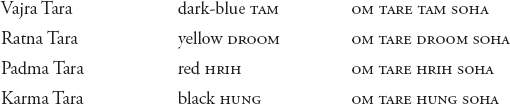
原书图片文字对照(补充新译)
| English | 中文 |
|---|---|
| Vajra Tara · dark-blue TAM · OM TARE TAM SOHA | 金刚度母 · 深蓝色 TAM · OM TARE TAM SOHA |
| Ratna Tara · yellow DROOM · OM TARE DROOM SOHA | 宝度母 · 黄色 DROOM · OM TARE DROOM SOHA |
| Padma Tara · red HRIH · OM TARE HRIH SOHA | 莲花度母 · 红色 HRIH · OM TARE HRIH SOHA |
| Karma Tara · black HUNG · OM TARE HUNG SOHA | 事业度母 · 黑色 HUNG · OM TARE HUNG SOHA |
The Retreat Manual adds,
《闭关手册》补充说:
Conclude the session in the same way you concluded the approach stage, except that here it is important to offer a tsok every day.
每座收结与近修阶段相同,但此时每日供荟供非常重要。
You conclude the session in the same way you concluded the approach section, and it is said that it is important when you focus on the accomplishment phase to offer a tsok every day.
每座收结与近修部分相同;据说,专修成就阶段时,每日供荟供非常重要。
I explained when we were talking about approach practice that mantras are visualized very clearly like the moon and the stars appear in the sky, but they don’t move. Here in the close approach, the example used is of a king and his emissaries. When a king wants to get something done, he sends an emissary to do it for him, and once the task has been completed, the emissary returns to report to the king. Likewise in the accomplishment stage, the main deity, Tara, emanates rays of light that touch the hearts of the deities in her retinue—Karma Tara for example—invoking each deity’s wisdom mind to accomplish her task. Having accomplished all her activities, the rays of light return to the main deity, bringing with them blessings and accomplishments.
讲近修时,我曾解释,咒语应观得非常清晰,如天空中的明月星辰,但并不移动。此处近近修用的是国王与使者的比喻。国王想完成某件事,便派使者代办;事情完成后,使者回来向国王报告。同样,成就阶段,主尊度母放出光芒,触及眷属诸尊的心间——例如事业度母——祈请各尊的智慧心完成她的任务。她完成所有事业之后,光芒回到主尊处,带来加持与成就。
I think I’ll repeat this part very simply, so you can understand. From the heart of the main deity, rays of light emanate, touching the heart and invoking the wisdom mind of one of the deities in the retinue, for example Karma Tara. That deity then emanates rays of light and so on, which accomplish the activity she has been charged with. These rays of light then return to the retinue deity, and having accomplished her task, she emanates rays of light that reconverge into the heart of the main deity, bringing blessings and siddhis.
我想将这部分非常简单地再讲一遍,便于你们理解。从主尊心间放出光芒,触及一位眷属尊的心间,祈请其智慧心,例如事业度母。该尊继而放出光芒等等,完成所受托的事业。然后,这些光芒回到眷属尊;她完成任务后,再放出光芒,重新汇入主尊心间,带来加持与悉地。
This visualization is also described in the Retreat Manual by Jamgön Kongtrul. At the heart of each of the Taras in the retinue—Vajra Tara, Ratna Tara, Padma Tara and Karma Tara—stand their respective seed syllables surrounded by their respective mantras. The colour of the seed syllable and mantra is the same as the colour of that deity.
蒋贡康楚的《闭关手册》也描述了此观想。各位眷属度母——金刚度母、宝度母、莲花度母与事业度母——心间立着各自的种子字,周围环绕各自咒语。种子字与咒语的颜色,与该尊身色相同。
That was the accomplishment practice. During approach practice, we acquaint ourselves with the deity and become quite close. During the accomplishment practice, we try to accomplish the deity, meaning we try to become one with or indivisible from the deity. This is the accomplishment we want to achieve.
以上是成就修法。近修时,我们熟悉本尊,与之变得十分亲近。成就修持中,我们尝试成就本尊,也就是尝试与本尊合一,或不可分离。这就是我们希望获得的成就。
You can only apply activity practice once you have accomplished and therefore become one with the deity through accomplishment practice. Until you are one with the deity there are no activities for you to accomplish. However, when we do sadhana practice, we must complete all three phases of approach, accomplishment and activity, which means that even if you have not completely accomplished the deity, you must still do the recitations associated with activity practice. Here, the activities are carried out by the four Taras who act as the gatekeepers. Do you remember the four deities at the gates? They accomplish four activities—pacifying, enriching, magnetising and subjugating. The way to direct the practice is as indicated in the text of the activity section,
只有通过成就修法成就本尊、与本尊合一之后,才能实行事业修法。在与本尊合一之前,并无事业可供你成办。然而,修成就法时,近修、成就与事业三个阶段都必须完成;这意味着,即使尚未完全成就本尊,也仍须念诵事业修法的相关仪轨。此处,由担任守门者的四度母执行事业。还记得四门的四尊吗?她们成办息、增、怀、诛四种事业。如何引导修持,事业部分的仪轨中已指明:
Myself the samayasattva, with the jnanasattva
我为三昧耶尊,与智慧尊
And the nirmanasattva,
及化现尊,
Send forth a brilliant profusion of rays of compassion
放射灿烂繁盛的悲光,
That invoke the wisdom mind of the Taras of the four families.
祈请四部度母之智慧心。
In turn, they send out rays of light
她们继而放出光芒,
That invoke the wisdom mind of the gatekeepers who accomplish activities.
祈请成办事业之守门尊的智慧心。
Rays of light emanate from the main deities to the next ones, touching each other in turn. Clearly actualise the visualization of the four seed syllables in their respective colours surrounded by their mantra malas as you recite the practice. Rays of light stream out from the five deities and the retinue to invoke Hook Tara. The five deities are the main deity and the four Taras. Basically, rays of light radiate from one deity to the next. From the three main deities Arya Tara, Amitayus and Ushnisha Vijaya, rays of light stream out and touch each of the four Taras in turn, starting with Vajra Tara. Then light streams out from the four Taras’ hearts, invoking the wisdom minds of the four Gatekeeper Taras. The Retreat Manual adds,
光芒从主尊放至下一尊,依次触及彼此。念诵仪轨时,清晰观想四个种子字,各具其色,周围环绕各自咒鬘。五尊与眷属放光,祈请钩度母。五尊指主尊与四度母。基本上,光芒从一尊放至下一尊。圣度母、无量寿佛与尊胜佛母三主尊放出光芒,依次触及四度母,从金刚度母开始。然后,光从四度母心间放出,祈请四守门度母的智慧心。《闭关手册》补充说:
The rays of light stream out […] to invoke Hook Tara. Hook Tara manifests many emanations, rays of light and infinite displays which accomplish the activity of pacifying all obstructing forces such as illness, negative spirits, negative actions, obscurations and so on. Accumulate only her mantra throughout the session. The conclusion is as before.
光芒放出……祈请钩度母。钩度母显现众多化身、光芒与无量展现,成办平息疾病、恶灵、恶业、障蔽等一切障碍力量的事业。整座只积累她的咒语。收结如前。
So we begin with Hook Tara to accomplish the pacifying activities. The Retreat Manual continues,
因此,先从钩度母开始,成办息业。《闭关手册》接着说:
Now alternate as follows.
现在依下述方式轮换。
During morning session, practise only Noose Tara’s mantra and visualization, accomplishing the enriching activities.
上午一座,只修索度母的咒语与观想,成办增业。
In the afternoon session, practise Iron Chain Tara’s mantra and visualization and accomplish the magnetising activities.
下午一座,修铁链度母的咒语与观想,成办怀业。
During the evening session, practise Bell Tara’s mantra and visualization and accomplish the subjugating activities.
晚间一座,修铃度母的咒语与观想,成办诛业。
Practise each activity by creating the relevant visualization of deities and rays of light to accomplish each specific activity. How you direct the practice is explained in the sadhana text,
修每一事业时,作相应诸尊与光芒的观想,以成办该项特定事业。如何引导修持,成就法仪轨解释如下:
Deities resound with the sound of their own mantras, which
诸尊发出各自咒音,
Fill the sky and pervade the ten directions.
充满虚空,遍及十方。
With infinite ways of training those beings who are ready,
以无量调伏有缘众生之法,
They pacify all disease, harmful forces, negativities and obscurations within dharmadhatu,
于法界中平息一切疾病、损害、罪恶与障蔽,
They increase longevity, merit, wealth and intelligence,
增长寿命、福德、财富与才智,
Bring the three realms, inner air and mind under control and
摄御三界、内气与心,
Destroy enemies, obstacle makers and duality.
摧毁敌人、障碍者与二元分别。
These supreme and common activities,
这些殊胜与共同事业,
Through the magic of the samadhi of emanating and reabsorbing rays of light,
藉放光收摄三摩地之神变,
Are all accomplished as I envision them.
皆如我所想而成办。
At the hearts of each of the Gatekeeper Taras stand the relevant syllables—DZA, HUNG, BAM and HO—surrounded by their respective mantras.
每位守门度母心间,立着相应种子字 DZA、HUNG、BAM、HO,各由自身咒语环绕。
This is how the activities are accomplished: from the heart of the main deity, rays of light invoke the surrounding four Taras, then emanate from their hearts to touch the hearts of the four Gatekeeper Taras who accomplish the activities. First, rays of light touch the heart of the Hook Tara accomplishing pacifying activities, then the hearts of the other gatekeepers successively to accomplish the activities of enriching, magnetising and subjugation. All these activities are accomplished through the emanation of rays of light.
事业如此成办:主尊心间放光,祈请周围四度母,再从她们心间放光,触及成办事业的四守门度母心间。先触及成办息业的钩度母心间,再依次触及其余守门尊心间,成办增、怀、诛事业。这一切事业都通过放光而成办。
An important aspect of this practice is that each deity resounds with the sound of their own mantra. So for example, at the hearts of the main deity and the jnanasattva is the mantra OM TARE TUTARE TURE SOHA. Each syllable produces its own sound: OM produces the sound “om”; TARE produces the sound “tare” and so on. And at the same time, each deity recites his or her respective mantra which is why the example used to illustrate the activity stage visualization is of bees buzzing around a broken hive. If you break the hive of a colony of bees, they will swarm around it, making their own buzzing sounds; likewise in this visualization, each syllable buzzes with its own sound.
此修法一个重要方面,是每位本尊都响起自身咒语之声。例如,主尊与智慧尊心间有 OM TARE TUTARE TURE SOHA 咒,每个咒字都发出自身声音:OM 发出“om”声,TARE 发出“tare”声,依此类推。同时,每位本尊也念诵各自咒语,因此,说明事业阶段观想的比喻,是蜜蜂围绕破蜂巢嗡嗡飞舞。若打破一群蜜蜂的蜂巢,它们会成群绕飞,各自发出嗡嗡声;同样,此观想中,每个咒字都嗡鸣自身之声。
The four different activities of pacifying, enriching, magnetising and subjugating are quite straightforward and laid out clearly in the text. Illness, spirits, forms of negativity and obscurations are each mentioned and addressed through the activity of pacifying.
息、增、怀、诛四种事业相当直白,文本中清楚列明。疾病、鬼神、种种恶业与障蔽,都一一提及,并以息业处理。
Through our practice we enrich, enhance or make more abundant longevity, merit, wealth and wisdom. Gelugpa lamas sometimes scold the Nyingmapas and accuse them of enhancing their own worldly wealth through such Nyingma visualization practices, which would be very bad. At the same time, being wealthy can be quite useful and very beneficial. In terms of wealth, there is no one wealthier than the Buddha! Buddha can manifest whatever he wants from the sky treasury—basically he can pluck material objects from primordial space. As Guru Rinpoche said, “I don’t need other people’s gold; all that appears and exists is gold to me.” Just by touching something someone like Guru Rinpoche could turn everything to gold.
通过修法,增益、增强或充实寿命、福德、财富与智慧。格鲁派上师有时会责备宁玛派,说他们通过这些宁玛观想修法增加自己的世间财富,那确实会很不好。同时,富有也可以相当有用,很有利益。论财富,没有谁比佛更富有!佛能够从虚空藏中显现任何所欲之物,基本上,可以从本初虚空中取出物质。正如莲师说:“我不需要别人的黄金;一切显有,对我都是黄金。”像莲师这样的人,只须触及,就能将一切化为黄金。
Next, with the magnetising activities, everything is brought under your control. So you bring all sentient beings of the three realms of existence under control and, more importantly, your own inner air, or lung, that is ridden by the mind, and the mind itself. By the time your mind and lung are completely under control, you will have reached enlightenment.
接下来,通过怀摄事业,将一切置于自己掌控之下。因此,你摄受三有一切众生,更重要的是,摄受自己内在的气、即 lung,以及乘在其上的心。当心与气完全受控时,你便已证得觉悟。
Jetsun Milarepa achieved enlightenment by bringing his mind and lung under control through tsalung practice. All yogic exercises that work with the channels and inner air, for example the Six Yogas of Naropa, are practised to bring our inner air, karmic wind and mind under control. Our bodies are like countries criss-crossed with roads (the channels), along which the inner air travels like a horse, ridden by the mind which is like the horse rider. If we cannot bring mind and inner air under control, the horse will run wild as if it had no rider at all. This is the situation most of us face at the moment. Another example is of a blind horse ridden by someone without legs. The blind horse wanders around but has no idea where it is going. Similarly, our inner air like the horse wanders everywhere in our bodies but has no idea where it’s really going, and the mind is like the legless rider who has no choice but to go wherever the horse goes. Through tsalung practice you can take control of and direct your inner air like a tame and well-trained horse and therefore direct the mind to go wherever you want it to. Once your lung is completely under your control, then all the concepts, thoughts and ideas disappear, never again to appear in your mind.
至尊米拉日巴通过气脉修法,令心与气受控而证悟。一切作用于脉与内气的瑜伽练习,例如那若六法,都是为了摄持内气、业风与心。我们的身体像道路纵横的国土,道路就是脉;内气如马沿路行走,心如骑手乘在马上。若无法摄持心与内气,马就会像无人驾驭一样狂奔。这正是我们大多数人目前的处境。另一个比喻,是无腿者骑盲马。盲马四处游走,却不知道往哪里去;同样,内气像马一样在体内到处行走,却不知真正去向,心则像无腿的骑手,别无选择,只能随马而去。通过气脉修法,你能掌控、引导内气,如同驾驭温驯训练有素的马,从而引导心随意而行。一旦气完全受控,一切概念、念头、想法便消失,永不再现于心。
Subjugation or wrathful activity is basically to kill the enemy you want eliminated, and that enemy is the delusion of duality or dualistic clinging.
降伏或忿怒事业,基本上就是杀死你想消灭的敌人,而这个敌人,就是二元迷妄或二元执著。
By relying on the common accomplishment of the activities of pacifying, enriching, magnetising and subjugating which we accomplish through the power of samadhi, we are able to reach the state of complete enlightenment, the supreme accomplishment. How are these common activities accomplished? By the magic of the emanating and reabsorbing samadhi. All our activities, everything, will be accomplished as if by a wish-fulfilling jewel, a precious gem that grants all wishes and prayers instantly; it doesn’t have to think about granting your wish, you just make your request and it is instantly fulfilled. And everything you want will be accomplished through the power of samadhi as you practise these four activities.
依靠三摩地之力成办息、增、怀、诛诸事业的共同成就,就能达到圆满觉悟这一殊胜成就。这些共同事业如何成办?通过放射收摄三摩地的神变。我们所有事业,一切,都将如依如意宝般成办。如意宝是立即满足一切愿望与祈求的珍宝,不必思考是否满足你的愿望,只要提出请求,就立即实现。修这四种事业时,一切所欲都将依三摩地之力成办。
The questions that always comes up around how to do the practice are, “How many mantras should I recite” and “How long should I practise for?” Even those of you who haven’t actually asked these questions are, I’m sure, waiting for the answers. So I’ll tell you!
关于如何修持,人们总会问:“应该念多少咒?”“应该修多久?”即使还没实际提出问题的人,我相信也在等答案。那我就告诉你们!
There are three options: time, number and signs. Time refers to the length of time you do the practice, the number of days or months. Number means you decide to recite a specific number of mantras. Signs mean you decide to practise until certain signs of accomplishment manifest.
有三种选择:时间、数量与征相。时间指修法时长,即多少天或多少月;数量指决定念诵特定数目的咒语;征相指决定修到某些成就征相显现为止。
All Guru Rinpoche’s instructions about how much time should be spent on this practice were intended for students of superior capacity like Vairotsana, King Trison Deutsen and Yeshe Tsogyal, and were therefore extremely short. This is why the instruction manual says that those of superior capacity should do the approach practice for three weeks, because that’s how long practitioners of superior capacity usually need to experience signs of accomplishment; accomplishment practice for one week; and activity practice for a single day. With just one day for the activity practice, do the pacifying activity in the early morning session, the enriching activity in the morning session, the magnetising activity in the afternoon session and the subjugating activity in the evening.
莲师关于此法应修多长时间的一切教授,都是对毗卢遮那、赤松德赞王与益西措嘉等上根弟子所说,因此时间极短。这也是教授手册说,上根者近修三周的原因,因为上根修行者通常只需这么久就能体验成就征相;成就修一周,事业修一天。事业只修一天,因此清晨一座修息业,上午一座修增业,下午一座修怀业,晚间修诛业。
Jamgön Kongtrul spoke briefly about how many mantras we should recite, and the instruction manual specifies that you must practise for three months simply for familiarization with the practice.
蒋贡康楚简要讲过应持诵多少咒,教授手册则明确说,仅为熟悉修法,也须修三个月。
To determine the number of mantras you recite, since the main mantra OM TARE TUTTARE TURE SOHA has ten syllables, it is said you should recite one hundred thousand for each of the ten syllables, making a total of one million, plus an extra hundred thousand to make up for any omissions or additions you make as you practise. The mantra of the combined practice OM TARE TUTTARE TURE HRIH DROOM BENDZA JNANA AYUKE SOHA has nineteen syllables, and you should recite seven hundred thousand, plus seventy thousand to make up for your mistakes. Recite the jnanasattva Amitayus’ mantra OM AMARANI DZIWANTIYE SOHA four hundred thousand times, and also do four hundred thousand recitations of the nirmanasattva Ushnisha Vijaya’s mantra OM AMRITA AYURDADE SOHA.
确定咒数时,由于主咒 OM TARE TUTTARE TURE SOHA 有十字,据说每字应诵十万遍,共一百万遍,再加十万遍,以弥补修持中的遗漏或增添。合修咒 OM TARE TUTTARE TURE HRIH DROOM BENDZA JNANA AYUKE SOHA 有十九字,应诵七十万遍,再加七万遍补过。智慧尊无量寿佛咒 OM AMARANI DZIWANTIYE SOHA 诵四十万遍,化现尊尊胜佛母咒 OM AMRITA AYURDADE SOHA 也诵四十万遍。
According to the Nyingma tradition, in the accomplishment practice, you usually recite one tenth of the number of mantras you do in approach practice. For example, in this practice you recite one million mantras during the approach practice which means you say one hundred thousand during the accomplishment practice. So recite one hundred thousand mantras for each of the four Taras and forty thousand mantras for each of the four Gatekeeper Taras. Here again, for the practice to be complete, you must add another ten percent, four thousand, to make a total of forty-four thousand. Jamgön Kongtrul says this number of mantras is appropriate for a practitioner of medium capacity.
依宁玛传统,成就阶段通常念诵近修咒数的十分之一。例如此法近修诵一百万遍,成就便诵十万遍。因此,四度母各诵十万遍,四守门度母各诵四万遍。这里同样,为使修法完整,必须再加百分之十,即四千遍,总计四万四千遍。蒋贡康楚说,这样的咒数适合中根行者。
If you want to do the practice more elaborately, multiply the number of mantras by four, so for example instead of one hundred thousand recitations, you do four hundred thousand. Jigme Lingpa said that what practitioners of the past were able to accomplish in one hundred thousand recitations would take four times as long in his time because they were already living in the degenerate time and the qualities of sentient beings were not as great.
若想修得更广大,就把咒数乘以四,例如由十万遍增为四十万遍。吉美林巴说,昔日修行者念十万遍便能成办的事,在他那个时代要花四倍时间,因为已处浊世,众生的素质不如从前。
If you don’t concentrate as you practise, it doesn’t matter how many million mantras you recite, your practice will be pointless. These days many people seem able to recite one hundred million mantras—I’ve met many monks who have recited more—but they tell me they don’t achieve any signs of accomplishment. This is because they can’t meditate or focus their minds as they recite the practice. The kinds of signs you might achieve are mentioned in the text. The best is to have a face-to-face meeting with the deity during which you hear him or her speak to you directly. The second best is to experience dreams during which you meet the deity—for Westerners, it seems, this happens quite easily! But most of these dreams aren’t authentic signs of accomplishment. Actually, they’re useless. I remember, when I was on my way to France once with Tulku Pema Wangyal, he told me that because Westerners’ samayas are so pure and they have genuine devotion for and faith in the teachings, they immediately achieve signs of accomplishments in their dreams. At the time I thought that this was probably the case. But then as time went on, I realised that most of the Westerners were actually just crazy! What they experienced weren’t real signs! I haven’t met anyone who achieved genuine signs of accomplishment. Experiences are like mist in the morning, they come and go, and generally the idea of experiences of all kinds seem to pop into their minds, but it doesn’t mean much. If you think to yourself, “I must have an indication, a sign! I must have some dreams! I’m sure I will have some really good dreams!” you’re bound to dream something, but the so-called signs you see in your dream won’t be real signs at all.
若修行时不专注,无论念多少百万遍咒,修行都无意义。如今,许多人似乎能念一亿遍咒;我见过许多僧人,念得更多,但他们告诉我,没有任何成就征相。这是因为念诵修法时,他们不能禅修、不能专心。可能获得的征相,文本中已有说明。最好的是亲见本尊,听到他或她直接对自己说话;其次,是梦见本尊——西方人似乎很容易做到!但多数这种梦都不是真实成就征相,实际上毫无用处。我记得有次与贝玛旺嘉祖古前往法国,他告诉我,西方人的三昧耶如此清净,对教法有真实虔敬与信心,因此立即在梦中获得成就征相。当时我想,大概确实如此。但后来渐渐发现,大多数西方人其实只是疯疯癫癫!他们的体验不是真正征相!我还未遇见获得真实成就征相的人。体验像晨雾,来来去去;一般而言,各种体验的念头似乎会突然冒进他们心里,却没有多大意义。若心想:“我必须有个迹象、征兆!必须做些梦!我肯定会做些很好的梦!”你当然会梦到点什么,但梦中看到的所谓征相,根本不是真正的征相。
If you do achieve genuine signs of accomplishment, it is said that you should receive the siddhis immediately, even if the signs appear in the middle of your retreat. If you don’t, the siddhis will fade away. The retreat manual clearly explains about receiving the siddhis which generally comes towards the end of the practices.
若获得真实成就征相,据说应立即领受悉地,即使征相出现在闭关中途。否则,悉地会消退。闭关手册清楚解释了领受悉地,通常在修法将结束时进行。
8. Tsok
8. 会供
There’s nothing special about the tsok in this practice. Tsok means “gathering”, so start by gathering excellent food and offering substances, in particular those that represent skilful means (something to eat) and wisdom (something to drink). Without these two kinds of offering the tsok will be incomplete. Similarly, the gathering of practitioners should include both men and women. A gathering of only male practitioners doesn’t qualify as a genuine ganachakra feast. Without women present, the practice is only a simple tsok offering.
此修法的会供没有什么特别之处。Tsok 意为“聚集”,因此先聚集上等食物与供品,尤其是代表方便的可食之物与代表智慧的可饮之物。没有这两类供养,会供就不完整。同样,修行者的聚集应包括男女。只有男性修行者的集会,不算真正的荟供轮会;没有女性在场,修法便只是简单的会供供养。
Start by blessing the offering substances, then immediately invite your guests. The tsok in the Chimé Phakmé Nyingtik practice contains a specific invitation. Follow the stages described in the text. Having invited the guests, make the offerings. This is what you do in the tsok offering. The purpose of this visualization is to emanate offering gods, goddesses and tsok substances, and for the gods and goddesses to offer the five sensory pleasures to the invited guests who include countless deities of the Three Roots, buddhas and bodhisattvas of the ten directions, and the dakas and dakinis of the twenty-four sacred places and the thirty-two sacred lands. They are pleased—body, speech and mind—with the infinite offerings you present to them.
先加持供物,然后立即迎请宾客。无死圣母心髓会供有专门迎请文,依文本所述次第进行。迎请宾客以后,献上供养。会供供养就是这样做的。这一观想的目的,是化现供养天子、天女与会供物,由天子天女向迎请的宾客献上五种感官妙欲。宾客包括无数三根本本尊、十方诸佛菩萨,以及二十四圣地、三十二圣境的勇父与空行母。你所献的无量供养,令他们身语意欢喜。
During the tsok, you must make offering for confession and fulfillment, this is the second tsok offering. The visualization for both offering the tsok and the fulfillment practice is the same. The only difference between these two parts of the practice is that you make more food offerings for the tsok and offer more objects in the fulfillment practice. Through the fulfillment practice, you offer all the offering substances, own up to all your faults, errors and mistakes and confess at the end of the practice. Having done so, it is important to be confident that all your mistakes and so on have been completely purified. The Chimé Phakmé Nyingtik doesn’t include a dralwa practice (sometimes translated as liberation or annihilation) which is usually found towards the end of a tsok to liberate or annihilate all the enemies related to ego clinging.
会供中,必须为忏悔与酬补而供养,这是第二次会供供养。献会供与酬补修法的观想相同,唯一区别是,会供时多供食物,酬补时多供物件。通过酬补修法,献上一切供物,承认所有过失、错误与失误,并在修法末尾忏悔。做完以后,重要的是确信一切过失等已完全净化。无死圣母心髓不含 dralwa 修法,有时译为解脱或歼灭;这种修法通常见于会供后段,用以解脱或歼灭与我执有关的一切敌人。
The Chimé Phakmé Nyingtik includes quite an elaborate practice of self-empowerment.97 Should you skip this section and not receive the self-empowerment, there is also a method for blessing the tsok by gathering the siddhis of longevity and dissolving them into the tsok substances.
无死圣母心髓包含相当广大的自灌顶修法。[97] 若略过此段、不受自灌顶,也有摄集长寿悉地并融入会供物、以此加持会供的方法。
Now it is time to enjoy the tsok. The men should start eating by using their right hands first, and women should use their left; the men should start by drinking and the women should start by eating. You should then nurture the experience of great bliss. It is said that if the practitioners wish to, they can now perform vajra songs and vajra dances. Next, gather the remaining tsok offerings and take them out to offer to the remainder deities and elemental spirits. Make prayers of aspiration, then make torma offerings to all the dharma protectors (male, female and neuter), rinse the plate you offered the torma on with amrita and offer the rinsing water to the twelve Tenma protectors of the land of Tibet who were tamed by Guru Rinpoche. The two plates that were used for the covenant, or cheto, and Tenma tormas are then placed upside down, and all the samaya breakers and obstacle makers are summoned and trapped beneath them, never to rise again. At the end, make a brief offering of praise to the mandala deities. Confess how inadequate your offerings were, all your transgressions, incorrect visualizations and recitations and so on, and recite the hundred-syllable mantra three times.
现在可以受用会供了。男性先用右手,女性先用左手;男性先饮,女性先食,随后应滋养大乐体验。据说,行者若愿意,此时可唱金刚歌、跳金刚舞。接着收集剩余会供,拿出去供给余供尊与元素精灵。作发愿祈祷,再向所有护法——男性、女性及中性——供食子,用甘露冲洗盛食子的盘,将冲洗水供给莲师所调伏、西藏国土的十二 Tenma 护法。然后将盟誓、即 cheto 食子与 Tenma 食子所用的两个盘倒扣,召摄一切破三昧耶者与作障者,困于盘下,永不再起。最后,简略赞颂坛城诸尊,忏悔供养不足、一切违犯、错误观想与念诵等,并诵百字明三遍。
Vajra pride is the second crucial point of kyerim practice. Your visualization of the deity must be clear. So far, what we’ve been doing is maintaining a clear visualization of the deities as we meditate on the main deity, the samayasattva in union with the consort, the jnanasattva, the seed syllable, the nirmanasattvas, the four Taras accompanying the main deity, the retinue and the four Gatekeeper Taras who accomplish the four activities. This is how we have been practising visualization and what we’ve been talking about over the past couple of days.
金刚慢是生起次第的第二个关键。你的本尊观想必须清晰。迄今,我们一直在观修主尊、与佛父双运的三昧耶尊、智慧尊、种子字、化现尊、伴随主尊的四度母、眷属,以及成办四事业的四守门度母时,保持诸尊的清晰观想。这就是我们一直在做的观想修行,也是过去几天讨论的内容。
But even more important than maintaining the clarity of our visualization is vajra pride or vajra confidence. Even if you achieve the clearest visualization possible, it is also vital for you to have a strong sense that you are the deity—this is vajra pride. Without it, even if you visualize yourself as the deity perfectly, that visualization will be no more than an image like a statue or a thangka. It will be a representation or picture of the deity, not the deity itself. Unless you have a strong sense that you are the deity, your visualization will not be the deity. A worse mistake would be to fake it by trying to make yourself look like something you know you’re not. In other words, to make yourself look like the deity, thinking, “Even though I am not the deity, I will try to see myself as the deity.” This is not how to approach this practice. Neither is, “Even though right now I am not the deity, through the practice I will become the deity.”
但比保持观想清晰更重要的,是金刚慢或金刚自信。即使已达到最清晰的观想,也仍必须强烈感到自己就是本尊,这就是金刚慢。没有它,即使把自己完美地观成了本尊,也不过是像塑像或唐卡那样的形象,是本尊的表现或图画,而非本尊自身。若没有强烈感到自己是本尊,观想就不是本尊。更严重的错误,是明知自己不是,却想装成那个样子;换言之,想让自己看起来像本尊,心想:“虽然我不是本尊,但我要试着把自己看成本尊。”修此法不应如此,也不应想:“虽然现在不是本尊,但通过修行会成为本尊。”
When we were talking about the view, specifically the ground, I explained that the nature of our mind is the dharmakaya and that the dharmakaya of the Buddha is no different from the dharmakaya that is our own minds. So as we visualize ourselves as the deity, the appearance we actualise is in fact a manifestation of this wisdom, this dharmakaya. Our visualization is wisdom manifesting with one face, two hands and so on. It’s no less than the manifestation of primordial wisdom, which is the very nature of your mind. The dharmakaya, the Buddha and this deity are no different from who you are or from your mind. Therefore at this point, it is vital to have absolute certainty, confidence and pride in this truth.
讨论见地、特别是基时,我解释过:自心本性就是法身,佛的法身与作为自心的法身并无差别。因此,观想自己是本尊时,所现起的形相,实际上就是这一智慧、这一法身的显现。我们的观想,是智慧显为一面二臂等;正是本初智慧的显现,而本初智慧就是自心本性。法身、佛与此本尊,都与你自身或你的心没有差别。因此,此时对这一真实具有绝对的确定、信心与自信,至关重要。
Longchen Rabjam said that whether or not your visualization is clear, the moment you start to think of the deity it is imperative that you feel this vajra pride. If you practise thinking, “Even though I am not the deity, I will try to actualise myself as the deity in order to accomplish really being the deity”, you will never accomplish anything. It just doesn’t work like that. Even though your body is not the body of the deity, your mind is the deity, and there is not one single doubt that this is so! Which is why you really must arouse that strong sense of confidence and pride in being the deity and why it is said that vajra pride is even more important than clear visualization. Even if you manage to create an extremely clear visualization, without vajra pride all you’ve done is create an empty image. This is why you need vajra pride. This is extremely important, as we can see from numerous quotations masters cite in the sacred texts and through reasoning.
龙钦绕降说,无论观想是否清楚,一开始忆念本尊,就必须感到这种金刚慢。如果修时想:“虽然我不是本尊,我要努力现起自己为本尊,以成就真正成为本尊”,那就永远成就不了任何东西。修法并不是这样起作用的。你的身体虽不是本尊身,但你的心就是本尊,这一点毫无疑问!所以,确实必须生起自己就是本尊的强烈确信与自豪,也因此说,金刚慢甚至比明晰观想更重要。即使观想极清晰,若无金刚慢,也只是造了个空洞形象。因此需要金刚慢。这极其重要,从上师所引诸多圣典教证与理证中,都可见到。
Along with a clear visualization and vajra pride, you must also practise a third element which is to remember the purity. If these three elements are part of your practice, you are practising kyerim.
除了明晰观想与金刚慢,还须修第三项,即忆念清净。修持具足这三个要素,就是在修生起次第。
This third point, remembering the purity, is basically to remember that everything you do in your meditation practice—the deity you visualize, the appearance of the palace and so on—is no different from the dharmakaya. They all manifest without ever separating or moving out of the space of the dharmakaya, which is why all these different aspects of practice must be embraced by the view of emptiness. This is the essential method for remembering the purity.
第三点忆念清净,基本上是记得:禅修中所作的一切,所观本尊、宫殿显相等等,与法身毫无差别。它们显现时,从未离开或移出法身之界,因此修法各方面都须由空性见摄持。这就是忆念清净的精要方法。
More elaborately, the significance of each aspect of the deities and palace—one face, two hands, two legs, the five silk ornaments, the eight jewel ornaments and so on—are specifically related to the enlightened qualities of a buddha. Therefore, you must bring to mind the purity of each of these aspects. But usually, people don’t understand, the meaning is not clear to them. Unless you study the commentaries and have followed a shedra type of training, you won’t really be able to understand these enlightened qualities. In Buddhism we talk of the four immeasurables, the four genuine restraints and four bases of miraculous powers that are among the thirty-seven elements that lead to enlightenment, the four means of gathering students, the seven branches of enlightenment, the six perfections and so on. Even though you hear and may even understand the words, you may find the meaning difficult to grasp. Actually, they are all related to different aspects of the deities, and if you want to know more, look at the different commentaries and practice instructions. Briefly though, it comes down to remembering the purity, and what I have explained today will suffice.
广说而言,诸尊与宫殿的每个方面——一面、二臂、双腿、五绸衣、八珍宝饰等等——都具体对应佛的觉悟功德。因此,应忆起各方面的清净。但通常人们不明白,不能清楚理解其义。除非学习释论并接受佛学院式训练,否则无法真正理解这些觉悟功德。佛教谈四无量、三十七菩提分法中的四正断与四神足、四摄、七觉支、六度等等。虽然听过,甚至懂这些词,仍可能难以把握意义。其实,它们全与本尊的不同方面相关;若想多了解,就读各种释论与修法教授。不过,简言之,就是忆念清净,今天我所解释的已经足够。
9. Dzogrim
9. 圆满次第
Now we turn to the extraordinary teachings on dzogrim, the Dzogchen practice that’s part of the Chimé Phakmé Nyingtik. Dilgo Khyentse Rinpoche wrote an elaborate commentary on the guru yoga sadhana based on the three great vidyadharas of longevity—Vimalamitra, Shri Singha and Guru Rinpoche—in which all the profound and crucial points of Dzogchen meditation are mentioned and is a part of the Chimé Phakmé Nyingtik cycle. You will find it in his Collected Works.
现在讲圆满次第的殊胜教法,即无死圣母心髓中所含的大圆满修法。顶果钦哲仁波切为以无垢友、师利僧哈及莲师三大长寿持明者为基础的上师瑜伽成就法,撰写了一部广释,其中提及大圆满禅修所有甚深关键,属于无死圣母心髓法类,可见于他的《文集》。
As I explained earlier, the practice of Chimé Phakmé Nyingtik purifies all the samsaric processes of beings and begins at the intermediate state or bardo. All sentient beings go through different stages of life. They take birth, grow up and become adults and accomplish various impure activities. The process of kyerim transforms all the impure aspects of a sentient being’s life into the pure characteristics of the deity. This is what we train ourselves to do in kyerim practice.
如前所释,无死圣母心髓净化众生轮回的一切过程,从中间状态,即中阴,开始。一切众生经历不同生命阶段:出生、成长、成年,并从事种种不净活动。生起次第将众生生命的一切不净方面,转为本尊清净特征。生起次第训练的正是这个。
Kyerim therefore has the power to eliminate all habitual tendencies that lead us to take rebirth in cyclic existence, samsara. There are two obscurations that cover our enlightened primordial wisdom—cognitive and habitual obscurations. Of these two, the obscurations of habitual tendencies are more difficult to remove than the cognitive, but kyerim purifies them both.
因此,生起次第有力消除使我们投生轮回的一切习气。遮蔽觉悟本初智慧的有两种障:认知障与习气障。二者中,习气障比认知障更难除,但生起次第能够净化二者。
From the moment we are born, all sentient beings know one thing—we will eventually die. Even the Buddha passed into parinirvana. This is why there is a section in the practice for dissolving the mandala.
从出生那一刻起,一切众生都知道一件事:我们最终会死。连佛陀也示现般涅槃。因此,修法中有收摄坛城的部分。
A! The samayasattvas, rigpa’s natural display,
A!三昧耶尊,本觉自然显现,
Are one taste, beyond any possible separation or reunion,
一味,超越任何分离与重合,
Within the expanse of the basic space of self-arising primordial wisdom,
于自生本初智慧之法界中,
So all their features like face and hands, all dissolve into all-pervading space.
面容手臂等一切形相,皆融周遍虚空。
I won’t explain the words. As we chant the syllable A, the dissolution process begins. At the beginning of the practice when we first visualize the main deity, we work from the inside out; during the dissolution, we visualize from outside in. So the fire encircling the vajra fence dissolves into the vajra sphere, which dissolves into the environment, which dissolves into the palace, which dissolves into the retinue deities, who dissolve into the main deity. Similarly, the seats dissolve into each other, then into the main deity. At this point, all that’s left is the main deity. The samayasattva dissolves into the jnanasattva, who dissolves into the TAM syllable which is the samadhisattva. Then the samadhisattva dissolves from bottom to top. In the end, all that’s left is the circle above the syllable, and even that dissolves into light and vanishes into the ultimate space. The dissolution process we go through at death is reflected in the process of dissolution we find in kyerim practice. Then you rest in that state.
我不解释字句。念 A 字时,收摄过程开始。修法最初观主尊时,由内而外;收摄时,由外而内。因此,金刚围外的火焰融入金刚轮,金刚轮融入环境,环境融入宫殿,宫殿融入眷属诸尊,眷属融入主尊。同样,各座依次融入,最后融入主尊。此时只剩主尊。三昧耶尊融入智慧尊,智慧尊融入 TAM 字三摩地尊。三摩地尊再自下而上消融,最后只剩字上方的圆点;连它也融为光,消失于究竟虚空。死亡时所经历的消融过程,映现于生起次第的收摄过程。然后安住此境。
Those bound by cyclic existence are reborn into samsara, but a buddha manifests as a nirmanakaya for the sake of sentient beings. So next is the reappearance or arising which is like a rebirth. By saying the syllable TAM, you provide the circumstances necessary for the arising to unfold.
受轮回束缚者再生于轮回,佛则为众生示现化身。因此,接下来是再现或再起,如同重生。念 TAM 字,提供现起所需的缘。
TAM
TAM
Once again, like a rainbow appearing from the sky,
再次如虹从虚空显现,
I arise in the form of the Lady of Immortality;
我现起无死圣母之身;
Appearances, sounds and thoughts,
一切显相、声音与念头,
Arise as deity and mantra, as the play of great wisdom.
显为本尊与咒语,乃大智慧之游戏。
OM AH HUNG
OM AH HUNG
When you arise again, it’s fine to visualize yourself as the main deity; you don’t have to visualize the entire retinue and the deity reappears to benefit all sentient beings.
再次现起时,只观自身为主尊即可,不必观整个眷属;本尊为利益一切众生而再现。
There is another key point here. If you do this practice in retreat, don’t dissolve the outer protective sphere. In retreat, you must maintain a continuous awareness of it. Each time you practise, re-establish it in your visualization, actualise its presence and only at the very end of the retreat do you dissolve it.
这里还有一个关键。若在闭关修此法,不要收摄外护轮。闭关中须持续保持对它的觉知。每次修时,在观想中重新建立、现起其存在,只在闭关最后结束时才收摄。
10. Requesting the Deities to Remain
10. 祈请诸尊安住
Before you dedicate, if you have been practising in the presence of a representation of the enlightened body, speech or mind of the deity, you must do a consecration or “request that the deities remain in the representations”. Ask the deities to remain in the images until they are destroyed by natural disasters brought on by the four elements—earth, water, fire and wind. A while ago there was a fire here in this shrine room at Deer Park and the main statue was almost burnt. If the fire had destroyed it, the wisdom deity would also have gone.
回向之前,若在本尊觉悟身、语、意所依前修持,须作开光,即“祈请诸尊安住所依”。请诸尊留住像中,直至这些像被地、水、火、风四大所致自然灾害毁坏。不久前,Deer Park 这间佛堂发生火灾,主像几乎烧毁。若火烧毁了它,智慧尊也会离去。
If you went through the elaborate practice of preparing a sand mandala to support your practice (something I doubt you’ll ever do), you have already asked the deity to remain until the sand mandala is dismantled. At the end of the practice, you ask them to leave through a ritual for requesting the wisdom deities to depart from the mandala.
若曾广作彩沙坛城作为修法所依——我怀疑你们会不会这样做——那么此前已请本尊安住,直至彩沙坛城拆除。修法结束时,通过祈请智慧尊离开坛城的仪轨,请诸智慧尊离去。
11. Dedication and Prayers of Aspiration
11. 回向与发愿
Next are the dedication and aspiration prayers. All Sutra and Tantra texts say that dedication and aspiration are extremely important elements in all practices.
接着是回向、发愿文。一切经续都说,回向与发愿是一切修法极其重要的部分。
The dedication,
回向:
HO
HO
The accumulations of the wisdom of primordial purity,
本初清净智慧之资粮,
And the accumulation of merit based on interdependent origination,
以及缘起所生福德资粮,
I dedicate within the space of the essence of enlightenment,
我于菩提本体之界回向,
The uncompounded expanse in which the two accumulations are indivisible.
即二资粮无别的无为界。
The prayer of aspiration,
发愿:
From now on and in all my lives,
从今乃至生生世世,
May I always be in your care, exalted Lady,
愿恒蒙圣母摄受,
And with the siddhis of longevity and wisdom,
以长寿与智慧悉地,
May I spontaneously accomplish all that truly benefits myself and others.
任运成办真实自他二利。
Your practice should be accompanied by the dedication of merit and aspiration prayers. As you say the prayers of auspiciousness, visualize the buddhas and bodhisattvas filling all of space and showering you with mandarava flowers as they sing songs of auspiciousness. If you have received many empowerments, you must know about the elaborate visualizations you are supposed to actualise as you recite prayers of auspiciousness. Also, offerings of blessing rice and grain, flowers, incense, music and so on are scattered. Anyone who’s received empowerments will have seen that too. At that point, you play cymbals and damaru.
修持应伴随福德回向与发愿。念吉祥祈愿时,观想诸佛菩萨遍满虚空,向你洒曼陀罗花雨,唱吉祥歌。若领受过许多灌顶,就应知道念吉祥祈愿时应现起的广大观想。也撒加持米谷、花,并供香、音乐等等。任何受过灌顶的人也见过这些。此时奏钹与达玛如鼓。
OM
OM
Holders of the dynamic energy of awareness in the mind direct, symbolic and aural lineages,
意传、表示与耳传传承中,持本觉妙力者,
Vidyadhara lamas, let auspiciousness abound!
持明上师众,愿吉祥增盛!
You who appear in infinite mudras of peaceful and wrathful deities,
显现无量寂忿本尊身相(mudras)者,
Yidam deities, let auspiciousness abound!
本尊诸圣众,愿吉祥增盛!
You who assist the yogis in increasing great bliss,
助瑜伽士增长大乐者,
Outer and inner dakinis, let auspiciousness abound!
内外空行母,愿吉祥增盛!
You who judge good and bad and dispel obstacles,
判别善恶、遣除障碍者,
Ocean of dharma protectors, let auspiciousness abound!
护法大海众,愿吉祥增盛!
May all be auspicious for the short-term activities of four types
暂时四种事业,
To fulfill the twofold benefits,
圆满自他二利,愿皆吉祥;
While ultimately, may all be auspicious for the direct experience
究竟直接亲证,
Of the immortal wisdom body.
无死智慧之身,愿皆吉祥。
All the verses of auspiciousness in this sadhana are composed with such sweet words that have a truly excellent meaning! We would say here “Sarwa Mangalam” which is Sanskrit, and you could say it too. Then,
此成就法一切吉祥偈,文字如此优美,含义如此殊胜!这里我们会说梵语“Sarwa Mangalam”,你们也可以说。然后,
Scatter flowers in all directions as you recite this prayer. Then celebrate…
念此祈愿时,向十方散花。然后庆贺……
To clarify, basically you can now throw a party and enjoy yourselves!
说清楚些,就是现在可以开派对,欢喜享受!
And increase the two accumulations.
并增长二资粮。
This means that you should accumulate as much merit and wisdom as you can and do whatever possible to accumulate even more merit and wisdom.
这意味着,尽量积累福德与智慧,尽一切可能积累更多福慧。
At the end in the last paragraph of the text, there is a short prophecy plus a brief history of the practice that details its benefits. It is very clear, you just have to read it to understand it. King Trison Deutsen and his son, Gyalse Lharje, are mentioned, and the five recipients of the practice are listed as King Trison Deutsen, his friend Yeshe Tsogyal, his subjects Vairotsana, Gyalwa Chöyang and Nubchen Sangye Yeshe.
法本末段,有简短授记与修法简史,详述其利益。非常清楚,只须阅读就能理解。提到赤松德赞王与其子 Gyalse Lharje;并列出五位修法领受者:赤松德赞王、友伴益西措嘉,以及臣民毗卢遮那、嘉瓦却央与努钦桑杰益西。
To you, the sovereign father and son,
And the subjects and friend—five in all.
予汝君王父子,以及臣民、友伴,共五位。
Father and son are Trison Deutsen and Gyalse Lharje.
父子是赤松德赞与 Gyalse Lharje。
Conceal it in the expanse of the great bindu,
藏于大明点之界,
For the benefit of future generations.
为利益后世众生。
When the time is ripe and the right interdependent
待时成熟,适当缘起
circumstances come together,
因缘聚合之际,
May it appear and benefit others on a vast scale!
愿此显现,广大利他!
This precious teaching was given to these five people, then hidden as a terma in their minds to be revealed in future for the benefit of sentient beings. The five recipients of these teachings also manifested in the future: King Trison Deutsen and Gyalse Lharje manifested as Jamyang Khyentse Wangpo; Vairotsana returned in the form of Jamgön Kongtrul; Gyalse Lharje Chokdrup Gyalpo’s incarnation was Chokgyur Lingpa; and Tertön Sogyal, Shechen Gyaltsab Pema Namgyal, Karmapa Tekchok Dorje, Khakhyab Dorje and Dodrupchen Jigme Tenpe Nyima are all believed to have been emanations of Gyalse Lharje Chokdrup Gyalpo. It’s interesting when a good prophecy is made just how many people are eager to say, “Yes, he was pointing at me! I’m the one who will accomplish this. I was the one he was writing about!”
此珍贵教法授予这五人后,作为伏藏藏于其心中,未来开启,以利益众生。这五位领受者后来也示现于世:赤松德赞王与 Gyalse Lharje 示现为蒋扬钦哲旺波;毗卢遮那转世为蒋贡康楚;Gyalse Lharje Chokdrup Gyalpo 的转世为秋吉林巴;伏藏师索甲、雪谦嘉察白玛南嘉、噶玛巴 Tekchok Dorje、Khakhyab Dorje,以及多智钦吉美丹贝尼玛,都被认为是 Gyalse Lharje Chokdrup Gyalpo 的化身。有趣的是,一有好的授记,竟有那么多人急着说:“对,他指的就是我!成办此事的是我!他写的就是我!”
Jamgön Kongtrul said over and again that Jamyang Khyentse Wangpo’s terma revelations are unique and extraordinary revelations. They contain few words but carry an extremely profound meaning and great blessings. He said the five main emanations of King Trison Deutsen were all great tertöns, the five king-like tertöns. The body emanation was Nyang Ral Nyima Özer, the speech emanation was Guru Chökyi Wangchuk, the mind emanation was Tashi Tobgyal, the activity emanation was the Great Fifth Dalai Lama and the quality emanation was Ngari Panchen. But according to Jamgön Kongtrul, Jamyang Khyentse Wangpo was greater than any of the five kinglike tertöns. Jamyang Khyentse Wangpo had five students who were also great tertöns which is why Khyentse Wangpo is considered to be the universal monarch of the profound terma tradition. He revealed the terma of the Chimé Phakmé Nyingtik, wrote it down, practised it, and after about a week Guru Rinpoche, Shri Singha, Vimalamitra and all the deities of the mandala appeared to him directly and he received their blessings. Khyentse Wangpo gave the Chimé Phakmé Nyingtik empowerment to Chokgyur Lingpa, and immediately Chokgyur Lingpa saw very clearly the main deity’s seven eyes—two in the deity’s feet, two in her hands and three on her face. He saw them very clearly for quite a long time.
蒋贡康楚一再说,蒋扬钦哲旺波的伏藏独特而非凡,文字少,意义极深,加持巨大。他说,赤松德赞王的五大化身,皆是伟大伏藏师,即五位王者般的伏藏师:身化身娘热尼玛沃色,语化身古如却吉旺秋,意化身 Tashi Tobgyal,事业化身伟大五世达赖喇嘛,功德化身阿里班钦。但蒋贡康楚说,蒋扬钦哲旺波比这五位中的任何一位都更伟大。他有五名弟子也是大伏藏师,因此被视为甚深伏藏传统的转轮王。他开启无死圣母心髓伏藏,将它记录下来并修持,约一周后,莲师、师利僧哈、无垢友与一切坛城诸尊,直接向他显现,赐予加持。钦哲旺波为秋吉林巴传无死圣母心髓灌顶,秋吉林巴立即极清楚地见到主尊七眼:双足各一、双手各一、面上三眼。他清楚见到它们,持续相当长时间。