本版为2026年依据英文原版重新完成的 AI 辅助中文新译,经过模型逐块审校,尚未人工定稿。原书作者、原英译者与编辑的署名均按原书保留;他们并非本次中文译者。
CHAPTER 11:
第十一章:
The Chimé Phakmé Nyingtik Torma
无死圣母心髓食子
by Tulku Orgyen Tobgyal
乌金督佳仁波切讲授
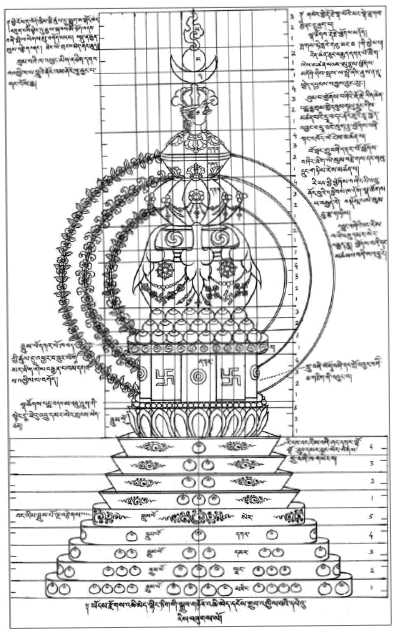
原书藏文食子图原样保留,图内藏文未转录或另译;相关说明见本章中英对照正文。
Drawing of the great Chimé Phakmé Nyingtik torma with explanations for its preparation, from the Treasury of Precious Termas.
无死圣母心髓大食子图及制作说明,出自《大宝伏藏》。
There’s a part of the Chimé Phakmé Nyingtik that I haven’t yet explained, and it’s one of the most important. I’ll explain it today; then tomorrow, you can practise it.
无死圣母心髓还有一部分我尚未解释,而它是最重要的部分之一。今天讲,明天你们就可以修。
Generally speaking, sadhana practices involve three visualizations—self-visualization, front visualization and vase visualization. Practices in the Nyingma terma tradition were written with practitioners of the highest capacity in mind which is why front and self-visualizations are practised together and only one mandala is visualized. The vase visualization was also written for the most capable practitioners, and that’s why the entire mandala of Chimé Phakmé Nyingtik is instantly visualized inside the vase. Less capable practitioners who are not at that level should follow a text that leads them step-by-step through the self-visualization of the deity, followed by the front visualization of the deity and then the vase visualization. But as Guru Rinpoche’s termas were intended for the best kind of practitioner, we meditate on the self-visualization and front visualization together. Having done so, with the recitation of a mantra the front and self-visualizations separate like one candle lighting another, and in an instant two mandalas are visualized. If you practise essentially, the vase visualization should also appear instantly. This is true for all such practices.
一般而言,成就法有三种观想:自生、对生与瓶生。宁玛伏藏传统修法,是为最高根器行者而写,因此自生与对生合修,只观一个坛城。瓶生也为最高能力者而写,所以整个无死圣母心髓坛城刹那观现于瓶内。未达此层次、能力较低者,应依循逐步引导先自生本尊、再对生、最后瓶生的法本。但莲师伏藏旨在引导最上等行者,所以自生与对生一起观修。如此修后,念一咒,自生与对生分开,如一烛点燃另一烛,刹那观现两个坛城。简要修持时,瓶生也应刹那出现。所有此类修法皆然。
If you have the “essence of immortality” which is the
若有“无死精髓”,即
torma support for this practice, you should add the deity
此修法的食子所依,应加入
generation practice called the Heart Essence of Complete
名为《圆满无死心髓》的
Immortality in order to visualize the torma as the deities.
本尊生起修法,将食子观为诸尊。
This is how the venerable master used to practise …
尊者上师过去就是这样修的……
The Heart Essence of Complete Immortality is a terma that was revealed by Chokgyur Lingpa, and when Jamyang Khyentse Wangpo who is the “venerable master” practised the Chimé Phakmé Nyingtik, he would add the generation of the deity from the Heart of Essence of Complete Immortality103 to the practice. This approach is a special feature of this teaching which means that at this point, we must meditate on the deities in the torma. So how do we do it? We recite the lines,
《圆满无死心髓》是秋吉林巴开启的伏藏。文中的“尊者上师”,即蒋扬钦哲旺波,修无死圣母心髓时,会加入《圆满无死心髓》[103]的本尊生起法。这是此教法的特殊之处,意味着此处必须观修食子中的诸尊。如何修?念以下文句:
HUNG HRIH
HUNG HRIH
Spontaneously, out of basic space, arises the great stupa of immortality …
无死大塔,从法界任运生起……
These verses tell us how to meditate on the entire mandala of deities in the torma. Right now, I don’t think anyone here is meditating on the torma as the entire mandala, apart perhaps from Chokling Rinpoche and the monks. Anyway here “basic space” means the great simplicity free from elaboration, and the great stupa of immortality arises naturally from this space to benefit sentient beings. It’s like the stupa of Ushnisha Vijaya.
这些偈颂说明如何在食子中观修整个本尊坛城。目前,我想这里除了可能秋林仁波切与僧众之外,没有人在将食子观为整个坛城。无论如何,这里的“法界”指远离繁复戏论的广大境界;无死大塔为利益众生,从此界自然生起。它如同佛顶尊胜母之塔。
… so vast it pervades the dharmadhatu, the expanse of space …
……广大遍满法界虚空……
This stupa is so vast that, like space, it fills the dharmadhatu, and that’s how you should meditate on it. It’s also like the palaces we describe when we practise the Narak Kong Shak, “without inside and outside”. This is the expanse which is as vast as the dharmadhatu itself.
这塔极其广大,如虚空般充满法界,应如此观修。也像修《Narak Kong Shak》时描述的宫殿,“无内无外”。此界与法界本身同样广大。
… in which stands the torma, made of the spontaneously present five essences.
……其中安立由任运五精华所成的食子。
Now for the shape of the torma,
现在讲食子的形状:
On the firm base, where the five mothers appear as five steps …
坚固基座上,五佛母显为五层台阶……
The “five mothers” are the five elements: space, wind, fire, water and earth. They are represented on the torma by five circular steps. The first step is blue which is space. The next step is green which appears in your visualization as a crossed vajra and represents the wind element. The wind element stands on and is supported by the empty expanse of space, the blue step. Above the crossed vajra in your visualization is a red triangle, the mandala of fire, which appears as the red step on the torma. The next step is white representing the white water mandala, and it appears in your visualization as a white disc. Above that is the yellow step, the earth mandala, which appears in your visualization as a yellow square. All these elements, the five mothers, form the “firm base” which can only be altered by the kind of fire that blazes at the end of a kalpa.
“五佛母”即空、风、火、水、地五大,在食子上表示为五层圆形台阶。第一层蓝色,是空;下一层绿色,观想中呈十字金刚杵,代表风大。风大立于空大之空界,也就是蓝层之上,由其承托。观想中,十字金刚杵上方为红三角火坛城,在食子上显为红层。下一层白色,代表白色水坛城,观想中为白圆盘。其上黄色层是地坛城,观想中为黄方形。五佛母诸大共同构成“坚固基座”,只有劫末炽火那样的火,才会使它改变。
Above these five circular steps are four square steps. The top of each square is divided into four triangles, which mark the four directions with four colours. Each colour represents the accomplishment of one of the enlightened activities of pacifying, enriching, magnetising or subjugating. In your visualization, gods and goddesses stand on these steps emanating the five kinds of sensory stimulants.
五层圆台阶上方,有四层方台阶。各方层顶面分四三角,以四色标示四方;每色代表成就息、增、怀、诛之一的觉悟事业。观想中,男女天神站在这些台阶上,化出五种妙欲。
On the firm base, where the five mothers appear as five steps,
坚固基座上,五佛母显为五层台阶,
Are self-arising bindus containing the sixteen awareness consorts,
自生明点中含十六明妃,
Who emanate offering clouds of abundant sensory delights.
化出丰盛妙欲供云。
The text about how to make this torma105 explains that eighty norbus—called “bindus” in the visualization—are placed on the circular steps to represent the eighty minor marks and that the square steps are ornamented with thirty-two norbus to represent the thirty-two major marks. Each of these spherical norbus contains hundreds of thousands of offering goddesses, the sixteen awareness-consorts described in the Nyingtik.106 Four goddesses appear on each step—one in each of the four directions—emanating cloud-like offerings of all the sensory stimulants. Above the square steps,
The lotus possessing billions of petals …
具有数十亿花瓣的莲花……
The anthers appear in yellow on the torma, above the lotus petals.
食子上,莲瓣之上以黄色表示花药。
… bears hundreds of thousands of bindus containing
……承载数十万明点,内含
cities of immortals And vidyadharas with power over life.
无死者之城与寿命自在持明者。
The bindus contain hundreds of thousands of cities of immortals filled with deities, goddesses and vidyadharas. Each city doesn’t contain just a few immortal vidyadharas, but millions and millions, all of whom have attained power over life just like Guru Rinpoche and Vimalamitra. This is what you should meditate on.
明点中有数十万无死者之城,充满男女本尊与持明者。每城不只是几个无死持明者,而是千百万,全都像莲师与无垢友一样,证得寿命自在。应当如此观修。
The natural radiance of the five families appears as the excellent mansion of complete victory,
五部自然光辉显为全胜妙宫,
Beautifully adorned with the five precious ornaments.
五种珍宝饰物美妙庄严。
Above the bindus is the excellent mansion of complete victory, the nature of which is the five buddha families. It is adorned with many precious ornaments represented on the torma by bindus, svastikas and coils of joy.
明点上方是全胜妙宫,其本性为五佛部。以许多珍宝饰物庄严,在食子上由明点、卍字与喜旋表示。
Here reside the attending four swift goddesses of longevity,
其中安住四位随侍的迅疾长寿天女,
…
……
Various deities reside in this mansion, starting with the four swift goddesses of longevity at the four doors.
各种本尊住于此宫,首先是四门的四迅疾长寿天女。
… and the goddess of power, Chandali the destroyer.
……以及具威力的毁灭母旃陀利。
Inside is the magnetising deity Chandali the destroyer, known as Mother of Life Chandali, who completely destroys all obstacles to life. She holds a long-life arrow in her right hand and an excellent vase in her left. She is inside the mansion, and so she should be visualized inside the mansion. Actualise all this in your practice. Above the mansion,
宫内是怀摄本尊毁灭母旃陀利,称为生命母旃陀利,彻底摧毁一切寿命障碍。她右手持长寿箭,左手持妙瓶。她在宫内,所以应观于宫内。修时现起这一切。宫殿上方,
The excellent vase of dharmakaya that fulfills all needs,
满足一切所需的法身妙瓶,
Adorned with bindus and the five insignia swathed with nets.
以明点及网所缠绕的五标帜庄严。
From a wish-granting tree’s foliage and blooming utpala flowers
如意树叶与盛开乌巴拉花中,
Rain down the excellent fruit of the desired accomplishments.
降下所欲成就的殊胜果实雨。
What is the significance? The vase gives us all the blessings and accomplishments, everything we need, and sensory stimulants fall like rain. Above the vase,
其意义何在?宝瓶赐予一切加持与成就、一切所需,妙欲如雨而降。宝瓶上方,
In the adorned eight-faceted wish-fulfilling jewel,
庄严的八面如意宝中,
The dagams with an opening to the sky, are Hayagriva and consort Varahi;
向天空敞开的 dagam 内,有马头明王与佛母亥母;
The crowning sun and moon ornaments blaze with wisdom fire.
顶上日月饰,智慧火炽盛。
The dagams are the eight segments that make up the eight-faceted jewel, and at the top of this jewel is a hole that opens into the sky. The deities you visualize inside the jewel are Hayagriva and Vajravarahi. And then above that,
Dagam 是组成八面宝的八个部分,宝顶有一孔,通向天空。观于宝内的本尊,是马头明王与金刚亥母。然后其上,
On the precious knot of eternity, the radiant net,
珍贵无尽结、光辉之网上,
Abide the sixteen peaceful and wrathful lords and ladies of longevity.
安住十六寂忿长寿父母尊。
The precious knot of eternity or radiant net is inside the eight-faceted jewel with sixteen peaceful and wrathful lords of life in union. The sixteen are the five buddhas in union with the five female buddhas, the five wrathful ones in union with the five wrathful female buddhas and also the six munis. Above them is a locket made from the semi-spherical sun and moon. And above that is a crossed vajra.
珍贵无尽结,或光辉之网,在八面宝内,安住十六寂忿双运寿主。十六尊是五佛与五佛母双运、五忿怒尊与五忿怒佛母双运,再加六能仁。其上是由半球形日月构成的宝盒,其上再有十字金刚杵。
Top and bottom clasped by the crossed vajra, bound by the chain of syllables,
上下以十字金刚杵夹合,咒字链缚,
The locket unites skilful means and wisdom. In its expanse
宝盒合方便与智慧,其界中,
Is the invincible, indestructible blazing vajra of the ten strengths.
无能胜、不可毁坏的十力金刚炽盛。
The upper part of the locket is the moon which represents skilful means; and the lower part is wisdom, represented by the sun. Together they represent the union of skilful means and wisdom. Half of the “indestructible blazing vajra” is inside the locket and half we can see is outside the locket above the semi-spherical moon. It has the ten strengths of a vajra which include invincibility and indestructibility.
宝盒上半是月,代表方便;下半是日,代表智慧。二者表示方便智慧双运。“不可毁坏的炽盛金刚”一半在盒内,另一半可见,在盒外、半球形月之上。它具金刚十力,包括无能胜与不可毁坏。
In the upper prongs are Oddiyana Amitayus,
上方诸股中,有乌仗那无量寿佛,
With consort Mandarava and a retinue of vidyadharas.
与佛母曼达拉娃、持明眷属。
The deities are inside the upper prongs of the vajra.
诸尊位于金刚杵上方各股之内。
In the lower prongs is the sovereign of longevity, Ushnisha Vijaya.
下方诸股中,为寿命自在主佛顶尊胜母。
In the hub, in bindus of the five essences,
中央枢纽五精华明点中,
Are the five kings and five queens of immortality
有无死五王与五后,
Manifesting in kayas arising naturally and primordially from basic space.
从法界本初自然生起而现为身。
In the middle of the vajra in the hub, visualize five spheres of light in five different colours; these are the five essences. Inside the bindus, visualize male and female buddhas of the five families who arise naturally and primordially from basic space.
金刚杵中部枢纽,观五色五光球,即五精华。明点中,观五部男女佛,从法界本初自然生起。
In the space around the torma, inside the large and small bindus,
食子四周虚空、大小明点之内,
Lamas, yidams, buddhas, bodhisattvas,
上师、本尊、诸佛、菩萨,
Dakas, dakinis, dharma protectors and swift goddesses
空行勇父、空行母、护法与迅疾天女,
All emanate rays of light and regather it.
皆放光芒而复收摄。
Any empty space left in and around the torma is filled from bottom to top with large and small bindus containing deities.
食子内部及四周一切余下空隙,自下而上,皆充满内含诸尊的大小明点。
… appear like dust motes in rays of sunlight, in a
……如日光中微尘显现,
complete mandala that pervades space …
成为遍满虚空的完整坛城……
These bindus are like motes of dust in shafts of light and pervade the whole of space—they are everywhere. All the deities emanate rays of light and regather it, which is what deities do.
这些明点如光束中的微尘,遍满整个虚空,无处不在。一切诸尊放光并收摄,这就是诸尊的事业。
… in a great mandala of these sixty thousand buddhas.
……此六万佛之大坛城。
The text says there are sixty thousand buddhas in the torma, but the number of deities isn’t limited to just sixty thousand. Actually, there are billions and billions of buddhas, of wisdom kayas, in this mandala—an inconceivable number.
法本说食子中有六万佛,但诸尊数量不限于六万。事实上,此坛城有数十亿、数十亿的佛与智慧身,数量不可思议。
In hundreds of thousands, millions, billions and so on
数十万、数百万、数十亿等等,
Of inconceivable buddha fields, appear kayas, wisdoms,
不可思议佛土中,显现诸身、智慧,
Qualities and activities, limitless, beyond measure.
功德与事业,无边无量。
The samayasattvas and jnanasattvas are primordially inseparable, …
三昧耶尊与智慧尊,本初无别……
The samayasattvas, jnanasattvas and deities inside the torma are primordially inseparable—they are one and the same.
三昧耶尊、智慧尊与食子内诸尊,本初不可分,完全是一体。
…a perfect ornament of Samantabhadra’s cloud-like offerings.
……圆满庄严普贤云状供养。
There are four ways of relating to the torma, including the torma as the deity or mandala, the torma as clouds of offerings and so on.108 Here, as described in the text, you consider this torma to be like a cloud of offerings and also the deities and so on.
对食子有四种理解方式,包括食子为本尊或坛城、食子为供云等等。[108] 这里,如法本所述,既视食子为供养云,也视为诸尊等。
Having done the self-, front and vase visualizations, you do the torma visualization. The addition of the torma visualization is a special feature of this practice. At this point actualise the visualization, recite the text and repeat the mantra. The explanation of this torma is more than fifteen pages long109 and includes a line drawing of the torma that details its proportions and is set out just like a diagram of a stupa. There are also instructions about how to fill this special torma with rolls of mantras (zung) for each of the deities we’ve mentioned.
自生、对生与瓶生观想之后,作食子观想。加入食子观想,是此修法的特征。此时现起观想,念法本并反复持咒。此食子的解释长逾十五页[109],并附食子线图,详列比例,排列方式如佛塔图。还有教授说明如何将上述各尊的咒卷(zung)装入这特殊食子。
On top of the torma is a green horse’s head, Hayagriva, to eliminate all obstacles. Above the horse’s head is the lamp of wisdom in the form of a sun and moon. The flame of wisdom blazes from the lamp of wisdom to dispel the darkness of ignorance. There’s a vertical white line on the horse’s forehead, and the middle of its forelock should be red.
食子顶上有绿色马头,即马头明王,用于遣除一切障碍。马头上方是日月形智慧灯,智慧焰从智慧灯中炽燃,驱散无明黑暗。马额上有一条竖直白线,额鬃中央应为红色。
This torma is the main practice support for the Chimé Phakmé Nyingtik and is placed on the shrine. The visualization of the deities is accompanied by the usual emanation and regathering of rays of light. On the last day of the drupchen, we receive siddhis from the supports of the enlightened body, speech, mind, qualities and activities, and the last we receive are from this torma.
此食子是无死圣母心髓的主要修法所依,安放坛上。观诸尊时,同时作通常的放光与收光。大修最后一天,我们从觉悟身、语、意、功德与事业的所依领受悉地,最后领受的就是此食子的悉地。
If I didn’t tell you this, you wouldn’t know, right? I didn’t know any of it either until someone told me. In 1980, Dilgo Khyentse Rinpoche did a six-month Chimé Phakmé Nyingtik retreat at Phuntsok Ling in Bhutan and asked me to make a Chimé Phakmé Nyingtik torma. I already knew how to make tormas and I also knew that to make a specific torma all you do is copy an example. But on that occasion, he told me which deities relate to the different parts of the torma. That’s when I received this meditation instruction from him.
若我不告诉你们,你们就不知道,对吧?我也原先一无所知,直到有人告诉我。1980年,顶果钦哲仁波切在不丹 Phuntsok Ling 作六个月无死圣母心髓闭关,请我做一个食子。我已经会做食子,也知道做某种特定食子,只须照样仿制。但那次,他告诉我食子不同部分对应哪些本尊。我就是那时从他领受此观修教授的。
The best kyerim practitioners can probably visualize one thousand buddhas in each grain of wheat used to make the torma—at least, that’s what people say. But let’s be clear about this: for myself, I really don’t know. All we can do is try our best to bring these details to mind. Meditating on them might be a bit difficult, but we can at least think about this visualization. We may not be able to actualise “hundreds of thousands, millions, billions and so on” of deities, but we can evoke a sense of them. When Dilgo Khyentse Rinpoche gave me the instruction on torma, I asked, “Can we really meditate like that?” “Yes, of course!” he replied.
最好的生起次第行者,也许能在制作食子的每粒麦子中,观出一千尊佛——至少人们这么说。但说清楚:我自己实在不知道。我们所能做的,就是尽力忆起这些细节。观修它们可能有点困难,但至少可以想一想这种观想。也许无法真正现起“数十万、数百万、数十亿等等”诸尊,但可以唤起一种感觉。顶果钦哲仁波切给我食子教授时,我问:“我们真的能这样观修吗?”他回答:“当然能!”