第九偈:“三宝”手印 Ninth Verse: ‘Three-Jewel’ Mudrā
Praise to Tāra! Whose fingers perfectly adorn your heart,
with mudrā symbolizing the three precious jewels,
adorned with a wheel of all directions,
whose radiant light, without exception, outshines all.
礼赞度母!手指圆满庄严心间,
结印象征珍贵三宝,
以遍方之轮为庄严,
灿然光明无余胜照一切。
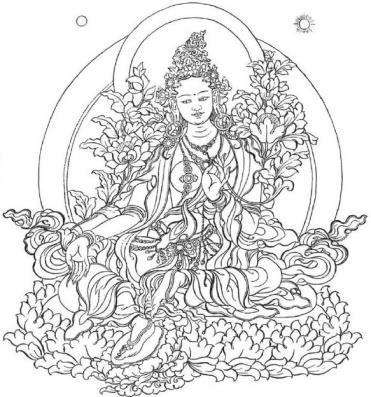
The three precious jewels are illustrated by the form of the uptala flower, which is the mudrā of Tāra’s commitment45. Whose fingers perfectly adorn your heart means cupped hand, the middle finger up and index finger joined from behind touch the top of the thumb up touching the root of the index fingers, arranged and directed towards the heart centre. If all disciples also hold this hand mudrā of commitment while doing this ritual, it bestows the blessing of the knowledge mantra goddess, as it is similar to the physical expressions of previous victorious goddesses. Adorned with a wheel of all directions means a mass of radiant, sparkling, extremely exciting light radiates out to the Buddha realms of all the ten directions; without exception, means emanates a radiant light that pervades and shines on everything. For the disciple, the mudrā invitation manifests radiant light rays from the realms of the ten directions and actual manifestation.
三宝以优钵罗花的形相表示,这就是度母的三昧耶印45。“手指圆满庄严心间”,意为手掌拢起,中指向上,食指从后方相合,触及拇指顶端,拇指向上触及食指根部,如此排列,朝向心间。若诸弟子在行此仪轨时也结此三昧耶手印,便能获得明咒女尊的加持,因为这与过去胜利女尊的身姿相似。“以遍方之轮为庄严”,意为明耀、闪烁、令人无比振奋的大团光芒,放射至十方一切佛土;“无余”意为放射周遍一切、照耀一切的光明。对于弟子,结印迎请使十方刹土的灿然光芒与真实显现得以呈现。
The hidden meaning is as follows. The example of the three precious jewels means the seminal fluids of the man, woman46and wind energy. Those three unify together, like the mudrā of the three fingers, all these three are bound at root chakra heart centre. At the navel essence drop inside the central channel, from the inner heat tummo of the primordial awareness body, radiant rays of light stream out and pervade all directions. Through the power/force of holding this dissolution, the recollection47 stage is generated.
本篇原注
45
Samayamudrā, seal of commitment. In the tantras, there are four types of mudra (Skt. catumudrā;. phyag rgya bzhi), which 'seal' the enlightened body, speech, mind and activity of the deity. The four mudrās are:
Samayamudrā,即誓约之印。在密续中,有四种印(梵语 catumudrā;phyag rgya bzhi),用以“印定”本尊觉悟的身、语、意及事业。四印是:
1. the great mudrā (mahāmudrā; phyag rgya chen po)
1. 大手印(mahāmudrā;phyag rgya chen po)
2. the dharma mudrā (dharmamudrā; chos kyi phyag rgya)
2. 法印(dharmamudrā;chos kyi phyag rgya)
3. the samaya mudrā (samayamudrā; dam tshig gi phyag rgya)
3. 三昧耶印(samayamudrā;dam tshig gi phyag rgya)
4. the activity mudrā (karmamudrā; las kyi phyag rgya)
4. 事业印(karmamudrā;las kyi phyag rgya)
46
This refers again to the red and white elements of the man and woman (khu rdul).
这再次指男女的红、白二界(khu rdul)。
47
The fifth of the six Kālacakra vajra-yogas is recollection (Anusmṛiti, rjes dran). According to Jamgon Kongtrul (HARDING 2007: 316-317]:
时轮六支金刚瑜伽的第五支是随念(Anusmṛiti,rjes dran)。据蒋贡康楚所说(HARDING 2007:316-317):
The branch of recollection is the thorough recollection of the empty-forms…. Anu is translated as “subsequent,” and smrti as “recollection” [or “remembering”]. The term anu can apply both to inferior (dman pa) and to superior (lhag pa), but in this case, it has the meaning of superior. Thus Anusmṛiti or subsequent recollection means superior recollection. Recollecting again what was previously cultivated in meditation, it is intense recollection (shin tu dran pa). It refers to the vigorous effort of meditating again and again on the empty-forms of mahāmūdrā.
随念支是对空色的彻底随念……Anu 译为“随后”,smrti 译为“忆念”[或“记忆”]。Anu 一词既可用于较低劣者(dman pa),也可用于更殊胜者(lhag pa),但此处取殊胜之义。因此,Anusmṛiti,即随后的忆念,意为殊胜的忆念。重新忆念先前禅修所培养的内容,就是强烈的忆念(shin tu dran pa)。它指的是奋力一再观修大手印的空色。
With Anusmṛiti the practitioner's body is substituted by the mahāmūdrā of empty-form. (The practitioner's body is naturally perceived as appearing as Kālacakra in union with the consort, Viśvamātā.) Through the union of male and female divine empty-forms, based on the blazing-melting of the white and red elements of the practitioner's physical body, one repeatedly cultivates and perfects the four joys in both upwards and downwards. Not only does this successively increase the experience of bliss but it also increases the experience of empty- form. Having brought the movement of the winds under control, the practitioner now starts to practise with the drops and winds and the forces that operate between them.
通过随念,修行者的身体由空色大手印所替代。(修行者自然觉察到自己的身体显现为与佛母 Viśvamātā 双运的时轮。)通过男女本尊空色的结合,以修行者肉身红白二界的炽燃与融化为基础,反复修习并圆满上下两种次第的四喜。这不仅逐步增进乐的体验,也增进空色的体验。修行者既已控制诸风的运行,现在便开始修持明点、风及二者之间作用的力量。