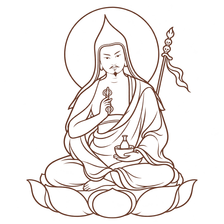
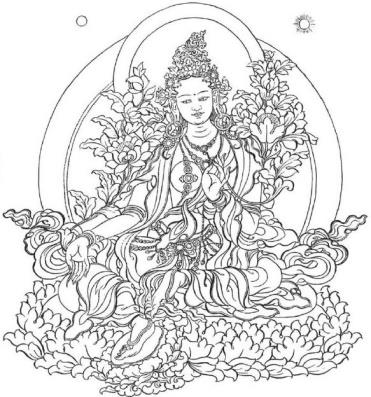
第十六偈:十字摧敌 Sixteenth Verse: Ten Syllables Destroying Enemies
Praise to Tāra! Who completely immersed in joy
totally destroys the bodies of enemies.
The saviouress arisen from the rigpa HŪṂ
from the array of sounds of the ten-syllable mantra.
礼赞度母!完全沉浸欢喜,
彻底摧毁怨敌之身。
从十字咒音的排列中,
由明觉 HŪṂ 生起救度母。
Completely immersed in joy, means the one with the mind of total joy of the meditative equipoise of a bodhisattva and accomplished vidhyadhara. The one who shatters into pieces and totally destroys the bodies of enemies who harm and do negative actions, such as the lords of those with power over other emanations and horrific evil-doers. The ten syllable mantra means: You, the goddess who arises from the arrayed mantra; rigpa means the embodiment of the blazing brilliant light lamp that arises from the rigpa mantra, letter HŪṂ. Therefore, it is taught that the ten-syllable mantra that approaches the HŪṂ seed syllable is that of wrathful Tāra.
“完全沉浸欢喜”,意为其心具有菩萨与成就持明平等安住的圆满欢喜。她将伤害、作恶的怨敌之身摧毁殆尽,碎为片片,如自在于他人化现者之主与恐怖的作恶者。“十字咒”意为:您这从排列之咒中生起的女尊;“明觉”意为从明觉咒HŪṂ字生起的炽耀明灯之体现。因此,教说接近HŪṂ种子字的十字咒,属于忿怒度母。
The ultimate meaning is as follows: the brilliant light of the mahāmudrā empty-form is the unchanging bliss of being completely immersed in joy. Bodies of enemies means defeating those forms whose appearances are impure. This is the stage of meditative stability64. The ten-syllables means the ten signs of attainment65 that come from halting parts of the ten chakras in the left and right [channels].
本篇原注
64
Meditative stability (bsam rten), is the second of the six Vajra-yogas. Tāranātha says:
禅定(bsam rten)是六支金刚瑜伽的第二支。多罗那他说:
The term dhyana has the meaning of holding the mind unwaveringly on the object (focus of attention). That also means to take control of the point of reference, such as when a door bolt that is well secured prevents the door frame from shifting or warping, allowing one to control opening and closing the door, the meaning is that one has control over the focus of attention.
dhyana 一词意为令心毫不动摇地安住于对境(注意的焦点)。它也意味着掌控所缘,就像牢固的门闩能够防止门框移位或扭曲,使人能够控制门的开合;其含义是能够掌控注意的焦点。
It states in the Vimalaprabha: "The mental focus is on various forms with the ten subjects and objects as one." This means to have the mind focused one-pointedly on the radiant light, empty-forms possessing the totality of possibilities, while having control over (the mind) being at rest or active, as one wishes. The meaning here is similar to the explanations in other vehicles, of one=pointed focus of attention.
《无垢光》中说:“心专注于种种形色,十种能取与所取成为一体。”这意味着心一境性地专注于具有一切可能性的光明空色,同时能够随意掌控(心)的安住或活动。此处的含义,与其他乘所解释的一境专注相近。
Kongtrul says (2007:303):
康楚说(2007:303):
This means resting in equipoise with one-pointed mental focus on the luminous clarity of images of emptiness endowed with the supreme of all aspects, allowing one to attain control of abiding and moving [of thought] as desired.
这意味着以一境专注,平等安住于具足一切胜妙相的空色影像之光明,使人能够随意掌控[心念的]安住与活动。
65
The ‘ten signs' are explained clearly in Systems of Buddhist Tantra by Jamgon Kongtrul: p 437-438, n. 21:
蒋贡康楚在《佛教密续体系》中清楚解释了“十相”:第437—438页,注21:
The ten signs (rtags bcu), specifically related to the sixfold yoga of the Kalachakra tantra, are empty images (stong gzugs) to be meditated upon for the actualization of the vajra body. These empty images are not produced by thoughts and are extremely clear. They are the manifestation of pristine awareness, free from subject-object dualism. They resemble space in that they are devoid of mental constructs, beyond existent and non-existent phenomena. They are the luminous clarity nature of one’s own mind and also the totality of the dimensions of awakening. Empty images manifest in infinite ways but are explained to be ten in number when considered in terms of their special importance and what they purify. The ten signs pertain to the yoga of the day (nyi mo’i rnal ’byor) and the yoga of the night (mtshan mo’I rnal ’byor). The four signs of the yoga of the night are smoke (du ba); mirage (smig rgyu); light in the sky (mkha’i snang) resembling fireflies; and blazing lamp (sgron me ’bar ba). The six signs of the yoga of the day are flame (me) (blazing yellow light); moon (zla ba) (blazing white light); sun (nyi ma) (blazing red light); Rahu (sgra gcan) (blazing black light); lightning (klog); and great sphere (thig le chen po) (an azure moon globe). After the appearance of these, in the center of the tenth sign, the great sphere, the yogin sees the image of Kalachakra and, simultaneously and instantaneously, the manifold images of the universe, as clear as water in one’s hand. These are called “signs” because they indicate the presence within oneself of ultimate pristine awareness and because they constitute the basis for the confidence that by experientially cultivating the path, one will be able to actualize pristine awareness. See Tāranātha’s Meaningful to Behold; CSI, f. 25a1-7.
十相(rtags bcu)特别与时轮密续的六支瑜伽相关,是为成就金刚身而应观修的空色影像(stong gzugs)。这些空色影像并非由分别念产生,而是极其清晰。它们是远离能取、所取二元分别之本初智的显现。它们如同虚空,没有心的造作,超越存在与不存在的诸法。它们是自心的光明本性,也是觉悟一切层面的总和。空色影像以无量方式显现;但若从其特殊的重要性以及所净化的对象来看,则解释为十种。十相属于昼瑜伽(nyi mo’i rnal ’byor)与夜瑜伽(mtshan mo’I rnal ’byor)。夜瑜伽的四相是烟(du ba)、阳焰(smig rgyu)、如萤火虫般的空中光(mkha’i snang),以及炽燃灯(sgron me ’bar ba)。昼瑜伽的六相是火焰(me)(炽耀黄光)、月(zla ba)(炽耀白光)、日(nyi ma)(炽耀红光)、罗睺(sgra gcan)(炽耀黑光)、闪电(klog)及大明点(thig le chen po)(蔚蓝色月轮)。这些显现之后,瑜伽士在第十相大明点的中心见到时轮的形象,并同时、刹那之间见到宇宙的万般形象,如掌中之水一般清晰。它们称为“相”,因为它们表明自身之内存在究竟本初智,并成为生起信心的依据:通过亲身修习道,便能现证本初智。参见多罗那他的《见即有益》;CSI,叶25a1—7。