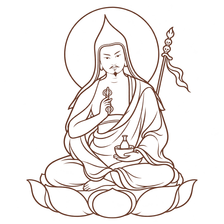
Barché Lamsel, The Prayer Which Removes All Obstacles from the Path
Rinpoche taught on the famous prayer to Guru Rinpoche called Barché Lamsel, The Prayer Which Removes All Obstacles from the Path, at the request of Rigpa London. He taught in two sessions, one in the morning and one in the afternoon of October 1st, 2023
应伦敦本觉会的祈请,仁波切讲解了著名的莲花生大师祈请文《遣除道障祈请文》。开示于2023年10月1日分两座进行,上午、下午各一座。
I’d like to begin by offering my tashi delek to you all. I’ve been requested to teach on the Barché Lamsel. I was told that since many of you recite this prayer often, you would find it helpful to know a little more about it. There are many different prayers to supplicate Guru Rinpoche and the Barché Lamsel is one of the most important.
首先,向大家道一声扎西德勒。有人请我讲解《遣除道障祈请文》。他们告诉我,你们许多人经常念诵这篇祈请文,因此多了解一些会很有帮助。祈请莲花生大师的祈请文有许多种,而《遣除道障祈请文》是其中最重要的几篇之一。
Concerning Guru Rinpoche, in brief, he is the embodiment of the wisdom, love, power, qualities and activities of all the buddhas of the three times. His compassion and aspirations are said to be exceptionally powerful, especially during the times when the five degenerations are rampant. “Exceptionally powerful” means that his compassion and sacred pledges are swifter, more limitless and more powerful than any other enlightened being. That’s the kind of lama we are talking about here.
简而言之,莲花生大师是三世一切诸佛智慧、慈爱、威力、功德与事业的总集。据说,他的慈悲与愿力格外强大,尤其是在五浊炽盛的时代。“格外强大”,是说他的慈悲与誓愿,比任何其他觉者都更迅速、更无量、更有力。我们这里所谈的,就是这样一位上师。
Jamyang Khyentse Wangpo says in the Lamrim Yeshe Nyingpo that the embodiment of the compassion of all the buddhas is Avalokiteshvara, the embodiment of the wisdom of all the buddhas is Manjushri, while the embodiment of the power and capacity of all the buddhas is Vajrapani. Likewise, Guru Rinpoche is the embodiment of the enlightened activities of all the buddhas—not of one, or a hundred, or a thousand different buddhas, but every buddha in all the infinite buddha fields in the ten directions and four times, more numerous than the grains of sand in the river Ganges. He is therefore, as Jamyang Khyentse wrote, one and the same as the protectors of the three families, Avalokiteshvara, Manjushri and Vajrapani.
蒋扬钦哲旺波在《道次第智慧藏》中说,一切诸佛慈悲的总集是观世音,一切诸佛智慧的总集是文殊,而一切诸佛力量与能力的总集是金刚手。同样,莲花生大师是一切诸佛觉悟事业的总集——不是一尊、一百尊或一千尊佛,而是十方四时、无量佛土中超过恒河沙数的一切诸佛。因此,正如蒋扬钦哲所写,他与三部怙主观世音、文殊、金刚手无二无别。
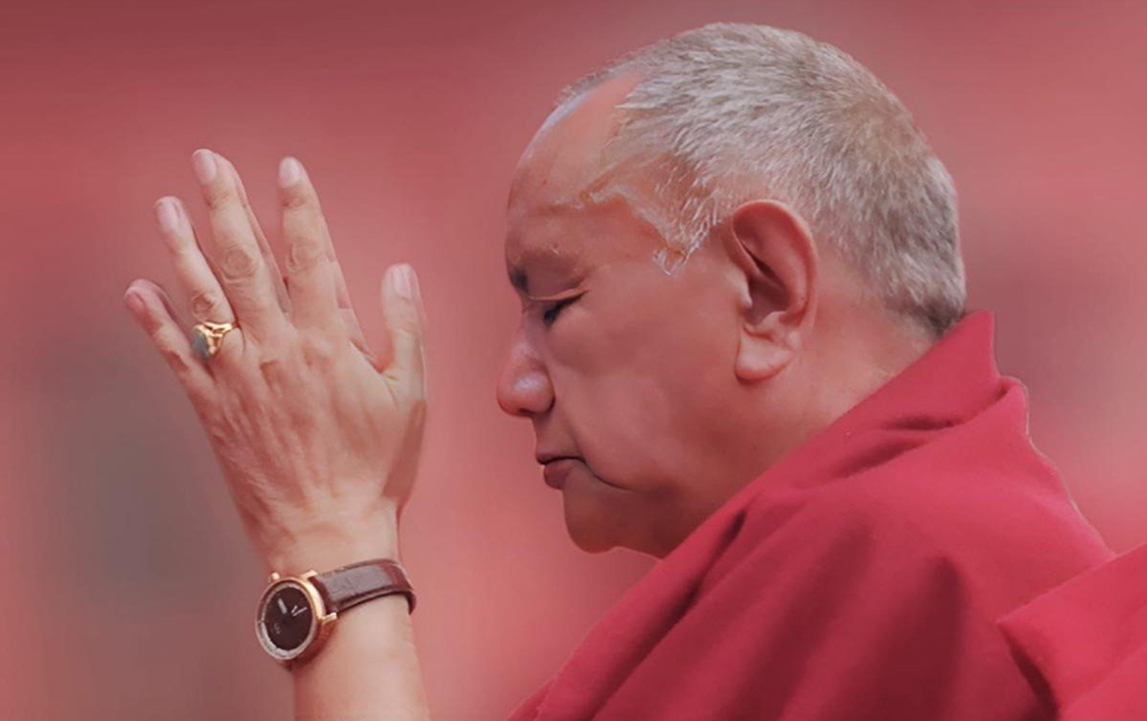
It is almost impossible for us to conceive or imagine everything that Guru Rinpoche achieved and accomplished. It is said that in a billion different universes there are a billion different Guru Rinpoches that appear to sentient beings in an infinite number of ways. Even in this limited world of ours, Guru Rinpoche is said to have manifested in countless different ways and performed innumerable activities in harmony with the perception of beings. In order to help people think of him, Guru Rinpoche also said: “For the sake of future people with pure samaya, I wrote and concealed ten thousand nine hundred biographies.” [1]
莲花生大师所成办的一切,我们几乎无法思议或想象。据说,在十亿个不同宇宙中,有十亿位不同的莲花生大师,以无量方式向众生显现。即使在我们这个有限的世界中,据说莲花生大师也曾随顺众生所见,显现无数形相,成办无数事业。为了让人们忆念他,莲花生大师还说:“为了未来守持清净三昧耶之人,我撰写并埋藏了一万零九百部传记。”[1]
Amongst all those different activities for the sake of sentient beings, he appeared to take birth. The protector Infinite Light (Amitabha) is the natural, self-appearance of the wisdom of all the buddhas. As he was residing in his buddha field of Sukhavati, to train and tame the difficult sentient beings of this world, he emanated from his heart a red seed syllable HRIH that fell on a blooming lotus flower on the south-western milky lake of Dhanakosha in the land of Oddiyana and from this Guru Rinpoche was miraculously born. This is the generally accepted account of how Guru Rinpoche appeared in our world. Our teacher, the perfectly enlightened Buddha Shakyamuni, prophesized that in the future, after his parinirvana, an enlightened being would appear who was even greater than himself, who would propagate the Secret Mantrayana teachings very widely and thereby benefit sentient beings on a vast scale. There are many different types of being: beings who have a physical form, like humans and nagas, but also beings who don’t possess a physical form, like gods, spirits and earth lords of different types. The Buddha Shakyamuni was able to tame sentient beings who had a physical body, however to tame the eight different classes of gods and spirits, a different type of manifestation was needed, one that was not tainted by birth from a womb. And so the second buddha, Padmakara, miraculously appeared.
在这些利益众生的种种事业中,他示现了诞生。怙主无量光佛阿弥陀佛,是一切诸佛智慧自然的自显。他安住于极乐佛土时,为了教化、调伏这个世界难以调伏的众生,从心间化现一个红色种子字HRIH,落在邬金国西南方达那郭夏乳海中一朵盛开的莲花上,莲花生大师便由此化生。这是普遍公认的莲花生大师来到我们世界的经过。我们的导师、圆满觉悟的释迦牟尼佛曾授记:未来,在他般涅槃之后,会出现一位比他更伟大的觉者,广弘秘密真言乘教法,由此广大利益众生。众生有许多类别:有人、龙等具有色身的众生,也有天、鬼神、各种地祇等不具色身的众生。释迦牟尼佛能够调伏具有色身的众生;然而,要调伏八部天神鬼众,就需要另一种没有胎生染污的化现。因此,第二佛莲花生便化生显现。
After Guru Rinpoche’s miraculous birth on the south-western lake of Dhanakosha, King Indrabodhi anointed Guru Rinpoche as his heir and offered him his kingdom. At first, Guru Rinpoche presided over the land of Oddiyana as a prince but then left to practice in the eight great charnel grounds until he reached the vidyadhara levels of attainment. In any case, in India, Oddiyana, Dramida, Zahor and so on, he was able to benefit sentient beings on a vast, inconceivable scale—greater even than the Buddha.
莲花生大师在西南达那郭夏海化生之后,因陀罗菩提王立他为继承人,把王国献给了他。起初,莲花生大师以王子的身份统治邬金国,后来离去,在八大尸陀林修行,直到证得持明成就果位。总之,在印度、邬金、达米达、萨霍尔等地,他以广大不可思议的规模利益众生,甚至超过了佛陀。
Guru Rinpoche travelled from India to Nepal and whilst there, received an invitation from King Trisong Deutsen to visit Tibet. It was in Tibet that his enlightened activities for the benefit of sentient beings reached unparalleled heights; it is impossible for our limited minds to fully fathom the depth and scope of all that he accomplished there. It is said that Guru Rinpoche stayed in Tibet for 120 years, however some people argue that this means 60 years since an ancient Indian custom counts one year as being equal to six months. His arrival in Tibet, the places that he visited, and the various activities that he performed, are all well documented in his biographies.
莲花生大师从印度来到尼泊尔,在那里接受赤松德赞王的邀请前往西藏。正是在西藏,他利益众生的觉悟事业达到了无与伦比的高度;以我们有限的心智,不可能完全领会他在那里所成办事业的深度与广度。据说,莲花生大师在西藏住了一百二十年。不过,有些人认为这指的是六十年,因为印度古时有以六个月计为一年的习惯。他抵达西藏、到访各地及成办种种事业的情形,在他的传记中都有详尽记载。
Guru Rinpoche is the embodiment of all sources of refuge and the manifestation of the wisdom, love and power of all the buddhas—we should therefore recite his prayers and supplicate him as much as we can. How should we do that? Firstly, by reading his life story and learning of his extraordinary qualities, we can develop faith and trust in him. Based on that faith and trust, a genuine and heartfelt devotion can be borne in our minds. It is with that kind of devotion that we should then invoke Guru Rinpoche through our prayers.
莲花生大师是一切皈依处的总集,是一切诸佛智慧、慈爱与威力的化现,因此我们应当尽力念诵他的祈请文,向他祈请。应当怎样做呢?首先,阅读他的生平,了解他的非凡功德,就能对他生起信心与信赖。在这种信心与信赖的基础上,心中便能生起真切、发自内心的虔敬。我们应当以这样的虔敬心,通过祈请文呼唤莲花生大师。
Guru Rinpoche said that if you pray to him, his compassion will come to you more swiftly than any other buddha, and his blessings will be more powerful. The reason for this is because of the vast power and strength of his aspirations.
莲花生大师说,如果向他祈请,他的慈悲会比任何其他佛更迅速地来到你身边,他的加持也更为强大。这是因为他的愿力具有广大的力量。
It goes without saying that Buddha Shakyamuni, the fourth buddha of this Fortunate Age, is the source of the teachings that we follow. After him, Manjushri, Avalokiteshvara, Vajrapani and Arya Tara are amongst the best known buddhas of the Mahayana tradition. When Guru Rinpoche went to Tibet, however, he taught not only the Mahayana teachings, but also Vajrayana and Dzogchen.
不言而喻,贤劫第四尊佛释迦牟尼佛,是我们所奉行教法的源头。其后,文殊、观世音、金刚手与圣度母,是大乘传统中最为人熟知的诸佛之一。然而,莲花生大师到西藏时,不仅传授大乘教法,也传授金刚乘与大圆满。
Guru Rinpoche didn’t, in fact, only travel to Tibet—there are many other places that he visited, where he turned the wheel of dharma and performed countless miracles. Though accounts of those travels must surely have been recorded, they don’t seem to have survived today. With the passage of time and multiple changes that have happened in those different lands, those records seem to have been lost.
事实上,莲花生大师并非只去过西藏;他还到访过许多其他地方,在那里转法轮、示现无数神变。这些行旅必定也曾有人记录,但那些记载似乎没有流传到今天。随着时光流逝,以及各地发生的多番变迁,那些记录似乎已经散失了。
In Tibet, on the other hand, every place that Guru Rinpoche visited and everything that he accomplished there was faithfully recorded and has been preserved until today. Records survive of the different places that he blessed and what took place there, right up to detailed descriptions of the valleys or mountains where he stayed.
但在西藏,莲花生大师到访的每个地方、成办的每项事业,都被忠实记录并保存至今。他所加持的各处、那里发生的事情,甚至他所住过的山谷或山峦的详细描述,至今都有记载流传。
There are many different prayers to invoke Guru Rinpoche. The one that captures their profound essence in a few words and is a very special pith instruction, is the Seven-line Prayer. More than one hundred great tertöns have appeared in Tibet and you will find this prayer in each one of their revelations. Hence it is known as the king of prayers.
祈请莲花生大师的祈请文有许多种。其中以寥寥数语摄集甚深精要、极为殊胜的口诀,就是《七句祈请文》。西藏曾出现一百多位大伏藏师,每位伏藏师的伏藏中都有这篇祈请文,因此它被称为祈请文之王。
Besides the Seven-line Prayer, the two most famous other prayers to Guru Rinpoche are the Barché Lamsel and Sampa Lhundrupma. These prayers were taught by Guru Rinpoche himself—they are his vajra words and carry all his blessings.
除了《七句祈请文》,另外两篇最著名的莲花生大师祈请文,就是《遣除道障祈请文》与《愿望任运成就祈请文》。它们由莲花生大师亲口宣说,是他的金刚语,具足他的一切加持。
So today, our focus is the Barché Lamsel prayer.
因此,今天我们着重讲《遣除道障祈请文》。
历史背景简述 Short Background History
The main disciples of Guru Rinpoche—King Trisong Deutsen, his son, Prince Murub Tsepo, Nupchen Sangye Yeshe, Gyalwa Chokyang, Vairotsana, Yeshe Tsogyal and so on—gathered in the Blazing Turquoise Shrine on the middle floor of Samye temple (Samye has three storeys and several shrines on the second floor). In that shrine room, they offered a large tsok as well as a mandala adorned with all the precious stones and metals that they owned. They then asked Guru Rinpoche:
莲花生大师的主要弟子——赤松德赞王及其子牟如赞普王子、努钦桑吉益西、嘉瓦确扬、毗卢遮那、益西措嘉等——齐聚桑耶寺中层的炽燃绿松石殿。桑耶寺有三层,第二层有数座殿堂。他们在殿中献上广大的荟供,以及用自己所有珍贵宝石、金属庄严的曼荼罗。随后,他们向莲花生大师请问:
“You said that in the future, genuine practitioners of the sacred dharma would face many obstacles on their path. Please can you teach us what all true dharma practitioners need to do to dispel those obstacles?”
“您曾说,未来真正修持正法的人,在修道途中会遇到许多障碍。请您教导,所有真正的修行人,应当怎样遣除这些障碍?”
With immense love and compassion, Guru Rinpoche replied:
莲花生大师以无比慈爱与悲心回答:
“It is excellent that you have made this request. Genuine practitioners of the dharma will indeed face many obstacles on their path. Despite this, there are ways that these obstacles can be removed completely. Once all obstacles have been removed, the supreme accomplishment, enlightenment, is achieved. There is no higher teaching I can give to you for removing those obstacles than praying to the lama, which is the supreme method. It is vital.”
“你们提出这样的请求,非常好。真正修持佛法的人,在道上确实会遇到许多障碍。尽管如此,仍有办法彻底遣除这些障碍。一切障碍遣除后,便能获得最殊胜的成就——觉悟。若要遣除这些障碍,我能给你们的教导,没有比祈请上师更殊胜的了,这是最殊胜的方法,极其重要。”
His students then replied:
弟子们接着说道:
“The master who has visited us in Tibet, the Land of Snows, is you, Guru Rinpoche. You have come here and shared many teachings and empowerments with us. We have reflected very carefully and think that there has never been in the past, nor is there now in the present, nor will there ever be in the future, a master greater than you. So, we humbly request that you share with us a prayer that is short in words, profound in meaning and full of blessings, through which we can invoke you.”
“来到雪域西藏看顾我们的上师,就是您莲花生大师。您来到这里,传授了许多教法与灌顶。我们仔细思量,认为过去不曾有,现在没有,未来也不会有比您更伟大的上师。因此,恳请您赐予一篇文字简短、义理甚深、加持充满的祈请文,让我们能够藉此呼唤您。”
Guru Rinpoche replied:
莲花生大师回答:
“The fact that you recognize this and have made such a request is truly excellent. I, Guru Rinpoche, am the embodiment of the wisdom, love and power of all the buddhas of the three times and the embodiment of the enlightened activities of all the victorious ones. If you pray to me, all your obstacles will be removed. Unless you supplicate the compassionate object of your prayers with genuine faith and devotion, the sun of blessings will never shine. Therefore, praying to the guru is extremely important.”
“你们能认识到这一点,并作这样的祈请,实在非常好。我莲花生,是三世一切诸佛智慧、慈爱与威力的总集,是一切胜者觉悟事业的总集。若向我祈请,你们的一切障碍都会遣除。若不以真切的信心与虔敬,向慈悲的祈请对境祈请,加持的太阳便永远不会照耀。因此,祈请上师极为重要。”
As for the words of the prayer, Guru Rinpoche touched his forehead to the forehead of King Trisong Deutsen, placed his right hand on the head of Prince Murub Tsepo, his left hand on the head of Yeshe Tsogyal, and recited the Barché Lamsel prayer to them with his vajra speech, the natural resounding of the dharmata. He concluded by saying, “Pray to me with these words.”
宣说祈请文时,莲花生大师以自己的额头抵住赤松德赞王的额头,右手置于牟如赞普王子头上,左手置于益西措嘉头上,以法性自然声的金刚语,为他们念诵《遣除道障祈请文》。最后他说:“用这些词句向我祈请。”
This prayer was later revealed as a terma by tertön Bakal Mukpo. You will find his revelation in the Rinchen Terdzö (Treasury of Termas). This terma of Bakal Mukpo is almost identical to the one later revealed by Chogyur Lingpa. There are a few extra lines in Chogyur Lingpa’s terma, but apart from that, they are the same.
后来,伏藏师巴卡穆波将这篇祈请文作为伏藏取出。他的伏藏可见于《大宝伏藏》。巴卡穆波的这一伏藏,与后来秋吉林巴取出的伏藏几乎完全相同。秋吉林巴的伏藏多了几句,除此之外,两者相同。
After having received the Barché Lamsel prayer from Guru Rinpoche, his disciples again offered a vast tsok offering and supplicated him a further time, requesting that he teach them the sadhana and activities related to it.
弟子们从莲花生大师处领受《遣除道障祈请文》之后,再次献上广大的荟供,又一次祈请他传授与此相关的成就法及事业。
Guru Rinpoche then transmitted to them his words, the natural resounding of the vajra dharmata, in the form of the entire Shyaldam Nyingjang (The Quintessential Manual of Oral Instructions), the root text of the Tukdrup Barché Kunsel cycle, inclusive of all its branch activities and related instructions.
于是,莲花生大师把金刚法性自然声的语教,以整部《口授精要手册》的形式传给他们。这是《上师意修·一切障碍遍除》法系的根本文,包含一切支分事业和相关教言。
What does it contain? The main practice is the sadhana of Tukdrup Barché Kunsel which centres on Guru Rinpoche in the form of Nangsi Zilnön (The Master Prevailing Over All that Appears and Exists). Above his head is the sambhogakaya Avalokiteshvara, the four-armed tamer of beings, and above his head, the dharmakaya Amitayus. They are the three kayas of the lama, who are “visualized in the manner of tiers” since they appear one above the other.[3] Surrounding Guru Rinpoche are his four main emanations, beginning with Gyalwé Dungdzin, standing on top of a four-petalled lotus. His eight secondary emanations also surround him, standing on top of an eight-faceted jewel. At the four gates, in each of the four directions, are the four gings who guard the gates of the mandala. Guru Rinpoche manifested this mandala in the sky before them so they could see it clearly for themselves. Finally, he dissolved the deities of the mandala back into his body.
其中包含什么?主要修法是《上师意修·一切障碍遍除》成就法,以莲花生大师的囊夕色农——威伏一切显有的上师——为主尊。他的头顶上是报身观世音、四臂调伏众生者;观世音头顶上则是法身无量寿佛。他们是上师的三身,因上下相叠而现,故称“以层叠方式观想”。[3]莲花生大师周围,站在四瓣莲花上的是以嘉威东津为首的四大主要化身;另有八位次要化身环绕,站在八面宝珠之上。在四方的四门,有四位守护坛城门户的金刚力士。莲花生大师在众人面前的空中显现这一坛城,使他们亲自看得清清楚楚。最后,他将坛城诸尊收摄回自己身中。
The root text of this terma teaching is called the Shaldam Nyingjang (The Quintessential Manual of Oral Instructions) which still exists today. The heart essence of all the instructions contained in that manual is the Barché Lamsel prayer.
这一伏藏教法的根本文名为《口授精要手册》,至今仍存。其中一切教言的心髓,就是《遣除道障祈请文》。
Guru Rinpoche’s disciples then asked:
莲花生大师的弟子随后问道:
“Should we practice these teachings now or is it better for us to conceal them as a terma, for the benefit of future generations?”
“我们应当现在修持这些教法,还是将它们埋藏为伏藏,以利益后世的人更好?”
Guru Rinpoche replied:
莲花生大师回答:
“There’s no need for you to spread these teachings now since I am still present amongst you and the times are still favourable. You should practice them for yourselves, but otherwise hide them as a terma.”
“现在不必弘扬这些教法,因为我仍住在你们中间,时机也仍然有利。你们自己应当修持,除此之外,就将它们埋藏为伏藏。”
The teachings were then concealed as terma by Khandro Yeshe Tsogyal at a place called Khala Rongo and two other locations following Guru Rinpoche’s exact instructions recorded in the terma text. Tashi Tseringma was requested to serve as guardian of the terma. Guru Rinpoche prophesized that in the future, the reincarnation of Prince Murub Tsepo would reveal this terma at the appropriate time. This reincarnation was none other than Chogyur Lingpa.
之后,空行母益西措嘉完全依照伏藏文中记载的莲花生大师指示,将这些教法作为伏藏,埋藏在卡拉荣果和另外两处地方,并请扎西次仁玛担任伏藏护法。莲花生大师授记,未来牟如赞普王子的转世,会在适当的时机取出这一伏藏。这个转世不是别人,正是秋吉林巴。
When Chogyur Lingpa was 20 years old, he revealed the yellow scroll for this special volume of the terma at Danyi Khala Rongo. He kept the terma secret for eight years until, together with Jamyang Khyentse Wangpo, he wrote down the yellow scroll contents at Dzongsar Tashi Lhatsé.
秋吉林巴二十岁时,在达尼卡拉荣果取出了这一特殊伏藏法函的黄卷。他将伏藏保密八年,之后才与蒋扬钦哲旺波一起,在宗萨扎西拉孜把黄卷内容写下。
The first recipients of the teaching were Jamyang Khyentse Wangpo who was the incarnation of King Trisong Deutsen, and Jamgön Kongtrul who was the emanation of Vairochana. They ensured that these teachings then spread widely throughout Tibet. Until today, these teachings remain very well-known and popular. I think it has been roughly 170 years since that time.
最先领受此法的,是赤松德赞王的转世蒋扬钦哲旺波,以及毗卢遮那的化身蒋贡康楚。他们使这些教法随后广传西藏。直到今天,这些教法仍然非常知名,广受奉行。我想,距离那时大约已有一百七十年。
概要 Summary
The prayer itself has many levels of meaning. On an outer level, it is a prayer to supplicate the three kayas of the guru; on an inner level it relates to the channels, inner air and energies; and on a secret level, it relates to the Dzogchen practices of trekchö (primordial purity of cutting through) and lhundrup tögal (direct approach of spontaneous presence). All these levels of practice are spoken of in the Quintessential Manual of Oral Instructions.
祈请文本身有许多层次的意义。外层面上,它是向上师三身祈请的祈请文;内层面上,它与脉、内风及能量有关;密层面上,它与大圆满的彻却——本初清净的直断——以及任运顿超——任运现前的直接趣入——修法有关。《口授精要手册》讲到了所有这些层次的修行。
The prayer itself refers to the main activities Guru Rinpoche performed while he was in Tibet; we remember Guru Rinpoche by recollecting those acts and invoke him to receive his blessings and siddhis in the form of the pacification of all our outer, inner and secret obstacles.
祈请文本身提及莲花生大师在西藏所成办的主要事业。我们藉由忆念这些事迹来忆念莲花生大师,祈请他赐予加持与悉地,令我们一切外、内、密障碍平息。
Of all practices, praying to the guru is the most important.
在一切修法中,祈请上师最为重要。
Unless you’ve received the empowerment, however, it’s a little difficult for me to share a commentary of this prayer with you. Generally speaking, it’s fine to give instructions on a prayer without empowerment, however with the Barché Lamsel it’s different because of the individual levels of meaning—outer, inner and secret. Most of you are probably unaware of what this even means. When you pray to a particular deity, it helps pacify all your outer, inner and secret obstacles, but to explain how that works in detail is quite complicated because you need to have received the empowerment. Nonetheless, I will do my best to explain it to you today. We will begin by first reciting the prayer three times.
不过,除非你们已领受灌顶,否则我为你们讲解这篇祈请文会有些困难。一般说来,没有灌顶也可以讲授祈请文的教言;但《遣除道障祈请文》有所不同,因为它具有外、内、密的各层意义。你们大多数人可能连这是什么意思都不清楚。向某一本尊祈请,有助于平息一切外、内、密障碍;但要详细解释其作用,就相当复杂,因为你们需要领受过灌顶。尽管如此,今天我仍会尽力为你们解释。首先,我们一起把祈请文念诵三遍。
传承 The Lineage
In general, the Nyingma tradition distinguishes two sets of teachings: the kama and terma. Compared to the kama teachings, which are transmitted from one master to another in a continuous lineage, beginning with the Buddha, the terma teachings are said to carry even greater blessings since the lineage of transmission is far shorter. It is extremely important to know and pay attention to the lineage of a particular teaching, otherwise you will be unable to authenticate it and trace it back to a valid source.
The lineage of transmission of the Nyingmapas comprises the mind-direct transmission of the victorious ones, the sign transmission of the vidyadharas and the aural transmission of realized beings. In addition, we speak of the transmission of compassionate blessings, the lineage of prophetically declared succession, the dakini’s seal of entrustment, the lineage empowered by aspiration, the word lineage of yellow scroll, and the lineage of samaya substances that liberate upon taste. In total, there are nine different lineages of transmission that need to be included when you talk about the Nyingma tradition.
宁玛派的传承包括胜者密意传、持明表示传及成就者耳传。此外,还讲到慈悲加持传承、授记继承传承、空行付嘱印传承、愿力灌顶传承、黄卷文字传承,以及尝即解脱的三昧耶物传承。总共九种传承,谈论宁玛传统时都需要包括在内。
With respect to termas, there are several different kinds: earth termas, mind termas, rediscovered termas, recollection termas, pure visions and so on. The type of transmission through which the Barché Lamsel has been passed down is that of the word lineage of yellow scroll.
伏藏又有数种不同类型:地伏藏、意伏藏、重取伏藏、忆念伏藏、净相等等。《遣除道障祈请文》所依的传承方式,是黄卷文字传承。
As I said earlier, the terma of Barché Lamsel discovered by Bakal Mukpo can be found in the Treasury of Termas (Rinchen Terdzö); its lineage of transmission has been preserved in that way. There’s no empowerment associated with the terma, just a reading transmission of the prayer, which has been passed down until today.
如前所说,巴卡穆波取出的《遣除道障祈请文》伏藏,可见于《大宝伏藏》,它的传承便是这样保存下来的。这个伏藏没有相应的灌顶,只有祈请文的读诵口传,一直传承至今。
Here, however, we are following the transmission lineage of Chogyur Dechen Lingpa’s terma of the Tukdrup Barché Kunsel cycle, which contains the Barché Lamsel. Chogyur Lingpa was able to decipher the symbolic script of the yellow scroll and dictated its contents to Jamyang Khyentse Wangpo, who faithfully wrote down this short prayer. This lineage of transmission, therefore, traces back to the words of the yellow scroll.
而我们这里遵循的,是秋吉德钦林巴《上师意修·一切障碍遍除》伏藏法系的传承,其中包含《遣除道障祈请文》。秋吉林巴能够解读黄卷中的符号文字,并将内容口述给蒋扬钦哲旺波,由他忠实写下这篇简短祈请文。因此,这一传承可以追溯到黄卷的文字。
Chogyur Lingpa first transmitted this teaching to Jamgön Kongtrul who then passed it on to the other masters who are now considered the ten major holders of the transmission lineage of the Tukdrup Barché Kunsel. Those ten masters belonged, in fact, to different schools of Tibetan Buddhism, and it was from them that the prayer spread more widely.
秋吉林巴最先把这个教法传给蒋贡康楚,后者再传给其他上师,也就是如今所称《上师意修·一切障碍遍除》传承的十大持有者。事实上,这十位上师属于藏传佛教的不同宗派,祈请文便由他们进一步广传。
In recent times, the greatest masters to have passed on the transmission of this cycle are Jamyang Khyentse Chökyi Lodrö and Dilgo Khyentse Rinpoche. When Jamyang Khyentse Chökyi Lodrö gave this transmission to Tarthang Tulku he told him, “If you say this prayer every day, you will not face any obstacles on that day.” Dilgo Khyentse Rinpoche used to say exactly the same. I have received this transmission many times from Dilgo Khyentse Rinpoche and I received it from Jamyang Khyentse Chökyi Lodrö too. This, then, covers the lineage of the prayer. There is no dharma without lineage.
近代传授这一法系的最伟大上师,是蒋扬钦哲确吉罗卓和顶果钦哲仁波切。蒋扬钦哲确吉罗卓把这一传承赐予塔唐祖古时,对他说:“如果你每天念诵这篇祈请文,那一天便不会遭遇任何障碍。”顶果钦哲仁波切也常说完全相同的话。我曾多次从顶果钦哲仁波切处领受这一传承,也从蒋扬钦哲确吉罗卓处领受过。以上就是祈请文的传承。没有传承,就没有佛法。
The Barché Lamsel prayer is part of the Tukdrup Barché Kunsel cycle; it was extracted from The Quintessential Manual of Oral Instructions so that we can easily practice the prayer every day. Those of us who are unable to practice the sadhana every day, whether the long, medium or short one, can at least find time to recite this prayer, right?
《遣除道障祈请文》属于《上师意修·一切障碍遍除》法系,从《口授精要手册》中摘出,使我们每天都容易修持。无论广轨、中轨还是略轨,若我们无法每天修持成就法,至少总能找出时间念一念这篇祈请文,对不对?
《遣除道障祈请文》的力量 The Power of the Barché Lamsel Prayer
I don’t know about former times, but in the past one hundred years, the prayers of Barché Lamsel, Sampa Lhundrupma and Twenty-one Praises to Tara became central to the daily practice of most Tibetans. Whether it’s the lamas and monks, or lay men and women, almost everyone recites these three prayers every day. The prayers carry great blessings—the proof is that so many people still recite them. If the prayers didn’t carry such blessings, they wouldn’t do that, would they?
更早的时代我不知道,但过去一百年来,《遣除道障祈请文》、《愿望任运成就祈请文》和《二十一度母赞》,已成为大多数藏人每日修持的核心。无论上师、僧人,还是在家男女,几乎人人每天都念这三篇祈请文。它们具有极大的加持,至今仍有这么多人念诵,便是证明。若没有这样的加持,大家也不会这样做,对不对?
For us Nyingmapas, the prayers we treasure the most are the Seven-line Prayer, Barché Lamsel and Sampa Lhundrupma. When we recite these prayers, immediately, on the south-west island of Oddiayana, Guru Rinpoche is moved, and like a cloud stirred by the wind he instantly appears before us. How do we know that? Because this was the pledge of Guru Rinpoche himself. Guru Rinpoche is not limited by a physical body, he is the natural manifestation of primordial wisdom. For him, there’s no such limitation as being in one place and then moving to another. In his wisdom mind, he can manifest anywhere at any time. As he said, “I will come as swift as a lightning bolt, grant siddhis and blessings, and eliminate all obstacles.” Guru Rinpoche also said that during the time of the five degenerations, the rapidity and power of his compassion and blessings would be even greater than before. To receive the blessings of the great compassion of beings like Guru Rinpoche we need faith and to arouse and strengthen our faith, we need to pray.
对我们宁玛派而言,最珍视的祈请文是《七句祈请文》、《遣除道障祈请文》和《愿望任运成就祈请文》。当我们念诵时,西南邬金洲的莲花生大师当即受到感动,如风吹动云朵一般,立刻现于我们面前。我们怎么知道呢?因为这是莲花生大师亲自许下的誓愿。莲花生大师不受色身限制,他是本初智慧的自然显现。对他而言,并没有身在一处、然后移往另一处的限制。在智慧心中,他随时随地都能显现。正如他所说:“我会如闪电般迅速到来,赐予悉地与加持,遣除一切障碍。”莲花生大师还说,在五浊时代,他慈悲与加持的迅速和力量,会比以前更强。要领受莲花生大师这样的圣者大悲的加持,我们需要信心;而要生起并增强信心,就需要祈请。
Whenever Jamyang Khyentse Wangpo had something important or difficult to do, he would immediately invoke Guru Rinpoche and recite the vajra words of the Seven-line Prayer. After one hundred recitations, Guru Rinpoche would appear before him, without fail. How do we know that? Because Jamgön Kongtrul clearly mentions this in his writings. The compassion and blessings of Guru Rinpoche extend to all beings—they are for all of us, not just Jamyang Khyentse. We, however, are veiled by obscurations and the habitual tendencies associated with them, hence we are unable to see Guru Rinpoche directly in front of us. If we keep praying to Guru Rinpoche, however, we will gradually be able to reduce our obscurations and eventually, within this lifetime, be able to see Guru Rinpoche. It’s not as though we have absolutely no chance of seeing Guru Rinpoche within this lifetime. It’s not like that at all—we can. It’s not as if Guru Rinpoche is very far from us. This is why Guru Rinpoche himself and all the great masters say that we need to pray to him.
每当蒋扬钦哲旺波有重要或困难的事情要办,便立即祈请莲花生大师,念诵《七句祈请文》的金刚语。念完一百遍后,莲花生大师必定出现在他面前。我们怎么知道呢?因为蒋贡康楚在著作中清楚提到了这一点。莲花生大师的慈悲和加持遍及一切众生,给予我们所有人,而不只给予蒋扬钦哲。但我们被障碍及其相应习气遮蔽,因此无法直接看见面前的莲花生大师。然而,若持续祈请,便能渐渐减轻障碍,最终在今生见到莲花生大师。并不是说我们今生完全没有机会见到他,根本不是那样,我们能够见到。莲花生大师并非远离我们。这就是为什么他本人以及一切大上师都说,我们需要向他祈请。
If you pray to Guru Rinpoche, the first thing to happen is that you will experience special signs. If you practice diligently and with heartfelt devotion, not just merely mouthing the words, after one week you will have signs in your meditative experience. There’s no doubt about this. The kind of experiences we are talking about here are feelings of bliss, an increase in faith and devotion, greater clarity and wisdom, and so on. Based on those experiences, whenever you think of Guru Rinpoche your hair will stand on end and tears will well up in your eyes. After some time, Guru Rinpoche will appear in front of you. If you pray to Guru Rinpoche and experience such signs, it shows that your path is heading in the right direction and that you are receiving the lama’s blessings.
若向莲花生大师祈请,最先发生的是体验到特殊征兆。若勤奋修持,发自内心地虔敬,而非只是嘴上念诵,一周后,修行觉受中便会出现征兆。这一点毫无疑问。这里所说的觉受,是喜乐的感受、信心与虔敬的增长、更明晰的心与更多智慧等等。在这些觉受的基础上,每当忆念莲花生大师,就会汗毛竖立、热泪盈眶。过一段时间,莲花生大师便会现于面前。若祈请莲花生大师而体验到这些征兆,便表明你的修行道路方向正确,正在领受上师的加持。
These are the kind of signs of Guru Rinpoche’s blessing that we can experience during the day. During the night, we will dream of Guru Rinpoche, of finding representations of the enlightened body, speech and mind, and so on. Beyond that, what might also happen is that we meet Guru Rinpoche face-to-face, in person, and receive instructions and prophecies from him.
这些是白天可以体验到的莲花生大师加持的征兆。夜里,我们会梦见莲花生大师,梦见找到觉悟身、语、意的所依,等等。此外,也可能亲自与莲花生大师面对面相见,从他那里领受教言和授记。
These are the signs of practice that can arise. They happen simply because our obscurations are being removed: we will start to see Guru Rinpoche in front of us, even though he has been present with us all the time.
这些都是修行中可能生起的征兆。它们之所以发生,只是因为我们的障碍正在遣除:虽然莲花生大师一直都在我们身边,这时我们才开始看见他在眼前。
Once we meet Guru Rinpoche, we will experience the samadhis of bliss, clarity and absence of thoughts within our minds, our body will experience the blissful warmth of tummo, we will utter words of truth and be able to overpower and bring under control everything that we perceive. It has happened for thousands and even hundreds of thousands of practitioners. You only ever hear people talk about the blessings they received from Guru Rinpoche and how powerful he is; you hardly ever hear someone say that praying to him didn’t work for them.
一旦见到莲花生大师,心中就会体验乐、明、无念的三摩地,身体体验拙火的乐暖,口出真实语,并能威伏、摄受所感知的一切。这已经发生在成千乃至成十万的修行人身上。你听到的,总是人们谈论从莲花生大师那里领受的加持,以及他何等有力;几乎不会听见有人说,向他祈请对自己没有作用。
It makes absolutely no difference where you come from, what your ethnic origin is, because the buddha nature pervades all sentient beings. All that you need to do is cultivate faith. If you have faith, you will have pure perception. If you have both faith and pure perception, devotion will arise. To put it very simply, in layperson’s language, you need to love Guru Rinpoche. We don’t like or love someone simply for no reason. The more you learn about Guru Rinpoche, just how extraordinary a master he is, the more you connect with him, and the more your feeling of closeness and love for him will grow. In dharma language, we call that having greater faith. It is a fact that throughout history, anyone who had faith in Guru Rinpoche received his blessing. There are countless practitioners who bear testimony to this.
你来自哪里、属于哪个族群,完全没有差别,因为佛性遍及一切众生。你所需做的,就是培养信心。有了信心,就会有清净观;信心与清净观兼具,便会生起虔敬。非常简单地用平常人的话说,就是你需要爱莲花生大师。我们不会无缘无故地喜欢或爱一个人。你越了解莲花生大师,越知道他是何等非凡的上师,就越能与他相应,亲近和爱他的感受也越增长。以佛法的语言说,这叫作信心增长。历史上,任何对莲花生大师有信心的人都领受了他的加持,这是事实。有无数修行人可以为此作证。
There are some people who say we shouldn’t talk like this because we sound just like the Christians. But this is different. You can check this for yourself. Try it. In his teachings, Guru Rinpoche says that if we pray to him for seven days, he will, without fail, hold us in his compassion and take care of us. We should do that for seven days. It’s not difficult, anyone can manage that. For seven days, just pray to Guru Rinpoche and see what happens. You cannot fool yourself—you know if something is true or not. Try it and see for yourself what the result is.
有些人说我们不该这样讲,因为听起来跟基督徒一样。但这是不同的。你可以亲自检验,试一试。莲花生大师在教法中说,若向他祈请七天,他必定以慈悲摄持、照顾我们。我们应该这样做七天。这并不难,人人都能做到。只管祈请莲花生大师七天,看看会发生什么。你骗不了自己,是真是假,自己知道。试一试,亲自看看结果如何。
That’s the point of a path—it starts at the beginning, progresses through different stages, and then arrives at the end. We have to start somewhere, to do something. If we don’t do anything, if we just sleep, listen to a few teachings, and don’t do any practice at all, then for sure nothing will happen.
修道的意义就在于此:从起点开始,经过不同阶段,最后到达终点。我们必须从某处起步,做点什么。如果什么都不做,只是睡觉,听几堂开示,完全不修行,那么肯定什么也不会发生。
------
------
Both Jamyang Khyentse Wangpo and Chogyur Lingpa received terma revelations by way of the Seven Authoritative Transmissions. No other tertön received transmissions in the same way. These seven include what are known as the Four Tukdrup (Four Guru Heart Practices) which comprise the outer practice of Tukdrup Barché Kunsel (Dispeller of All Obstacles), an earth terma; the inner practice of Sampa Lhundrupma (Spontaneous Accomplishment of Intentions), also an earth terma; the secret practice of Tsokyé Nyingtik (Lake Born Heart Essence), a mind terma; and the innermost secret practice of Guru Draktsal (Guru Power of Wrath), an earth terma. Regarding the Tukdrup Barché Kunsel, there are five root and branch sets of teachings. The four heart practices are termas of both Jamyang Khyentse Wangpo and Chogyur Lingpa who discovered them in unison.
蒋扬钦哲旺波和秋吉林巴,都通过七大教法传承领受伏藏启示。没有其他伏藏师以相同方式领受过传承。这七种传承包括所谓的四种上师意修:外修《上师意修·一切障碍遍除》,是地伏藏;内修《愿望任运成就》,也是地伏藏;密修《海生心髓》,是意伏藏;以及最极密修《上师忿怒力》,是地伏藏。《上师意修·一切障碍遍除》有五组根本与支分教法。这四种意修,都是蒋扬钦哲旺波与秋吉林巴共同取出的伏藏。
Here we are discussing the Barché Lamsel prayer which is the essence of the outer cycle of Tukdrup Barché Kunsel. The main feature of this cycle is the sadhana of Guru Rinpoche in the form of Nangsi Zilnön (‘the master prevailing over all that appears and exists’). Guru Rinpoche Nangsi Zilnön is surrounded by twelve manifestations which correspond to the twelve great deeds that he performed whilst in Tibet.
这里所讲的《遣除道障祈请文》,是外修《上师意修·一切障碍遍除》法系的精髓。这一法系的主要特色,是以莲花生大师囊夕色农——“威伏一切显有的上师”——为本尊的成就法。莲花生大师囊夕色农周围有十二种化身,对应他在西藏成办的十二大事业。
The Sampa Lhundrupma cycle speaks of thirteen other manifestations of Guru Rinpoche and elsewhere forty are spoken of. Basically, Guru Rinpoche appears in many different forms. All these different forms can be essentialized, however, in the eight manifestations of Guru Rinpoche. These manifestations represent different ways that Guru Rinpoche appeared to sentient beings in different situations so as to guide and teach them.
《愿望任运成就》法系讲到莲花生大师另外十三种化身,其他地方则讲到四十种。基本上,莲花生大师有许多不同的显现。不过,这一切不同形相,都可以归摄为莲花生大师八种化身。这些化身代表莲花生大师在不同情况下,为了引导、教化众生而向他们显现的不同方式。
Today, from amongst all those different ways in which Guru Rinpoche manifested, we are following the approach of Barché Lamsel.
今天,在莲花生大师一切不同的化现方式中,我们遵循的是《遣除道障祈请文》的方式。
祈请文词句释义 Explanation of the Words of the Prayer
Om ah hum vajra guru pema siddhi hum ༔
Om ah hum vajra guru pema siddhi hum ༔
The Barché Lamsel prayer begins with the Vajra Guru mantra, om ah hum vajra guru pema siddhi hum, which captures the essence of all prayers to Guru Rinpoche. This mantra includes in its twelve syllables all twelve branches of the Buddha’s teaching. To train sentient beings, the dharmakaya arises in the form of the sambhogakaya, and the sambhogakaya manifests in the form of the nirmanakaya—deities which arise from the dynamic energy of emptiness, together with the mantras that are their essence. The deities and the essence mantras have the potential to bring about the realization of the non-conceptual primordial wisdom of the enlightened mind and the attainment of buddhahood.
《遣除道障祈请文》以金刚上师心咒om ah hum vajra guru pema siddhi hum起首,摄集了一切莲花生大师祈请文的精髓。这十二个音节包含佛陀的全部十二分教。为教化众生,法身现为报身,报身又现为化身——从空性的力用中生起的本尊,以及作为其心髓的真言。本尊与心咒具有使人证悟觉悟心的无分别本初智慧、成就佛果的力量。
Tertön Karma Lingpa revealed an explanation of the meaning of the Vajra Guru mantra that Guru Rinpoche shared with Khandro Yeshe Tsogyal, in response to her request. The meaning, in short, is as follows:
伏藏师噶玛林巴取出过一篇金刚上师心咒意义的解释,是莲花生大师应空行母益西措嘉祈请而向她宣说的。简而言之,其义如下:
om ah hum represent the three kayas (dharmakaya, sambhogakaya and nirmanakaya) of the Buddha.
om ah hum代表佛的三身:法身、报身与化身。
vajra (dorje) means unbreakable—the seven vajra qualities of being uncuttable, indestructible, and so on. This basically refers to emptiness which cannot be altered in any way.
vajra(dorje)意为不可破坏,指不可割断、不可摧毁等七种金刚功德。这基本上是指无论如何都不能改变的空性。
guru means unsurpassable, supreme—there is nothing higher or greater.
guru意为无上、至尊,没有比它更高或更伟大的。
padma (pema) refers to the fact that in essence Guru Rinpoche belongs to the lotus family of buddhas and is the natural radiance of the wisdom of discernment
padma(pema)指莲花生大师在本质上属于诸佛的莲花部,是妙观察智的自然光辉。
siddhi means all the blessings and attainments.
siddhi意为一切加持与成就。
hum is like the request, ‘Please grant me your blessings.’
hum如同祈请:“请赐予我加持。”
In short, this means: ‘Embodiment of the three kayas, vajra lama, Lotus-born Guru, please grant me all the blessings of your enlightened body, speech and mind.’
简而言之,就是:“三身总集、金刚上师、莲花生尊,请赐予我您觉悟身、语、意的一切加持。”
This mantra is said to carry tremendous blessings. Whichever practice of Guru Rinpoche you might engage in, there’s no greater mantra you can recite than the Vajra Guru mantra. For this reason, this mantra, which is the essence of all the prayers to Guru Rinpoche, is placed at the beginning of the Barché Lamsel prayer as an invocation.
据说,这一真言具有极大的加持。无论修持哪一种莲花生大师修法,都没有比金刚上师心咒更殊胜的真言可念。因此,这一摄集一切莲花生大师祈请文精髓的真言,放在《遣除道障祈请文》的开头,作为启请。
To the dharmakaya Amitabha we pray! ༔
祈请法身阿弥陀佛!༔
The prayer then invokes the dharmakaya Buddha Amitabha, the Buddha of Infinite Light, who resides in the pure land of Great Bliss (Sukhavati), towards the westerly direction.
接着,祈请文呼唤法身阿弥陀佛、无量光佛,他住于西方大乐净土,也就是极乐世界。
The Buddha taught the Amitabha sutras in which he said that since his enlightenment, Amitabha has been living in the pure land of Great Bliss for fifteen Sukhavati days.[4] Buddha Amitabha’s qualities are inconceivable, beyond anything we can imagine with our limited minds. The Buddha himself said that if you wanted to speak about the Protector Amitabha—his different names, his qualities, the description of his buddha field, and so on—it’s possible, but it would take far too long. All these attainments came about as a result of the five hundred great aspirations that Amitabha made for all sentient beings while training as a bodhisattva on the path to enlightenment. One of those aspirations was that whoever might hear his name, ‘Amitabha’, would be reborn next to him in his pure land, Sukhavati. In the Amitabha Sutra, the Buddha teaches extensively about the different names of Amitabha or Amitayus—they are the same—, the aspirations that he generated, his vast compassion, the display of his buddha field, and so on.[5]
Generally speaking, it is said in the tantras that the extraordinary kindness of the Buddha was to turn the wheel of the dharma in our world, but even more exceptional was his gift of sharing with us Amitabha’s names, the display of his buddhafield (Sukhavati), and his dharani and sutras. The same was true for Buddha Akshobhya’s names, sutras, and so on.
一般而言,续典中说,佛陀在我们这个世界转法轮,恩德非凡;而更为殊胜的恩赐,是向我们宣说阿弥陀佛的名号、极乐佛土的庄严,以及其陀罗尼与经教。对于阿閦佛的名号、经教等,也是如此。
So the dharmakaya Amitabha appears first in the prayer. The prayer then continues:
因此,祈请文首先出现的是法身阿弥陀佛。接着说:
To the sambhogakaya—the Great Compassionate One—we pray! ༔
祈请报身大悲尊!༔
The Great Compassionate One, the sambhogakaya Avalokiteshvara, is endowed with immense compassion: at the feet of Buddha Amitabha, he vowed to cultivate bodhichitta to free all sentient beings from the endless cycle of samsara and to never give up until it was completely empty.
大悲尊、报身观世音,具有广大悲心。他曾在阿弥陀佛足前,立誓修持菩提心,令一切众生脱离无尽轮回,并且在轮回彻底空尽之前,永不放弃。
Avalokiteshvara is the embodiment of the compassion of all the buddhas of the three times. He has immense compassion. In his sadhanas we see that he can manifest as dharmakaya, as sambhogakaya and as nirmanakaya, in peaceful forms or in wrathful emanations, with one face and two hands, three faces and six hands, right up to one thousand faces and one thousand hands. Basically, he manifests in whatever form is necessary to tame sentient beings. As it is said:
观世音是三世一切诸佛慈悲的总集,具有广大悲心。从他的成就法中可见,他能显为法身、报身、化身,显为寂静尊或忿怒化身,一面二臂、三面六臂,乃至千面千臂。基本上,凡调伏众生所需的形相,他都能显现。正如偈颂所说:
Your thousand arms are the thousand universal monarchs,
Your thousand eyes the thousand buddhas of this fortunate age,
You who teach each and every one of us according to our needs,
Lord Avalokiteshvara, to you I pay homage!
您的千臂是千位转轮圣王,
您的千眼是贤劫千佛,
您随顺每个人的所需施教,
怙主观世音,我向您顶礼!
In terms of his compassion and enlightened activities, there’s no one who can compare to Avalokiteshvara. Even if he had to stay in the hell realms for hundreds of thousands of kalpas to help just one tiny sentient being, he would do so without the slightest hesitation or regret. So extraordinary is his compassion and power that whoever recites or hears his names, or practices his mantras and sadhanas, will without doubt be liberated. In the world in general and in Tibet in particular, many great masters have appeared who are emanations of Avalokiteshvara. The Dalai Lama, the Karmapa, the omniscient Drukchen Rinpoche are all said to be emanations of Avalokiteshvara. There are also said to be places—rocks, trees, and so on—which are natural manifestations of Avalokiteshvara that appear to help sentient beings. Basically, Avalokiteshvara manifests in whatever form works to liberate sentient beings. Here, in the Tukdrup Barché Kunsel, Avalokiteshvara manifests in the form of the four-armed Great Tamer of Beings.
就慈悲与觉悟事业而言,无人能与观世音相比。即使必须在地狱中住上成十万劫,只为帮助一个渺小众生,他也会毫不犹豫、毫不后悔地这样做。他的慈悲与力量如此非凡,任何人只要念诵或听闻他的名号,修持他的真言与成就法,必定能够解脱。在整个世界,尤其在西藏,出现过许多观世音化身的大上师。据说达赖喇嘛、噶玛巴和遍知竹钦仁波切,都是观世音的化身。据说也有一些地方,如岩石、树木等等,是观世音为帮助众生而自然显现的。基本上,凡能使众生解脱的形相,观世音都会显现。在这里的《上师意修·一切障碍遍除》中,观世音显为四臂大调伏众生尊。
To the nirmanakaya Padmakara we pray! ༔
祈请化身莲花生!༔
Through the expressive power of the dharmakaya’s and sambhogakaya’s compassion, the nirmanakaya Guru Rinpoche arose. Since this nirmanakaya, Guru Rinpoche, appeared miraculously from a lotus, he is given the name, ‘Padmakara’ or ‘Lotus-born’. He is the ground from which all the other emanations manifest.
由法身与报身慈悲的表现力量,化身莲花生大师显现。因这位化身莲花生大师从莲花中化生,故名“贝玛嘎拉”,即“莲花生”。他是一切其他化身显现的根本。
Then the text speaks of Guru Rinpoche’s liberating activities:
随后,祈请文讲到莲花生大师度众解脱的事业:
Wondrous emanation, master of mine, ༔
稀有化身,我的上师,༔
We each have our own root teacher, but they are all emanations of Guru Rinpoche. Guru Rinpoche is referred to as a ‘wondrous emanation’ because he wasn’t born in samsara like an ordinary sentient being due to their karma, but purely as a result of the aspirations he made to help sentient beings. How he manifests is in no way disassociated from the sentient beings he seeks to help. On the contrary, beings are able to fully relate to those methods through all their senses—form, sound, taste, touch and smell. He manifests in a multitude of relatable ways that in essence don’t truly exist. To genuinely help sentient beings, emanations need to manifest in ways that accord with their capacities and senses. If they manifest in ways that are totally beyond their sensory fields and capacities, that wouldn’t be useful, there would be no communication.
我们每个人都有自己的根本上师,但他们都是莲花生大师的化身。莲花生大师被称为“稀有化身”,因为他不是像普通众生那样,由业力投生轮回,而完全是由利益众生的愿力而生。他的显现方式,与他要利益的众生绝不脱离。相反,众生能够通过所有感官——色、声、味、触、香——充分地与这些方便相应。他以种种众生能够亲近的方式显现,而这些显现在本质上并不真实存在。化身若要真正利益众生,就必须依照他们的根器与感官而显现。若显现方式完全超出他们的感知范围与能力,就没有用,彼此也无从沟通。
In India, you were born…
您诞生于印度……
Guru Rinpoche manifests in all kinds of ways to guide sentient beings. We cannot therefore give a definitive list of all his manifestations. Even though there are so many different emanations of Guru Rinpoche, the one we are discussing here today is the master who was born in India. Concerning his birth, there’s a lot we could say, there are many written accounts of how this happened. Again, however, this is something that is totally beyond the understanding of our limited minds.
莲花生大师以种种方式显现来引导众生,因此我们无法列出他全部化现的确切清单。虽然有如此多不同的莲花生大师化身,今天所谈的,是那位诞生于印度的上师。关于他的诞生,有许多可说,也有许多书面记述。不过,这仍然完全超出我们有限心智的理解。
His birth in the heart of a blossoming lotus flower in the milky lake of Dhanakosha to the north-west is the generally accepted version stated in the terma tradition. At the same time, the kama tradition says that Guru Rinpoche was born from a womb. And there are several other versions: one account says that he was born from a bolt of lightning that struck the Blazing Meteoric Mountain of Mount Malaya in Sri Lanka; another that he is the son of the King of Oddiyana; and a few very old Tibetan texts that say he was the son of the King Dharmasingha.
伏藏传统普遍接受的说法,是他在西北达那郭夏乳海的一朵盛开莲花的花心中诞生。同时,教传传统则说莲花生大师是胎生。此外还有其他数种说法:一种说他从击中斯里兰卡玛拉雅山炽燃陨铁山峰的一道闪电中诞生;另一种说他是邬金国王之子;还有几部非常古老的藏文典籍,说他是达摩僧诃王之子。
Generally speaking, the enlightened activities of the buddhas, their life and liberation, is beyond the capacity of ordinary sentient beings to understand. If you were to ask Guru Rinpoche, “So, which version is true? Were you born miraculously or from a womb? Were you the son of a King of India? Were you born from a bolt of lightning on Mount Malaya? Which one is the correct version?” He would doubtless tell you, “I have gone beyond birth, death, appearance, and so on. The way I appear to you, that is the correct version. If there are a hundred different sentient beings, there will probably be a hundred different perceptions. I am nothing more than that.”
一般而言,诸佛的觉悟事业及其生平解脱事迹,超出普通众生的理解能力。若你问莲花生大师:“那么,哪种说法是真的?您是化生还是胎生?您是印度某位国王的儿子吗?您是从玛拉雅山的一道闪电中诞生的吗?哪一个版本才正确?”他无疑会回答:“我已超越生、死、显现等等。我向你如何显现,那就是正确的说法。若有一百个不同众生,可能就有一百种不同的所见。我也无非如此。”
Generally speaking, when things appear to sentient beings there’s a certain commonality of experience, what the majority perceive, the ‘official version’. In this case, it is miraculous birth from the heart of a lotus. The accounts of his life from the terma tradition say:
一般说来,事物向众生显现时,体验中会有某种共同之处,即大多数人的所见,也就是“公认版本”。在这里,就是从莲花花心化生。伏藏传统的传记说:
Still, it remains the case that Guru Padmasambhava, Guru Padma Tötrengtsal, Guru Padmakara, or the eight manifestations, all appeared on different occasions, in different circumstances, to those present at that time.
尽管如此,莲花生上师、莲花颅鬘力上师、莲花生尊,或八种化身,确实都是在不同场合、不同情境下,向当时在场的人们显现。
…you studied and you contemplated; ༔
……您闻法、思惟;༔
Once he had manifested, Guru Rinpoche then listened to teachings and contemplated them while he was in India. He’s a buddha, he’s already enlightened, so does he need to receive teachings and contemplate them? No. But since he has manifested to guide sentient beings, he appears to go through the motions of those different activities, purely to show us the way.
莲花生大师显现之后,在印度听闻教法并加以思惟。他是佛,早已觉悟,还需要听法、思惟吗?不需要。但既然为引导众生而显现,他便示现这些不同的活动,纯粹是为我们指明道路。
He received all the different teachings, at all levels, from a great many masters. His main teacher was the king of vidyadharas, Shri Singha. The eight vidyadharas are important teachers of Guru Rinpoche. The great shravaka disciple of Buddha Shakyamuni, Ananda, is also one of his teachers.
他从许多上师那里领受了各个层次的种种教法。他的主要上师是持明之王师利僧哈。八大持明也是莲花生大师的重要上师。释迦牟尼佛的大声闻弟子阿难,也是他的上师之一。
He then meditated and reached accomplishment, practicing while leaning his back on the stupas of the eight great charnel grounds. He also turned the wheel of the dharma in those sacred places for all the dakinis who resided there. Through all these endeavours, Guru Rinpoche became a fully accomplished mahasiddha. Everyone agrees on this—there’s no debate. He was a mahasiddha since a being he could not tame through his enlightened powers, or a being who could overcome him, is unheard of.
随后,他在八大尸陀林倚靠佛塔而修,禅修并获得成就。他也在这些圣地,为住在那里的所有空行母转法轮。藉由这些行持,莲花生大师成为圆满成就的大成就者。对此人人认同,没有争议。他是大成就者,因为从未听说有哪一个众生,他不能以觉悟的力量调伏;也未听说有哪一个众生能够胜过他。
To the heart of Tibet you came, to subjugate its arrogant demons, ༔
您来到西藏中心,降伏骄慢魔众,༔
As an accomplished mahasiddha, no one knows for sure how many years he spent in Tibet. What is clear is that the King of Tibet, Trisong Deutsen, invited him three times to Tibet.
这位圆满成就的大成就者,在西藏住了多少年,没有人确切知道。清楚的是,西藏国王赤松德赞曾三次邀请他赴藏。
As it says in the prayer, Guru Rinpoche’s first act on arriving in Tibet was to subjugate the arrogant demons who held dominion there. How he went about this is described at great length in his biographies. We don’t have time to go into all those details here—you can refer to those historical accounts if you wish to know more. In short, on Mount Hepori above Samye, he tamed all the arrogant king-like spirits of Tibet and bound them under oath.
正如祈请文所说,莲花生大师到达西藏后的第一项事业,是降伏掌控当地的骄慢魔众。他是如何做的,传记中有极详尽的叙述。这里没有时间讲这些细节;如果想进一步了解,可以查阅那些史传。简而言之,他在桑耶上方的海波日山,调伏西藏所有骄慢如王的鬼神,并以誓言将其约束。
Tibet’s history is a vast topic and many scholars have written about it. What is generally accepted is that Guru Rinpoche spent around 120 years in Tibet. His accomplishments during that time were so extraordinary that until today, the people of Tibet have remained under the protection of his blessings. It is said that even after King Trisong Deutsen passed away, Guru Rinpoche continued to stay in Tibet for a further 30 years. In his different biographies, you can read about how he went to every corner of Tibet—there’s not a square inch of land that he did not set foot on and bless. In particular, he blessed the 108 practice places, the 25 sacred places, and so on. He also hid many termas which were later revealed by the great tertöns, beginning with the Nepali tertön Sangye Lama. From the time of Guru Rinpoche until now there has been an uninterrupted stream of tertöns who have appeared continuously and revealed terma teachings, all of which originate from Guru Rinpoche.
西藏历史是个广阔的主题,许多学者都曾撰述。普遍接受的说法,是莲花生大师在西藏住了约一百二十年。他在那段时期成办的事业如此非凡,直到今天,西藏人民仍受到他加持的护佑。据说,即使赤松德赞王去世后,莲花生大师仍在西藏又住了三十年。在各部传记中,可以读到他如何遍行西藏每个角落,没有一寸土地不曾踏足并加持。尤其,他加持了一百零八处修行地、二十五处圣地等等。他也埋藏许多伏藏,后来由尼泊尔伏藏师桑吉喇嘛开始的诸大伏藏师取出。从莲花生大师的时代直到如今,伏藏师不断出现,未曾中断,取出的伏藏教法全都源自莲花生大师。
In Orgyen you dwell, accomplishing the benefit of beings: ༔
您住于邬金,成办众生利益:༔
In short, Guru Rinpoche is a truly extraordinary master, with limitless power and compassion. It is to this lama that we pray. Hence we implore him,
总之,莲花生大师是一位极其非凡、具有无量威力与慈悲的上师。我们祈请的正是这位上师。因此,我们恳求:
With your compassion, inspire us with your blessing! ༔
以您的慈悲,赐加持启发我们!༔
As I said before, the power and blessings of Guru Rinpoche are extremely swift. When we pray to Guru Rinpoche, we request him to bless ourselves and everyone around us—all beings. When we receive his blessing, our ordinary body, speech and mind are transformed into the natural expression of primordial wisdom—the vajra body, speech and mind. Through the blessing of his wisdom mind, great primordial wisdom, all sentient beings in the impure cycle of existence will awaken and be liberated. So we pray,
如前所说,莲花生大师的威力与加持极为迅速。向他祈请时,我们请求他加持自己及周围所有的人——一切众生。领受他的加持后,我们平凡的身、语、意,就转为本初智慧的自然流露,即金刚身、语、意。藉由他智慧心、大本初智慧的加持,不净轮回中的一切众生都将觉醒、解脱。因此,我们祈请:
With your love guide us and others along the path! ༔
以您的慈爱,引导自他行于道!༔
For those of us who are unable to be liberated during this lifetime, in the bardos, or when the bardo of becoming that’ll lead us to a new life arises, through the power of his compassion, Guru Rinpoche and the five families of dakinis will lead us, to the accompaniment of music of vinas and flutes descending from the heavens, to buddha fields such as the Copper-coloured Mountain. They can take us by the hand and lead us there, perfectly. This is what we say in the Prayer to be Reborn on the Copper-coloured Mountain:
对于我们这些无法在今生解脱的人,在中阴时,或在将引向新生命的有中阴现起时,凭借他的慈悲力,莲花生大师与五部空行母,会伴着从天降下的维纳琴与笛声,引领我们前往铜色山等佛土。他们能够牵着我们的手,圆满地把我们带到那里。这就是《往生铜色山祈愿文》中所说的:
When death arrives with all its overpowering force, ༔
Let the messengers of Padma, the dakinis, gracefully dancing, ༔
Actually take us by the hand, ༔
Just as they did Kharchen Za and Guna Natha, ༔
And lead us to the paradise of Lotus Light! ༔ [7]
当死亡以压倒一切的力量来临,༔
愿莲师使者、曼妙起舞的空行母,༔
真正牵起我们的手,༔
如昔对待卡钦氏女与古那那他,༔
引领我们往莲花光净土!༔[7]
With your realization, grant us attainments! ༔
以您的证悟,赐予我们成就!༔
Since the wisdom mind of Guru Rinpoche is like a wish-fulfilling jewel that can grant us anything we want, we ask him to effortlessly grant us all the attainments, both ordinary and supreme.
莲花生大师的智慧心如如意宝,能够赐予我们所愿的一切,因此我们祈请他,无勤地赐予一切共同与殊胜成就。
With your power, dispel the obstacles facing us all! ༔
以您的威力,遣除我们一切障碍!༔
In terms of accomplishing the four activities and removing obstacles, there’s no one greater or more powerful than Guru Rinpoche. We therefore ask that he dispels all obstacles for both ourselves and all sentient beings.
说到成办四种事业、遣除障碍,没有谁比莲花生大师更伟大、更有力。因此,我们祈请他遣除自己与一切众生的全部障碍。
Outer obstacles—dispel them externally ༔
外障,于外遣除;༔
In terms of the obstacles that we need to remove, the prayer mentions three levels: outer, inner and secret. Outer level obstacles are those caused by the four primary elements, such as earthquakes, fires and storms—all the various environmental catastrophes that can happen. As a result of the imbalance of the four elements in the environment, the four elements that compose our body also become disturbed and we experience all kinds of sicknesses. The obstacles related to the four elements are of major consequence. For example, if all the winds in the earth’s atmosphere were suddenly to cease, all sentient beings would be dead within a few hours—it’s that powerful. When such obstacles occur, apart from praying to the buddhas and bodhisattvas, or enlightened beings like Guru Rinpoche, and asking them to remove the obstacles, there’s not much we can do to avert them. Take, for example the severe inundations that flooded New York a few days ago—you can’t solve that problem by sending out your army or dropping a bomb.
关于需要遣除的障碍,祈请文提到三个层次:外、内、密。外障是四大种引起的障碍,如地震、火灾、风暴,以及可能发生的各种环境灾难。环境中的四大失衡,构成我们身体的四大也随之紊乱,使我们罹患种种疾病。四大相关的障碍,后果重大。譬如,地球大气中的风若突然全部停息,一切众生就会在几小时内死亡,其力量就是这么大。这类障碍发生时,除了祈请诸佛菩萨或莲花生大师这样的觉者,请他们遣除障碍,我们实在没有多少办法可以防止。譬如几天前纽约遭遇的严重洪灾,派出军队或投下一枚炸弹,并不能解决问题。
Inner obstacles—dispel them internally, ༔
内障,于内遣除;༔
Inner obstacles are the obstacles that prevent us from practicing the dharma. Basically, they are thoughts (namtok), however you might describe them: the five types of negative emotions, the three poisons, or simply just ignorance. When we are veiled by ignorance, mental obscurity that is devoid of any wisdom or intelligence, we cannot discern what positive steps we should take and end up making all the wrong decisions. These obstacles need to be dispelled internally, within you. The way to dispel them is through knowing how things are, but that’s not easy. If you have great wisdom and intelligence, you will understand this. So, to dispel these obstacles you need to be conscious of the five negative emotions and to recognize that their every aspect needs to be abandoned. You need to recognize and abandon them. It is said that all thoughts are dharmakaya, right? For Dzogchen practitioners, they see all their thoughts as being nothing other than the dynamic display of the dharmakaya rigpa. However you care to explain thoughts, whether you say that their essence is the dharmakaya, basically they are delusion. When you know that all the thoughts that occupy your mind-stream are delusion and allow them to dissolve within the expanse of the dharmakaya, your rigpa-awareness, they are dispelled internally. This is something you have to experience for yourself, you will know when it happens.
内障是阻碍我们修持佛法的障碍。基本上,它们就是念头,无论如何描述——五种烦恼、三毒,或单说无明,都是如此。无明是不具任何智慧或明辨力的心之蒙昧,被它遮蔽时,我们无法分辨该采取哪些善的行动,最终作出种种错误决定。这些障碍需要在内、在自己心中遣除。遣除的方法,是如实了知事物,但这并不容易。如果具有很大的智慧与明辨力,你就会理解。因此,要遣除这些障碍,必须觉察五种烦恼,认识到它们的每一方面都需要舍弃。你需要认清并舍弃它们。不是常说一切念头都是法身吗?大圆满行者将一切念头视为法身觉性的力用显现,除此之外别无他物。然而,无论你怎样解释念头,是否说其体性是法身,基本上它们就是迷乱。当你知道占据自心相续的一切念头都是迷乱,让它们消融于法身的广界、自己的觉性之中,它们就于内遣除了。这必须亲自体验,发生时你就会知道。
Secret obstacles—dispel them into space! ༔
密障,遣除于法界!༔
Basically, secret obstacles boil down to dualistic grasping, thinking that there is an outer object and an inner subject, the mind. Even though neither subject nor object truly exist, we project that they do and grasp onto their assumed reality. If we remain within the basic space of the dharmadhatu, or emptiness, free of any kind of grasping, those projections (of objects that we consider to be external and a subject that is internal) will naturally dissolve by themselves.
基本上,密障归结为二元执著,认为有一个外在对境,以及一个内在主体——心。虽然主体与对境都不真实存在,我们却投射它们存在,执取其假定的真实性。若安住于法界本然的广阔、也就是空性之中,离于任何执著,那些投射——被我们视为外在的对境及内在的主体——便会自然自行消融。
But that’s not easy! It’s easy to talk about but unless you receive the blessing of the lama, it is extremely difficult to put into practice. This is why we need to pray to the lama. What follows next are some of the ways in which we can pray to Guru Rinpoche:
但这并不容易!说来容易,若未领受上师加持,实际修持却极其困难。因此,我们需要祈请上师。接下来,是向莲花生大师祈请的几种方式:
In devotion, I pay homage and take refuge in you! ༔
我以虔敬顶礼,皈依于您!༔
Filled with devotion, we prostrate and take refuge with our body, speech and mind. Then we recite the mantra once more, which is the real supplication to Guru Rinpoche:
我们满怀虔敬,以身、语、意顶礼、皈依。随后再次念诵真言,这才是真正向莲花生大师祈请:
om ah hum vajra guru padma siddhi hum ༔
om ah hum vajra guru padma siddhi hum ༔
The prayer then focuses on the various manifestations of Guru Rinpoche that correspond to the twelve main deeds of his life. We invoke each one in turn and ask for their blessings.
之后,祈请文转向莲花生大师的种种化身,对应他一生中的十二大事业。我们逐一启请,祈求加持。
嘉威东津 Gyalwé Dungdzin
When we gaze on the wonder of your perfect form, ༔
Your right hand forms the mudra of the sword, ༔
Your left in the mudra of summoning. ༔
Your mouth held open, with teeth bared, you gaze up into the sky. ༔
O Gyalwé Dungdzin, Protector of Beings ༔
…
瞻仰您圆满身相的奇妙,༔
右手结持剑印,༔
左手结召摄印。༔
张口露齿,仰望天空。༔
众生怙主嘉威东津!༔
……
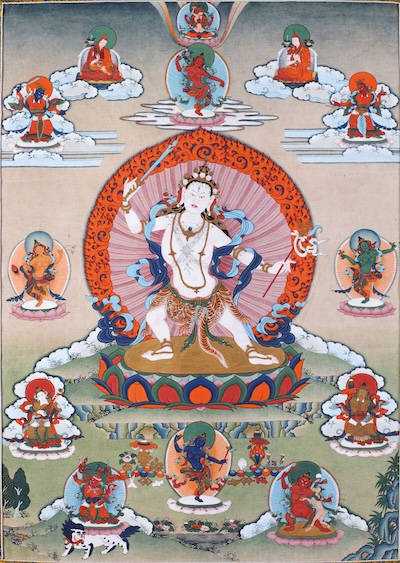
The first manifestation represents Guru Rinpoche in his magnetizing form and refers to the time he was the prince who would become Pema Gyalpo.[8] The words of the prayer are quite self-explanatory: he holds a sword in the right hand and a hook in the left, his mouth is open baring his teeth as he gazes upwards. At the end of each section, the verses of supplication are repeated.
第一种化身,是莲花生大师的怀摄身相,指他尚为王子、后来成为莲花王的时期。[8]祈请文的文字相当明白:他右手持剑,左手持钩,张口露齿,向上凝望。每一段结尾,都重复祈请的偈颂。
语狮子 Mawé Sengé
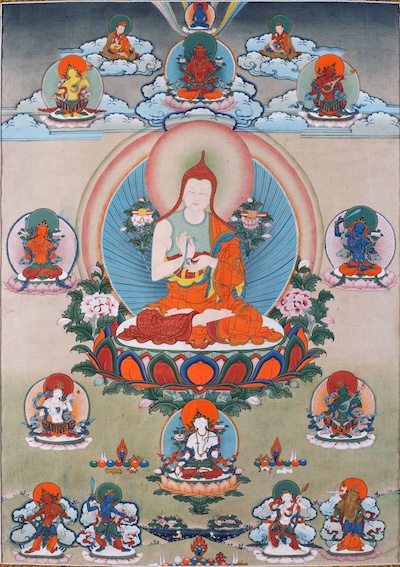
When hearing the priceless teachings of dharma, ༔
Your body shines with a dazzling radiance of light, ༔
In your right hand, volumes of the tripitaka, ༔
In your left, the texts of Kilaya. ༔
All these profound teachings have infused your mind, ༔
O Pandita of Yangleshö: ༔
…
听闻无价正法之时,༔
身放耀眼光芒,༔
右手持三藏经卷,༔
左手持金刚橛法典,༔
一切甚深教法融入您的心中,༔
扬列秀的班智达!༔
……
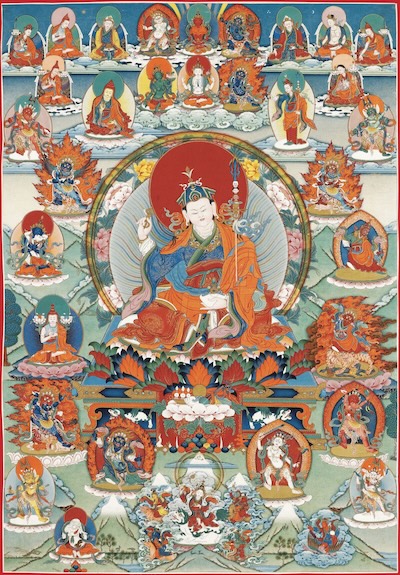
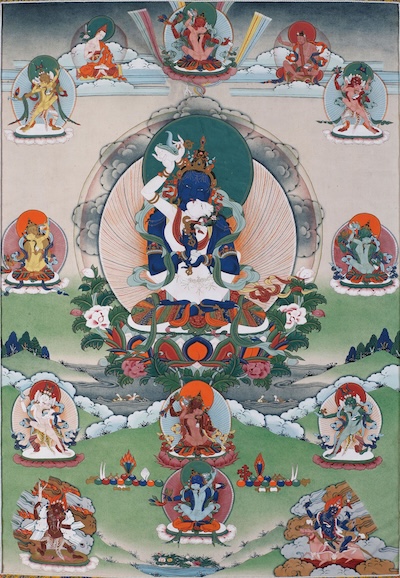
Concerning the description of each manifestation, I think it would be easier for you to simply look at the thangka rather than me explaining what the details are. You won’t be able to remember all those details anyway!
至于每一种化身的描述,我想,你们直接看唐卡,会比听我解释细节更容易。反正那些细节,你们也记不住!
In this manifestation, Mawé Sengé, Guru Rinpoche takes the form of a great pandita (scholar) who is Manjushri, the lord of knowledge. Mawé Sengé is Guru Rinpoche indivisible from Manjushri and manifests as a yidam to help students increase their wisdom and knowledge. The practice of this manifestation is very beneficial. It really has the power to help beings of lesser capacity develop their intelligence and improve their study.
在语狮子这一化身中,莲花生大师显为大班智达、大学者,也就是智慧之主文殊。语狮子是与文殊不可分的莲花生大师,显为本尊,帮助弟子增长智慧与学识。修持这一化身非常有益,确实有力量帮助根器较弱的众生增长才智、改善学习。
杰秋楚桑 Kyéchok Tsul Zang
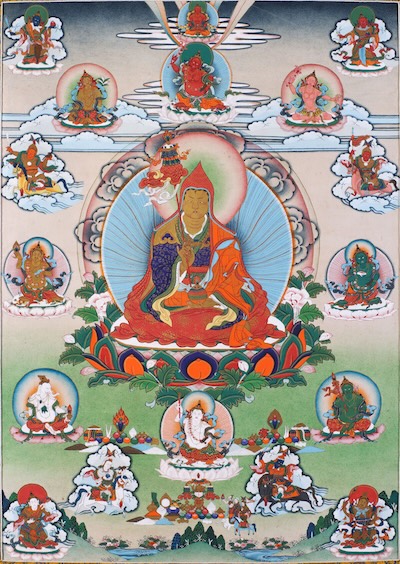
When placing under oath the protectors who abide by their vows ༔
In that supreme place of power, immaculate and enchanting, ༔
On the very border of India and Tibet, ༔
You grant your blessing, and as soon as you arrive ༔
The mountain becomes fragrant, a sweet scent wafting through the air, ༔
Even in winter lotus flowers bloom, ༔
And there flows a spring called ‘Nectar of Enlightenment’. ༔
In this supreme and sacred place, inundated with bliss, ༔
O Kyéchok Tsul Zang, clad in dharma robes, ༔
Your right hand wielding a nine-spoked vajra, ༔
Your left holding a jewelled casket ༔
Brimful of the elixir of rakta. ༔
You bind under oath the dakinis and guardians who keep their pledges, ༔
And you attain the siddhi of beholding the yidam deity face to face: ༔
…
令守誓护法立誓之时,༔
在那无垢悦意、威力殊胜的地方,༔
正位于印度与西藏边境,༔
您降临赐予加持,随即,༔
山间芬芳,香气飘扬,༔
即使冬季也有莲花盛开,༔
泉水流出,名为“菩提甘露”。༔
在这喜乐充盈的殊胜圣地,༔
杰秋楚桑,您身披法衣,༔
右手挥舞九股金刚杵,༔
左手持珍宝匣,༔
匣中盛满惹达甘露。༔
您以誓言约束守诺的空行与护法,༔
获得亲见本尊的悉地:༔
……
This manifestation, Kyéchok Tsul Zang, is Guru Rinpoche appearing in the form of a wealth deity. The basis of the enjoyment of the gods and wealth of humans comes entirely from the wealth deities. Wealth is essential since it makes everything possible; even the greatest dharma-kings and patrons cannot accomplish anything unless they have sufficient means. The great king of India, Ashoka, and the great dharma-king of Tibet, Trisong Deutsen, were able to benefit the dharma and propagate it on such a vast scale solely due to their wealth. For example, King Ashoka managed to gather five hundred arhats during the period of one rains-retreat to hold the first dharma council. Likewise, King Trisong Deutsen gathered 108 great panditas and 108 great lotsawas to translate the entire corpus of the Buddhist teaching in Tibet. These were enormous undertakings. If you really think about the scale of those projects and what was accomplished during those times, you will realize just how extraordinary an achievement it was. These successes were solely made possible by wealth.
杰秋楚桑这一化身,是莲花生大师显为财神。天人的受用与人间的财富,其根源完全来自财神。财富至关重要,因为有了它,一切才能成办;即使最伟大的法王与施主,若没有足够资财,也无从成办。印度的大王阿育王和西藏的大法王赤松德赞,能如此广泛地利益、弘扬佛法,完全是因为有财富。譬如,阿育王曾在一次结夏安居期间,集会五百阿罗汉,举行第一次佛法结集。同样,赤松德赞王集会一百零八位大班智达和一百零八位大译师,在西藏翻译全部佛教教典。这些都是巨大的事业。若真正想一想这些工作的规模,以及当时所成办的一切,便会认识到,那是何等非凡的成就。这些成就,全都因为有财富才成为可能。
都吉谢钦 Dükyi Shechen
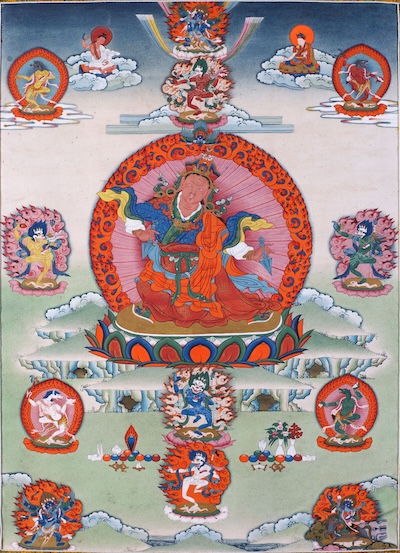
When you establish the teaching of the buddhas, ༔
And practise in the Slate Mountain forest, ༔
Your ‘kila of approach’ soars into the wide open sky. ༔
You catch it with the vajra mudra, roll it ༔
Between your hands and hurl it into the Sandalwood Forest, ༔
Which bursts into flames, evaporating its lake. ༔
In an instant, you burn the land of the tirthikas to ashes, ༔
And crush their dark yaksha lords into dust. ༔
O peerless Dükyi Shechen: ༔
…
建立诸佛教法之时,༔
您在石板山林中修持,༔
“念诵之橛”飞升旷阔虚空。༔
您以金刚手印接住,༔
在两掌间搓动,掷向檀香林,༔
林中烈焰燃起,湖水蒸干。༔
刹那将外道之地烧成灰烬,༔
将他们的黑夜叉主碾为微尘。༔
无与伦比的都吉谢钦!༔
……
This manifestation of Guru Rinpoche is indivisible with the yidam Vajrakilaya. Generally, we can say that Guru Rinpoche has accomplished and become inseparable from all the yidam deities, but the one that he has a special affinity to is Vajrakilaya. Having accomplished the yidam Vajrakilaya, Guru Rinpoche became indivisible from him, hence this manifestation of Dükyi Shechen. Practice instructions explain that we should see the yidam as indivisible with our lama—when lama and yidam are indivisible, blessings and accomplishment come very easily.
莲花生大师的这一化身,与本尊金刚橛无二无别。一般而言,可以说莲花生大师已成就一切本尊,与一切本尊不可分离,但他特别相应的本尊是金刚橛。成就金刚橛本尊后,莲花生大师与之无二无别,因此有了都吉谢钦这一化身。修持教言说,应观本尊与自己的上师无二;当上师与本尊不可分时,加持与成就便很容易到来。
赞林坚秋 Dzam Ling Gyen Chok
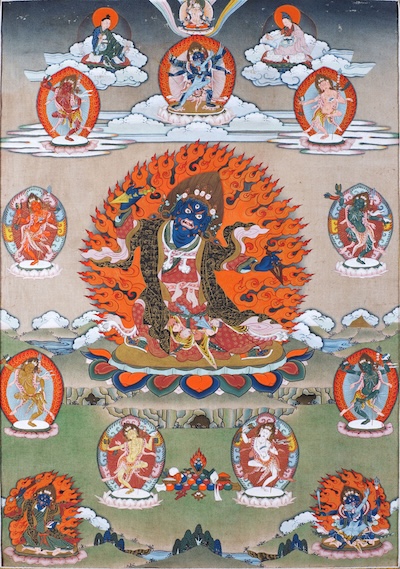
When overpowering the rakshasas, ༔
You appear as a youth in nirmanakaya garb, ༔
Your amazing, beautiful form, with its lovely hue, ༔
Perfect teeth and golden hair, gorgeous ༔
Like a youth of sixteen years, ༔
Wearing all the jewel ornaments. ༔
Your right hand grips a kila of bronze, ༔
Subjugating maras and rakshasas. ༔
Your left hand holds a kila of teak, ༔
Granting protection to your devoted sons and daughters, ༔
Around your neck you wear a kila of iron— ༔
You and the yidam deity are inseparable, ༔
O Dzam Ling Gyen Chok, manifestation of non-duality: ༔
…
威伏罗刹之时,༔
您着化身服饰,显为少年,༔
身相奇妙俊美,肤色悦意,༔
牙齿齐美,头发金黄,༔
如十六岁的美丽少年,༔
佩戴一切珍宝庄严。༔
右手紧握青铜橛,༔
降伏魔与罗刹。༔
左手持柚木橛,༔
保护虔敬的男女弟子,༔
颈间佩戴铁橛——༔
您与本尊无二无别,༔
赞林坚秋,无二的化现!༔
……
This manifestation of Guru Rinpoche is indivisible from the yidam, Yangdak Heruka. In order for Guru Rinpoche to reach the supreme accomplishment of the vidyadhara of mahamudra, he firstly had to remove obstacles through Vajrakilaya practice before he could reach attainment through the practice of Yangdak. Hence, we find sadhanas that bring together Yangdak Heruka and Vajrakilaya into one practice. Here, this manifestation of Guru Rinpoche is indivisible with Yangdak Heruka through whose practice Guru Rinpoche reached the supreme accomplishment.
莲花生大师的这一化身,与本尊扬达嘿噜嘎无二无别。为了获得大手印持明的殊胜成就,莲花生大师首先须修金刚橛遣除障碍,然后才能通过扬达修法获得成就。因此,有些成就法将扬达嘿噜嘎与金刚橛合为一修。这里,莲花生大师的这一化身,与使他获得殊胜成就的本尊扬达嘿噜嘎无二无别。
莲花生 Pemajungné
When you choose to go to the ‘Land of Phantoms’ ༔
The ground on which the blazing pyre is lit ༔
Turns into a lake, the width of an arrow shot, ༔
Where, on a lotus blossom, you appear, cool and sparkling. ༔
Within the lotus, you display your realization ༔
And win the name of Pemajungné, ‘Lotus-born’. ༔
You come in person as a completely realized buddha— ༔
O wondrous nirmanakaya, such as you: ༔
…
您决定前往“幻影之地”时,༔
燃起熊熊柴堆的地面,༔
化为一箭之广的湖泊,༔
您现于莲花上,清凉明耀。༔
在莲花之中,您显示证悟,༔
得名贝玛炯内——“莲花生”。༔
您以圆满证悟的佛亲自降临——༔
如您这般的稀有化身!༔
……
This is Guru Rinpoche in the form of Pemajungné or Padmasambhava, ‘the one who arose from a lotus’. It refers to the time Guru Rinpoche travelled to the land of Zahor where the King, failing to recognize his qualities, attempted to burn him on a blazing pyre of firewood. Guru Rinpoche transformed the flames into a lake and remained totally unharmed.
这是莲花生大师显为贝玛炯内或莲花生,即“从莲花中生起者”。它指莲花生大师前往萨霍尔国时,国王未能认识他的功德,企图将他置于熊熊燃烧的柴堆上烧死。莲花生大师把火焰化为湖泊,自己丝毫无损。
切巴帕贝仁增 Khyepar Pakpé Rigdzin
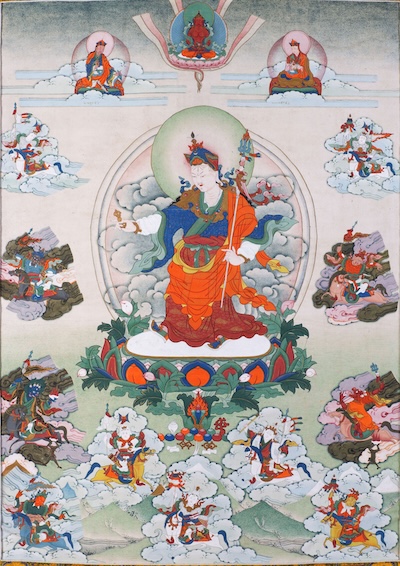
When you shine as the sun over Tibet, ༔
An awe-inspiring guide for any with devotion in their hearts, ༔
You display whatever forms each being needs to be tamed. ༔
High up on the Khala mountain pass in Tsang, ༔
You place the genyen of the dralas under oath. ༔
Down in the valley of Tsawarong, ༔
It was the arrogant genyen of the gods, ༔
Twenty-one of them, you make swear fealty. ༔
In Mangyul, at the temple ‘Cloud of Love’, ༔
You grant attainments to the four bhikshus. ༔
O supreme Khyepar Pakpé Rigdzin: ༔
…
您如太阳照耀西藏之时,༔
成为一切心怀虔敬者威严的向导,༔
随众生所需,显现调伏之身。༔
在后藏卡拉山口高处,༔
您令战神中的近事护法立誓。༔
下至擦瓦绒山谷,༔
您令诸天中骄慢的近事护法,༔
共二十一位,立誓效忠。༔
在芒域“慈云”寺,༔
您赐予四位比丘成就。༔
至尊切巴帕贝仁增!༔
……
This manifestation of Guru Rinpoche is indivisible from Nyima Özer, who is one of the eight manifestations. It refers to the time Guru Rinpoche first arrived in Tibet. He is depicted in a walking posture, holding a vajra in his right hand and a khatamka in his left.
莲花生大师的这一化身,与八种化身之一的尼玛沃色无二无别,指莲花生大师初到西藏的时期。他被绘为行走的姿态,右手持金刚杵,左手持卡章嘎。
祖珠图钦 Dzütrul Thuchen
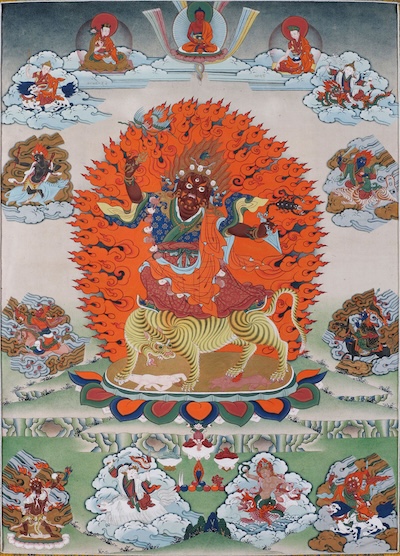
On Palmotang’s plain of glory ༔
You give the twelve tenma goddesses their binding oath. ༔
Up on the Khala pass of Central Tibet, ༔
You bind the white snow goddess Gangkar Shamé under oath. ༔
In the marshlands of Damshö before Mount Lhabüi Nying, ༔
You swear Thangla Yarshu to a solemn vow. ༔
High up, on the peak of Mount Hepori, ༔
You place all the devas and rakshasas under oath: ༔
And out of all these great gods and demons, ༔
Some offer up the very essence of their life force, ༔
Some are turned into guardians of the teachings, ༔
Others take the pledge to act as your servants. ༔
O mighty Dzutrul Thuchen:༔
…
在吉祥的贝莫塘平原,༔
您令十二丹玛女神受持誓约。༔
在前藏卡拉山口高处,༔
您令白雪女神岗嘎夏美立誓。༔
在拉布宁山前的当雄沼泽,༔
您令唐拉雅秀郑重立誓。༔
高高的海波日山顶,༔
您令一切天与罗刹立誓:༔
所有这些大力天神鬼众之中,༔
有些献上自身的命力精髓,༔
有些成为教法护持者,༔
有些发誓成为您的仆从。༔
大力祖珠图钦!༔
……
This is Guru Rinpoche manifesting as Dorje Drolö, whose name means ‘exceedingly more wrathful than wrathful’. Sometimes he is also referred to as ‘Trowö Trogyal’ which means ‘Wrathful King of Wrath’, or ‘Cholwé Trogyal’, ‘Crazy King of Wrath’, in the sense of ‘crazy with wrath’—the completely wrathful expression of wisdom. The sacred place associated with this wrathful manifestation is Paro Taktsang in Bhutan where Guru Rinpoche manifested as Dorje Drolö. Guru Rinpoche is depicted as riding on a tigress. Some sources say this tigress is a dakini while others say it is a wild man-eating tigress that Guru Rinpoche was able to tame.
这是莲花生大师显为多杰卓洛,其名意为“远比忿怒更忿怒”。有时也称“措沃措嘉”,意为“忿怒之忿怒王”,或“却威措嘉”,意为“狂忿怒王”,意思是“狂怒”,即智慧完全忿怒的表现。与这一忿怒化身相关的圣地,是不丹的帕罗虎穴,莲花生大师在那里显为多杰卓洛。他被绘为骑着母虎。有些资料说,这只母虎是空行母;另一些说,它是一只食人的野生母虎,被莲花生大师调伏。
金刚忿怒力 Dorjé Drakpo Tsal
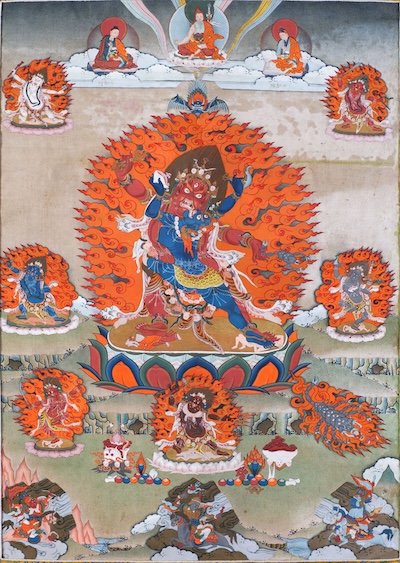
When you plant the teachings of the sublime dharma, ༔
As if hoisting a victory banner, ༔
Samyé is completed spontaneously, with no need to be built, ༔
And the entire vision of the king is fulfilled. ༔
Then, you bore the names of three supreme beings— ༔
One was Padmakara, ‘Lotus-born’, ༔
One was Padmasambhava, ༔
And one was Tsokyé Dorjé, ‘the Lake-born Vajra’. ༔
O Dorjé Drakpo Tsal, now we invoke you by your secret name: ༔
…
您建立殊胜正法之时,༔
如同高举胜幢,༔
桑耶无须建造,任运成就,༔
国王的全部愿景皆得圆满。༔
当时,您具有三位殊胜者的名号——༔
一为贝玛嘎拉,“莲花生”,༔
一为莲花生,༔
一为措杰多杰,“海生金刚”。༔
金刚忿怒力,现以您的密名祈请:༔
……
This manifestation of Guru Rinpoche, Guru Drakpo, appeared in order to tame the damsi and gyalgong demons of Tibet.[9] If you look carefully, you will find that almost all the tertöns discovered termas related to Dorje Drolö and Guru Drakpo at some point in their life. The form of Guru Rinpoche known as Guru Drakpo is considered to be particularly special.
莲花生大师的这一化身——忿怒上师——是为调伏西藏的破誓鬼与王鬼魔众而显现的。[9]仔细查看就会发现,几乎所有伏藏师,都曾在人生某个时期取出与多杰卓洛、忿怒上师相关的伏藏。莲花生大师名为忿怒上师的这一身相,被认为尤其殊胜。
嘎丹珍杰 Kalden Drendzé
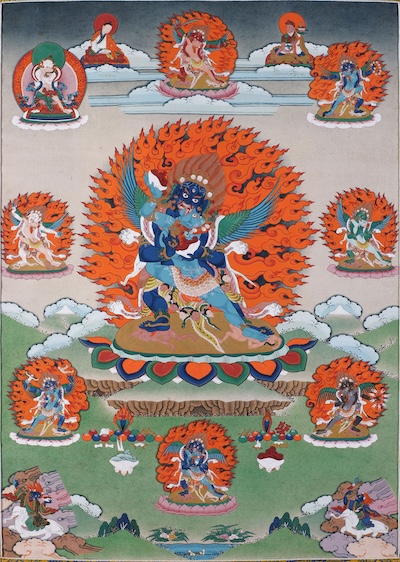
When you practise at Samyé Chimphu, ༔
You ward off harmful circumstances, and grant attainments. ༔
You set the king and ministers on the path to liberation, ༔
Destroying those teachings of the Bönpos that conjure evil spirits, ༔
And showing the dharmakaya, precious and immaculate. ༔
O Kalden Drendzé, you lead us fortunate ones to buddhahood: ༔
…
您在桑耶青浦修持之时,༔
遣除违缘,赐予成就。༔
令国王与臣子踏上解脱道,༔
摧毁苯教召唤恶灵的那些教法,༔
显示珍贵无垢的法身。༔
嘎丹珍杰,您引导我们这些具缘者成佛!༔
……
This manifestation represents Guru Rinpoche in the form of Chemchok Heruka, one of the eight deities of the Kagyé mandala. When Guru Rinpoche was in India, Zahor and other lands, he gave the empowerment and transmissions for the Kagyé Deshek Düpa. He also granted this empowerment in Tibet. The central deity of the Kagyé is Chemchok Heruka, so this manifestation is Guru Rinpoche indivisible from Chemchok Heruka.
这一化身,是莲花生大师显为八大法行坛城八尊之一的大胜嘿噜嘎。在印度、萨霍尔等地时,莲花生大师曾传授《八大法行·善逝总集》的灌顶与传承,也在西藏传过这一灌顶。八大法行的中央主尊是大胜嘿噜嘎,因此这一化身,就是与大胜嘿噜嘎无二的莲花生大师。
In Tibet, there has been a continuous succession of accomplished siddhas who have reached attainment through practicing the Kagyé deities. There’s a general approach in which you practice all Kagyé deities together and a specific approach in which you practice each one separately. The Kagyé is the main yidam practice of the Nyingmapas.
在西藏,通过修持八大法行本尊而获得成就的悉达,代代相续,未曾中断。修法有总、别两种方式:总修是同时修持全部八大法行本尊,别修则是分别修持每一尊。八大法行是宁玛派主要的本尊修法。
罗刹颅鬘 Raksha Tötreng
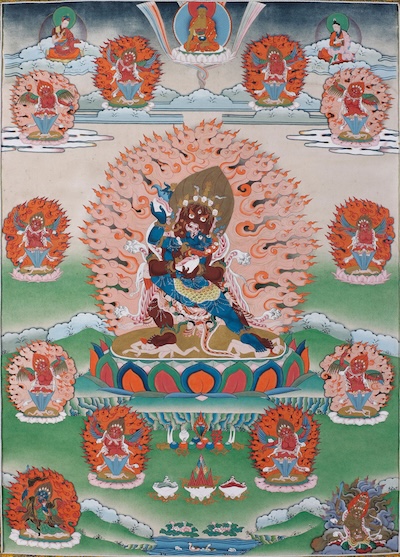
Then you leave, and for the land of Orgyen, ༔
Where now you subjugate the rakshasa demons; ༔
Great wonder—surpassing any human being, ༔
Great marvel—in your phenomenal enlightened actions, ༔
Great might—with all your miraculous powers: ༔
…
随后,您启程前往邬金国土,༔
如今在那里降伏罗刹魔众;༔
大稀有——超越一切人类,༔
大奇妙——您非凡的觉悟事业,༔
大威力——您一切神变力量:༔
……
This refers to the time when Guru Rinpoche, having granted the transmissions and empowerments of the Kagyé Deshek Düpa, and generally having completed his work for sentient beings in Tibet, left for the Copper-coloured Mountain, the land of the rakshasas, in the south-west. To subjugate those rakshasas he manifested as the King of Rakshasas, Raksha Tötreng. He has remained there until today, appearing in this form, taming countless sentient beings.
这指莲花生大师传授《八大法行·善逝总集》的传承与灌顶,大体完成在西藏利益众生的事业之后,前往西南方罗刹国土铜色山的时期。为了降伏这些罗刹,他显为罗刹之王罗刹颅鬘。直到今天,他仍住在那里,以这一身相调伏无量众生。
How do we know this? All the tertöns of Tibet as well as many thousands of other great masters have actually been to the Copper-coloured Mountain and seen this for themselves. They have written about it and still today, great masters and tertöns continue to go to the Copper-coloured Mountain and bear witness to this, right? So this verse makes reference to the Copper-coloured Mountain where Guru Rinpoche currently presides, manifesting as the King of Rakshasas.
我们怎么知道呢?西藏所有伏藏师,以及成千上万其他大上师,确实去过铜色山,亲眼见到这一切,并将其写下。直到今天,大上师与伏藏师仍不断前往铜色山,见证此事,对不对?因此,这一偈指的是铜色山,莲花生大师目前正以罗刹之王的身相住持其间。
You need to know how each one of these eleven manifestations relates to the main deeds Guru Rinpoche performed while he was in Tibet, as detailed in his biographies. When you read those biographies, there’s a way you can relate to them on an outer level and an inner level. On an inner level, the different activities indicate how Guru Rinpoche progressed on the path and bhumis by accomplishing the four vidyadhara levels: the levels of full maturation, power over life, mahamudra, and spontaneous presence. There is a tradition of explaining how he accomplished each of those levels in relation to the events described in his biographies. This tradition comes from Jamyang Khyentse Wangpo.[10]
你们需要知道,这十一种化身各自如何对应莲花生大师在西藏所成办、传记中详述的主要事业。阅读这些传记时,可以从外、内两个层面去理解。在内层面,不同事业显示莲花生大师如何成就异熟、寿自在、大手印和任运四种持明果位,经过诸道、诸地。有一种传统,依照传记所述事迹,解释他如何成就每一果位。这个传统出自蒋扬钦哲旺波。[10]
To become an accomplished mahasiddha, you need to progress through each one of these four levels of vidyadhara, and that is exactly what Guru Rinpoche did. You need to distinguish each one of those stages very clearly, not in some vague indecisive kind of way. Of course, we can simply say that Guru Rinpoche accomplished the four levels of a vidyadhara, but it is far better if we can say at which point he accomplished which level. This needs to be clear for such a statement to have any real significance.
要成为圆满成就的大成就者,需要经过四种持明的每一果位,莲花生大师正是这样做的。必须把每个阶段分辨得清清楚楚,不能模糊不决。当然,我们可以简单地说莲花生大师成就了四持明果位;但若能指出,他在何时成就哪一果位,那就更好。只有说清楚,这样的陈述才有真正的意义。
From a dharma point of view, Guru Rinpoche is the most supreme kind of being—basically he was primordially liberated, in other words he was born enlightened. For our sakes, however, he showed how one needs to progress through all the different stages of the path. The way we develop and progress through the different stages of the Vajrayana path is by accomplishing these four levels of a vidyadhara successively. As Guru Rinpoche showed how he attained each stage, he also displayed the qualities associated with that level. This is an important point.
从佛法的观点看,莲花生大师属于最殊胜的众生,基本上是本初解脱,换句话说,生来已经觉悟。然而,为了我们,他示现了如何经过修道的不同阶段。我们在金刚乘道路上发展、经过各阶段的方式,就是依次成就这四种持明果位。莲花生大师示现证得每一阶段时,也显现与该阶段相应的功德。这一点很重要。
As Jigme Lingpa said:
如吉美林巴所说:
There’s a profound point to understand here. And if there is something to understand, there is something to think about. The understanding I am talking about here is very different from thoughts such as, “Oh, Guru Rinpoche is such a great being, he was so brilliant from the start, we cannot possibly imitate or get anywhere close to him”.
这里有一个需要理解的甚深要点。既有所应理解,也就有所应思惟。我这里所说的理解,与“哦,莲花生大师如此伟大,一开始就那么了不起,我们不可能效仿,更不可能接近他”这类想法,非常不同。
上师大乐王 Guru Dechen Gyalpo
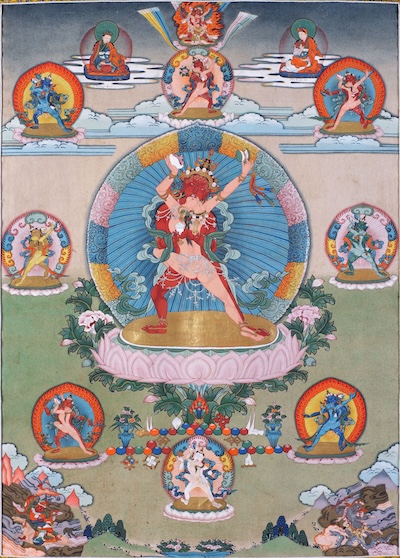
The next verse brings everything together, in summary.
下一偈把一切总摄起来。
Endowed with wisdom body, speech and mind, you are our glorious guide; ༔
You have freed yourself of obscurations, and so know the three realms with vivid clarity; ༔
You have attained the supreme siddhi, and so possess the supreme body of great bliss; ༔
All the obstacles to our enlightenment—eliminate them for good! ༔
…
您具智慧身语意,是我们吉祥的导师;༔
您已远离障碍,故鲜明了知三界;༔
您已证得殊胜悉地,故具殊胜大乐身;༔
令一切障碍我们成佛者,永远消除!༔
……
This manifestation is said to be Guru Rinpoche indivisible from Chakrasamvara and Yangdak Heruka.
据说,这一化身,是与胜乐金刚、扬达嘿噜嘎无二的莲花生大师。
This concludes this extremely brief commentary to the Barché Lamsel prayer that links Guru Rinpoche’s various manifestations to the twelve main deeds of his life.
以上便结束了对《遣除道障祈请文》极其简略的解释,将莲花生大师的种种化身,与他一生十二大事业联系起来。
如何念诵《遣除道障祈请文》 How to recite the Barché Lamsel prayer
How should you recite the Barché Lamsel prayer? When you recite the prayer, you should imagine that all sentient beings as vast as space are gathered around you, like a crowd in a large marketplace.
应当如何念诵《遣除道障祈请文》呢?念诵时,应观想广大如虚空的一切众生聚集在你周围,如同大集市中的人群。
The object of your prayer is Guru Rinpoche in the form of Nangsi Zilnön, who is indivisible from your own mind. We consider Guru Rinpoche as being the embodiment of all sources of refuge. The body of Guru Rinpoche is in essence the lama, his speech the yidam, and his mind the dakini. This is explained at great length in the ngöndro commentaries. We need to apply this understanding when we come to invoke Guru Rinpoche as the embodiment of all sources of refuge. We also think that he holds each sentient being with his tremendous compassion, power, and love.
祈请的对境,是与自心不可分离的莲花生大师囊夕色农。我们视莲花生大师为一切皈依处的总集。他的身,在本质上是上师;他的语是本尊;他的意是空行母。前行注释中对此有广泛解释。祈请莲花生大师为一切皈依处总集时,应运用这一理解。也要想到,他以广大的慈悲、威力与慈爱摄持每一个众生。
As we pray to Guru Rinpoche, we express our devotion through our body by joining our hands together at our heart; through our speech by reciting the profound verses of the Barché Lamsel prayer; and through our mind, full of devotion, recalling as much as we can all the symbolism and meaning of the words of the prayer.
祈请莲花生大师时,身在心间合掌,表达虔敬;语念诵《遣除道障祈请文》甚深偈颂;心充满虔敬,尽可能忆念祈请文词句的一切象征与意义。
So here you can follow the tradition of viewing Guru Rinpoche as the all-embodied jewel—you focus just on his person alone as the source of all refuge. If you wish to practice more elaborately you can visualize Guru Rinpoche in front of you and above his head, the sambhogakaya Avalokiteshvara with four arms, and above his head, the dharmakaya Amitayus. Around him are arranged the twelve emanations and at the four gates, the dakas of the four families. All these deities are the manifestation of Guru Rinpoche, his self-expression, and are indivisible from him, like the sun and its rays. They are simply manifestations that appear in accordance with the needs of different sentient beings. In essence, they are fundamentally one and the same. Try to hold that in your mind as you recite the prayer of the Barché Lamsel.
这里,可以依循将莲花生大师视为总摄一切之宝的传统,只专注于他一尊,将他视作一切皈依处。若希望修得更广,可观想莲花生大师在面前,他的头顶是四臂报身观世音,观世音头顶是法身无量寿佛;周围排列十二化身,四门有四部勇父。这一切尊众都是莲花生大师的化现、他的自显,与他不可分离,如同太阳及其光芒。它们只是依照不同众生所需而出现的化身,在本质上,根本是同一、无二的。念诵《遣除道障祈请文》时,尽量将此铭记于心。
You shouldn’t just mouth the words—you need to actualize their meaning and pray from the depths of your heart. You need to abandon all distractions, whether they be in your mind or come from your senses.
不应只是嘴上念诵,而要令其意义真正现起,从内心深处祈请。必须舍弃一切散乱,无论来自心中还是感官。
You can recite the Barché Lamsel prayer in formal sessions of practice, with the Dusum Sangye and the Vajra Guru mantra. At best, you should recite the prayer every day, but at least on the 10th Guru Rinpoche day and other similar special occasions.
可以在正式修持座中,配合《三世诸佛祈请文》和金刚上师心咒,念诵《遣除道障祈请文》。最好每天念诵,至少也应在初十莲花生大师日,以及其他类似的殊胜日子念诵。
Also, whenever you think of the lama, you should make prayers in that moment.
此外,每当忆念上师,就应当在那一刻祈请。
If you pray in this way, Guru Rinpoche will hold you in his compassion. Guru Rinpoche himself promised to his followers, “I, the Lotus-born, will always hold you with my compassion.” If you pray to Guru Rinpoche, you will clearly see signs of his compassion.
若如此祈请,莲花生大师便会以慈悲摄持你。他亲自向追随者承诺:“我莲花生,始终会以慈悲摄持你们。”向莲花生大师祈请,就会清楚看见他慈悲的征兆。
The prayer is taken from the Tukdrup Barché Kunsel which is a very large cycle of teachings. It contains many different dharma teachings alongside its root and subsidiary sadhanas. Each one of the twelve manifestations have specific practices and activities. It would be highly beneficial for you to receive the empowerment of this cycle at some point, although I don’t think you will be able to complete all its practices. In any case, this is how to practice the twelve manifestations of Guru Rinpoche.
这篇祈请文出自《上师意修·一切障碍遍除》,这是一个十分庞大的法系。除根本与支分成就法外,还包含许多不同教法。十二种化身,各自都有特定修法与事业。在某个时候领受这一法系的灌顶,会非常有益;不过,我想你们恐怕无法完成它的全部修法。总之,莲花生大师十二化身就是这样修持的。
本次传承 Lineage
Today, I’ve explained the Barché Lamsel prayer to you and given you the reading transmission. I received this transmission from none other than Dorje Chang, Jamyang Khyentse Chökyi Lodrö. I have also completed the Tukdrup Barché Kunsel retreat a few times and performed many drupchens based on the practice. I recite the sadhana and the prayer every day. There’s nothing particularly extraordinary about all this except the fact that I received the transmission from Dorje Chang, Jamyang Khyentse Chökyi Lodrö, and my samayas with him are utterly pure. There’s not a single instant where I broke my samaya with him—I have never had so much as a second of wrong view towards him. The lineage of transmission you have received therefore is completely pure and for this reason, I believe there will be some benefit. What kind of benefit? The elimination of your outer, inner and secret obstacles, and the bestowal of accomplishments.
今天,我为你们解释了《遣除道障祈请文》,也给予了读诵口传。我领受这一传承的上师,不是别人,正是金刚持蒋扬钦哲确吉罗卓。我也曾数次完成《上师意修·一切障碍遍除》的闭关,并以此法修过许多大修。我每天都念诵成就法与祈请文。这一切并没有什么特别了不起的,唯有一件事:我从金刚持蒋扬钦哲确吉罗卓处领受传承,而且与他的三昧耶完全清净。我没有一瞬间破坏过与他的三昧耶,甚至从未对他生起过一秒邪见。因此,你们领受的传承完全清净,也因此,我相信会有一些利益。什么利益呢?遣除你们的外、内、密障碍,并赐予成就。
问答 Questions and Answers
Is it possible to reverse the ‘age of degeneration’, or have things gone too far already?
有可能扭转“五浊恶世”吗?还是情况已经发展得太远了?
Generally speaking, it would be very difficult to reverse this trend because it has come about as a result of the shared negative karma of sentient beings[12] . However, if with a pure heart and good motivation you wish to do something about the situation, there are actually things you can do. There are many teachings and prophecies that address this. Unfortunately, it’s very difficult to find practitioners who can come together and perform the required practices at the time indicated by the prophecies. Even if those causes and conditions do come together, it’s even more difficult to find practitioners who have the necessary power to make the practices effective. During the reign of the Fifth Dalai Lama, Terdak Lingpa said there was no one alive at that time who had sufficient power to make the practices fully effective. That was the situation back then. I don’t think there is anyone amongst us today who can do the practices in such a way that we will see the full result and impact.
一般而言,要扭转这一趋势非常困难,因为它是众生共同恶业的结果。[12]不过,若以清净心和良好动机,希望为这种局面做些什么,实际上仍有可做的事。有许多教法与授记谈到这一点。遗憾的是,很难找到能够在授记指定的时机聚集起来、修持所需法门的修行人。即使那些因缘齐备,要找到具有足够力量、使修法生效的修行人,就更加困难。第五世达赖喇嘛在位时,德达林巴曾说,当时在世的人中,没有谁具备足够力量使这些修法充分生效。那时的情形已是如此。我不认为今天我们之中,有谁能这样修持,使完整的结果与作用显现。
How can we use this practice to enhance our practice of trekchö?
如何运用这一修法,来增进我们的彻却修持?
If you recite this prayer a lot, in the way that I have just explained, it will remove your secret obstacles and when that happens, you will see a great improvement in your trekchö practice. It is generally stated in the Dzogchen teachings that the greatest practice you can do is praying to the lama. To increase the power of your meditation, there’s no better practice than praying to the lama. In fact, this is true for all aspects of your dharma path. When we pray to the lama, the result is that we receive their blessing, and this manifests as a direct experience of the nature of trekchö. It’s not just about praying though—you need to give rise to genuine devotion in your mind when you pray. If you have devotion, you will receive the blessings and the accomplishments. This point lies at the heart of the Nyingma teachings.
若依照我刚才解释的方法,大量念诵这篇祈请文,就会遣除密障;密障遣除时,彻却修持便会大有进步。大圆满教法通常都说,所能修的最殊胜法门,就是祈请上师。要增强禅修的力量,没有比祈请上师更好的修法。事实上,修道的各个方面都是如此。祈请上师的结果,是领受他的加持,这会显现为对彻却本性的直接体验。但不只是祈请而已,祈请时还须在心中生起真切虔敬。有虔敬,就会领受加持与成就。这一点是宁玛教法的核心。
I currently practice Riwo Sangchö in the mornings and Rigdzin Düpa in the evenings, which are both practices of Guru Rinpoche. So do I really need to do this practice as well?
我目前早晨修《山净烟供》,晚上修《持明总集》,两者都是莲花生大师的修法。那么,我真的还需要修这个法吗?
Definitely! You know if you ask that kind of question, “Should I do this practice, or is it okay if I don’t?” you will always get the answer, “Yes, you should do it.” No one’s going to tell you not to practice something!
当然!你知道,如果问“我应当修这个法,还是不修也可以?”这类问题,得到的答案永远是:“是的,你应当修。”没有人会告诉你不要修某个法!
You’ve clearly said that praying to the lama is very important. Would you say it is okay to just make up our own prayers, spontaneously, when we think of the lama? Would that work just as well as the prayers that come from termas, like the Barché Lamsel?
您已清楚说到,祈请上师非常重要。忆念上师时,我们能否随即自发地编成自己的祈请文?它们会与《遣除道障祈请文》这样的伏藏祈请文同样有效吗?
I’ve no idea what kind of prayers enter your head but what I do know is that the Seven-line Prayer, Barché Lamsel and Sampa Lhundrupma are the vajra words of Guru Rinpoche himself. Therefore, these prayers are held to be very sacred and powerful. In Tibet, there are many people who compose all sorts of prayers. If you go to the main temple in Lhasa, the Jokhang, people line up outside to offer their prayers and if you pay close attention to what they’re saying, you’ll hear all kinds of things. I do that, I just walk slowly along the line and listen to what they’re saying. Some people say whatever comes to their minds in that moment, their own compositions. That happens.
我不知道你脑中会出现什么祈请文,但我知道,《七句祈请文》、《遣除道障祈请文》和《愿望任运成就祈请文》,是莲花生大师亲口宣说的金刚语。因此,这些祈请文被视为极其神圣、有力。西藏有许多人编写各式各样的祈请文。如果到拉萨的主要寺院大昭寺,会见到人们在外面排队祈请;仔细听他们说什么,就会听到各式各样的话。我就这样做,沿着队伍慢慢走,听他们说什么。有些人想到什么就说什么,是自己编的。这种情况确实存在。
I always struggle with absolute and relative truth, and the union of them. When you talk about removing obstacles, I’ve been praying to Guru Rinpoche most of my life to remove obstacles and develop some understanding, but I still have many obstacles. How am I to understand this continued manifestation of relative obstacles?
对于胜义谛、世俗谛及二者双运,我一直感到难以理解。说到遣除障碍,我一生大部分时间都在祈请莲花生大师遣障、增长理解,却仍有许多障碍。该如何理解这些持续显现的世俗障碍?
On the relative level there are obstacles and on that relative level, we pray to remove those obstacles. On the absolute level, there is no one who prays, no object of our prayer, and no obstacle… it is beyond all that. We recite prayers so that we can realize the absolute truth. Do we still need to make prayers on that relative level then? Yes, of course we do. We are not enlightened yet and therefore still experience a lot of obstacles. As long as a continuous flow of thoughts still arises in our minds, we will have obstacles. Until we reach enlightenment, we will continue to have obstacles.
世俗层面有障碍,我们也在世俗层面祈请遣除障碍。胜义层面,没有祈请者,没有祈请的对境,也没有障碍……它超越这一切。我们念诵祈请文,是为了证悟胜义谛。那么,在世俗层面还需要祈请吗?需要,当然需要。我们尚未觉悟,因此仍经历许多障碍。只要心中仍然不断生起念头,就会有障碍。在成佛之前,我们都会继续有障碍。
In London, there are many people interested in yoga centres. Many people try to do mindfulness practice in business companies. They see that material comfort alone does not fulfil them. How can we skilfully connect such people to a genuine practice lineage, without coming across as being like a missionary?
伦敦有许多人对瑜伽中心感兴趣,也有许多人尝试在企业中做正念练习。他们发现,仅有物质上的舒适,并不能使自己满足。我们怎样善巧地帮助这样的人与真正的实修传承建立联系,又不让人觉得像是在传教?
You already answered your own question—you need to be skilful. Myself, I have no idea how to do this. The only encounters I have had with the West is through the Rigpa centres and my sole intention in coming to them was to support Sogyal Rinpoche. I’m not a lama who has Western students, in Europe, America, and so on. So I really have no idea how to answer your question. I’m not the person to ask. I’ve heard that nowadays people follow the teachings just in name. What you’re saying is probably true. I think that Vajrayana, the vehicle that takes the fruition as the path, will be extremely difficult to transport here. I say this because it seems that the power of these teachings is diminishing. You might then ask, “What can we do when the teachings have degenerated like this?” Nothing. The Buddha himself prophesized that the teachings would degenerate. So there’s no point for people like us to ask such a question. Buddha’s disciples asked him, “What should we do when the teachings fall into decline?” The Buddha answered that this happens because the merit of sentient beings is being exhausted. I can see for myself how the teachings of the Vajrayana have degenerated.
你已经回答了自己的问题:需要善巧。我自己不知道该怎么做。我与西方的接触,只有通过本觉会中心;我到这些中心的唯一目的,是支持索甲仁波切。我不是在欧洲、美国等地拥有西方弟子的上师,因此确实不知道如何回答。这个问题不应当问我。我听说,如今有人只是名义上追随教法。你说的大概是真的。我想,要把金刚乘——以果为道的乘——带到这里,会极其困难。我这样说,是因为这些教法的力量似乎正在减弱。你可能接着问:“教法如此衰落,我们能做什么?”什么也做不了。佛陀自己已授记教法会衰落。因此,像我们这样的人,问这种问题也没有意义。佛陀的弟子曾问他:“教法衰落时,我们该怎么办?”佛陀回答,这种情况是因为众生的福德正在耗尽。我自己也看得见,金刚乘教法是如何衰落的。
Are obstacles that manifest in dreams considered outer, inner or secret obstacles?
梦中显现的障碍,属于外障、内障还是密障?
Both inner and secret obstacles can arise in dreams. Outer obstacles don’t manifest so much in dreams. For example, you might dream of a great fire that destroys everything in its path but in reality, nothing gets burnt. A real fire would burn down everything. It’s easier to eliminate the outer type of obstacles. Inner obstacles are more difficult to purify, and secret obstacles even more so. If you are a dharma practitioner, the secret obstacles are the worst kind.
内障与密障都可能在梦中生起。外障在梦中显现得不多。譬如,可能梦见一场大火把所经之处全部烧毁,但实际上没有任何东西烧着。真正的火则会烧毁一切。外障比较容易遣除,内障更难净化,密障就更难。对修行人而言,密障是最严重的障碍。
Rinpoche, is it okay to recite the prayer in English or will it lose some of its authenticity and power if we do that?
仁波切,可以用英语念诵这篇祈请文吗?这样会不会失去一些原有的真确性与力量?
Yes, there will probably be some loss of blessings if you recite the prayer in English. That’s true. At the same time, as it says in Samantabhadra’s Aspiration to Good Actions:
是的,用英语念诵,可能会损失一些加持。这是真的。同时,正如《普贤行愿品》所说:
In the language of the gods, nagas and yaksas,
In the language of kumbhandas and humans too,
In however many kinds of speech there may be—
I shall proclaim the dharma in the language of all!
以诸天、龙与夜叉的语言,
以及鸠槃荼与人类的语言,
无论有多少种言语——
我都以一切语言宣说佛法!
The enlightened speech can manifest in any language. Some people say that Sanskrit is the best language, Tibetan is not as good, and English even less so, but personally I don’t agree with that point of view. Each culture has its own language which they use to communicate and express meaning. As long as the language expresses the meaning, it’s fine. Jamyang Khyentse Wangpo said that Chinese people should use the Chinese language, Tibetans the Tibetan language, Indians Sanskrit, and so on—it’s the same as long as the meaning is conveyed. There’s a lot said about this in the Guhyagarbha Tantra (Secret Essence Tantra). As far as I’m concerned, it doesn’t matter what language you use provided the meaning is understood.
觉悟语能够以任何语言显现。有些人说,梵文最好,藏文差一些,英文更差;但我个人并不同意。每种文化都有自己的语言,用来沟通、表达意义。只要语言能表达意义,就可以。蒋扬钦哲旺波说,汉人应当用汉语,藏人用藏语,印度人用梵语等等,只要意义能够传达,都是一样的。《秘密藏续》对此有许多说明。在我看来,只要能理解意义,使用什么语言并不重要。
My question is about the visualization that accompanies the prayer. You said that Guru Rinpoche is in the centre and Amitabha above, but in other Vajrayana practices, there’s usually additional elements of visualization, for example in the practice of Riwo Sangchö in which we should visualize Guru Rinpoche’s kapala overflowing with nectar and so on. Can you say a bit more about what we can visualize Guru Rinpoche is doing, when we recite the prayer?
我的问题是关于念诵祈请文时的观想。您说莲花生大师在中央,阿弥陀佛在上方;但其他金刚乘修法,通常还有其他观想内容,例如《山净烟供》中,应观想莲花生大师的颅器甘露盈溢等等。能否再说一点,念诵祈请文时,可以观想莲花生大师正在做什么?
So you don’t know what Guru Rinpoche Nangsi Zilnön looks like? You can see his image here [points to ‘Looks Like Me’ print]. Guru Rinpoche himself said this image really looked like him. This statue was originally enshrined in Samye in Tibet. It was made by Tami Gonso, ‘Tami’ means foreigner, and ‘Gonso’ was his name. Some say he was Nepalese, others that he was Indian. Wherever he came from, according to historical accounts, he is the one who made this statue while looking at Guru Rinpoche. It is said that Guru Rinpoche then radiated rays of light which touched the statue and made it look exactly like him.
那么,你不知道莲花生大师囊夕色农的样子吗?可以看这里的像[指向“与我相像”图像]。莲花生大师亲自说过,这尊像非常像他。原像供奉于西藏桑耶寺,由塔弥贡索制作:“塔弥”意为外国人,“贡索”是他的名字。有些人说他是尼泊尔人,另一些说是印度人。无论来自何处,依历史记载,就是他一边看着莲花生大师,一边塑造了这尊像。据说,莲花生大师随后放出光芒,触及塑像,使它与自己完全相像。
When the great tertöns would go to see this statue, it would speak to them. If you read the biographies of those great masters, you can confirm that. This photo was taken by the Queen Mother of Sikkim during her visit to Samye monastery in 1935. That’s the only photograph that was ever taken of it. Afterwards, the statue was destroyed during the Cultural Revolution. So this is the only image we have. This is the form of Guru Rinpoche known as Nangsi Zilnön; Guru Rinpoche holds the vajra extended in front of him. The form of Guru Rinpoche that holds the vajra at his heart is called Tsokyé Dorje and the one that holds the kapala with both hands resting on his lap is Padmasambhava. In Riwo Sangchö practice, Guru Rinpoche appears in the form of Tsokyé Dorje, according to the sadhana revealed by Lhatsun Namkha Jigme in the cycle called Rigdzin Sokdrup from which the Riwo Sangchö is extracted. There are many different forms of Guru Rinpoche. The thangka of Tukdrup Barché Kunsel you were shown on the screens was painted by one of Jamyang Khyentse Chökyi Lodrö’s artists. That’s the image you should refer to. There’s no need to talk too much about it.
大伏藏师前往瞻仰这尊像时,塑像会对他们说话。读那些大上师的传记,就能证实。这张照片是锡金王太后于1935年访问桑耶寺时拍摄的,也是这尊像唯一的一张照片。后来,塑像在文化大革命中被毁。因此,这是我们仅存的影像。这就是名为囊夕色农的莲花生大师身相,他把金刚杵向前伸出。将金刚杵持于心间的身相,称为措杰多杰;双手捧颅器、安置膝上的,称为莲花生。《山净烟供》修法中,莲花生大师显为措杰多杰,这是依拉尊南喀吉美所取《持明命修》法系中的成就法,《山净烟供》就是从中摘出的。莲花生大师有许多不同身相。刚才屏幕上展示的《上师意修·一切障碍遍除》唐卡,是蒋扬钦哲确吉罗卓的一位画师绘制的。应当参照那幅图,没有必要说得太多。
Translated by Gyurme Avertin
Edited by Philip Philipou and David Rand
英译:久美·阿韦尔坦
编辑:菲利普·菲利普、戴维·兰德
原注 Notes
出处与版本
原刊:ALL-OTR · Barché Lamsel, The Prayer Which Removes All Obstacles from the Path。讲授:1st October 2023;London, United Kingdom。原刊发布日期:2024-08-19。