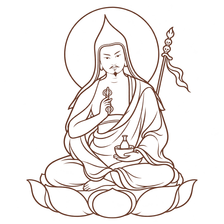
The Cool Grove Charnel Ground
On 30 December 2019, Rinpoche took his monks on the one hour journey from Bodhgaya to the Cool Grove Charnel Ground. First Rinpoche explained to them why charnel grounds are so important for tantric practitioners. Then he spoke about the Cool Grove Charnel Ground. He explained why we know there is no doubt that that place is the original charnel ground where the great vidyadharas of the past practised. He also spoke about its special connection with Mahasiddha Shavaripa.
2019年12月30日,仁波切带僧众从菩提伽耶出发,经过一小时的路程,来到清凉林尸陀林。首先,他解释尸陀林为什么对密续修行者如此重要,接着谈到清凉林尸陀林。他说明,我们为何可以毫不怀疑地确定,此地正是昔日大持明们修行的原始尸陀林,也谈到这里与大成就者夏瓦日巴的特别因缘。
尸陀林的意义 The Significance of Charnel Grounds
First, let me explain about charnel grounds. In a nutshell, the Nyingma tradition explains that there was an extraordinarily vicious rudra called Black Liberation who had to be annihilated and liberated. So Hayagriva and Vajravarahi appeared on top of the Blazing Meteoritic Mount Malaya and relied on the skilful means of union free of attachment and of liberation to annihilate Black Liberation. Then, they threw his body parts on the world. The places where they landed became the eight great charnel grounds, the twenty-four sacred places and the thirty-two sacred lands.
The evil beings in Black Liberation’s retinue have made these sixty-four sacred places their home – mostly the eight great charnel grounds, but also in the twenty-four sacred places and the thirty-two sacred lands. As it is said “They did not stay in the middle but protect the edges”, which means that they did not remain in the middle of the mandala but went to the edges of the mandala to offer protection. They pledged to accomplish the benefits of sentient beings as long as the Buddha’s teachings remain, by helping fortunate ones to gain accomplishment, and by punishing those who lack karmic fortune as they judge good and bad.
黑解脱眷属中的恶类,将这六十四处圣地作为住处,主要住在八大尸陀林,也住在二十四圣境与三十二圣地。正如所说:「不住中央,守护边缘。」意思是,他们没有留在坛城中央,而是到坛城边缘守护。他们立誓,只要佛法住世,就利益众生:帮助有缘者获得成就,并辨别善恶,惩罚缺少善缘者。
According to the Sarmapas, after the Bhagavan Buddha had turned the wheels of Hinayana and Mahayana teachings, the dharma kings Suchandra and Indrabhuti requested him to turn the wheel of Vajrayana. Buddha manifested in the form of Guhyasamaja, Chakrasamvara and Kalachakra for example, and turned the dharma wheel of Secret Mantra for the fortunate disciples able to attain enlightenment without abandoning the objects of desire. When he arose as Chakrasamvara, Hevajra, Guhyasamaja and so on, he placed the dakas and dakinis of the twenty-four sacred places, thirty-two sacred lands and eight great charnel grounds in the mandala, based on the mandala of his body. According to Chakrasamvara teachings for example, in each of the sixty-four sacred places resides a chief daka and a chief dakini, so there are sixty-four chief dakas and sixty-four chief dakinis. The ones who reign over the eight great charnel grounds are considered to be the main ones.
依新译派而言,世尊佛陀转小乘与大乘教法之轮后,法王月贤与因陀罗菩提请求他转金刚乘法轮。佛陀便显现密集、胜乐、时轮等形相,为能不舍欲境而成佛的有缘弟子,转秘密真言法轮。当他现为胜乐、喜金刚、密集等时,便以自身坛城为基础,将二十四圣境、三十二圣地与八大尸陀林的勇父空行母安置于坛城中。譬如胜乐教法说,六十四处圣地,每处都有一位主勇父与一位主空行母,因此共有六十四位主勇父与六十四位主空行母。其中,统领八大尸陀林的,被视为主要尊众。
Guru Rinpoche practised mainly in the eight charnel grounds and as a result he actualized the supreme siddhi of ‘mahamudra’ (i.e. he reached enlightenment). He arose in the body of Yangdak Heruka, in whose retinue are the eight Gaurii who dwell in the eight charnel grounds.
莲花生大师主要在八大尸陀林修行,因此现证「大手印」的殊胜悉地,也就是证得菩提。他现起仰达嘿噜嘎之身,其眷属中有住于八大尸陀林的八高丽母。
This is how the eight charnel grounds are presented in the teachings. Although there are also other ways to explain them, Secret Mantra always considers them important and powerful places. To actualize the supreme siddhi, we must go to the charnel grounds and practise yogic conduct with the dakas and dakinis.
教法就是这样介绍八大尸陀林的。虽然还有其他解释方式,但秘密真言总是将它们视为重要而有威力的地方。要现证殊胜悉地,我们必须前往尸陀林,与勇父空行母一起修持瑜伽行。
The most important great beings to have attained the supreme siddhi are the eight great vidyadharas in the Nyingma tradition, and the eighty-four mahasiddhas in the Sarma lineages. The special places at which all these great masters have attained the supreme accomplishment are the eight charnel grounds. After they attained this level of realization they continued to practise in the charnel grounds where they engaged in yogic practices, bringing all the dakinis under their power and keeping them around to help them.
When these great masters were staying in the great charnel grounds engaging in yogic activities, they accomplished their special deity, their yidam. Then, all the dakas and dakinis transmitted to these yogis and yoginis the tantras, sadhanas, practice instructions and ritual instructions they themselves had received in Akanishtha for the siddhas to spread them in the human world. For example, as Naropa engaged in tantric conduct in the great charnel grounds with Tilopa – who looked like a fisherman – the dakinis transmitted to them the Chakrasamvara father tantras, mother tantras and non-dual tantras. Likewise, the dakinis taught all eighty mahasiddhas of India when they stayed in the charnel grounds practising their yidam (Avalokiteshvara, Vajrapani, Akshobhya, Vajravarahi, Guhyasamaja, Yamantaka and so on). The siddhas then transmitted the teachings they received to a human student, individually; the student practised the instructions and progressively reached accomplishment, so that nowadays, these lineages of teachings have spread throughout the world and these teachings are still available to us. That is why we consider these charnel grounds to be extremely sacred. As Guru Rinpoche said,
当这些大上师住在大尸陀林中行持瑜伽事业时,便成就了自己的殊胜尊——本尊。随后,一切勇父空行母将自己在色究竟天领受的续典、成就法、修持教授与仪轨教授,传给这些男女瑜伽士,使成就者能够将它们传播到人间。例如,那若巴与外貌如渔夫的帝洛巴,在大尸陀林修密续行时,空行母向他们传授了胜乐的父续、母续与无二续。同样,印度八十大成就者在尸陀林修持各自本尊——观世音、金刚手、不动佛、金刚亥母、密集、大威德等——时,也都受到空行母的传授。之后,成就者将所得教法,一一单传给人间弟子;弟子依教授修持,逐渐获得成就。因此,如今这些教法传承已遍及世界,我们仍能领受。这就是我们为何视这些尸陀林为极其神圣的地方。正如莲花生大师所说:
In charnel grounds, “people gather during the day, gods and demons gather at night, and dakinis gather at dusk and dawn”. They grant the siddhis to the fortunate ones with the right karma, while they punish the unfortunate beings with wrong views to whom they are invisible – that is how powerful and fierce they are. The great masters have said that the dakas and dakinis gather in charnel grounds like clouds and mist.
尸陀林中,「白昼人众聚集,夜晚神魔聚集,黎明与黄昏空行母聚集」。他们赐予具善业缘者悉地,又惩罚那些见不到他们、具有邪见的无缘众生;他们就是如此有力而威猛。大上师们说,勇父空行母在尸陀林中,如云雾般聚集。
清凉林尸陀林 The Cool Grove Charnel Ground
The most important charnel ground is the Cool Grove. Actually, in India all charnel grounds – i.e. all places where corpses are discarded – are called sitavana, which probably translates into Tibetan as ‘silwatsal’ – cool grove in English. However, the Cool Grove near Bodhgaya, which is located “in a place similar to the hill slope near Nalanda” is very special. As testified in the accounts that have reached us, this charnel ground is the place where many of the vidyadharas of India lived and practised. They include some of the great Indian mahasiddhas famous in Tibet such as the king of vidyadharas, Hungkara, and Guru Rinpoche who spent seven years there sitting against a stupa.
最重要的尸陀林是清凉林。实际上,在印度,所有尸陀林,也就是弃置尸体之处,都称为 sitavana;这个词译成藏语,大概就是 silwatsal,意为「清凉林」。不过,菩提伽耶附近,位于「一处类似那烂陀附近山坡之地」的清凉林,尤其特别。流传至今的记载证实,这处尸陀林是许多印度持明居住、修持的地方,其中包括一些在西藏著名的印度大成就者,如持明之王吽迦罗,以及曾在这里背靠一座塔,坐修七年的莲花生大师。
I don’t know if in India the history of this place and its significance as a sacred place have been clearly preserved through the ages. However, a truly reliable source is Dorje Chang Jamyang Khyentse Chökyi Lodrö, who visited it at the end of 1956.
我不知道,在印度,此地的历史与其作为圣地的意义,是否历代都有清楚保存。不过,一个真正可靠的来源,是1956年底曾来此参访的金刚持蒋扬钦哲确吉罗卓。
As Khyentse Rinpoche was sitting in the cave here and his attendants were outside making some preparations for tsok, he met the glorious Shavaripa. Shavaripa was one of the greatest mahasiddhas of India known as the ‘deer carrying mahasiddha’. He was such an incredible mahasiddha that he is sometimes considered the most import of the eighty mahasiddhas. Rinpoche said that he appeared very clearly to him wearing a tiger-skin skirt and bone ornaments, and holding a bow and arrow. He also carried the carcass of a deer slung over his shoulder, which he threw in front of Rinpoche. Dorje Chang Chökyi Lodrö concentrated and focussed on the visualisation in which he was merging his mind with Shavaripa’s wisdom-mind; at that moment his body started to tremble violently. Trong Gönpo Tseten, an attendant at the Khyentse Labrang, was there arranging some offerings – Jamyang Khyentse Chökyi Lodrö’s handwritten notes say “Gönpo Tseten, who was in front of me, saw this happen.”[2] When I asked Gönpo Tseten about it, he said that everyone was outside either preparing tea or cooking, while Rinpoche was alone in the meditation cave. Gönpo Tseten didn’t see Shavaripa, but he saw Rinpoche’s body tremble violently, gazing in the sky and slightly jumping up and down. Khyentse Rinpoche was not well at the time and Gönpo Tseten wondered if the lack of ventilation in the cave combined with the smoke from the numerous butter lamps and the vast amount of incense had aggravated Rinpoche’s condition.
当钦哲仁波切坐在这里的洞中,侍者在外面准备荟供时,他见到了吉祥夏瓦日巴。夏瓦日巴是印度最伟大的成就者之一,被称为「肩负鹿身的大成就者」。他的成就如此不可思议,有时甚至被视为八十大成就者中最重要的一位。仁波切说,他非常清晰地显现,穿着虎皮裙、佩戴骨饰,手持弓箭,肩上还扛着一具鹿尸,并将鹿尸放到仁波切面前。金刚持确吉罗卓专注于观想,将自心与夏瓦日巴的智慧心相融;那一刻,他的身体开始剧烈颤动。钦哲拉章的侍者 仲贡波次丹 当时正在那里摆设供品。蒋扬钦哲确吉罗卓的亲笔笔记写道:「在我面前的衮波策登看到了这一幕。」[2]我后来问衮波策登,他说,当时大家都在外面煮茶或做饭,只有仁波切独自在修行洞里。衮波策登没有看见夏瓦日巴,但见到仁波切身体剧烈颤动,望着天空,微微上下跃动。那时钦哲仁波切身体不好,衮波策登怀疑,是不是洞内通风不足,加上大量酥油灯与香的烟气,使仁波切的病情加重了。
In any case when Jamyang Khyentse Chökyi Lodrö came here, he had a direct encounter with the glorious Shavaripa, and an exceptional realization arose in his mind. He also composed a short sadhana of Shavaripa that you can find in his collected works[3] .
无论如何,蒋扬钦哲确吉罗卓来到此地时,直接见到了吉祥夏瓦日巴,心中生起殊胜证悟。他还撰写了一篇夏瓦日巴简短成就法,可在他的全集中找到[3]。
At that time, someone known as “Sakya Lama” who hailed from Derge was staying there doing retreat. Khyentse Chökyi Lodrö gave him a lot of money, everything he could find actually, and told him, “Build here a shrine to the Six Arm Mahakala that the glorious Shavaripa practised – it should benefit the Buddha’s teachings in general”. The lama put a lot of effort to build the protector’s shrine, or gönkhang, that we see here.
当时,一位来自德格、被称为「萨迦喇嘛」的人,正在这里闭关。钦哲确吉罗卓给了他很多钱,实际上把能找到的钱都给了他,并说:「在这里,为吉祥夏瓦日巴所修的六臂大黑天建一座殿,应该能利益整体佛教。」这位喇嘛付出很大努力,建成了我们在这里看到的护法殿。
Khyentse Chökyi Lodrö came back on pilgrimage in 1958 after the protectors’ shrine had been built. There is a picture of Jamyang Khyentse Chökyi Lodrö standing in this door with his hands on the door frame on both sides. The size of the door will give you an idea of Khyentse Rinpoche’s height, as it is still exactly the same today.
护法殿建好后,钦哲确吉罗卓于1958年再次来朝圣。有一张照片,拍到蒋扬钦哲确吉罗卓站在这道门中,双手放在两侧门框上。门的大小能让你们知道钦哲仁波切有多高,因为它今天仍与当时完全一样。
This tells us that this place is extremely blessed.
这些都告诉我们,这个地方有极大的加持。
Later, Dilgo Khyentse Rinpoche and Kyabje Khamtrul Rinpoche who considered this place to be extraordinarily sacred, came here and perform a group practice of Mahakala together.
后来,顶果钦哲仁波切与怙主康楚仁波切也认为此地极为神圣,便来到这里,共同修持大黑天法。
The main Gelugpa protector is the glorious Swift-acting Six Arm Mahakala. Jamgön Lama Tsongkhapa considered him to be the main protector of the teachings, and a wrathful emanation of Avalokiteshvara.
格鲁派主要的护法,是吉祥速行六臂大黑天。蒋贡上师宗喀巴将他视为主要的佛法护持者,以及观世音菩萨的忿怒化身。
This protector known as Six Arm Mahakala appeared to the siddha Shavaripa. After he met him in the cave, he composed a short praise of the protector known as ‘The short prayer of Shavaripa’. To this day, the Gelugpas often recite it, every time they have a break in the practice for example.
这位称为六臂大黑天的护法,曾向成就者夏瓦日巴显现。夏瓦日巴在洞中见到他之后,撰写了一篇简短赞颂,名为《夏瓦日巴短祈祷文》。直到今天,格鲁派仍常念诵,例如每次修法休息时就会念。
There is a tradition of telling the story of the encounter between Shavaripa and Mahakala according to which the protector’s presence was so overwhelming that the siddha didn’t dare to look straight at him. So he first looked down, the story goes, which is why the prayer begins with “I prostrate to you, Swift-acting Avalokiteshvara.”[4] Then his eyes went up a little and he stared at the dharmapala’s feet under which he saw Vinayaka. He progressively looked up, as reflected in the prayer that describes the deity from bottom to top, finally mentioning the sindhura mark between his eyebrows, and Akshobhya on his head he dared glancing at for a brief instant.
In any case, this Mahakala resides in the cave here.
无论如何,这位大黑天就住在这里的山洞中。
There is also a tree by the door, it is just one tree – “a single sandalwood tree”:
门旁还有一棵树,只有这一棵——「一株独生檀香树」:
The Shangpa Kagyu still practise Six Arm Mahakala, which is the main form of Mahakala that has been transmitted to Tibet. The accounts of the transmission of this teaching say that the deity is invited from a single tree that stands by the entrance of the practice cave of glorious Shavaripa in the Cold Grove Charnel Ground in India – this is the tree.
香巴噶举至今仍修持六臂大黑天,这是传入西藏的大黑天主要形相。此教法的传承记载说,要从印度清凉林尸陀林中,吉祥夏瓦日巴修行洞入口旁的一棵独树,迎请这位本尊;说的就是这棵树。
The Chokling terma collection contains a Six Arm Mahakala practice revealed by Chokgyur Lingpa. The yellow scroll of the terma was handwritten by Guru Rinpoche on the bark of the sandal wood tree that stands by the meditation cave in the Cool Grove Charnel Ground.
《秋林伏藏》中有秋吉林巴取出的六臂大黑天修法。此伏藏黄卷,是莲花生大师亲笔写在清凉林尸陀林修行洞旁那棵檀香树的树皮上的。
Now that we have come here today, we are going to do a Sampa Lhundrup tsok, and although I have been here many times, I feel very fortunate to have this opportunity to do this practice here and offer tsok.
今天既然来到这里,我们就要修一次《愿望任运成就》荟供。虽然我来过很多次,但能够有机会在这里修此法、献荟供,我仍觉得非常有福。
During a “tsok”, we must offer the outer, inner and secret offerings to all the deities of the lama, yidam, dakini and dharmapala, and all the dakas and dakinis who live in the twenty-four sacred places, thirty-two sacred lands and eight charnel grounds.
「荟供」时,我们必须向上师、本尊、空行母、护法的一切尊众,以及住于二十四圣境、三十二圣地与八大尸陀林的一切勇父空行母,献上外、内、密供养。
The outer tsok offerings are the five sensory stimulants – offerings that the tsok guests eat, drink, feel etc. –, the enjoyment of great bliss and so on. We offer them in the greatest possible quantity. Actual offerings and those imagined by mind are all arranged and blessed. The first portion, the intermediary fulfilment offering and the liberation offering are offered before the remainder offering is blessed and given to tsok guests.
外荟供是五种悦意感官供物,也就是供荟供宾客吃、喝、触受等的供品,以及大乐的享用等。我们尽可能大量供养。实际供品与意幻供品,都陈设妥当并加持。先献初分、中间的酬补供与解脱供,然后再加持余供,施予荟供宾客。
The inner offering is based on the vajra body of the practitioner: the offerings to eat, drink, and so on, which are great bliss in nature, are offered to all the dakas and dakinis who rest on the nadi petals (the channels of the chakras) of the vajra body.
内供依修行者的金刚身而作:将饮食等本性为大乐的供物,献给安住于金刚身脉瓣——脉轮中的脉——上的一切勇父空行母。
Finally, when great bliss arises, experiences and realisation grow and the secret offerings, the indivisibility of bliss and emptiness and so on, are offered.
最后,大乐生起时,觉受与证悟增长,便献上乐空无别等秘密供养。
If you offer such a ganachakra feast, you will have the great good fortune of accumulating vast amount of merit.
若能作这样的荟供轮,就有极大的福缘,积累广大的福德。
Translated by Gyurme Avertin
Edited by David Rand
英译:久美·阿韦尔坦
编辑:戴维·兰德
原注 Notes
出处与版本
原刊:ALL-OTR · The Cool Grove Charnel Ground。讲授:30th December 2019;Cool Grove Charnel Ground, Bihar, India。原刊发布日期:2024-12-03。