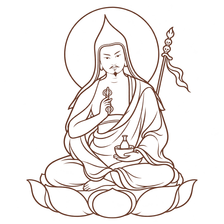
Yangleshö
Late one night, Rinpoche paused as he walked past the upper cave at Yangleshö, sat down at the entrance of the cave to say some prayers and then, to inspire modern pilgrims, spontaneously began to recount, in his inimitable manner, the history of ‘the Asura cave’.
一天深夜,仁波切经过扬列秀上洞,停下脚步,坐在洞口诵几篇祈请文。随后,为启发今日朝圣者,便以他独有的方式,自然谈起“阿修罗洞”的历史。
For Nyingmapas, Yangleshö is the most important sacred place in the world. For us, Guru Rinpoche is the embodiment of all sources of refuge. He is the emanation of all the buddhas of the past, regent of all the buddhas of the present, and the basis from which all the buddhas of the future will manifest.
对宁玛派而言,扬列秀是世间最重要的圣地。于我们,莲花生大师总集一切皈依处,是过去一切诸佛的化身、现在一切诸佛的补处,也是未来一切诸佛显现的基础。
Buddha Shakyamuni prophesied that a being even greater than himself would appear in this world; that being was Guru Rinpoche.
释迦牟尼佛曾授记,一位甚至比他更伟大的圣者,将出现于世间;那就是莲花生大师。
Buddha Shakyamuni was born from the womb, whereas Guru Rinpoche had a miraculous birth. Buddha Shakyamuni was an ordinary nirmanakaya, whereas Guru Rinpoche was a supreme nirmanakaya – a vajra master who emanates all the mandalas and regathers them within himself. Buddha Shakyamuni passed into parinirvana at the age of eighty, whereas Guru Rinpoche is still present in this world and has yet to pass into parinirvana.
释迦牟尼佛从母胎出生,莲花生大师则神变化生。释迦牟尼佛是普通化身,莲花生大师是殊胜化身,一位化现一切坛城、又将其摄回自身的金刚上师。释迦牟尼佛八十岁入般涅槃,而莲花生大师仍住世,尚未入般涅槃。
In this world, the Buddha Shakyamuni displayed twelve deeds and Guru Rinpoche eleven. The Teacher demonstrated passing into parinirvana – the twelfth deed – but Guru Rinpoche did not and will remain until the universe is destroyed at the end of the kalpa. This is why Guru Rinpoche is, for Nyingmapas, the most precious of all masters.
此世中,释迦牟尼佛示现十二事业,莲花生大师示现十一事业。导师示现了第十二事业,入般涅槃;莲花生大师没有,将住至劫末宇宙毁坏。因此,对宁玛派,他是一切上师中最珍贵的。
Of the teachings Guru Rinpoche gave while performing the eleven activities, the most important was that of attaining enlightenment. Although he has always been enlightened, he attained enlightenment in the eyes of the world when he accomplished the supreme siddhi, which is the Mahamudra level of a vidyadhara. The tantras talk of four levels of a vidyadhara, and the Mahamudra level is enlightenment. To accomplish that level, Guru Rinpoche came here to Yangleshö, “at the border of Nepal and Tibet” and “the border of India and Nepal.”
莲花生大师行十一事业时所给予的教导中,最重要的是成就觉悟。虽然始终觉悟,他成就殊胜悉地,即大手印持明位时,在世人眼中达到了觉悟。续典说持明四位,大手印位就是觉悟。为了成就此位,他来到这里扬列秀,“尼泊尔与西藏边境”“印度与尼泊尔边境”。
Chokgyur Lingpa’s revelations contain a ‘Kathang’ or ‘Chronicle of Guru Rinpoche’s life’ that is part of the terma called Seven Profound Cycles[1] . Guru Rinpoche himself narrated the story and Yeshe Tsogyal wrote it down, then hid it as a terma that was later revealed by Chokgyur Lingpa. What does it say?
秋吉林巴的伏藏中,有一部《卡唐》,即《莲花生大师生平纪事》,属于《七甚深法系》伏藏[1]。故事由莲花生大师亲自口述,益西措嘉记下,再埋为伏藏,后来由秋吉林巴取出。文中说什么?
In the upper cave of Yangleshö
于扬列秀上洞,
By saying the upper cave of Yangleshö, the implication is that a lower cave also exists – we only talk about the second floor of a house if there is a first floor. So,
说扬列秀上洞,意味着也有下洞;只有一楼存在,才会谈二楼。所以:
In the upper cave of Yangleshö
I practised the great glorious Yangdak Heruka.
于扬列秀上洞,
我修大吉祥扬达嘿噜嘎。
In order to attain the Mahamudra level, Guru Rinpoche had to practise Yangdak. In the same way that the maras attacked Buddha Shakyamuni with their magic just as he was about to awaken fully, they also displayed their magical powers just as Guru Rinpoche was about to attain enlightenment.
为证得大手印位,莲花生大师须修扬达。如释迦牟尼佛即将圆满觉悟时,诸魔以幻术攻击他,莲花生大师将觉悟时,诸魔也示现神变。
The Seven Profound Cycles Chronicle says,
《七甚深法系纪事》说:
In the upper cave of Yangleshö
I practised the great glorious Yangdak Heruka.
At that time, obstacles tormented India and Nepal with great suffering,
于扬列秀上洞,
我修大吉祥扬达嘿噜嘎。
当时障碍令印度、尼泊尔备受大苦,
To create obstacles for Guru Rinpoche, the maras inflicted drought on the lands of India and Nepal. All the fields turned to dust, and pestilence and disease of all kinds created great suffering for the people. The main culprit behind these obstacles was a naga called Nöchen Gomaka, who lived in the pond, here at Yangleshö.
为给莲花生大师制造障碍,诸魔使印度、尼泊尔遭旱,田地全成尘土,瘟疫与各种疾病,令人民大苦。障碍背后的主犯,是住在扬列秀池中的龙,名为 诺钦果玛迦。
The practice of Vajrakilaya is for repelling obstacles; no practice is more powerful. So Guru Rinpoche sent a messenger to India to ask the five hundred panditas gathered at the Vajra Seat to send him the text of Vajrakilaya practice, which they did. Our Seven Profound Cycles Chronicle reads,
金刚橛修法用于遣障,无法比它更有力。因此,莲花生大师派使者去印度,请聚集金刚座的五百班智达,送来金刚橛修法文本;他们依请送来。我们的《七甚深法系纪事》写道:
I asked the masters for a Dharma method through which I could repel them.
我向诸师求能遣除这些障碍的法门。
The “Dharma method with which to repel them” that the Indian masters sent was the Vidyottama Vajrakilaya Tantra.
印度上师送来的“能遣除它们的法门”,就是金刚橛最胜明续。
They sent someone carrying the Vidyottama teaching on Vajrakilaya.
他们派人携来金刚橛最胜明教法。
And,
又说:
As soon as he set foot in Nepal the obstacles were pacified.
他一踏入尼泊尔,障碍即息。
The mere arrival of the messenger who carried the sadhana to Nepal was enough to pacify the obstacles.
仅仅是携带成就法的使者抵达尼泊尔,就足以平息障碍。
Then I attained the supreme accomplishment of Mahamudra.
继而,我证得大手印殊胜成就。
Guru Rinpoche says that he attained the supreme accomplishment of Mahamudra vidyadhara in Nepal. That means this very cave – the upper cave – is where Guru Rinpoche reached the vidyadhara level of Mahamudra, the supreme accomplishment of enlightenment. So, as Guru Rinpoche said, he reached enlightenment through the practice of Yangdak Heruka and the obstacles that arose at that time were repelled with Vajrakilaya.
莲花生大师说,他在尼泊尔证得大手印持明的殊胜成就。这意味着,正是此洞、上洞,是他达到大手印持明位、殊胜觉悟成就的地方。因此,如他所说,觉悟通过修扬达嘿噜嘎而得,当时出现的障碍,则以金刚橛遣除。
So, having eliminated the obstacles through Vajrakilaya and accomplished realization through Yangdak, Guru Rinpoche produced, for the sake of future generations, sadhanas that combine Yangdak Heruka and Vajrakilaya. In the Nyingma tradition we talk about ‘Yangphur practices’ which combine Yangdak Heruka and Vajrakilaya. Yangdak is for accomplishing siddhis, and Vajrakilaya is for eliminating obstacles. The peaceful form of both is Vajrasattva, the lord of all families.
如此,以金刚橛遣障,以扬达成就证悟后,为利益后世,莲花生大师编成扬达嘿噜嘎与金刚橛合修的成就法。宁玛传统说的“扬普修法”,就是二者合修。扬达用于成就悉地,金刚橛用于遣障;两者的寂静形相,都是一切部主金刚萨埵。
This is where Guru Rinpoche bound the Vajrakilaya protectors to their oath; it is said that Dakshinkali – one of the four kalis of the Kathmandu valley – became one of the protectors of the Vajrakilaya teachings (one of the four shronamas). The terma teachings mention “the Asura cave[2] ...” when describing how the twelve Tenma sisters were bound by their oath. The name asura in Sanskrit means ‘secret cave’.
A student of Situ Chökyi Jungné called Khamtrul Chökyi Nyima thoroughly researched all the facts about these events, which took place a millennia ago, then wrote a pilgrimage guide. Master and student both visited Nepal and stayed for a long time. They were both students of Kathok Rigdzin Chenpo, a very important lama in Tibet, and a mahasiddha, who had originally visited Nepal at the invitation of the king, whose Hindu priests had failed to cure him of a very a serious illness. Kathok Rigdzin Chenpo gave the king some medicine and recited some mantras, and was able to cure him. So the king became a Buddhist. A few years later, though, the king offered a Hindu sacrifice. Kathok Rigdzin Chenpo was so upset that he beat the king savagely. By the time he had finished, the king was little more than a corpse, unable even to move a limb, let alone stand up – but incandescent with rage. Rigdzin Chenpo had gone way too far. Not only had he physically assaulted the king, he had sat on the king’s own throne!
One thousand soldiers were therefore sent to kill Rigdzin Chenpo. For three days, the soldiers mounted a fearsome attack on Rigdzin Chenpo, but not one of their spears or swords left so much as a scratch on his body. So once again, the king became a Buddhist – he had no choice.
因此,国王派一千士兵去杀大持明。三天中,士兵猛烈攻击,却没有一支矛、一把剑,在他身上留下哪怕一道划痕。于是,国王再度成为佛教徒,别无选择。
I have told you this story to give you an idea of the kind of master Kathok Rigdzin Chenpo Rinpoche was. Situ Chökyi Jungné and Khamtrul Chökyi Nyima were both students of his and their stories have been engraved on brass in the Swayambhunath Stupa. The inscriptions were discovered a couple of years ago when the cover of the stupa was removed – Tarthang Tulku wanted to have it gilded – exposing the stupa’s inner layer.
讲这个故事,是让你们大致了解噶陀大持明仁波切是怎样的上师。司徒确吉迥乃与康楚确吉尼玛,都是他的弟子;他们的事迹刻在斯瓦扬布佛塔的黄铜上。几年前,塔唐祖古想为塔镀金,拆去外覆层,露出内层,才发现这些铭文。
It was this lama, Khamtrul Chökyi Nyima, who wrote a pilgrimage guide for all the sacred places of Nepal. And it was he who stated that, for Nyingmapas, who are the followers of Guru Rinpoche, Yangleshö is exactly the same as the Vajra Seat – there is not the slightest difference between them. Buddha Shakyamuni reached enlightenment at the Vajra Seat and Guru Rinpoche reached enlightenment at the Asura cave in Yangleshö. And this is why Yangleshö is so sacred.
正是康楚确吉尼玛这位上师,为尼泊尔所有圣地写了朝圣指南。他说,对追随莲花生大师的宁玛派,扬列秀与金刚座完全相同,毫无差别。释迦牟尼佛在金刚座觉悟,莲花生大师在扬列秀阿修罗洞觉悟。因此,扬列秀如此神圣。
Jamyang Khyentse Chökyi Lodrö also came here and wrote a description of this pilgrimage site in the form of a prophecy, which Sogyal Tulku asked me to explain when we made a pilgrimage here together[3] . In it, Rinpoche Chökyi Lodrö even foretells precisely which years his next incarnation will visit this place. Back then, the text had been printed out and stuck to the wall, but it’s not here anymore.
Is that clear? It’s shameful for Vajrayana students not to know these things. As I’ve told you before, if you come to a place like this without knowing anything of its spiritual history, you are like a dog that dumbly follows its master.
清楚了吗?金刚乘弟子不知道这些,令人惭愧。如以前说过,来到这种地方,却不知其修持历史,就像狗懵懂地跟着主人。
This is the place where Guru Rinpoche reached the Mahamudra level of vidyadhara. What does that mean? The supreme accomplishment of the Mahamudra level of a vidyadhara is reached through meditation. A buddha perceives no impurity whatsoever, everything is pure. Actually, it’s not even pure because the buddha dharmakaya is space-like wisdom. When a place has been blessed with that space-like wisdom, it becomes sacred.
这里是莲花生大师证得大手印持明的地方。什么意思?大手印持明位的殊胜成就,通过禅修证得。佛所见毫无不净,一切清净。实际上,甚至不称清净,因为佛法身是如虚空的智慧。一处地方经这如虚空的智慧加持,就成为圣地。
You and I are unable to bless anything at all, whereas it is said that after Guru Rinpoche invoked the blessings during an empowerment he gave at Samye Chimphu, the ground, rocks and everything shook for hours. That’s what happens when things arise as the display of emptiness. And such blessings are inexhaustible – emptiness cannot be exhausted, right?
你我无法加持任何东西;但据说,莲花生大师在桑耶青朴传灌顶、召请加持之后,大地、岩石及一切,震动数小时。当万法作为空性游舞现起时,便会如此。而这样的加持无尽,因为空性不可能穷尽,对吧?
So now, we just have to make a connection with this place. Any kind of connection will do, a good connection, a bad connection, merely walking here... All connections are beneficial. But if mind is aware of the sacredness of the place, the blessings we receive will be even more potent.
所以,如今只须与此地结缘。任何缘都可以:善缘、恶缘、仅仅走来这里……一切联系都有利益。但若心中了知此地神圣,所得加持会更强。
I’ll give you an example: if you light a massive bonfire, just by being near it everyone will feel its warmth, whether they like the heat or not. To like the warmth is ‘pure perception’, and not liking it is ‘impure perception’; but at the level of the Buddha’s wisdom there is no difference because the buddhas’ compassion is said to be ‘all-pervasive’, right? What is that warmth? It is the quality of the Buddha. And that quality is available constantly, not here one minute and gone the next.
举个例子:点起巨大篝火,只要靠近,无论喜不喜欢热,人人都能感到温暖。喜欢温暖,是“清净观”;不喜欢,是“不清净观”。但在佛智层面,没有差别,因为诸佛悲心被说为“周遍”,对吧?那温暖是什么?就是佛的功德。而功德恒常可得,不是这一刻有、下一刻没了。
This is why we should visit this kind of place – a place where the blessings are inexhaustible. Just by visiting Yangleshö, its blessings will automatically enter into us. So if we can get here, the place will bless us. We are used to the idea that lamas bless people or statues by throwing rice or barley at them. It’s a method that works well, but is nothing in comparison with the blessings Guru Rinpoche can give us! There is no one who can give blessings more powerfully than the Buddha and Guru Rinpoche.
所以,应来这种加持无尽的地方。仅仅来到扬列秀,加持便自动进入我们;只要能来到,此地就会加持。我们习惯认为,上师向人或佛像撒米、青稞,便给予加持。这是有效方法,但与莲花生大师能给我们的加持相比,实在微不足道!没有谁能比佛陀与莲花生大师更有力地加持。
Basically, buddhas’ qualities are inconceivable – we can’t even imagine them, let alone describe them. You and I emulate the Buddha by practising kyerim and meditating on the infinite purity of the universe and all beings. We meditate on the world and the entire external universe, and think of it as being primordially pure, right? So, when we practice in this cave, we meditate on turning the cave into the immeasurable palace of the deities. But our meditation is not stable, whereas Guru Rinpoche’s meditation was stable. And not only was Guru Rinpoche’s meditation stable, it remains unchanging. No-one can affect it. If even a billion mara armies tried to alter it, they wouldn’t make the slightest impact. And not only was Guru Rinpoche’s meditation stable, it continues to remain stable and unchanging to this very day. No-one can affect it! Even a billion mara armies would be unable to alter it in any way or make the slightest impact. This is the calibre of meditation that Guru Rinpoche mastered, and it is known as the ‘vajra-like samadhi’. You and I cannot perceive it because we don’t have pure perception, but if we did, we would be able to see the entire universe in its infinite purity.
基本上,诸佛功德不可思议,连想象都不能,更不用说描述。你我通过修生起次第,观宇宙及一切众生无量清净,来仿效佛陀。我们观修世界及整个外在宇宙,视其本初清净,对吧?所以,洞中修法时,观想洞窟转为诸尊无量宫。但我们的禅修不稳固,莲花生大师的却稳固。不仅稳固,还恒常不变,无人能影响。即使十亿支魔军试图改变,也无法造成丝毫影响。莲花生大师的禅修不仅当时稳固,至今仍稳固不变,无人能影响!即使十亿支魔军,也无法以任何方式改变,或造成丝毫影响。这就是莲花生大师所掌握的禅定程度,称为“金刚喻三摩地”。你我因无清净观而看不见;若有,便能见整个宇宙无量清净。
Is that clear? Other people don’t seem to be aware of these things. Earlier, I spoke a little bit about this with Dzongsar Khyentse. He then asked me about it several times on WeChat.
清楚了吗?其他人似乎不知道这些。此前,我与宗萨钦哲稍谈过,他后来又在微信上问了几次。
Today, Chokyi Nyima told me that Khenpo Jigphun, who spent twenty days here, said that the rock surrounding the cave is filled with termas.
今天,确吉尼玛告诉我,曾在此住二十天的堪布晋美彭措说,洞窟周围岩石充满伏藏。
Translated by Gyurmé Avertin
Edited by Janine Schulz
英文口译:久美·阿韦尔坦
英文编辑:雅尼娜·舒尔茨
原注 Notes
出处与版本
原刊:ALL-OTR · Yangleshö。讲授:18th May 2018;Yangleshö, Nepal。原刊发布日期:2018-05-29。