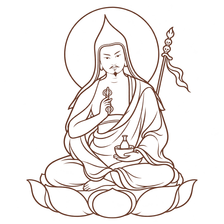
The Sacred Cave of Yangleshö
On the afternoon of October 10th, 2025, Orgyen Tobgyal Rinpoche reached the Asura Cave in Nepal for yet another drupchen. Upon arrival at the cave, he spoke to the small group of monks who had accompanied him about the sacredness of the place they would be spending their next week at, perched high above the valley of Pharping. For anyone planning to visit this sacred site, it is well worth reading what Rinpoche had to say.
2025年10月10日下午,乌金督佳仁波切抵达尼泊尔阿修罗洞,再次举行大修。来到洞窟后,他向随行的少数僧人谈起这处圣地的神圣性;接下来一周,他们将在这座高踞帕平山谷之上的洞窟度过。凡计划前往此圣地者,都很值得读读仁波切这番话。
I think all of you gathered here today have faith and devotion to Guru Rinpoche. I’m not sure whether it’s total trust, complete confidence, but at least you have some level of devotion towards him. Therefore, I think it may be of some benefit if I talk a little about Guru Rinpoche and this sacred place, Yangleshö.
我想,今天聚在这里的各位,都对莲花生大师有信心与虔敬。我不确定是否已完全信赖、充满确信,但至少具有某种程度的虔敬。因此,我想,谈一点莲花生大师与扬列秀这处圣地,或许会有所帮助。
During this, our present kalpa, it is said that one thousand and two buddhas will appear and reach the state of enlightenment. Who said this? It was none other than the Buddha Shakyamuni who, in the Sutra of the Good Aeon, recounted the names of all those buddhas, who their parents were, which master they received dharma teachings from, and how long they lived. Of those one thousand and two buddhas, Buddha Shakyamuni is the fourth. Preceding him were the buddhas Krakucchanda, Kanakamuni and Kasyapa. We are now living in the time when the teachings of the fourth buddha, Buddha Shakyamuni, are present in our world.
据说,我们现在这个劫,将有一千零二尊佛出现,达到觉悟。谁说的?正是释迦牟尼佛。他在《贤劫经》中,说出这些佛的名号、父母是谁、从哪位上师领受佛法,以及寿命多长。在一千零二尊佛中,释迦牟尼佛是第四尊。此前有拘留孙佛、拘那含牟尼佛、迦叶佛。我们如今生活的时代,世上仍有第四佛释迦牟尼佛的教法。
As Patrul Rinpoche said, the entire teaching of the Buddha can be summarized in these four lines:
如巴楚仁波切所说,佛陀全部教法,可归纳为四句:
Commit not a single unwholesome action,
Cultivate a wealth of virtue,
Tame completely this mind of ours—
This is the teaching of the buddhas.
诸恶莫作,
众善奉行,
自净其意,
是诸佛教。
These four lines encapsulate the entire teaching of the Buddha. Provided there is one person who is still able to explain these lines, the ‘dharma of explanation’ can be said to be present in our world. Basically, what this means is that we should abandon negative actions and adopt positive ones. If we adopt positive actions we can attain perfect enlightenment. If we commit negative actions, on the other hand, the result will be rebirth in the three lower realms where we won’t be able to gain a higher rebirth nor follow the path that leads to liberation. If there is someone who can contemplate these four lines, the ‘dharma of realization’ is also said to be present.
这四句总摄佛陀全部教法。只要还有一人能解释这几句,就可以说,“讲说之法”仍存世间。基本意思是,应弃恶行、行善业。行善,就能达到圆满觉悟;相反,若造恶,结果将生三恶道,无法得到善趣之身,也不能走向解脱道。若有人能思惟这四句,也就说“证悟之法”仍然存在。
These two aspects, the ‘dharma of explanation’ (teachings) and the ‘dharma of realization’ (practice), are still very much present in our world today. This is what we mean when we say that the teachings of the Buddha Shakyamuni are still present in our world. Nowadays, however, it’s difficult to find highly learned and realized beings who, like the great masters of the past in India, Tibet and other places, were able to perform miracles, possess unimpeded knowledge of all that there is to know, and read the mind of others. It’s difficult to meet beings like that in our world today. Basically, we have been born in a time when the teachings of the Buddha barely remain. Nonetheless, this is still a sign that we have great merit.
“讲说之法”,即教法,与“证悟之法”,即修持,这两方面,今天仍明显存在于世间。我们说释迦牟尼佛教法仍住世,就是这个意思。不过,如今难以找到像过去印度、西藏及其他地方的大德那样,博学且有证悟、能行神变、无碍了知一切所知、能知他心的人。今日世界,很难遇到这样的圣者。基本上,我们生在佛法仅勉强留存的时代。但这仍是具有大福德的征象。
We have all had the tremendous merit to be born in a country where the teachings of the Buddha are still very much present, such as Tibet, Bhutan, Sikkim, and even here in Nepal, where the dharma still flourishes somewhat. This is our great good fortune. It’s really an excellent circumstance which is said to be the result of great merit. Who said this? Our teacher, Buddha Shakyamuni.
我们都有极大福德,生在佛陀教法仍很兴盛的地方,如西藏、不丹、锡金,甚至这里尼泊尔,佛法也仍有一定兴盛。这是极大的幸运,确实是很好的因缘,据说是大福德的结果。谁说的?我们的导师释迦牟尼佛。
I don’t need to say too much about Buddha Shakyamuni since everybody knows who he is. Indeed, it’s not just Buddhists who know about the Buddha Shakyamuni—the followers of other religions, too, even though they have their own teacher or god that they follow, also know about and have great respect for him.
释迦牟尼佛不必多说,人人都知道他是谁。实际上,不只是佛教徒知道,其他宗教信徒,虽然各有奉行的导师或神,也知道释迦牟尼佛,并极为尊重他。
The Buddha lived for eighty years until, at Kushinagar, he passed into parinirvana. At that time he prophesied to his disciple, Ananda:
佛陀住世八十年,在拘尸那迦入般涅槃。当时,他向弟子阿难授记:
Ananda, do not feel dejected. Twelve years after I pass into parinirvana,
a being even greater than myself will be born on the Lake Danakosha.
阿难,不要沮丧。我入般涅槃十二年后,
将有比我更伟大的圣者,诞生于达那郭夏湖。
This is the prophecy that he gave and for this reason, Guru Rinpoche is said to be even greater than the Buddha himself—at least, this is what we Nyingmapas say. And we have valid explanations for why we say this. One such reason is the fact that the Buddha was unable to tame certain beings; these beings could only be tamed by the teachings of the secret mantra vajrayana and the one who turned the wheel of the teachings of secret mantra vajrayana was Guru Rinpoche. He wouldn’t have been able to do this if he was born normally, from a womb, therefore he was born miraculously in the heart of a lotus flower on the Lake Danakosha.
他作了这样的授记。因此,莲花生大师被说成比佛陀本人更伟大,至少我们宁玛派这样说,也有合理解释。一个原因是,佛陀无法调伏某些众生;那些众生只能由秘密真言金刚乘教法调伏,而转秘密真言金刚乘法轮的,是莲花生大师。若普通地从母胎出生,就无法这样做,因此他于达那郭夏湖莲花心中神变诞生。
There are different accounts of his birth: some say that Guru Rinpoche was born eight years after the Buddha passed into parinirvana, others twenty-four years. There are a few different versions. Since we are Nyingmapas, we follow the Kathangs (biographies of Guru Rinpoche) as our scriptural authority. They state that the Buddha said:
关于他的诞生,有不同记载:有说佛陀般涅槃八年后,有说二十四年后,有几种版本。既然我们是宁玛派,便以《卡唐》,即莲花生大师传记,作为教证依据。其中说佛陀曾言:
Ten minus two years later,
On an island of the Danakosha Lake,
A being greater than me will come.
十年减二之后,
达那郭夏湖之岛上,
将有胜于我者来临。
This means that Guru Rinpoche was born eight years after the Buddha passed into parinirvana. Of course, we accept the Kathangs as being valid sources.
这意味着,莲花生大师生于佛陀般涅槃八年后。当然,我们接受《卡唐》为可靠依据。
The south-western milky lake of Danakosha is located in present day Pakistan and it was here, upon a blossoming lotus flower, that Guru Rinpoche was miraculously born. He was not born of parents, a mother and father, but was self-arising, instantaneously, like a streak of lightning. Amitabha, who resides in the pure land of Sukhavati, emanated from his heart a red hrih syllable of bodhichitta which descended upon the pistil of a blossoming red lotus flower with enormous leaves and petals, floating on the waters of Lake Danakosha. Guru Rinpoche was born as the syllable transformed into the Lotus-born Guru.
西南方的达那郭夏乳海,位于今巴基斯坦;莲花生大师就在这里一朵盛开莲花上神变诞生。他不是从父母出生,而是如一道闪电,自然、刹那间出现。安住极乐净土的阿弥陀佛,从心间化现一个红色菩提心 hrih 字,降在达那郭夏湖上一朵红莲的花蕊上。莲花开放,叶片、花瓣巨大,漂浮水面。该字转为莲花生上师,莲花生大师由此诞生。
There are many accounts of the life of Guru Rinpoche which can be found in both the kama and terma traditions. In the termas, for example, Guru Rinpoche himself said that for the sake of future practitioners with pure samaya, he wrote and concealed no less than 10,900 biographies. [1]
教传与伏藏传统中,都有许多莲花生大师生平记载。例如,伏藏中,莲花生大师自己说,为利益未来三昧耶清净的修行者,他撰写、埋藏的传记,不少于一万零九百部。[1]
These biographies are accounts of the life of a buddha; we cannot say with any definite certainty, this is exactly what that buddha did and what they did not do. For example, if you look into the lives of some of the great masters of the past, they were able to manifest themselves in twenty-five different emanations at the same time, in order to help sentient beings. Chandraprabha Kumara, Gampopa’s past life as a bodhisattva, for example, appeared to some people giving teachings, to others practicing meditation, and to others still doing something entirely different. So one person could see the master appearing simultaneously in twenty or thirty different ways, doing different things.
这些传记记述的是一尊佛的生平,不能确切断言,这尊佛究竟做过什么、没做过什么。例如,查阅往昔某些大德的生平,会发现,为了帮助众生,他们能够同时显现二十五种不同化身。比如冈波巴前世为菩萨时的月光童子,有人见他讲法,有人见他禅修,还有人见他做完全不同的事。因此,一个人可能同时见到上师以二三十种方式显现,做不同事情。
Those with pure karma were, of course, able to perceive this; but even those with impure karma could also perceive it. They were all non-deceptive, correct perceptions for each person. Therefore, we cannot say that there is just one version that is true and all the others are wrong. In actual fact, all of them are true.
业清净的人当然能见,甚至业不清净者也能见。对每个人而言,那些都是无欺、正确的所见。因此,不能说只有一个版本真实,其余都错;实际上,全部真实。
When we look into the biographies of Guru Rinpoche, who was the embodiment of the enlightened activity of all the buddhas, and read about all his different activities, we cannot say, “This is the right version, this one is incorrect.” We cannot make that kind of distinction.
莲花生大师是一切诸佛觉悟事业的化身。查阅其传记、读到各种事业时,我们不能说:“这个版本对,那个不对。”不能作这种分别。
What we can say with certainty is that he was a guru who reached the state of enlightenment by following the path of secret mantra vajrayana. In order to reach complete enlightenment by following the path of secret mantra vajrayana, one needs to perfect the five paths and ten bhumis. In Vajrayana terms, these are equivalent to the four levels of a vidyadhara: the vidyadhara of full maturation, the vidyadhara with power over life, the mahamudra vidyadhara and the spontaneously accomplished vidyadhara. If you don't progress through those four levels, you cannot reach enlightenment through the path of secret mantra vajrayana.
能够确定的是,他是一位循秘密真言金刚乘之道而证得觉悟的上师。循此道达到圆满觉悟,须圆满五道十地。以金刚乘术语说,这对应持明四位:异熟持明、寿命自在持明、大手印持明、任运成就持明。若不历经这四位,就不能通过秘密真言金刚乘之道觉悟。
This brings us to the main point that I wanted to talk about today, which is this sacred place of Yangleshö. If you look into the different textual sources, some say that Yangleshö lies on the border between India and Nepal, while others say it lies between Nepal and Tibet. In any case, what all the texts agree upon is the place where Guru Rinpoche attained the state of mahamudra vidyadhara and reached enlightenment—Yangleshö in Nepal. There is no doubt about this—they all place the event at the same place. Every account of his life, whether from the terma or kama tradition, agrees on this.
这就说到今天想谈的重点:扬列秀圣地。不同文献中,有说扬列秀位于印度、尼泊尔边境,也有说在尼泊尔与西藏之间。无论如何,所有文献一致认为,莲花生大师在尼泊尔扬列秀证得大手印持明、达到觉悟。这一点毫无疑问,各种文献都将此事置于同一地方。无论伏藏或教传传统,每一种生平记述都同意。
This is also what is stated in the texts that were found in the caves of Dunhuang, in the Gansu province of western China. These texts are more than a thousand years old and clearly state that Guru Rinpoche accomplished the practice of Vajrakilaya and attained the mahamudra level of vidyadhara realization, the full state of enlightenment, at the sacred cave of Yangleshö. The texts found in those caves were perfectly preserved because of the desert climate and absence of any humidity. They haven’t been altered in any way for more than a thousand years and are undisputedly authentic. Some of those texts have now found their way into museums and libraries in France and other countries where they are being preserved and translated.
中国西部甘肃敦煌洞窟中发现的文献,也如此记载。这些文献已有一千多年,明确说,莲花生大师于扬列秀圣洞成就金刚橛修法,证得大手印持明、圆满觉悟。由于沙漠气候、没有湿气,洞中发现的文本保存完好。一千多年未被改动,真实性无可争议。其中一些如今进入法国及其他国家的博物馆、图书馆,受到保存并被翻译。
The important point here is that all of those sources, every single one, clearly states that the place where Guru Rinpoche attained the level of mahamudra vidydhara and reached enlightenment is this very place we find ourselves today, Yangleshö.
这里重要的是,所有来源,每一种,都明确指出:莲花生大师证得大手印持明、达到觉悟的地方,就是我们今天所在的扬列秀。
The place where the Buddha reached enlightenment is Bodhgaya in India and this sacred site was lost to us for around 800 years. We didn't know where it was until the English colonialists excavated the area and revealed it. It turned out to be the genuine seat of the Buddha’s enlightenment that we can now visit today. The place where Guru Rinpoche reached enlightenment, conversely, has always been known about and preserved in our tradition. All the texts agree on this point and recount the story of how he attained enlightenment here.
佛陀觉悟之地,是印度菩提伽耶。这处圣地曾失落约八百年,我们不知道它在哪里,直到英国殖民者发掘这一地区,才重新显露。结果证实,这正是佛陀觉悟之座,如今可以前往。相反,莲花生大师的觉悟之地,在我们的传统中始终为人所知、得到保存。所有文献对此一致,也都讲述他如何在这里觉悟。
When Guru Rinpoche started to practise at Yangleshö, he faced many obstacles. There were many years of drought, famine and starvation, which led to the deaths of a great many people. At some point, Guru Rinpoche came to the clear realisation that he should practise Vajrakilaya in order to remove these obstacles.
莲花生大师开始在扬列秀修持时,遭遇许多障碍。多年干旱、饥荒、饥饿,导致大量死亡。后来,他明确认识到,应修金刚橛,以遣除这些障碍。
Guru Rinpoche sent several messengers to the glorious seat of Nalanda to acquire the teachings of Vajrakilaya, since they were practicing this deity there to avert obstacles. In response, they sent him the volumes of the Vajrakilaya tantras such as the Vidyottama Tantra (‘The 100,000 Sections of Unexcelled Knowledge’). Some sources say he received just one volume of text, others the load carried by one person, and others still, the loads carried by six people. In any case, at Yangleshö, he then practised Vajrakumara, the deity of the phurba of accomplishment, whose mantra is om vajra kili kilaya hung p’et. The instructions on how to practise the generation and completion phases of the deity, the root teachings, are found in the Vidyottama Tantra, the essence of which is the root tantra that we recite each day. [2] This is the Indian text that was sent from the glorious seat of Nalanda to Guru Rinpoche while he was in Nepal.
莲花生大师派遣数位使者,前往吉祥那烂陀求取金刚橛教法,因为那里正修此本尊遣障。那烂陀回应,送来最胜明续(“无上明十万品”)等金刚橛续典。有些来源说,只收到一函;有些说是一人背负的数量;还有说是六人所背的数量。无论如何,他随后于扬列秀修持金刚童子,即成就橛之本尊,其咒为om vajra kili kilaya hung p’et。如何修本尊生起、圆满次第的根本教法,见于最胜明续;其精髓,就是我们每日诵读的根本续。[2]这就是从吉祥那烂陀送给当时在尼泊尔的莲花生大师的印度文本。
Here again, there are different versions of this story. According to some accounts, Guru Rinpoche went in person to Nalanda with two companions to request the tantras from Prabhahasti and then returned to Nepal to practise it. Some sources say he practised for seven days, or three months, or even three years. In any case, he practised Vajrakilaya and as a result, became indivisible with the yidam deity, Vajrakilaya. Hence, he composed many sadhanas in which Guru Rinpoche and Vajrakilaya are indivisible.
这一故事同样有不同版本。有些记载说,莲花生大师亲自带两名同伴到那烂陀,向 波罗诃悉帝 求续,再返尼泊尔修持。关于修持多久,有说七天、三个月,也有说三年。无论如何,他修金刚橛,由此与本尊金刚橛无二无别。因此,他撰写了许多莲花生大师与金刚橛无别的成就法。
In actual fact, Guru Rinpoche was originally supposed to practise Yangdak Heruka to attain the mahamudra vidyadhara level, but in order for him to be able to practise this properly, he first had to remove obstacles through the practice of Vajrakilaya. That is why you find many sadhanas that combine Yangdak and Vajrakilaya together.
实际上,莲花生大师原本要修扬达嘿噜嘎,以证得大手印持明。但为了如法完成此修持,必须先通过金刚橛修法遣障。因此,有许多扬达与金刚橛合修的仪轨。
In any case, he practised Vajrakilaya at Yangleshö and bound under oath the four Bhumipati goddesses and the other protectresses, individually taming each of these twelve phurba protectresses. According to the Dunhuang texts, one evening, four girls arrived at his cave, intent on making obstacles for him. Through dza hum bam ho and the hook mudra and the other mudras, Guru Rinpoche summoned them into his hat and imprisoned them there.
总之,他于扬列秀修金刚橛,令四位地母及其他护法女神受誓,逐一调伏十二位普巴护法母。依敦煌文献,一天晚上,四位女子来到洞前,想给他制造障碍。莲花生大师以dza hum bam ho及钩印等手印,将她们召入帽中,囚禁其中。
When he opened his hat the following morning, the four girls were still there. He asked them who they were; they replied that they were the protectresses of Vajrakilaya. They were the four shvanamas, four mahadevis, and the four bhumipatis—the twelve protectresses of the phurba. One by one, he bound them under oath as well as the four purusa brothers, and the other protectors of Vajrakilaya, instating them as protectors of the phurba. This is the sacred place where this happened.
第二天早晨打开帽子,四位女子仍在。他问她们是谁,她们答是金刚橛护法母:四位 修瓦那玛、四位 大天女、四位 地母,即普巴十二护法母。他逐一令她们受誓,也令四位 布鲁沙 兄弟及其他金刚橛护法受誓,立为普巴护法。此处就是发生这些事的圣地。
It’s the place where nine vajra peaks rise up, which makes it an extremely sacred place. Counting from here upwards, there are nine vajras that ascend. At least that’s what the lamas say— personally, I don't know. It is also said that “the path of the sun and moon are far apart, which makes it a supreme place of practice”, which means that the sun and moon rise in the east and there is no obstacle to block their course until they set in the west. River’s flow here continuously and they also say this place lies on the uninterrupted path from Bodhgaya to Lhasa. That’s to say, it’s easy to go from here to Bodhgaya and to Tibet, both. This means that the roads also are without interruptions or blockages.
这里九座金刚峰拔地而起,因此极其神圣。从这里向上数,有九座金刚依次上升。至少,上师们这样说;我个人不知道。又说:“日月之路相隔遥远,令此成为殊胜修行处。”意思是,日月从东方升起,直到西方落下,行程都不受遮挡。这里河流常年不断;也说此地位于从菩提伽耶到拉萨畅通无阻的路上。也就是说,从这里前往菩提伽耶或西藏都很方便,道路同样无间断、无阻塞。
What’s certain is that Guru Rinpoche consecrated this sacred place through the power of deity, mantra, mudra and samadhi, transforming it into the three mandalas of Vajrakilaya. [3] Once a place has been consecrated in this way, the blessing doesn’t go away, it doesn’t dissipate. It remains there. We cannot see this because of our impure karma and the dense obscurations that veil us. But if those obscurations are even somewhat purified, we will be able to hear the sound of the wind, water and all the elements, as the natural sound of the Vajrakilaya mantra. Likewise, we will see in all the surrounding mountains, rocks and trees, the mantra and the form of the deities naturally appearing there. In an environment such as this, where we perceive everything purely, our mind will rest in the natural state free from all conceptual elaboration and become one with Vajrakilaya. Such places are indeed very sacred.
可以确定的是,莲花生大师以本尊、咒、印、三摩地之力,为此圣地开光,将其转为金刚橛三坛城。[3]一处地方这样被开光后,加持不会离去、不会消散,而会留在那里。我们看不见,是因为业不清净,厚重障碍遮蔽。但若障碍稍得清净,便能听到风、水及一切元素之声,就是金刚橛咒自然之声。同样,会看见周围所有山、石、树中,自然显现咒语与本尊形相。在这样一切所见皆清净的环境,心会安住于离一切戏论的自然本性,与金刚橛合一。这样的地方,确实极神圣。
Nowadays, all we can do is come to places like this and receive their blessings. We cannot actually bless a place ourselves. A lama like myself, for example, cannot do that. For that, you need to have a high realisation. So all we can do is receive blessings from these places and that’s why we go on pilgrimage. In the past, great beings such as Guru Rinpoche or the great abbot Vimalamitra, were able to bless a place merely by meditating on its inherent primordial purity. That’s how they were able to consecrate it. Unfortunately, we are nowhere near that level and that’s why, in this day and age, all we can do is receive blessings from sacred places that have already been consecrated.
如今,我们能做的,只是到这些地方领受加持,自己无法真正加持一处地方。比如我这样的上师,就做不到;那需要很高证悟。所以,只能领受这些地方的加持,这也是为何朝圣。过去,莲花生大师、无垢友大堪布等大德,仅观修一处地方内在的本初清净,就能加持它,由此为其开光。遗憾的是,我们远未达到那个层次;因此如今,只能领受已经开光圣地的加持。
‘Pharping’ is the name of this place, and many people consider that ‘Yangleshö’, the actual place of accomplishment, is the lower cave where Chatral Rinpoche’s monastery is located. The Hindus call it Shesh Narayan Pokhari and consider it the sacred place of a naga. But the way that we determine the location is based on the biography of Guru Rinpoche that was revealed by Chokgyur Lingpa, “The Wish-fulfilling Tree”, which states that he accomplished the practice of the Great Glorious One, Yangdak Heruka in the upper cave:
此地名为“帕平”。许多人认为,真正的成就处“扬列秀”,是夏札仁波切寺院所在的下洞。印度教徒称它 舍什那罗延池,视为龙的圣地。但我们确定位置的依据,是秋吉林巴所取莲花生大师传记《如意树》,其中说,他在上洞成就大吉祥扬达嘿噜嘎修法:
This means that the distinction between an upper and a lower cave is made. In the upper he “performed the practice of the glorious Yangdak Heruka”, which is the cave behind me. According to Chokling Rinpoche, when he came here, he found a large cave even higher up than here. In any case, this upper cave where we are now is the one we determine as being the place where Guru Rinpoche attained the mahamudra level of vidyadhara. All the Nepalis call it the Asura Cave, which means secret cave.
这意味着,文中区分上洞、下洞。他在上洞“修吉祥扬达嘿噜嘎”,就是我身后的洞。秋林仁波切说,他来这里时,曾在比这里更高的地方,找到一个大洞。无论如何,我们认定,现在所在的上洞,就是莲花生大师证得大手印持明之处。尼泊尔人都称它阿修罗洞,意思是秘密洞。
The Sixteenth Karmapa, Rangjung Rigpe Dorje, came here, and Dilgo Khyentse Rinpoche also came here many times. He wouldn't sit inside the cave, he would just go briefly inside and then sit outside, in front of the entrance. The reason is that inside the cave, with all the butter lamps that were lit and incense that was burning, he didn't feel well. So he’d sit outside where he could be in the fresh air and see the sky. I've also come here many times—we used to put the mandala inside the cave, close it with a curtain, and then sit outside, with all the monks, in front of the entrance. We held many drupchens here. Later, once they’d built the temple, we started to do drupchens in there.
第十六世噶玛巴 让炯日佩多杰 曾来这里,顶果钦哲仁波切也来过多次。他不在洞中坐,只短暂进去,再坐在外面洞口前。原因是,洞中点着许多酥油灯,又焚香,让他感到不适。所以坐在外面,可以呼吸新鲜空气、看见天空。我也来过多次;过去将坛城置于洞中,以帘子遮起,然后与全体僧众坐在洞外入口前。我们在此举行过多次大修。后来建了寺殿,就开始在殿内修大修。
The first time we came here to practise a drupchen, when we came to the ritual for receiving the siddhis related to the four activities, we arranged the siddhi tormas on the mandala. These tormas, specifically the pacifying and enriching ones, started to drip with so much düdtsi, it overflowed from the plates. I brought this düdtsi to Dilgo Khyentse Rinpoche, who was in Bhutan at the time of the drupchen, and asked him once he’d returned to Nepal to verify whether it was genuine. He said yes, it definitely was. This shows just how extraordinarily blessed and sacred this place is.
第一次来此修大修,进行领受四事业相关悉地的仪式时,我们将悉地食子安置坛城上。其中,尤其息灾、增益食子,开始滴出大量甘露,甚至溢出盘子。我将甘露带给顶果钦哲仁波切;大修时他在不丹,待他回到尼泊尔,我请他验证是否真实。他说,是的,绝对真实。这说明此地加持何等非凡、何等神圣。
You've all arrived here for the drupchen that we will practice on this occasion, so you're all extraordinarily fortunate. When we come to a sacred place like this we need to receive its blessings, and for that to happen, we need to pray, to invoke. Otherwise, nothing will happen. If you remain in some kind of dumb state and just sit around here all day, you’re no different from the birds that hover around here and have no chance of actualizing anything like pure perception. If you’re like that, your impure perceptions will just remain impure. You won’t receive any of the blessings and siddhis of this place, just like the birds who remain as birds. We human beings have a special quality: we know how to pray, we know how to differentiate between what we should adopt what we should abandon. If we pray to Guru Rinpoche, not just mouthing the words, but from the bottom of our hearts, with complete trust, then it's impossible for us not to receive his blessings. One of the Lotus Born Guru’s qualities is that he will never fail us.
大家为了这次大修来到这里,都极其幸运。来到这样的圣地,须领受其加持;为此,需要祈请、呼唤,否则不会发生什么。若只在一种呆滞状态中,整天坐着,就和这里盘旋的鸟一样,毫无机会现前清净观。那样的话,不清净的所见仍是不清净,也不会得到这里的加持与悉地,就像鸟仍然只是鸟。人有特殊品质:知道如何祈请,知道分辨何者应取、何者应舍。若不只是嘴上念,而从心底以全然信赖祈请莲花生大师,就不可能得不到加持。莲花生上师的一项功德,就是绝不辜负我们。
So we're going to stay here for seven days to do a drupchen. Whether you're happy to be here or not, you're here, so make the most of it! Do the practice without letting your mind or eyes be distracted, and whenever you have a break, you should meditate. Meditate on Vajrakilaya, recite the Vajrakilaya mantra, and let whatever arises in your mind be liberated the moment it arises. I say this, but most of you here have no idea what I’m talking about. Therefore, just simply pray—pray to Guru Rinpoche and Vajrakilaya, as being indivisible. We pray in order to accomplish the two siddhis, ordinary and supreme, and to eliminate obstacles. If you do that, you'll derive great benefit from being here.
所以,我们要在此住七天,举行大修。无论喜欢不喜欢,既然来了,就充分利用!修持时,不让心和眼睛散乱,休息时也应禅修。观修金刚橛,持诵金刚橛咒,让心中一切所起,当生即解脱。我虽这样说,但在座多数人不知道我在说什么。因此,只须祈请,向无二无别的莲花生大师与金刚橛祈请。祈请是为了成办共同、殊胜二悉地,并遣除障碍。如此,就会从这次停留中得到大利益。
Personally speaking, I think I have quite impure perception. I first came here in 1958, with my father, and have been coming back ever since. The population of the town has continuously grown since then and more and more buildings have mushroomed. Actually, the blessing of a sacred place should normally increase, but I have the feeling the opposite is happening.
就我个人而言,我想自己的知见相当不清净。1958年,我第一次随父亲来这里,此后不断回来。镇上人口一直增长,建筑越来越多,如雨后春笋。实际上,圣地加持通常应该增长,但我感觉,情况正相反。
The first time I came here, there were no buildings whatsoever. There were just the footprints, nothing else. The place was really pregnant with blessings. I went to the cave and practised with my father—we did the Tukdrup Trinlé Nyingpo and offered a tsok, and a lot of nectar seeped out from the cave. Now we don't see a single drop of nectar. A lot of people come here but I think many of them have impure samayas. Of course, some people come here full of devotion, but I’m sure others come out of mere curiosity. So because of these circumstances, I think the blessings have waned.
第一次来时,完全没有建筑,只有足迹,别无他物。此地确实充满加持。我与父亲到洞中修《上师意修·事业精髓》,供荟供,洞里渗出许多甘露。如今,一滴也见不到。来的人很多,但我想,许多人三昧耶不清净。当然,有些人满怀虔敬而来,但也肯定有人只是好奇。因此,我想,由于这些情况,加持减弱了。
All of us gathered here on this occasion, who have genuine devotion for Guru Rinpoche, should pray to him, for as he himself said,
这次聚在此处、真正虔敬莲花生大师的各位,应当向他祈请。正如他自己所说:
For all men and women with faith in me, I, Padmasambhava,
Have never departed - I sleep beside their door.
For me there is no such thing as death,
Before each person with faith, there is a Padmasambhava.
凡对我具信的男女,我莲花生
从未离去,安眠于其门旁。
于我,无所谓死亡;
每位具信者面前,皆有一位莲花生。
You will receive his blessings, without fail. Therefore we should all pray to Guru Rinpoche. There's a few important secret points I should also tell you, but I'm not going to as I don’t think you’ll understand them. Furthermore, many of you are sitting here with your recorders out and whatever I say will doubtless end up being spread everywhere. Therefore, that’s all I’m going to say today.
你们必定得到他的加持。因此,大家都应祈请莲花生大师。还有几个重要秘密要点,本该告诉你们,但我不说,因为觉得你们不会理解。再说,许多人坐在这里,拿着录音机;无论说什么,无疑最后都会传遍各处。因此,今天就说这些。
Translated by Gyurme Avertin
Edited by Phillip Philippou
英文口译:久美·阿韦尔坦
英文编辑:菲利普·菲利普
原注 Notes
I wrote and concealed ten thousand nine hundred biographies.
Quotation from Orgyen Lingpa. padma bka’ thang, Beijing: Mi rigs dpe skrun khang, 1996, page 3.
我撰写并埋藏一万零九百部传记。
引自乌金林巴,《莲花遗教》,北京:民族出版社,1996年,第3页。
出处与版本
原刊:ALL-OTR · The Sacred Cave of Yangleshö。讲授:10th October 2025;Pharping, Nepal。原刊发布日期:2025-11-22。