The Mudra of Confession
An hour after his customary daily “pep talk” during a Chime Phakmé Nyingtik drupchen, Rinpoche seized the opportunity to point out to all the practitioners gathered in Lerab Ling’s majestic temple – Palri Pema Ösel Dargyé Ling – just how important it is for Vajrayana practitioners to perform the mudra that accompanies the Inexpressible Ultimate Confession (Yeshe Kuchok).
在一次无死圣母心髓大修中,仁波切照例作完每日的“鼓劲开示”约一小时后,抓住机会向聚集在法国列绕林宏伟寺院——吉祥莲花光明兴盛洲——的所有修行者指出:对金刚乘行者而言,诵念《不可言说究竟忏悔文》时结相应的手印,是多么重要。
There’s something else that I need to say to you westerners: you have spent too much time studying. From a very young age until quite late in life all you do is study and not much else. So unless you are specifically taught how to do something, you are unable to pick things up by looking and listening: you cannot learn by simply watching what other people do. But perhaps in your culture, just picking things up from others doesn’t work because you could end up being sued for copyright infringement.
还有一件事,我必须对你们这些西方人说:你们花在读书上的时间太多了。从很小的时候直到相当大的年纪,你们所做的几乎只有读书,很少做别的。所以,除非有人专门教你们怎么做,否则你们就不能靠观察和聆听来学会一件事;你们不能仅仅看别人怎么做就学会。不过,也许在你们的文化里,直接照着别人学确实行不通,因为最后可能会被告侵犯版权。
As so many of you suffer from this learning impediment, it is no wonder that, although all the monks do the mudra for confession and fulfilment when we chant the Inexpressible Ultimate Confession (Yeshe Kuchok), not one of the westerners even attempts it! (The mudra for confession and fulfilment is when you join the tips of the middle, ring and little fingers and fold the two index fingers in front of them.)
你们当中这么多人都有这种学习障碍,也就难怪我们诵念《不可言说究竟忏悔文》时,虽然所有僧人都结忏悔与酬补手印,西方人却连一个尝试的都没有!(忏悔与酬补手印,是将两手中指、无名指和小指的指尖相接,再将两根食指弯到它们前面。)
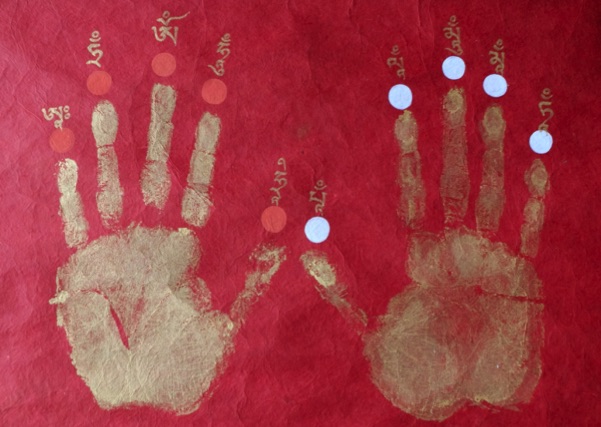
The practices we are doing – Vajrayana practices – involve deity, mantra, mudra and samadhi and that means that we have to perform many mudras. When we do mudra, our right hands represent the aspect of skilful means and the buddhas of the five families, and our left hands represent the aspect of wisdom and the female buddhas of the five families. The tips of the fingers on our right hands are marked by the seed syllables of the male buddhas (om hung tram hrih ha), and the tips of our left-hand fingers are marked with mum lam pam mam tam, the seed syllables of the female buddhas. The Secret Essence Tantra explains that, for example, the syllable om must meet the syllable hung in one mudra, and that mum and tam are joined in another. This tantra also explains how to form mudras by raising one finger and leaving the others folded, or by raising two fingers and folding the others, and so on, depending on the mudra.
我们所修持的法——金刚乘修法——涉及本尊、咒语、手印和三摩地,也就是说,我们必须结很多手印。结手印时,右手代表方便及五部佛父,左手代表智慧及五部佛母。右手指尖标有佛父的种子字(om hung tram hrih ha),左手指尖则标有佛母的种子字 mum lam pam mam tam。《秘密藏续》解释说,例如,结一种手印时,om 字必须与 hung 字相接;结另一种时,mum 与 tam 相合。这部续典也说明了如何依不同手印,竖起一根手指而将其他手指屈起,或者竖起两根手指而将其他手指屈起,等等。
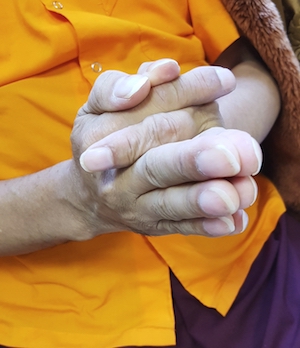
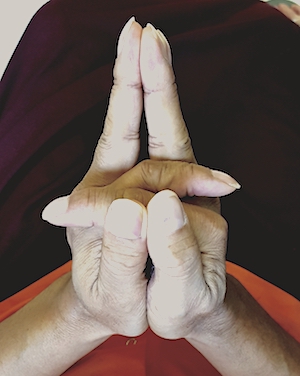
This particular mudra – for confession and fulfilment – is performed as a way of acknowledging our faults, broken vows and promises, which we must purify through confession practice[1] . We make this mudra to indicate that we have broken promises and vows and that we know we are at fault.
结这个特别的手印——忏悔与酬补手印——是为了承认我们的过失,以及违犯的誓言和承诺;我们必须以忏悔修法净除这些过失[1]。我们结这个手印,表示自己违犯了承诺与誓言,也知道自己有错。
As I’ve already said, all the monks do this mudra, but not a single one of you westerners has watched what they were doing or tried to emulate them. That’s why I started out by saying that, unless you are taught something directly, you are unable to learn. And that’s why I’m now telling you how to do this practice. If a glass of water is placed in front of a westerner, you won’t drink until you have first asked permission, “Can I drink the water?” If there is no one to ask, you won’t drink. It looks to me as though your lives are such that you have never been allowed to look at someone else and copy what they do; that’s why you don’t do the mudras.
正如我已经说过的,所有僧人都结这个手印,但你们西方人没有一个观察他们在做什么,或试着模仿。因此,我一开始才说,除非有人直接教你们,否则你们就学不会。也因此,我现在才告诉你们该怎样修。如果在一个西方人面前放一杯水,你们会先请示:“我可以喝这杯水吗?”得到许可之前,你们不会喝。如果没有人可以问,你们就不喝。在我看来,你们的生活好像从来不允许你们看着别人、照着别人做;所以你们才不结手印。
The basis of all mudras is to join our two hands so that the tips of our fingers touch and all the male and female deities unite. This is the basis from which an inconceivable array of other mudras unfolds.
一切手印的基础,是将两手相合,使指尖相接,令所有男女本尊相合。从这一基础中,开展出不可思议的种种其他手印。
Similarly, the basis or ground of all deities is Samantabhadra. Samantabhadra is the basis from which infinite buddha manifestations spring, such as the buddhas of the five families. The syllable a is the basis from which all other sounds and mantras manifest – all vowel, consonants and expressions arise from a. Samadhis begin with the samadhi of suchness which is the source from which the infinite methods for directing the practice emanates. And each method is done at a specific and appropriate point in the practice.
同样,一切本尊的基础或根本是普贤王如来。无量佛的化现,例如五部佛,都从普贤王如来这一基础中显现。a 字是一切其他声音与咒语显现的基础——所有元音、辅音和言语都从 a 生起。三摩地始于真如三摩地,它是一切引导修行的无量方法所生起的源头。而每一种方法,都在修法中某个特定而适当的时刻运用。
Today, I have had to tell you that you should do this mudra when you recite the Inexpressible Ultimate Confession. How many years have we been coming here to Lerab Ling? How many times have you seen the monks do this mudra during the practice? Yet, not one of you has looked at what they were doing and done it yourself.
今天,我不得不告诉你们:诵念《不可言说究竟忏悔文》时,应该结这个手印。我们来列绕林已经多少年了?你们在修法中看过僧人结这个手印多少次了?可是,你们没有一个看着他们怎么做,自己也跟着做。
This mudra is not specific to the Inexpressible Ultimate Confession, it is a general mudra for use during confession and purification. We do it because we inevitably make mistakes during practice – including in the mudras we perform – and therefore need to purify those mistakes through confession practice. Since you cannot use your eyes to see what's happening around you, I felt I had to tell you directly that you should do this mudra to purify the mistakes you make when you perform mudras.
这个手印并非《不可言说究竟忏悔文》专用的,而是忏悔与净障时通用的手印。我们之所以结它,是因为修法时难免犯错——包括所结的手印也会有错——因此,需要通过忏悔修法净除这些错误。既然你们不能用自己的眼睛看看周围正在发生什么,我就觉得必须直接告诉你们:应该结这个手印,来净除自己结手印时所犯的错误。
Translated by Gyurmé Avertin
Edited by Janine Schultz
英译:久美·阿韦尔坦
编辑:雅尼娜·舒尔茨
原注 Notes
出处与版本
原刊:ALL-OTR · The Mudra of Confession。讲授:21st July 2015;Lerab Ling, France。原刊发布日期:2017-07-17。